Category: Compliance & Risk

  • Freelance Contracts in India: What Founders Must Include to Avoid Disputes?

    Freelance Contracts in India: What Founders Must Include to Avoid Disputes?

    India now has over 11.2 million gig workers — and that number is climbing fast. Yet most founders who hire freelancers do it on a WhatsApp message and a handshake. When things go wrong — missed deadlines, stolen designs, unpaid invoices — there’s nothing to stand on. A proper freelance contract in India is the only thing that changes that.

    No contract means no leverage. Here’s exactly what to put in one.

    📌 TL;DR: A freelance contract in India is a legally enforceable agreement under the Indian Contract Act, 1872. Every founder hiring a freelancer must include scope of work, payment terms, IP ownership, confidentiality, TDS obligations, and a dispute resolution clause. Lawizer can help you draft or review a watertight freelancer agreement online — without a lawyer visit.

    What You’ll Learn

    • Why a freelance contract in India is a legal document — not just a formality
    • The 8 clauses every founder must include before work begins
    • How to handle tax, IP, and dispute clauses the right way under Indian law
    • Common mistakes founders make — and how to avoid them

    Why a Freelance Contract Is a Legal Document, Not a Formality

    Here’s the thing. A freelance contract in India isn’t just paperwork you send out of habit — it’s a binding agreement governed by the Indian Contract Act, 1872. The moment both parties agree on consideration (the payment), scope, and deliverables, that contract becomes enforceable in an Indian court. That means if your UI designer walks off mid-project with your brand assets, or if a client in Mumbai refuses to pay after 3 months of work, you have legal recourse — but only if you have a signed agreement.

    What most founders miss: verbal agreements and Slack confirmations count for almost nothing when there’s a real dispute. The Code on Social Security, 2020 — which came into force in November 2025 — formally defines “gig workers” for the first time in Indian law, but it primarily protects platform workers, not direct freelance hires. For the Bengaluru design agency that hires a Kolkata-based content writer directly, the contract is still the only safety net.

    If you’re still building the legal groundwork for your startup, getting your freelance agreements in order is as foundational as your incorporation documents.

    Freelancing Agreement Drafting Services - Legal AT India

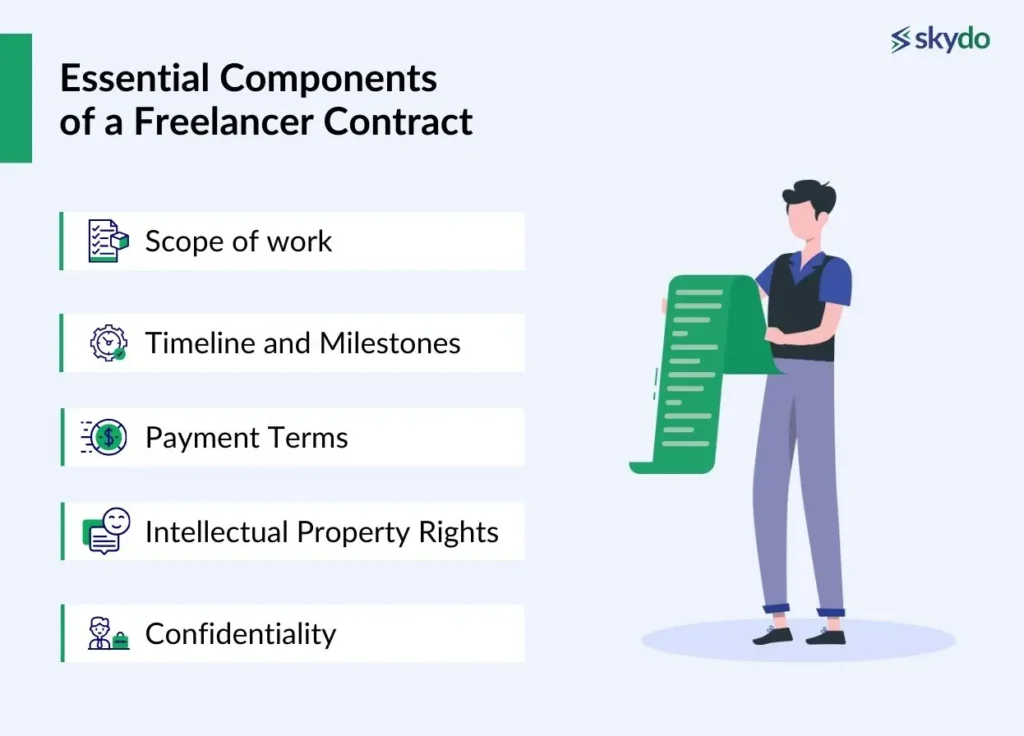
    Clause 1 & 2: Scope of Work and Deliverables

    Let’s break this down. The most common reason freelance disputes happen in India is not money — it’s vagueness. “Build me a website” means completely different things to a founder and a developer. Your contract must define deliverables with surgical precision: how many pages, which features, what tech stack, how many revision rounds.

    The scope of work clause should answer these questions without ambiguity:

    • What exactly will be delivered? Name every output — files, formats, dimensions, word counts
    • What is explicitly excluded? If SEO isn’t included in a content project, say so
    • How many revision rounds are included? Unlimited revisions = unlimited scope creep
    • What are the project milestones and deadlines? Include specific dates, not “ASAP”

    A quick example: a Delhi-based D2C brand hiring a Figma designer should state “5 screens, mobile + desktop, 2 rounds of revisions, delivered as .fig and .png files by [date]” — not just “design the app.”

    Clause 3 & 4: Payment Terms and Late Payment Penalties

    The short answer: always define payment structure, due dates, and what happens when payment is late — all in the contract itself. According to Razorpay’s freelancer agreement guide, a freelance contract must include the compensation amount, payment schedule, any additional service fees, and a late payment clause. Skipping any one of these is how founders end up chasing invoices for months.

    Here’s what your payment clause should cover:

    • Payment structure: Fixed fee, milestone-based, or hourly — pick one and commit
    • Advance payment: Asking for 25–50% upfront is standard practice and protects both sides
    • Payment due date: “Net 15” or “Net 30” from invoice date — never “when convenient”
    • Late payment penalty: A monthly interest rate (typically 1.5–2%) kicks in after the due date passes
    • Payment method: Bank transfer, Razorpay, or UPI — and the currency (INR vs USD for cross-border)

    One thing many Mumbai-based startups hiring international freelancers overlook: if payment is in foreign currency, you’ll need to factor in FEMA (Foreign Exchange Management Act) compliance for outward remittances above certain thresholds.

    Clause 5: Intellectual Property and Ownership Rights

    This is the clause that founders get wrong most often — and it can cost the most. By default under Indian law, the creator of a work owns it. That means if your contract is silent on IP, the logo your designer made, the code your developer wrote, and the copy your writer produced could technically belong to them — not you. Ownership transfers to the client only when the contract explicitly says so, and typically only after full payment.

    Your IP clause needs to spell out:

    • When does ownership transfer? Specify it’s upon receipt of final payment
    • What’s included? All source files, working files, and final deliverables
    • Can the freelancer showcase the work? Define portfolio rights explicitly
    • What about pre-existing IP? If the freelancer uses their own templates or code libraries, state that clearly

    What most founders miss: even if you’ve paid in full, if your contract doesn’t include an IP assignment clause, proving ownership in a dispute is complicated. Get this in writing before work starts.

    Co-founder Agreement

    Clause 6: Confidentiality (NDA) and Non-Compete

    If your freelancer is working on an unreleased product, accessing customer data, or seeing your pricing models — you need a confidentiality clause. This is essentially a lightweight NDA (Non-Disclosure Agreement) built into the freelance contract. It prevents the freelancer from sharing your business information with competitors, discussing project details publicly, or using proprietary information to pitch to your rivals.

    The confidentiality clause should define what counts as confidential (business plans, source code, client lists, financial data), how long the obligation lasts (usually 2–3 years after project end), and what the consequences of a breach are.

    A quick note on non-competes: Indian courts have historically been reluctant to enforce overly broad non-compete clauses for freelancers, since Section 27 of the Indian Contract Act, 1872 restricts agreements that restrain trade. Keep any non-compete narrow — specific client names or a defined geographic region — rather than a blanket “you can’t work in this industry.”

    Clause 7: Tax Obligations — TDS and GST

    Tax is where Indian freelance contracts quietly fall apart. There are two key obligations founders must address: TDS (Tax Deducted at Source) and GST (Goods and Services Tax). Getting either wrong exposes both the founder and the freelancer to compliance issues.

    TDS Under Section 194J

    Under Section 194J of the Income Tax Act, if you’re paying a freelancer for professional or technical services and the total payment exceeds ₹50,000 in a financial year, you must deduct TDS — typically at 10%. The contract should state which party is responsible for TDS, and the freelancer’s PAN must be collected for compliance. If you’re filing ITR filing for your business, TDS deducted on freelance payments must be reported correctly.

    GST Registration Threshold

    If a freelancer’s annual turnover exceeds ₹20 lakh (₹10 lakh in some special category states), they must register for GST and charge 18% GST on services. Your contract should state whether the quoted fee is inclusive or exclusive of GST, and if it’s exclusive, who bears that cost. Always ask for the freelancer’s GSTIN before signing.

    Clause 8: Termination and Dispute Resolution

    Projects go sideways. Founders change direction. Freelancers disappear. Your termination clause should cover what happens in each scenario — who keeps what money, who owns partially completed work, and how much notice either side must give. A standard notice period of 7–14 days is common for short projects; 30 days for longer retainers.

    The dispute resolution clause is equally critical. Define:

    • Jurisdiction: Which city’s courts govern the contract (e.g., “Courts in Bengaluru shall have exclusive jurisdiction”)
    • Arbitration first: Many contracts include a clause requiring arbitration before litigation — it’s faster and cheaper
    • Governing law: Always “Laws of India” — important for cross-border freelance arrangements

    A quick example: if your startup is in Hyderabad but the freelancer is in Pune, pick one city as the jurisdiction — don’t leave it blank and fight over it later.

    Frequently Asked Questions

    Q: Is a freelance contract legally valid in India?

    A: Yes. A freelance contract is legally enforceable in India under the Indian Contract Act, 1872, provided it meets the basic requirements of a valid contract — offer, acceptance, lawful consideration, and competent parties. A written and signed agreement (including digitally signed ones under the IT Act, 2000) carries strong evidentiary weight in Indian courts and can be used to claim payment or seek damages for breach.

    Q: Do I need to deduct TDS when I pay a freelancer in India?

    A: If you’re paying a freelancer for professional or technical services and the total payment crosses ₹50,000 in a financial year, you must deduct TDS at 10% under Section 194J of the Income Tax Act. You’ll need the freelancer’s PAN to do this, and you must deposit the deducted amount with the government and issue a TDS certificate (Form 16A) to the freelancer.

    Q: Who owns the work a freelancer creates — the founder or the freelancer?

    A: Under Indian copyright law, the creator of a work is the default owner. Unless your contract explicitly includes an intellectual property assignment clause, the freelancer technically retains ownership of what they create — even if you’ve paid for it. Always include a clause stating that IP transfers to you upon full payment, and list all deliverables (including source files) within the scope of that transfer.

    Q: Can a freelance contract be signed digitally in India?

    A: Yes. Digital signatures are legally valid in India under the Information Technology Act, 2000 (IT Act). You can use tools like DocuSign, Adobe Sign, or even a scanned signature on a PDF for standard freelance agreements. For high-value contracts, a digitally signed document with a trusted third-party certificate adds extra enforceability.

    Q: What happens if a freelancer doesn’t deliver and refuses to return the advance?

    A: If your contract includes a clear scope of work, payment terms, and a termination clause, you have grounds to pursue recovery through a civil court or consumer forum, or through arbitration if the contract specifies it. Without a written contract, proving the terms of the arrangement becomes very difficult. This is why drafting the agreement before any advance is paid is non-negotiable.

    Q: Does a freelancer in India need to charge GST?

    A: A freelancer must register for GST and charge 18% GST on services only if their annual turnover exceeds ₹20 lakh (₹10 lakh in special category states like Manipur, Mizoram, and Nagaland). Below this threshold, GST registration is optional. Your contract should always clarify whether fees are GST-inclusive or exclusive, and request the freelancer’s GSTIN if they are registered.

    Ready to draft a legally sound freelance agreement?
    Lawizer’s experts handle everything — contract drafting, legal review, and startup compliance — fully online, starting at just ₹999. No CA visit needed.
    Get Your Freelance Contract Drafted →

  • Legal Audit for Startups: What to Check Every Quarter

    Legal Audit for Startups: What to Check Every Quarter

    Most Indian startups get hit with MCA penalties, GST mismatches, or investor red flags not because they ignored compliance — but because they checked it once and never came back. A quarterly legal audit for startups costs a few hours every 90 days. The alternative can cost ₹50,000 to over ₹10 lakh in late fees, compounding penalties, and reinstatement costs.

    Here’s exactly what to review every quarter — so legal problems don’t ambush you at the worst possible time.

    📌 TL;DR: A quarterly legal audit for startups in India covers four core areas: MCA/ROC filings, GST and TDS compliance, contract and IP health, and HR/labour law status. Running this check every 90 days prevents director disqualification, investor due diligence failures, and penalty accumulation under the Companies Act 2013. Lawizer’s startup legal services can help you run and fix each of these areas entirely online.

    What You’ll Learn

    • Which MCA and ROC filings to verify every quarter — and what happens if you miss them
    • The GST and TDS checks that catch 90% of tax compliance gaps before they become notices
    • Contract, IP, and HR items most founders overlook until due diligence knocks
    • A simple 4-area framework you can run in-house or hand to your CA in under a day

    Why Quarterly — Not Annual — Is the Right Cadence

    Annual compliance reviews made sense when businesses moved slowly. Startups don’t. A new co-founder joins in March, a contractor agreement expires in June, your GST turnover crosses ₹10 crore in September — and none of these trigger automatic alerts. By the time your annual audit flags the gap, the deadline has passed and the penalty clock has been running for months.

    Here’s the thing: MCA charges ₹100 per day of delay on most ROC forms — with no upper cap on penalties for forms like MGT-7 (Annual Return). Miss a quarterly TDS return and you’re looking at ₹200 per day as a delay fee, plus interest on the unpaid amount. These aren’t theoretical risks. Every year, thousands of MSME and startup directors across India receive MCA strike-off notices that are entirely preventable with a basic 90-day review cycle.

    The quarterly rhythm also aligns naturally with India’s GST filing calendar (monthly GSTR-1 and GSTR-3B), TDS return quarters (April–June, July–September, October–December, January–March), and advance tax payment installments. Reviewing compliance once a quarter means you’re never more than 90 days away from catching a problem early.

    Check #1 — MCA and ROC Filings Status

    Start every quarterly audit on the MCA21 portal — the Ministry of Corporate Affairs’ online compliance hub. Log in and pull your company’s master data. Check that your registered office address is current, all directors have active DIN (Director Identification Number) status, and no forms are showing as “pending” or “under processing” without a valid reason.

    What most founders miss: the DIR-3 KYC (Director KYC form) deadline falls on September 30 every year. Miss it and your DIN gets deactivated — you can’t sign any company documents until you pay a ₹5,000 reactivation fee and file. If you have multiple directors, make sure every single one has completed their KYC for the current year before Q2 ends.

    Key forms to check each quarter

    • ADT-1 — Auditor appointment form. Must be filed within 15 days of the first board meeting. If your startup is in its first year and this hasn’t been done, fix it immediately.
    • MGT-7 / MGT-7A — Annual Return. Due 60 days after AGM (Annual General Meeting). Small companies file the simplified MGT-7A. Late filing penalty: ₹100 per day, no cap.
    • AOC-4 — Financial Statements. Due 30 days after AGM. Same per-day penalty applies.
    • DPT-3 — If your company has received any loans or deposits. Due June 30 annually. Non-filing penalty: up to ₹1 crore or twice the deposit amount, whichever is lower.
    • MSME-1 — If you owe money to MSME vendors for over 45 days. Filed half-yearly. Investors check this closely.
    Legal Compliances for Startups in India: A Practical Checklist for Founders

    Check #2 — GST and TDS Compliance Health

    GST compliance is a monthly obligation — but the quarterly audit is where you catch the mismatches that build up. Pull your GSTR-2B (auto-populated Input Tax Credit statement) for the last three months and reconcile it against your purchase register. From 2026, the GSTN (Goods and Services Tax Network) flags supplier-recipient mismatches in real time, so any unreconciled difference shows up as a risk during an inspection or investor data room review.

    A quick example: if your supplier filed their GSTR-1 late and you’ve already claimed the ITC (Input Tax Credit — the GST you paid on purchases, which you can offset against your GST liability), that claim will be reversed in your next GSTR-3B. You’ll owe the tax plus interest. Catching this quarterly means you can chase the vendor before the reversal hits.

    On the TDS side, verify that deductions are current for all qualifying payment categories. Let’s break this down: TDS (Tax Deducted at Source) must be deducted on professional fees above ₹30,000 at 10%, contractor payments above ₹30,000 per transaction at 2%, and rent above ₹2,40,000 per year at 10%. Quarterly TDS returns are due on July 31, October 31, January 31, and May 31. A missed quarterly return attracts ₹200 per day as a late fee — plus interest at 1.5% per month on unpaid TDS from the date it was due to be deposited.

    E-invoicing threshold: are you caught yet?

    From April 1, 2026, e-invoicing is mandatory for businesses with turnover above ₹5 crore. If your startup has crossed this threshold and you haven’t enabled e-invoice generation through your billing software or the GSTN portal, every B2B invoice you’ve raised without it is technically non-compliant. Check your last four quarters of turnover and confirm your e-invoicing status every time you run a legal audit.

    Check #3 — Contracts, IP, and Cap Table Hygiene

    This is the area that trips up investor due diligence most often — and it has nothing to do with ROC deadlines. Every quarter, pull up a simple register of your active contracts and check three things: expiry dates, IP assignment clauses, and unsigned documents sitting in email threads.

    A vendor SLA that expired six months ago but is still being performed is legally murky territory. A freelance developer who built your core product but never signed an IP assignment agreement means your company doesn’t cleanly own the code — something any serious investor or acquirer will catch immediately. These aren’t edge cases. They’re among the most common closing conditions flagged in investor due diligence of Indian startups.

    ESOP and cap table: reconcile every quarter

    If you’ve granted ESOPs (Employee Stock Ownership Plans — equity option grants to employees), the ESOP pool on your cap table must match the scheme document and every PAS-3 filing (a form filed with the ROC whenever shares are allotted). Granted but unvested options must be disclosed separately from vested-but-unexercised options. Investors and acquirers will reconcile this in the data room — mismatches add weeks to closing timelines. Run this check once a quarter, not once a year.

    Also verify your trademark status if you’ve filed one. The trademark registration process in India can take 18–24 months, and objections or oppositions during examination require a response within 30 days. Missing that window means abandonment. Set a quarterly reminder to check your application status on the CGPDTM (Controller General of Patents, Designs and Trade Marks) portal.

    Legal Compliances for Startups in India: A Practical Checklist for Founders

    Check #4 — HR, Labour Law, and Data Privacy Status

    If your headcount has changed in the last quarter, your labour law registrations may need updating. PF (Provident Fund) registration is mandatory once you cross 20 employees; ESIC (Employees’ State Insurance Corporation) kicks in at 10 employees in most states. Both have state-level Shops & Establishment Act registrations that require amendment when headcount, address, or working hours change.

    The POSH Act (Sexual Harassment of Women at Workplace Act, 2013) requires every company with 10 or more employees to have a constituted Internal Complaints Committee (ICC). The ICC must submit an annual report to the district officer — but quarterly is a good time to confirm your ICC is still validly constituted, especially if a member has resigned or changed roles. Investors and large enterprise clients increasingly ask for proof of POSH compliance before signing.

    On data privacy: if your startup collects personal data from Indian users, the Digital Personal Data Protection Act 2023 (DPDPA) is already in play. Investors are treating DPDPA readiness as a legal due diligence item, particularly for B2C, SaaS, healthtech, and edtech startups. Each quarter, verify that your privacy policy reflects current data processing practices, your consent mechanisms are active and explicit, and any data processor agreements (DPAs — contracts with third-party vendors who handle your users’ data) are in place.

    If your business qualifies as an MSME, check that your MSME Udyam registration reflects your current NIC code, turnover, and investment in plant and machinery. An outdated Udyam certificate can cause you to miss government scheme benefits or create misrepresentation issues during tenders and bank loan applications.

    Frequently Asked Questions

    Q: Is a quarterly legal audit mandatory for startups in India?

    A: A quarterly legal audit is not mandated by law, but many of the compliance deadlines it tracks — TDS returns, e-invoicing, DIR-3 KYC, and POSH reporting — fall at quarterly or semi-annual intervals. Running a structured 90-day review ensures no deadline is missed between annual statutory audits. For funded startups, most investor agreements include a covenant requiring the company to remain in good regulatory standing, which effectively makes quarterly monitoring necessary.

    Q: What happens if a startup misses an ROC filing deadline?

    A: The MCA charges ₹100 per day of delay on most ROC forms including MGT-7 and AOC-4, with no upper cap. If a company fails to file annual returns for two consecutive years, the Registrar of Companies can initiate a strike-off under the Companies Act 2013, which leads to the company being removed from the register. Directors of struck-off companies can be disqualified from holding directorships in any Indian company for five years under Section 164(2).

    Q: How is a quarterly legal audit different from a statutory audit?

    A: A statutory audit is a mandatory annual financial review conducted by an independent chartered accountant under the Companies Act 2013 — it looks at whether your financial statements are accurate. A quarterly legal audit is an internal or advisor-led compliance review that checks whether all filings, registrations, contracts, and regulatory obligations are current and complete. The two serve different purposes and should both be in your compliance calendar.

    Q: Do DPIIT-recognised startups get any compliance exemptions?

    A: DPIIT (Department for Promotion of Industry and Internal Trade) recognition under the Startup India scheme unlocks three consecutive years of income tax exemption under Section 80-IAC, angel tax exemption under Section 56(2)(viib) for allotments after April 1, 2024, and self-certification under six labour laws. However, core MCA filings — AOC-4, MGT-7, GST returns, and TDS obligations — are not waived. A DPIIT-recognised startup that has crossed the ₹100 crore turnover threshold without updating its status creates a misrepresentation risk that any investor will flag.

    Q: What should I check in a legal audit before raising a funding round?

    A: Before opening a data room for investors, run a pre-due diligence legal audit covering: clean MCA filing history with no pending defaults, all director DINs active and KYC current, ESOP pool reconciled to PAS-3 filings, all founding IP assigned to the company (not held personally by founders), GST registration active with no unreconciled GSTR-2B mismatches, valid DPIIT recognition if applicable, and POSH compliance documented. Catching and fixing these items before the term sheet is signed prevents costly closing conditions that delay and sometimes kill funding rounds.

    Q: Can I do a legal audit myself or do I need a CA or lawyer?

    A: Founders can run the MCA portal checks, GSTR-2B reconciliation, and contract expiry reviews themselves with a structured checklist. However, TDS return verification, statutory audit coordination, ESOP scheme compliance, and DPDPA readiness typically require a CA or legal professional for accuracy. Many startups use a combination — founders track the calendar and flag items, while a CA or compliance platform handles the actual filing and remediation. The goal of a quarterly audit is early detection, not necessarily self-filing.

    Ready to clean up your startup’s compliance gaps?
    Lawizer’s experts handle everything — MCA and ROC filings, GST registration and returns, trademark registration, and MSME Udyam registration — fully online, starting at just ₹999. No CA visit needed.

    Start your compliance review on Lawizer →

  • Running a Business With a Friend? Read This Before You Make Them a Director:

    Running a Business With a Friend? Read This Before You Make Them a Director:

    Most Indian startup disputes don’t start with money. They start with a handshake — the moment you decided your friend would be a good person to build this with, and skipped the paperwork that would have protected both of you.

    Under the Companies Act, 2013, appointing a director isn’t a casual decision. It’s a legal act with consequences that outlast the friendship, and in some cases, outlast the company.


    TL;DR: Making someone a director gives them legal standing to act on behalf of your company — signing contracts, accessing bank accounts, voting on resolutions. Without a co-founder agreement and a well-drafted AOA, a falling-out can lock you out of your own business. This post covers exactly what rights a director gets, what liabilities come with the role, and how to structure the appointment so you stay protected.


    Founders Agreement in India (2026): Free Template, Key Clauses & Legal Guide

    What You’ll Learn

    • What legal rights a director gets the moment they’re appointed
    • What liabilities attach to a director — including ones most founders don’t expect
    • How director removal actually works under the Companies Act, 2013
    • Why a co-founder agreement is non-negotiable, and what it must cover
    • A checklist for appointing a co-founder director the right way

    What Happens the Moment You Appoint Someone a Director

    When your friend gets a DIN (Director Identification Number) and signs Form DIR-2, they become a director of record at the MCA. That’s not symbolic — it’s legal standing.

    From that point, your new director can:

    • Execute contracts and agreements on behalf of the company
    • Access company bank accounts (if authorised by the board)
    • Vote on board resolutions — including ones that affect your own position
    • Be held personally liable by regulators and creditors for the company’s defaults

    That last point is where most first-time founders are caught off guard. Under Section 166 of the Companies Act, 2013, every director owes a fiduciary duty to the company — not to you personally, and not to your friendship. They must act in the best interest of the company as defined by law, even when that conflicts with what you want.


    The Liabilities Your Friend Is Signing Up For

    This is the conversation most co-founders skip. A director in India can be personally liable for:

    • Tax defaults: Under Section 179 of the Income Tax Act, directors of a private company can be held personally liable for unpaid tax dues if the company’s assets are insufficient to cover them.
    • GST non-compliance: The GST Act allows recovery from directors personally if the company fails to deposit collected GST.
    • ROC filing defaults: Directors named in a company are responsible for ensuring annual filings — AOC-4, MGT-7, ADT-1 — are submitted on time. Defaults attract penalties starting at ₹100 per day per form, with no upper cap in many cases.
    • FEMA violations: For startups taking foreign investment, directors can face FEMA proceedings if filings to the RBI are missed.

    None of these liabilities disappear just because the directorship was informal or the company was small. Your friend needs to understand what they’re signing before they sign it.

    Duties & liabilities of director - Law Times Journal

    How Director Removal Actually Works (And Why It’s Harder Than You Think)

    Here’s the scenario nobody wants to think about until it’s too late: the partnership sours, and you want them out.

    Under Section 169 of the Companies Act, 2013, a director can be removed by an ordinary resolution at a general meeting — but the process has teeth:

    1. Special notice (28 days before the meeting) must be given to all members.
    2. The director being removed has the right to make a representation to the shareholders, which must be circulated before the vote.
    3. If the director also holds shares, their shareholding is completely unaffected by their removal as a director. They remain a shareholder.

    That last point is where co-founder disputes get expensive. You can remove someone from the board, but if they hold 25% of your company’s equity, they can still block special resolutions, access financial information as a member, and, depending on your AOA, may have pre-emption rights on share transfers.

    This is exactly why a co-founder agreement — drafted before any appointment — is not optional.


    What a Co-Founder Agreement Must Cover

    A co-founder agreement (sometimes structured as a Shareholders’ Agreement or SHA) is a private contract between founders. It doesn’t get filed with the MCA, but it is legally enforceable. At a minimum, it should address:

    • Equity split and vesting schedule: How much each founder holds, and whether shares vest over time (typically 4 years with a 1-year cliff). Vesting protects the company if a co-founder exits early.
    • Roles and decision-making authority: Which decisions require unanimity, which require majority, and who has operational authority over what.
    • IP assignment: All IP created by a co-founder must be formally assigned to the company — not left in their personal name.
    • Exit and buyout mechanics: What happens if a co-founder wants to leave, is removed, or dies — including a right of first refusal on their shares.
    • Non-compete and non-solicitation clauses: Standard protections for a defined period post-exit.

    Setting up your business registration properly from day one — with the right AOA provisions and a co-founder agreement locked in — is far cheaper than unwinding a badly structured partnership later.


    The Checklist: Appointing a Co-Founder Director the Right Way

    Before you file DIR-2 and DIR-12 with the MCA, work through this:

    • [ ] Co-founder agreement drafted and signed (before any MCA filing)
    • [ ] Equity split agreed in writing, with a vesting schedule if applicable
    • [ ] AOA reviewed — ensure it reflects your actual governance intentions (quorum rules, reserved matters, removal procedure)
    • [ ] DIN obtained for all new directors (apply via DIR-3 on MCA V3 portal)
    • [ ] DSC (Digital Signature Certificate) obtained — required for all MCA filings
    • [ ] DIR-2 (consent to act as director) signed and collected
    • [ ] DIR-12 (intimation of appointment) filed with the MCA within 30 days of appointment
    • [ ] Board resolution passed approving the appointment
    • [ ] New director added to company’s Register of Directors (Section 170)

    If your company takes any foreign investment now or in the future, also ensure your co-founder agreement and SHA are compatible with your cap table structure and FEMA requirements. A trademark registration for your brand, done early, also ensures that IP is in the company’s name before a co-founder dispute ever arises.


    Frequently Asked Questions

    Q: Can I appoint a friend as a director without giving them shares? A: Yes. Directorship and shareholding are legally separate under the Companies Act, 2013. You can appoint someone as a director with zero equity — they get governance rights but no ownership stake. Document this clearly in the co-founder agreement to avoid future claims.

    Q: What is the minimum number of directors for a private limited company? A: A private limited company requires a minimum of 2 directors and can have up to 15 (extendable by special resolution). At least one director must be ordinarily resident in India — meaning they have stayed in India for at least 182 days in the previous calendar year.

    Q: If my co-founder leaves, are they still liable for company defaults that happened while they were a director? A: Yes, in most cases. Liability under Section 179 of the Income Tax Act and equivalent provisions attaches to the period during which a person served as director. Filing Form DIR-11 (resignation) and DIR-12 (intimation) promptly limits exposure for future defaults, but past-period liabilities can survive a resignation.

    Q: Does a director removal affect their shareholding? A: No. Removal under Section 169 only ends their directorship. Their equity stake remains intact. If you want them out of the cap table as well, the co-founder agreement’s buyout clause — triggered by the removal — is the mechanism that handles that.

    Q: What happens if we never signed a co-founder agreement and the partnership breaks down? A: Without a co-founder agreement, disputes fall back on the Companies Act, the AOA, and general contract law — a much slower and more expensive resolution path. Courts have held that oral agreements among founders carry weight but are notoriously hard to prove. Get it in writing before the problem, not after.

    Q: Can a director be appointed without their knowledge? A: No. Form DIR-2 — the written consent to act as director — is mandatory and must be signed by the incoming director before DIR-12 is filed. Fraudulent appointment of directors without consent is a criminal offence under the Companies Act, 2013.


    Making someone a director is one of the most consequential decisions in your startup’s early life. Lawizer helps founders structure co-founder agreements, draft director appointment documents, and stay compliant with MCA filings — fully online, starting at ₹4,999. Get started →

  • Freelance Contracts in India: What Founders Must Include to Avoid Disputes

    Freelance Contracts in India: What Founders Must Include to Avoid Disputes

    One unpaid invoice. One “that wasn’t in scope” argument. One freelancer who walks off mid-project with your source files. A weak freelance contract in India turns into exactly that — and founders usually find out the hard way, after the money’s already gone.

    Here’s the good news: almost every one of these fights is preventable with five clauses, written correctly, before work starts.

    📌 TL;DR: A legally sound freelance contract in India must cover scope of work, payment terms with TDS/GST clarity, IP ownership, confidentiality, and dispute resolution. Under the Indian Contract Act, 1872, even an email exchange can form a binding contract — but without these five clauses spelled out in writing, founders are left arguing over interpretation instead of terms. Lawizer helps founders draft and review these agreements before they’re signed, not after a dispute starts.

    What You’ll Learn

    • Why a written contract matters even for a two-week project
    • How to write a scope clause that actually stops scope creep
    • The TDS and GST details most founders get wrong
    • How to lock down IP ownership and confidentiality
    • What a fair termination and dispute clause looks like

    Why a Handshake Deal Isn’t Enough

    Here’s the thing: a freelance contract in India doesn’t need a fancy format to be enforceable. Under the Indian Contract Act, 1872, any agreement with free consent, lawful consideration, and a lawful object is binding — even an exchange of emails can count as a concluded contract.

    That sounds reassuring, until you realise it also means a vague WhatsApp “sounds good, let’s start” can be legally binding too, with none of the protection a proper agreement gives you.

    What most founders miss: enforceable and easy-to-enforce are two different things. An email thread rarely has a payment schedule, an IP clause, or a jurisdiction for disputes.

    When the freelancer disappears mid-project or a client refuses to pay the final milestone, that’s exactly what you need in writing — not reconstructed from old chat messages.

    Freelancing in India isn’t a fringe arrangement anymore. Independent, project-based work has grown fast enough that most founders will hire a freelancer before they hire their first full-time employee — which makes a reusable, solid contract template one of the highest-leverage documents in a startup’s early life. Getting your business legal documentation right from the first hire avoids rework later.

    Scope of Work: Killing Scope Creep Before It Starts

    The single most common freelance dispute isn’t about payment — it’s about what “the project” actually included. A scope clause should specify the deliverables, define the number of included revisions, and clearly list any exclusions. “Website redesign” is not a scope. “5 pages, 2 rounds of revisions, content upload not included” is.

    The short answer is simple: if it isn’t written down, the freelancer and the client will likely remember it differently.

    Add a change-order line — any request outside the listed scope needs written approval and a separate quote before work begins on it. This single sentence prevents most “can you also just add…” arguments from turning into unpaid extra work or a refused invoice.

    • List deliverables individually, not as a bundle
    • Name the exact number of revisions included
    • State explicitly what’s out of scope
    • Require written approval for any scope addition

    Payment Terms, TDS & GST: Where Money Fights Start

    Payment clauses fail founders in two ways: they’re either too vague to enforce, or they skip the tax details entirely. Let’s break this down. A proper payment clause needs the total fee, the schedule (say, 40% upfront and 60% on delivery), accepted payment methods, and a late-payment penalty — commonly 1.5–2% monthly interest on overdue invoices.

    Then there’s tax. If you’re paying a resident freelancer for professional services, you must typically deduct TDS (Tax Deducted at Source — the tax a business deducts before paying certain vendors) under Section 194J once payments exceed the threshold notified for the financial year. Check the current limit on the Income Tax Department portal before finalising the clause, as the government revises thresholds periodically.

    Separately, GST rules apply if the freelancer crosses the GST registration threshold. Your contract should state who is GST-registered. It should also explain how invoices will reflect GST. Confirm the current registration limits on the  GST portal.

    For example, if your contract doesn’t mention TDS, the freelancer may invoice you for the full amount and you may pay it in full. Months later, you could discover that the law required you to deduct tax before making the payment, creating a reconciliation headache for both sides.

    One line fixes this. Add the following clause: “Payments will be made after deducting applicable TDS under the Income Tax Act, 1961. The freelancer will provide a valid PAN for TDS purposes.”

    IP Ownership & Confidentiality: Who Owns the Work

    Most freelance disputes over intellectual property happen because founders assume ownership transfers automatically once they pay. It doesn’t. Your contract needs an explicit IP assignment clause stating that all rights in the work product transfer to the client upon full and final payment — not upon delivery, and not upon signing.

    Add a confidentiality clause covering any business data, product plans, or customer information the freelancer accesses during the project, and how long that obligation survives after the contract ends — typically one to three years.

    For technical freelancers, also include an IP indemnity clause. It ensures their work doesn’t infringe another person’s copyright or trademark, protecting you from legal liability if it does. If your work touches a registered mark or brand name, pairing this with a proper trademark registration closes the loop on ownership.

    Termination & Dispute Resolution: Your Exit Ramp

    What most founders miss until it’s too late: a contract with no exit clause traps both sides. Include a termination-for-convenience clause with a notice period (commonly 15–30 days), and specify what happens to work-in-progress and partial payments if either side ends the engagement early.

    For dispute resolution, name a mechanism upfront — negotiation first, then mediation or arbitration — and fix the jurisdiction (which city’s courts or arbitration seat applies). Skipping this doesn’t avoid disputes; it just means you’ll be arguing about where to argue, on top of the original disagreement.

    If your business is registered under a specific legal structure, make sure the entity name in the contract matches your incorporation documents exactly, since a mismatch can complicate enforcement later.

    Frequently Asked Questions

    Q: Is a freelance contract legally valid in India without a lawyer drafting it?

    A: Yes. Under the Indian Contract Act, 1872, an agreement is enforceable once it has free consent, lawful consideration, and a lawful object — a lawyer isn’t legally required to draft it. That said, for high-value or complex projects, a legal review helps catch gaps before they become disputes.

    Q: Can I sue a freelancer or client based only on WhatsApp or email messages?

    A: Possibly — Indian courts have held that a concluded contract can arise from correspondence alone, even without a signed document. However, email-only agreements usually lack payment terms, IP clauses, and a dispute mechanism, which makes proving your case slower and harder. A signed written agreement is the safer default.

    Q: Do I need to deduct TDS when paying an Indian freelancer?

    A: In most cases, yes — TDS applies to payments for professional services under Section 194J once you cross the threshold notified for the financial year. Confirm the current limit on the Income Tax Department portal before finalising your payment clause, since thresholds change periodically.

    Q: When does IP ownership transfer from the freelancer to my company?

    A: Only when your contract says so explicitly — ownership does not transfer automatically just because you paid. Most Indian freelance contracts state that all rights transfer to the client upon full and final payment, so this line needs to be written into the agreement, not assumed.

    Ready to get your freelance contracts dispute-proof?
    Lawizer’s experts handle contract drafting, GST registration, and MSME registration — fully online, starting at just ₹999. No CA visit needed.

    Get Your Freelance Contract Reviewed →