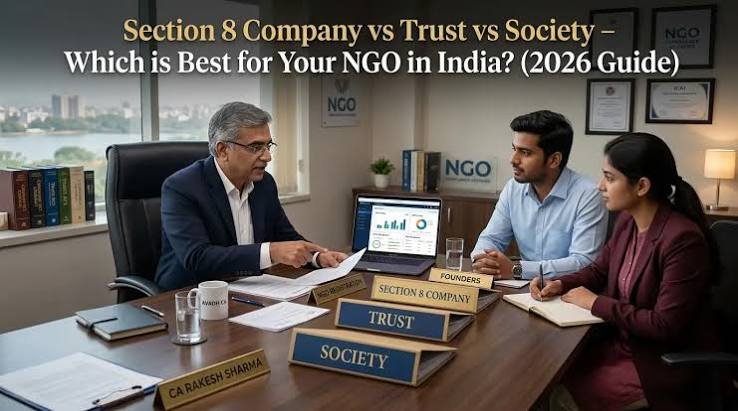
Category: Founder Legal Hurdles

  • Section 8 Company vs NGO vs Trust: Which
Structure Is Right for Social Startups?

    Section 8 Company vs NGO vs Trust: Which Structure Is Right for Social Startups?

    Out of India’s roughly 1.87 lakh registered NGOs, only about 11,000 are Section 8 companies — the rest are trusts and societies. So if you’re picking a legal structure for your social startup, the popular choice isn’t always the right one for you.

    Get this wrong and you’ll either drown in compliance you didn’t need, or hit a funding wall you didn’t see coming.

    TL;DR: Choosing between a Section 8 company, a Trust, and a Society comes down to three things — how much compliance you can handle, how big your funding ambitions are, and how much control you want to keep. Trusts are cheapest and simplest, Societies suit membership-driven groups, and Section 8 companies win on credibility for CSR and foreign funding. Lawizer helps social founders register and stay compliant with all three structures under one roof.


    What You’ll Learn

    • The real difference between a Section 8 company, a Trust, and a Society
    • Which structure costs less to run every year
    • How the new Income Tax Act 2025 changes tax treatment for all three
    • A simple decision framework based on your startup’s scale and funding goals

    Section 8 Company, Trust, and Society: What Each One Actually Is

    Here’s the thing: “NGO” isn’t a legal structure at all. It’s an umbrella term. Every NGO in India is registered as one of three things — a Trust, a Society, or a Section 8 Company — and each answers to a different law.

    A Trust is created under the Indian Trusts Act, 1882 (or your state’s public trust law), through a Trust Deed. A trustee holds assets on behalf of beneficiaries. You need just 2 trustees, there’s no elected body, and once trustees are in, they typically stay for life unless the deed says otherwise.

    A Society is registered under the Societies Registration Act, 1860, and needs a minimum of 7 members plus a governing body that’s usually elected. It’s the go-to structure for membership-driven groups — alumni associations, cultural bodies, community welfare organisations.

    A Section 8 Company is registered with the Ministry of Corporate Affairs (MCA) under the Companies Act, 2013. It functions like a private limited company — directors, MOA, AOA — except profits can never be distributed to members and must go back into the company’s charitable objects.


    Cost and Compliance: The Number That Actually Matters

    What most founders miss: the registration fee is a one-time cost. The compliance bill is the one that decides whether your structure survives year three.

    A Trust’s annual compliance typically runs ₹5,000–₹15,000 — basic bookkeeping and an income tax filing, with no regulator breathing down your neck beyond that.

    A Section 8 Company, on the other hand, usually costs ₹25,000–₹75,000 a year to keep compliant: statutory audits, annual ROC filings (AOC-4, MGT-7), board meeting records, and adherence to accounting standards.

    A quick example: if your social startup runs on an annual budget under ₹25 lakh with two or three people managing it, that compliance overhead can eat a real chunk of your funds before a single rupee reaches your beneficiaries.

    • Trust — cheapest, minimal ongoing paperwork, no regulator beyond Income Tax
    • Society — moderate compliance, needs annual general meetings and elected renewals
    • Section 8 Company — highest compliance, mandatory audits, ROC filings every year

    Funding and Credibility: Where Section 8 Pulls Ahead

    The short answer: if your growth plan involves corporate CSR money or foreign donors, a Section 8 Company gives you a real edge. Companies collectively spent over ₹1,84,222 crore on CSR between 2014 and 2023, and most large corporates prefer routing that money to Section 8 entities because their filings sit publicly on the MCA portal — donors can verify legitimacy without asking.

    Trusts and Societies aren’t shut out of CSR or 80G benefits, but they lean on informal trust and local reputation rather than a public paper trail. That works well for grassroots and community-level work, but it slows you down the moment you’re pitching a national foundation or an overseas funder for a six-figure grant.

    Setting up your business registration the right way from day one also makes it easier to layer on 12A and 80G approvals later, regardless of which structure you pick.


    Income Tax Act 2025: The Rule That Changes Everything

    Let’s break this down, because this is the part most 2024-era comparisons still get wrong. From 1 April 2026, the Income Tax Act 2025 introduces a unified “Registered Non-Profit Organisation” (RNPO) framework under its Chapter on non-profits — and it applies identically to Trusts, Societies, and Section 8 Companies.

    Under this framework, all three structures file the same Form 10A for provisional registration (valid 3 years) and Form 10AB for regular registration (valid 5 years, or 10 years if income stays under ₹5 crore for two preceding years). The 85% income-application rule and cancellation grounds are also now identical across structures.

    What this means practically: your choice of structure no longer changes your tax exemption eligibility. It only changes your governance model, your compliance workload, and how easily you can raise institutional money — which is exactly why the cost and credibility factors above matter more than ever.


    So Which Structure Should Your Social Startup Pick?

    Here’s a simple way to decide, based on where your startup actually is today — not where you hope it’ll be in five years.

    • Choose a Trust if you’re a small, family-led, or founder-controlled initiative with a budget under ₹25 lakh and no near-term plans for CSR or foreign funding.
    • Choose a Society if your work is membership-based — think alumni networks, cultural collectives, or community welfare groups that want democratic, elected leadership.
    • Choose a Section 8 Company if you’re building for scale — planning to approach corporate CSR desks, apply for government grants, or eventually register under MSME as your social enterprise grows commercially alongside its charitable arm.

    One more thing worth knowing: you can start as a Trust and move to a Section 8 Company later once you have traction — you can’t directly “convert” a Trust into one, but you can incorporate the Section 8 entity fresh and transfer operations across, subject to legal formalities.


    Frequently Asked Questions

    Q: Which is better, Trust or Section 8 company, for a small NGO?

    A: For a small, founder-run NGO with a limited budget, a Trust is usually better because it costs less to set up and maintain every year. Move to a Section 8 Company once you’re actively pursuing CSR funding or foreign donations that require higher transparency.

    Q: Can a Section 8 company have just 2 people running it?

    A: Yes. A Section 8 Company needs a minimum of 2 directors and 2 subscribers, and the same two people can hold both roles. You’ll need Digital Signature Certificates (DSC) and Director Identification Numbers (DIN) for both, which adds roughly ₹2,000–₹4,000 to setup costs.

    Q: Does the Income Tax Act 2025 change which structure I should pick?

    A: Not directly on tax grounds. From 1 April 2026, Trusts, Societies, and Section 8 Companies all follow the identical RNPO registration process for tax exemption. Your structure choice should now be based on governance style, compliance capacity, and funding goals rather than tax benefits.

    Q: Is a Section 8 company the same as an NGO?

    A: A Section 8 Company is one type of NGO, not a synonym for it. NGO is the broad category; Trust, Society, and Section 8 Company are the three specific legal structures you can register an NGO under in India.

    Q: Can I convert my existing Trust into a Section 8 company?

    A: You cannot directly convert a Trust into a Section 8 Company under current law. Instead, you register a new Section 8 Company and transfer the Trust’s assets and operations to it, following the applicable legal and tax procedures.


    Ready to register your social startup the right way? Lawizer’s experts handle Trust, Society, and Section 8 Company registration — plus 12A, 80G, and FCRA guidance — fully online, starting at just ₹4,999. No CA visit needed.


  • India’s New Income Tax Act 2025Key Changes Startup
Founders Must Know  :

    India’s New Income Tax Act 2025Key Changes Startup Founders Must Know :

    Six decades. That’s how long the Income Tax Act, 1961 governed every rupee of business income in India — and on April 1, 2026, it got replaced. If you’re running a startup, this isn’t a “read it later” compliance update. Your ESOP grant letters, TDS filings, and advance tax workings are already operating under a different rulebook.

    Here’s the part that trips up most founders: you’re currently filing your FY 2025-26 return under the old 1961 Act, even though your business has been operating under the new 2025 Act since April 1. Two legal frameworks, running in parallel, for at least one filing cycle. Let’s break this down.

    📌 TL;DR: The Income Tax Act, 2025 replaced the Income Tax Act, 1961 with effect from April 1, 2026, cutting the law down from roughly 819 sections to 536 and introducing a single “Tax Year” concept that replaces the old Financial Year/Assessment Year split. For startups, the core benefits — the Section 80-IAC tax holiday, angel tax exemption, and loss carry-forward protection — continue under renumbered sections, but ESOP deferral windows, TDS section numbers, and compliance documentation all need updating.


    What You’ll Learn

    • Why the government replaced a 64-year-old tax law and what actually changed
    • What “Tax Year” means and why it replaces Financial Year and Assessment Year
    • How your startup’s 80-IAC tax holiday, angel tax exemption, and ESOP terms carry over
    • What TDS and compliance changes to prepare for right now

    Why the Old Act Got Replaced

    The Income-tax Act, 1961 was built for a paper-based economy with face-to-face assessments. Over six decades, patchwork amendments pushed it past 800 sections spread across 47 chapters. That overgrowth raised compliance costs and fuelled disputes with multi-year case backlogs. It also never sat comfortably with e-commerce, platform income, or cross-border digital transactions — problems that simply didn’t exist when the law was written.

    The government’s response was structural, not cosmetic. The new Act reduces provisions from 819 sections to 536, received Presidential assent in 2025, and came into force on April 1, 2026, applicable from Tax Year 2026-27 onwards. The reassuring part for founders: the core scheme and fundamental principles of the old Act largely remain intact. This is a rewrite for clarity, not a redesign of how tax is calculated.


    “Tax Year” Replaces Financial Year and Assessment Year

    This is the single change every founder will notice on every form, notice, and Form 16 going forward.

    Under the old system, income earned in one year — called the Previous Year or Financial Year — was assessed in the following year, called the Assessment Year. So income from FY 2024-25 was taxed in AY 2025-26. This dual-reference system was unique to India and created confusion that persisted for 64 years. Tax professionals estimated that selecting the wrong Assessment Year was among the top five reasons for defective return notices across the country.

    The new Act scraps both terms. A single “Tax Year” now covers both the earning and assessing of income under one label — defined simply as the 12-month period from April 1 to March 31. No more one-year lag, no more juggling two different year labels for the same income.

    What most founders miss: this change doesn’t alter when you file or how much you owe. It only removes the confusion. If you incorporate mid-year, your first Tax Year runs from your incorporation date to the following March 31, exactly as the old Previous Year rules worked for new businesses.

    The short answer for your filing this July: you’re still submitting an AY 2026-27 return under the old 1961 Act for income earned in FY 2025-26. The new Act only governs income earned from April 1, 2026 onwards. Your first Tax Year 2026-27 return under the new law isn’t due until mid-2027.


    7 Legal Tax-Saving Strategies Every Startup Founder Should Use (2026)

    What Happens to Section 80-IAC, Angel Tax, and Your Startup Benefits

    If your company has DPIIT (Department for Promotion of Industry and Internal Trade) recognition, the benefits you’ve been counting on don’t disappear — they move.

    The 100% profit deduction for any three consecutive years out of your first ten, formerly under Section 80-IAC, now sits under Section 140 of the new Act. Angel tax — the provision that once taxed share premiums above fair market value as “income from other sources” — was already abolished with effect from April 1, 2025 under Finance Act 2024, and that relief carries forward cleanly into the new framework. Section 79’s protection of carried-forward losses through funding rounds also continues, so a fresh priced round won’t wipe out your accumulated losses, as long as original promoters retain control.

    Here’s the thing founders keep getting wrong: DPIIT recognition alone still doesn’t activate the tax holiday. You need a separate Inter-Ministerial Board (IMB) certificate obtained by filing Form 1 with the Income Tax Department. As of early 2026, only around 3,700 startups had received IMB approval out of over 2.07 lakh DPIIT-recognised companies. Most founders hold the DPIIT certificate, assume they’re covered, and quietly miss out on a benefit worth lakhs in saved tax.

    On ESOPs, pay close attention. The eligible-startup ESOP tax deferral mechanism moves to Section 392 of the new Act. Allotments made from April 1, 2026 onwards now carry a 60-month deferral window — up from the earlier 48 months — before perquisite tax becomes due. But this extended window only applies if your company holds the IMB certificate, not just DPIIT recognition. Every grant letter, ESOP scheme document, and board resolution still citing 1961-Act section numbers needs to be re-papered for allotments dated April 1, 2026 onwards. It’s a paperwork task, not a legal overhaul, but skipping it creates filing inaccuracies your company is responsible for correcting.

    Latest TDS Rates Chart Tax Year 2026-27 | Effective April 2026

    TDS Compliance: Fewer Sections, But a Documentation Overhaul

    TDS (Tax Deducted at Source) is where founders feel the new Act most directly, because it touches every vendor payment, contractor invoice, rent cheque, and salary run.

    Under the old Act, businesses navigated roughly 37 separate TDS sections — Section 194A through 194T — each with different thresholds, rates, and filing requirements. The new Act consolidates these into around 20 sections. Section 393 is now the primary TDS provision, with related payment categories grouped as subsections rather than standalone sections.

    Fewer sections should mean fewer thresholds to memorise. But the documentation overhaul that comes with this is non-trivial. Here’s what your team needs to update before your Tax Year 2026-27 compliance work begins:

    Chart of accounts: Remap all entries from old section numbers to new equivalents

    TDS rate schedules: Update internal rate cards and accounting software configs

    Payroll configurations: Reflect the current standard deduction under the new Act

    Vendor contracts and SOPs: Any reference to old section numbers in payment terms or vendor agreements needs updating

    ESOP documentation: As noted above — grant letters, board resolutions, and scheme documents

    A quick example: if your Bengaluru startup pays a Razorpay or Meesho integration partner, the TDS deduction on that payment now references a different section number. Your accountant may already know this, but your internal finance team’s SOP likely doesn’t. The correction obligation sits with your company, not your CA firm.


    Frequently Asked Questions

    Q: Does the Income Tax Act 2025 apply to my ITR filing this year?

    No, not yet. If you’re filing your return in July 2026 for income earned in FY 2025-26, you’re still governed by the Income Tax Act, 1961. The new Act only applies to income earned from April 1, 2026 onwards. Your first return under it isn’t due until mid-2027.

    Q: Will my startup’s tax holiday under Section 80-IAC still apply?

    Yes. The three-year, 100% profit deduction benefit continues under the new Act, now positioned under Section 140. Eligibility rules remain the same — you need both DPIIT recognition and a separate IMB certificate obtained by filing Form 1 with the Income Tax Department.

    Q: What is a “Tax Year” and how is it different from Financial Year?

    Tax Year is a single 12-month period from April 1 to March 31 that replaces both the old Financial Year (when income was earned) and Assessment Year (when it was taxed and filed). Under the new Act, the year you earn income and the year you report it share the same label, removing the one-year offset that caused decades of confusion.

    Q: Do I need to update my ESOP grant letters?

    Yes, if they reference 1961-Act section numbers and cover allotments dated April 1, 2026 or later. Those allotments fall under Section 392 of the new Act. If your company holds an IMB certificate, the perquisite tax deferral window on new allotments also extends from 48 months to 60 months.

    Q: Is angel tax really gone for good?

    The provision taxing share premiums above fair market value was abolished from April 1, 2025 and doesn’t reappear anywhere in the new Act. If you raised funding before that date, it’s worth checking with your CA whether any prior assessments remain open.

    Q: How many TDS sections do we need to track now?

    Roughly 20, down from about 37 under the old Act. Section 393 is now the primary TDS provision, with payment categories grouped as subsections rather than separate standalone sections.


    Ready to get your startup compliant under the new Act?

    Lawizer’s experts handle Income Tax Act 2025 transition reviews, DPIIT and IMB certification, and ongoing ITR filing — fully online, starting at just ₹999. No CA visit needed.

    Talk to a Lawizer expert → lawizer.com/startup-businesslegal

  • POSH Compliance for Indian Startups: The Complete Founder’s Guide

    POSH Compliance for Indian Startups: The Complete Founder’s Guide

    A CEDA study surveying 200 senior HR officers found that 59% of Indian organisations had not set up an Internal Complaints Committee — the single most critical requirement under the POSH Act 2013. For startups hiring their 10th employee this month in Bengaluru or Pune, that statistic is a legal liability, not just a data point. POSH compliance for startups India isn’t optional. It’s a statutory obligation with a penalty of ₹50,000 on the first offence, escalating to licence cancellation on repeat violations.

    The MCA made it even harder to ignore: from July 14, 2025, every company must now disclose POSH complaint data inside its Board Report. Founders who treat POSH as an HR afterthought are about to face audit tables, District Officer surveys, and Supreme Court-directed district-level verification checks. Here’s everything you need to set it up correctly — before a complaint forces you to.

    TL;DR: Every Indian startup with 10 or more employees must comply with the Sexual Harassment of Women at Workplace (Prevention, Prohibition and Redressal) Act, 2013 — commonly called the POSH Act. POSH compliance for startups India requires constituting an Internal Complaints Committee (ICC), drafting and displaying a POSH policy, conducting annual awareness training, and filing an ICC Annual Report by January 31 each year. Non-compliance attracts a fine of up to ₹50,000 (with licence cancellation for repeat offences), plus mandatory Board Report disclosures under the MCA’s July 2025 amendment. Lawizer can help you set up the full POSH framework — policy, ICC, and filings — entirely online.

    What You’ll Learn

    — When exactly the POSH Act applies to your startup and who it covers — How to constitute a legally valid ICC under Section 4 of the POSH Act — What your POSH policy must include, how to display it, and annual filing requirements — Penalties your startup faces for non-compliance in 2025 and 2026 — The 2025 MCA amendment and SHe-Box registration — what changed and what you must do now

    When Does the POSH Act Apply to Your Startup?

    The Sexual Harassment of Women at Workplace (Prevention, Prohibition and Redressal) Act, 2013 kicks in the moment your organisation crosses 10 employees. And the headcount isn’t restricted to permanent staff on payroll. Interns, contractual workers, freelancers, consultants, and even gig workers attached to your business all count toward the threshold. A Bengaluru SaaS startup with 8 full-time engineers and 3 contract QA testers? That’s 11 people. POSH applies immediately.

    Here’s the thing: the Act covers every kind of workplace. Remote employees, hybrid setups, client sites, co-working spaces like WeWork or IndiQube — all fall under ICC jurisdiction. A 2024 advisory from the Ministry of Women and Child Development explicitly extended POSH obligations to remote and work-from-home arrangements, making digital workplace conduct — Slack messages, Zoom calls, email — covered behaviour. “PoSH will stop being location-related and become behaviour-oriented,” as one HR professional put it. Startups that scaled fast through the pandemic and never addressed POSH are now operating in a high-risk grey zone.

    What most founders miss: if your startup has fewer than 10 employees, you don’t need an ICC — but you must ensure your team is aware of the Local Complaints Committee (LCC) constituted by the District Officer under Section 6. Once you cross 10, the ICC obligation is immediate. There’s no grace period in the Act.

    How to Constitute a Valid ICC Under Section 4

    The Internal Complaints Committee (ICC) — the body mandated under Section 4 of the POSH Act to receive, investigate, and resolve workplace sexual harassment complaints — is the structural backbone of your entire POSH framework. Get the composition wrong and every inquiry the ICC conducts can be legally challenged. District Officer surveys and the Supreme Court’s August 2025 direction in Aureliano Fernandes v. State of Goa have placed incorrectly constituted ICCs directly in the crosshairs of enforcement.

    A legally valid ICC must have at minimum four members. Here’s the exact composition:

    Presiding Officer: A senior woman employee. She chairs the ICC and signs off on the Annual Report.

    Two internal members: Employees committed to the cause of women’s rights or with experience in social work. At least one must be from the same establishment.

    One external member (mandatory): A person from an NGO or association committed to women’s rights, or a lawyer or advocate with relevant expertise. This is not optional. An ICC without an external member is improperly constituted and its findings are voidable.

    At least 50% of ICC members must be women. Members serve a maximum term of 3 years, after which the ICC must be reconstituted or members renewed. The founding document — an ICC constitution order signed by the CEO or authorised signatory — must be issued, appointment letters sent, and ICC details published on your intranet and displayed on notice boards. This is the paperwork most early-stage founders in Delhi and Mumbai skip entirely.

    A Quick Example: How a 15-Person Startup Should Structure Its ICC

    Say you’re a 15-person fintech in Hyderabad. Your Presiding Officer could be your senior woman engineer or a woman co-founder. Two internal members — one from ops, one from product. Your external member could be empanelled through a POSH compliance services firm or sourced from a local NGO working on women’s issues. Issue appointment letters, fix a small honorarium for the external member, and document the constitution order. That’s your ICC. Simple — but you have to actually do it.

    startup support and compliance - Company Registration Trivandrum | GST Trivandrum | Trademark | Partnership | LLP | Project Report Thiruvananthapuram | Startup

    Drafting Your POSH Policy: What Must Actually Be in It

    Under Section 19 of the POSH Act read with Rule 13 of the POSH Rules, 2013, every employer must formulate a written POSH policy and disseminate it widely. A generic template downloaded from the internet is not enough — courts have held that a boilerplate policy that employees have never seen is no different from having no policy at all. Your POSH policy must include at minimum:

    — A clear definition of sexual harassment with workplace-specific examples (physical, verbal, non-verbal, digital) — The complete complaint procedure — how to file, timelines, and what happens after — Protections for complainants, witnesses, and ICC members against retaliation — Confidentiality obligations — breaching these attracts a separate fine of ₹5,000 — ICC member names, contact details, and the external member’s credentials — Penal consequences of sexual harassment under both the POSH Act and the Bharatiya Nyaya Sanhita, 2023 (which replaced the IPC)

    Once drafted, the policy must be displayed prominently — both physically (notice boards, breakrooms) and digitally (company intranet, onboarding portal). Every new hire must be oriented on the policy. Annual awareness training for all employees is mandatory, not just for ICC members. If your startup uses Zoho People or Darwinbox, embed the POSH policy acknowledgement into the onboarding flow — that creates a documented paper trail if a complaint is ever raised. You can get expert help structuring a watertight compliance framework through Lawizer’s startup legal services (https://lawizer.com/startup-businesslegal), which covers POSH policy drafting alongside incorporation, IP, and employment contracts.

    Statutory Timelines: What Happens After a Complaint Is Filed

    Let’s break this down. Once a complaint lands with the ICC, the POSH Act prescribes a strict inquiry timeline that cannot be ignored. Missing these deadlines exposes the employer — not just the ICC — to legal liability.

    7 days: Complaint copy must be sent to the respondent after ICC receives it 10 working days: Respondent must submit reply with evidence and witnesses 90 days: Full inquiry must be completed 10 days post-inquiry: ICC must issue its report to employer and both parties 60 days post-report: Employer must act on ICC recommendations 90 days: Window for either party to appeal before a Labour Court or tribunal

    What most founders miss: an internal POSH inquiry does not bar criminal action. A complainant can simultaneously file under the Bharatiya Nyaya Sanhita or pursue civil damages. The two tracks run in parallel. This is why thorough ICC documentation — verbatim interview notes, evidence chain of custody, reasoned findings — matters far more than founders realise. One poorly documented ICC inquiry can turn into a High Court writ petition under Article 226 citing natural justice violations.

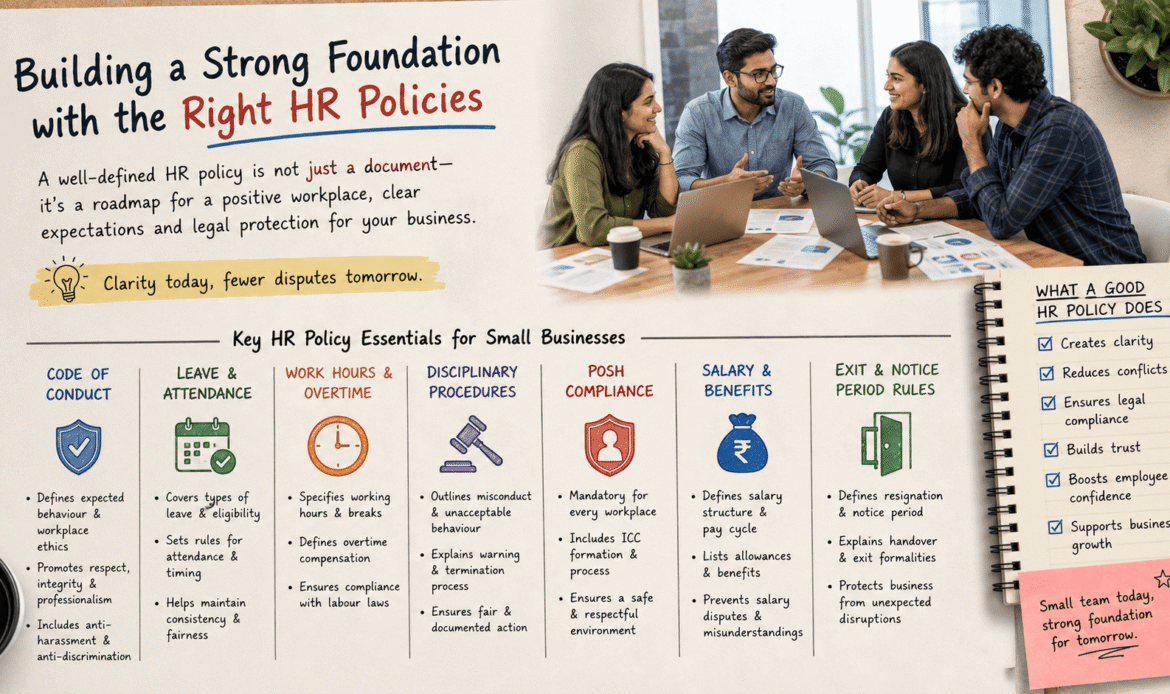
    HR Policy Template for Small Businesses

    Annual Filings, MCA 2025 Amendment, and SHe-Box Registration

    POSH compliance isn’t a one-time setup. There are recurring annual obligations that every startup must calendar. Under Section 21 of the POSH Act, the ICC must submit an Annual Report to both the employer and the District Officer — typically by January 31 each year (some states like Gurugram have moved this to February 28). The report must capture the number of complaints received, disposed of, and pending beyond 90 days, along with details of awareness training conducted.

    The July 2025 MCA amendment — through the Companies (Accounts) Second Amendment Rules, 2025, effective July 14, 2025 — added a significant new layer. Every company must now disclose inside its Board Report: the number of POSH complaints received, disposed of, and pending beyond 90 days, plus the gender composition of the workforce. Missing these disclosures can attract penalties up to ₹5 lakh under the Companies Act, 2013. This means POSH data is now part of your ROC filing — a hard deadline item alongside AOC-4 and MGT-7 for your Private Limited Company.

    Additionally, the SHe-Box (Sexual Harassment Electronic Box) portal — run by the Ministry of Women and Child Development — now requires IC registration. The Delhi government directed all entities to register their internal committees on SHe-Box in June 2025, following the Supreme Court’s directive. Protecting your startup legally from multiple fronts — from POSH to trademark disputes — is best handled end-to-end; Lawizer’s business protection services (https://lawizer.com/startup-businesslegal/protectbusiness/TrademarkRegistrationPage) cover both legal compliance and IP protection in one place.

    Penalties for POSH Non-Compliance: What Your Startup Actually Risks

    The short answer: the consequences are real, escalating, and now harder to ignore than ever. Under Section 26 of the POSH Act, failure to constitute an ICC, failure to act on ICC recommendations, or failure to file annual reports are all punishable offences. Here’s how the penalty structure breaks down:

    First offence: Fine up to ₹50,000 Repeat offence: Double penalty (₹1,00,000+) and potential cancellation of business licence or startup registration Board Report non-disclosure (Companies Act 2013): Penalties up to ₹3,00,000 to ₹5,00,000 for false or missing statements in Directors’ Report Confidentiality breach by ICC members: Fine of ₹5,000

    The enforcement environment has also sharpened dramatically. In August 2025, the Supreme Court in Aureliano Fernandes v. State of Goa directed all States and Union Territories to conduct district-wise surveys within six weeks to verify whether ICs had been constituted. Non-compliance during those surveys could result in regulatory action including refusal of licence renewals. For a DPIIT-recognised startup or a company seeking government tenders, a POSH non-compliance flag is an existential risk — not just a fine.

    Frequently Asked Questions

    Q: Does POSH apply to my startup if I have only 10 employees?

    A: Yes. Section 4 of the POSH Act mandates ICC constitution at every establishment with 10 or more employees. This count includes permanent, contractual, intern, and freelance workers. The obligation kicks in from the day your headcount crosses the threshold — there is no grace period, and “10 employees” is a hard statutory trigger, not a guideline.

    Q: What happens if my startup doesn’t have a single woman employee — do I still need an ICC?

    A: Yes. The POSH Act’s protective scope covers all women who interact with your workplace — clients, vendors, delivery partners, women visiting the office. The ICC obligation is tied to the employer’s headcount, not to whether you currently have women on staff. Additionally, future hiring will almost certainly bring women employees, and setting up the ICC proactively avoids scrambling later when a complaint actually lands.

    Q: Can a co-founder or director serve as the Presiding Officer of the ICC?

    A: A woman co-founder or senior woman employee can serve as Presiding Officer, provided she meets the requirement of being a “senior woman employee” as per Section 4 of the POSH Act. However, she must not have a conflict of interest with either the complainant or respondent in any inquiry. For very small startups where all senior women are founders, engaging an external POSH consultant to play a structured advisory role alongside internal members is a sensible approach.

    Q: What changed with the MCA July 2025 amendment and how does it affect my annual filing?

    A: The Companies (Accounts) Second Amendment Rules, 2025, effective July 14, 2025, require every company to include detailed POSH disclosures in its Board’s Report — the number of complaints received, disposed of, and pending beyond 90 days, plus the gender composition of the workforce. These disclosures become part of your ROC annual filing under the Companies Act, 2013. Missing or inaccurate disclosures can attract penalties up to ₹5 lakh on the company and its directors.

    Q: Do I need to file a POSH Annual Report even if there were zero complaints during the year?

    A: Yes. The ICC Annual Report must be filed with the District Officer by January 31 (or your state’s applicable deadline) regardless of whether any complaints were received. A zero-complaint year still requires reporting on ICC constitution details, awareness training conducted, and overall compliance status. Filing demonstrates your prevention framework is active — and that itself is what regulators and auditors look for.

    Q: What is the SHe-Box portal and is registration mandatory for startups?

    A: SHe-Box (Sexual Harassment Electronic Box) is the central complaint portal run by the Ministry of Women and Child Development. It allows any woman to file a workplace sexual harassment complaint online, routed to the appropriate IC or LC. Following the Supreme Court’s directive and the Delhi government’s June 2025 order, all entities — including private startups — are required to register their Internal Committees on SHe-Box. Non-registration is increasingly treated as evidence of POSH non-compliance during District Officer surveys.

    Ready to set up POSH compliance for your startup? Lawizer’s experts handle everything — ICC constitution, POSH policy drafting, annual report preparation, and SHe-Box registration — fully online, starting at just ₹2,999. No lengthy back-and-forth with compliance consultants needed.

    Get Your POSH Framework Set Up → https://lawizer.com/startup-businesslegal


  • What Happens Legally If Your Startup Misses Payroll?

    What Happens Legally If Your Startup Misses Payroll?

    ₹20,722.5 crore. That’s the combined FY25 loss reported by 45 loss-making Indian startups so far. When the runway gets short, payroll is often the first casualty. Missing even one salary cycle may seem like a temporary cash-flow issue to a founder. Legally, however, it isn’t.

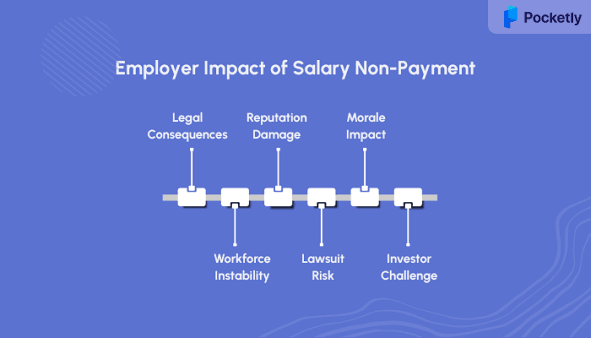
    The moment payday passes without payment, the issue goes beyond a simple delay. You begin accumulating legal liability under at least three separate laws.

    📌 TL;DR: Delaying or skipping employee salaries in India isn’t just a cash-flow issue — it’s a compliance breach under the Payment of Wages Act, and in serious cases can trigger criminal proceedings, Companies Act liability, or an insolvency petition under the IBC. Founders who act early — with written communication, structured settlement plans, and proper documentation — significantly reduce their legal exposure. Lawizer helps startups stay compliant on payroll, ROC filings, and labour law so a rough quarter never becomes a legal crisis.

    What You’ll Learn

    • Whether delaying salary is actually illegal in India, and by how many days
    • The specific laws that apply — Payment of Wages Act, IPC/BNS, Companies Act, IBC
    • What your employees can legally do if you miss payroll
    • How unpaid salaries can escalate into an insolvency petition against your company
    • Practical steps to protect the company (and yourself, personally) before it gets there

    Is It Actually Illegal to Delay Employee Salaries?

    Yes — and most founders underestimate by how much. Employers must pay wages before the 7th day of the following month in smaller establishments and before the 10th day in larger ones, as required by the Payment of Wages Act, 1936. There’s no grace period for “waiting on the next funding tranche.”

    Here’s the thing: this Act currently covers employees earning up to ₹24,000 a month, which includes the vast majority of early-career hires at most startups — support staff, junior developers, sales executives, and operations teams.

    Employees who earn above that threshold still receive legal protection and can pursue civil recovery through a summary suit or, in senior roles, file a straightforward money recovery claim.

    What most founders miss: a company doesn’t need to formally “refuse” to pay to be in breach. Simply missing the statutory deadline — even by a few days, even with a WhatsApp message promising payment “next week” — is a compliance violation the moment it happens.

    The Laws That Kick In When Payroll Is Missed

    Salary non-payment in India isn’t governed by one law — it’s a stack of them, and each one gets more serious than the last.

    1. Payment of Wages Act, 1936 — the civil layer

    This is the first trigger point. Delayed wages entitle the employee to file a claim with the labour authority, and courts have the power to order payment of the dues plus compensation, on top of the original amount owed.

    2. Criminal liability for intentional non-payment

    For example, if a startup records salaries as “paid” in its books but never transfers the money to employees, it does more than delay payment—it misrepresents the facts. Authorities can prosecute this conduct as cheating or criminal breach of trust under criminal law, in addition to any labour-related claims.

    3. Companies Act, 2013 — fraud provisions

    If a company combines unpaid salaries with falsified financial records—for example, by recording payroll as disbursed in books submitted for audit or fundraising while employees remain unpaid—Section 447 of the Companies Act treats the conduct as corporate fraud. This offence carries far more severe consequences than a simple wage dispute.

    4. The new Labour Codes

    India’s four consolidated labour codes came into force on November 21, 2025, replacing 29 older laws.

    Under the new framework, authorities continue to penalize payment delays, and employers can no longer use payroll structures that artificially reduce statutory contributions. Basic pay must now account for at least 50% of total compensation, directly increasing gratuity and provident fund (PF) liability calculations.

    What Employees Can Legally Do If You Miss Payroll

    The short answer: more than most founders assume, and faster than most founders expect. A typical sequence looks like this:

    • Send a formal legal notice demanding payment within a fixed window, usually 7–15 days
    • File a complaint with the jurisdictional Labour Commissioner, who can summon the employer for reconciliation
    • Escalate to the Labour Court if the complaint isn’t resolved, with claims filed within one year of default
    • Pursue a civil recovery suit for managerial or senior staff not covered under the Payment of Wages Act
    • File as an operational creditor under the Insolvency and Bankruptcy Code if dues cross ₹1 lakh

    Let’s break this down further with the piece founders underestimate most: once a legal notice lands, the clock is already running publicly. A response — or lack of one — becomes evidence in any future proceeding.

    This is exactly the kind of documentation gap that proper business compliance support is built to close before it becomes a liability.

    How Missed Salaries Can Trigger Insolvency Proceedings

    Here’s the escalation path founders genuinely don’t see coming. Under the Insolvency and Bankruptcy Code, an employee owed ₹1 lakh or more in unpaid wages qualifies as an “operational creditor” — the same legal category as an unpaid vendor.

    The process starts with a demand notice. If the company doesn’t respond or settle within the specified period, employees can collectively petition the NCLT, which can trigger appointment of a resolution professional and formation of a creditors’ committee.

    If the company fails to resolve the issue, creditors can push it into liquidation—a legal outcome that began with a missed payday.

    A quick example shows why documentation matters: courts have repeatedly ruled that employers cannot arbitrarily withhold earned wages, and employees remain entitled to recover them even when the employment arrangement contains procedural irregularities.

    Clean records protect both the company and the employee. Clean records protect the company as much as they protect the employee.

    How Founders Can Protect Themselves Before It Escalates

    The good news: almost every escalation on this list is avoidable with early, documented communication. What actually works:

    • Communicate delays in writing before the due date, not after — silence is what triggers legal notices
    • Never show salary as “paid” internally or to auditors if it hasn’t actually been disbursed
    • Prioritise partial payments over zero payments — courts and employees respond very differently to good-faith effort
    • Put a written settlement plan in place with dates, even if amounts are staggered
    • Keep statutory filings — PF, ESIC, TDS on salary — current even when gross pay is delayed, since these carry separate penalties

    If your startup is also behind on tax filings or MSME-linked payment obligations during a cash crunch, those compliance gaps compound fast — each one is a separate legal exposure, not a single combined problem.

    Frequently Asked Questions

    Q: Is it illegal for a startup to delay salary by a few days?

    A: Yes. Under the Payment of Wages Act, 1936, employers must pay wages within 7 days after the wage period ends for smaller establishments and within 10 days for larger ones.Any delay beyond this, even without malicious intent, is technically a violation founders should treat seriously.

    Q: Can an employee file a criminal case against a startup for not paying salary?

    A: Yes, in cases involving intentional deception — such as salary shown as disbursed in records but never actually transferred. Authorities can pursue this as cheating or criminal breach of trust, separately from the labour claim for the unpaid amount.

    Q: Can unpaid employee salary lead to my startup being taken to insolvency court?

    A: Yes. Under the IBC, an employee owed ₹1 lakh or more can file as an operational creditor. If the company doesn’t respond to a demand notice, employees can collectively petition the NCLT, which can ultimately lead to liquidation proceedings.

    Q: What should a founder do first if the company genuinely can’t make payroll?

    A: Communicate the delay in writing before the due date, offer a partial payment if possible, and put a dated settlement plan on record.
    The law treats documented, proactive communication very differently from silence that forces employees to escalate the issue on their own.

    Q: Do the new labour codes change the penalties for salary delays?

    A: Yes. India’s four consolidated labour codes took effect on November 21, 2025, and payment delays remain fully punishable under the new framework.
    Additionally, employers must keep basic pay at or above 50% of total compensation, changing how they calculate PF and gratuity liabilities even before a payment delay occurs.

    Ready to get your startup’s payroll and compliance airtight?
    Lawizer’s experts handle payroll compliance reviews, statutory filings, and labour law documentation — fully online, starting at just ₹1,999. No CA visit needed.

    Talk to a Lawizer compliance expert →

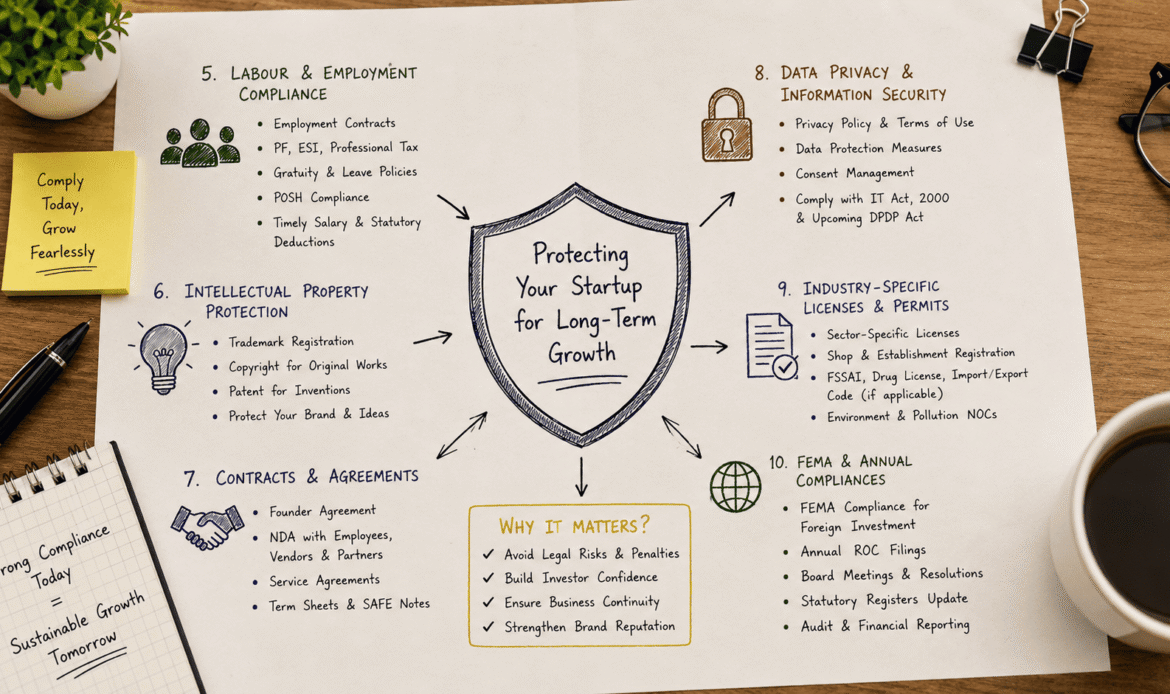
  • Why Compliance Gaps Kill Startup Funding Rounds in India

    Why Compliance Gaps Kill Startup Funding Rounds in India

    A 2025 study on Indian fintech due diligence found that 73% of failed deals traced back to regulatory gaps — missed licences, KYC lapses, and messy cross-border filings. If you’re heading into a funding round, compliance gaps are the single most preventable reason term sheets fall apart.

    Investors don’t walk away because your product is weak. They walk away because your paperwork doesn’t match your story.

    📌 TL;DR: Indian startups routinely lose funding rounds over compliance gaps like missed MCA filings, unassigned IP, undocumented ESOPs, and a cap table that doesn’t match the Registrar of Companies’ records. Investors treat these as governance red flags, not paperwork errors, and they either cut valuation, add protective clauses, or exit the deal entirely. Lawizer helps founders fix these gaps — incorporation, GST, MSME, and ROC filings — before an investor’s lawyer finds them first.

    What You’ll Learn

    • The specific compliance gaps that most often derail Indian startup funding rounds
    • Why investors treat small filing lapses as governance red flags, not clerical mistakes
    • A practical checklist to get your startup diligence-ready before term sheet stage

    Why Investors Treat Compliance Gaps as Deal-Breakers

    Here’s the thing: investors aren’t auditing your paperwork for fun. A missed filing tells them something bigger — that operational discipline is missing somewhere else too.

    Legal due diligence reports from Indian VC-backed deals show that more than half of failed rounds involve issues around revenue recognition, burn-rate reporting, or undocumented liabilities, not just product or market concerns.

    What most founders miss: compliance records aren’t a formality you clean up before a round. They’re evidence. When your Ministry of Corporate Affairs (MCA) filings, GST returns, and internal cap table all line up without explanation, it shortens diligence timelines and protects your valuation. When they don’t, investors either delay closing, demand indemnities, or walk.

    The Five Compliance Gaps That Kill Indian Funding Rounds

    The short answer: most funding rounds don’t die over one catastrophic issue. They die over a pattern of small, avoidable gaps that pile up in the data room. These are the ones that show up again and again in Indian startup due diligence.

    • Missed ROC filings: AOC-4, MGT-7, and DIR-3 KYC are annual, non-negotiable filings under the Companies Act, 2013. Recent MCA data shows nearly 18% of active startups missed at least one annual form in FY 2024–25, and each miss adds daily penalties plus a red flag in your compliance history.
    • Cap table mismatches: If your internal cap table doesn’t match the Register of Members filed in Form MGT-7, investors treat it as a serious discrepancy — not a typo.
    • Unassigned IP: Under Indian law, intellectual property created by a founder or freelancer belongs to the creator unless it’s formally assigned to the company. Missing IP assignment agreements are one of the most common reasons diligence stalls.
    • Undocumented ESOPs: An ESOP scheme approved informally, without a shareholder special resolution filed via Form MGT-14, is technically unauthorised — and investors will ask you to fix it as a closing condition.
    • GST and TDS mismatches: Delayed GST returns or input tax credit discrepancies trigger automated notices, and investors now expect at least two years of clean tax filing history before they commit.

    How Compliance Gaps Actually Cost You Money and Time

    Let’s break this down. A single missed DPT-3 filing or a deactivated Director Identification Number (DIN) from a skipped DIR-3 KYC doesn’t just cost a penalty. It stalls the entire round while your lawyers scramble to fix it mid-negotiation — and every week of delay is a week where the investor can renegotiate terms or lose interest.

    A quick example: founders preparing for Series A routinely discover, right in the middle of diligence, that unpaid vendor dues weren’t reflected in the books, or that a director loan was never reported on Form DPT-3. Each of these is fixable on its own.

    Together, three or four of them signal weak financial control, and that’s what actually erodes valuation — not the individual filing.

    This is also where MSME Udyam registration matters more than founders expect — investors check it as part of vendor payment compliance, since companies with unresolved MSME dues beyond 45 days face mandatory half-yearly disclosure under Form MSME-1.

    Building a Diligence-Ready Compliance Spine

    What separates startups that close rounds smoothly from those that don’t isn’t luck — it’s a compliance routine that runs quietly in the background, independent of fundraising timelines. Founders who pass due diligence on the first attempt tend to share the same habits.

    Quarterly, not annual, compliance check-ins

    Waiting until a term sheet lands to review your MCA and GST status means you’re fixing years of gaps under time pressure. A quarterly review catches issues while they’re still cheap to correct.

    Every founder and freelancer signs an IP assignment

    This should happen at the point of hiring, not right before a data room goes out. It’s a one-page fix that removes one of the most common deal-breakers investors flag.

    Trademark and brand protection early

    Investors also check whether your core brand assets are actually yours to defend. A trademark registration filed early, through the IP India portal, signals that your intangible assets are protected — something diligence teams increasingly flag when it’s missing.

    Clean, filed tax history

    Investors typically review at least two years of income tax filings during due diligence. Keeping your ITR filings current, alongside GST returns on the GSTN portal, removes an entire category of objections before they surface.

    What to Fix Before Your Next Funding Conversation

    If a round is even loosely on your roadmap for the next six months, start with the three areas that carry the most weight in diligence: your cap table, your IP assignments, and your top statutory filings. These are where ownership and control actually sit, and they’re where investors look first.

    Founders who go through company incorporation and compliance the right way from day one rarely face this scramble. If you incorporated quickly and deferred the paperwork, now is the point to close the gap — before an investor’s counsel finds it for you.

    Frequently Asked Questions

    Q: Can a startup really lose a funding round just because of missed MCA filings?

    A: Yes. Missed filings like AOC-4 or DIR-3 KYC signal weak governance to investors, and combined with other gaps, they can lead to reduced valuation, added protective clauses, or a walked deal. Investors view MCA filing history as a direct proxy for how disciplined a founding team is.

    Q: What compliance documents do investors ask for first?

    A: Investors typically start with MCA incorporation and filing records, the cap table with supporting Form PAS-3 filings, board meeting minutes, IP assignment agreements, and GST or income tax filing history. These form the baseline before deeper legal and financial due diligence begins.

    Q: How early should we start compliance clean-up before raising funds?

    A: Most advisors recommend starting three to six months before you plan to raise, since fixing statutory gaps, reconciling cap tables, and completing IP assignments takes time. Startups that maintain investor-ready records year-round avoid this scramble entirely.

    Q: Is an unregistered trademark actually a funding risk?

    A: Yes, especially for consumer or brand-led startups. Investors want assurance that your core brand identity is legally defensible, and an unregistered trademark leaves your most valuable intangible asset exposed to disputes or copycats after the round closes.

    Q: Do informal ESOP promises to early employees cause problems during diligence?

    A: Yes. ESOP grants issued without a shareholder-approved scheme filed with the MCA are technically unauthorised, and investors will require you to ratify or restructure them before closing, which adds time and legal cost to the round.

    Ready to make your startup diligence-ready?
    Lawizer’s experts handle company incorporation, GST filing, MSME registration, and trademark protection — fully online, starting at just ₹1,999. No CA visit needed.

    Get your compliance in order →

  • ESOP for Startup Employees: Set It Up the Right Way

    ESOP for Startup Employees: Set It Up the Right Way

    78% of Indian startups now offer ESOPs, up from just 59% in 2021. And yet, most founders get the paperwork wrong on the first try. Common mistakes include choosing the wrong pool size, skipping the cliff clause, or filing Form SH-6 months late.

    An ESOP helps startups retain employees only when founders structure it correctly from day one.

    Get it wrong, and you could dilute the founders more than necessary. You might also give your best engineer an ESOP grant with a weak legal foundation. Here’s how to build it properly.

    📌 TL;DR: Setting up an ESOP for startup employees in India means creating a pool (typically 10–15% of equity), getting board and shareholder approval under Section 62(1)(b) of the Companies Act 2013, and drafting a scheme with a clear vesting schedule — usually 4 years with a 1-year cliff. Lawizer handles the drafting, filings, and compliance so founders don’t lose deals or grants to paperwork errors.

    What You’ll Learn

    • How to size and create your ESOP pool without over-diluting founders
    • How vesting, cliffs, and exercise price actually work in practice
    • Which MCA filings and board resolutions you cannot skip
    • How Employees Pay Tax on ESOPs and What Founders Should Explain Upfront

    What Is an ESOP and Why Indian Startups Use It

    An ESOP (Employee Stock Option Plan) gives an employee the right — not the obligation — to buy company shares at a fixed price in the future. It’s not ownership on day one. It’s a promise: stay, contribute, and you’ll earn the right to buy in at today’s price, even if the company’s value climbs many times over by the time you exercise.

    Here’s the thing. Cash-strapped early-stage startups in Bengaluru, Mumbai, and Delhi cannot always match the salaries offered by large tech companies. Instead, they use ESOPs to attract the same engineers and product professionals. They offer equity instead of, or alongside, cash compensation.

    Under the Companies Act, 2013 (Section 62(1)(b)), private limited companies can issue ESOPs following Ministry of Corporate Affairs rules, and DPIIT-recognised startups get added flexibility, including the ability to grant options to promoters and directors, which other private companies can’t do.

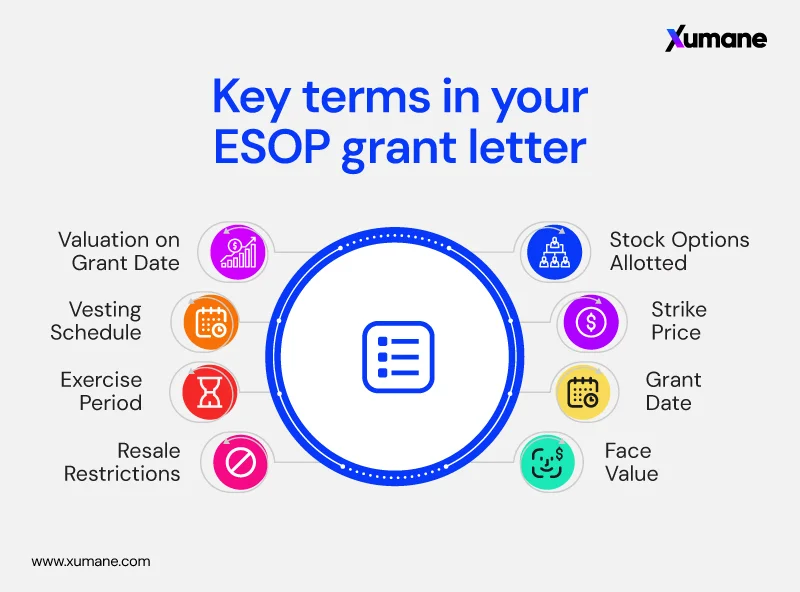
    What most founders miss: an ESOP works as a retention tool only if employees actually understand it. A grant letter full of jargon with no explanation of vesting or tax impact does very little for morale, however generous the number of options looks on paper.

    How to Set Up an ESOP Pool the Right Way

    An ESOP pool is a portion of the company’s equity that founders reserve specifically for employees. Most Indian startups create the pool before a funding round so founders absorb most of the dilution instead of incoming investors. Investors also expect startups to follow this approach.

    • Seed stage: around 10% of fully diluted equity
    • Series A and beyond: 12–15%, and growing further at later stages as senior hires join
    • Approval needed: board resolution plus special resolution from shareholders

    A quick example: if you set a 10% pool pre-Series A and the new investor takes a 25% stake, your pool dilutes proportionally too. Founders often “top up” the pool back to the original target right after the round closes, so there’s enough room for the next 18–24 months of hiring.

    If you’re incorporating your startup and structuring equity at the same time, handle company incorporation and compliance together. This approach lets you build the ESOP pool into your cap table from the start instead of adding it later.

    Vesting Schedule, Cliff, and Exercise Price

    This is where most ESOP confusion lives, both for founders drafting the scheme and employees trying to figure out what they actually own. The standard structure across Indian startups is a 4-year vesting period with a 1-year cliff.

    In simple terms, employees do not receive any vested options during the first 12 months. Leave before that, and the entire grant lapses — this is the cliff, and Indian rules treat one year as the minimum. Cross the cliff, and 25% vests immediately.

    The remaining 75% typically vests monthly or quarterly over the next three years, allowing the employee to become fully vested by month 48.

    Exercise price, explained

    The exercise price (also called strike price) is what an employee pays per share when they exercise vested options — locked in at the Fair Market Value (FMV) on the grant date, determined by a registered valuer. If the company’s FMV rises later, the employee still pays the old, lower price. That gap is the wealth-creation part of the deal.

    • Vested options: employee CAN exercise, hasn’t yet
    • Exercised options: employee has paid and now holds shares
    • Post-termination exercise window: Employees usually have 90 days after leaving the company to exercise their vested options. Most people consider a window of less than 30 days unfair to employees.

    The Legal Documents and MCA Filings You Cannot Skip

    Let’s break this down. An ESOP isn’t a verbal promise or a line in an offer letter — it needs a documented, board-and-shareholder-approved scheme to hold up legally and to survive due diligence at your next funding round.

    • ESOP scheme document: objective, eligibility, pool size, vesting terms, exercise price formula, and what happens on termination or acquisition
    • Board and shareholder resolutions: approving the scheme and each subsequent grant
    • Individual grant letters: signed by company and employee, specifying number of options and vesting schedule
    • File Form SH-6: within 60 days of shareholder approval to disclose the ESOP scheme.
    • Register of Employee Stock Options: maintained by the company for every grant issued

    Founders who skip the SH-6 filing or fail to keep grant letters signed often find out the hard way — during Series A due diligence, when the investor’s legal team flags every gap and stalls the term sheet until it’s fixed.

    How ESOPs Are Taxed in India

    ESOP taxation catches almost every first-time recipient off guard, so it’s worth explaining to your team before they exercise, not after. Tax hits at two separate points.

    At exercise: the difference between the FMV on the exercise date and the exercise price is treated as perquisite income and taxed as salary, at the employee’s slab rate. At sale: any further gain is taxed as capital gains — short-term or long-term depending on the holding period.

    DPIIT-recognised startups get a meaningful exception here: eligible employees can defer the perquisite tax until they sell the shares, leave the company, or five years pass from allotment, whichever comes first. That removes the cash-flow problem of owing tax on shares you haven’t sold yet.

    If your startup qualifies, this deferral is worth building into how you communicate ESOP value at the offer stage — and it’s worth getting your tax filing and compliance sorted around it so neither the company nor the employee gets caught off guard at assessment time.

    Common ESOP Mistakes Founders Make

    A few patterns show up again and again in early-stage Indian startups, and they’re avoidable with a bit of planning upfront.

    • Creating a pool without a hiring plan — leads to either an underused pool or a mid-year restructuring scramble
    • No clawback clause — makes it hard to recover unvested equity when someone exits early
    • Arbitrary exercise price — not backed by a re
    • istered valuer’s FMV report, which creates tax and compliance risk
    • Over-diluting too early — giving away a large pool before the company has proven traction, which complicates future rounds
    • Poor communication — employees who don’t understand vesting or tax rarely value the grant the way founders expect them to

    The upside of getting this right is real: over a dozen Indian startups ran ESOP buybacks in 2025, helping more than 9,200 employees unlock actual wealth from options that were structured, documented, and communicated properly from the start.

    Frequently Asked Questions

    Q: How much equity should a startup set aside for ESOPs in India?

    A: Most Indian startups reserve 10–15% of fully diluted equity for their ESOP pool. Seed-stage companies typically start around 10%, increasing to 12–15% by Series A as leadership hires join. The right number depends on your hiring plan for the next 18–24 months.

    Q: What happens to my ESOP if I leave before one year?

    A: If you leave before completing the one-year cliff, all granted options lapse and you receive nothing. This is standard under Indian ESOP practice and exists to protect the company from granting equity to employees who don’t stay long enough to contribute meaningfully.

    Q: Can the exercise price be changed after the grant is made?

    A: No. The exercise price is fixed at the Fair Market Value on the grant date and cannot be reduced or altered retroactively without triggering tax complications. This is exactly why the exercise price should be based on a formal valuer’s report, not an internal estimate.

    Q: Are ESOPs taxed twice in India?

    A: Yes. Tax applies once at exercise, when the gap between FMV and exercise price is taxed as salary income, and again at sale, when further gains are taxed as capital gains. DPIIT-recognised startups can offer eligible employees a deferral on the exercise-stage tax.

    Q: Do I legally need board approval to grant ESOPs, or can I just issue them informally?

    A: Board approval, and in most cases shareholder approval, is mandatory under Section 62(1)(b) of the Companies Act, 2013. Grants made without proper resolutions and Form SH-6 filings can be challenged later and often surface as red flags during investor due diligence.

    Q: Can promoters or founders receive ESOPs too?

    A: Generally, promoters and directors holding over 10% equity are excluded from ESOP eligibility. DPIIT-recognised startups get an exception for the first 10 years from incorporation, allowing them to grant ESOPs to promoters and directors as well.

    Ready to set up your ESOP the right way?
    Lawizer’s experts handle ESOP scheme drafting, board and shareholder resolutions, and Form SH-6 filing — fully online, starting at just ₹4,999. No CA visit needed.

    Set Up Your ESOP with Lawizer →