
Category: legal basics

  • Shareholders’ Agreement for Startups: 8 Clauses You Cannot Afford to Skip

    Shareholders’ Agreement for Startups: 8 Clauses You Cannot Afford to Skip

    India now has over 1.64 lakh DPIIT-recognised startups — yet most founders spend more time debating their pitch deck font than reading the one document that decides who controls their company when things go wrong. A shareholders’ agreement (SHA) is that document. And a poorly drafted one has ended more promising Indian startups than bad markets ever have.

    Eight clauses. Get them right, and your startup has a rulebook that works for you at every stage — from first hire to first exit

    📌 TL;DR: A shareholders’ agreement (SHA) for startups in India is a private, legally binding contract between company shareholders that governs equity, voting rights, exits, and dispute resolution — separate from the publicly filed Articles of Association (AoA). The 8 non-negotiable SHA clauses include vesting schedules, anti-dilution protection, ROFR, drag-along and tag-along rights, reserved matters, IP ownership, non-compete, and dispute resolution. Lawizer’s legal experts can draft a founder-ready SHA fully online, without a single CA visit.

    What You’ll Learn

    • What a shareholders’ agreement is and why it’s different from your AoA
    • The 8 clauses every Indian startup SHA must include — and what each one actually protects
    • Common mistakes Indian founders make and how courts in India have ruled on SHA disputes
    • What to do before your next funding round to make sure your SHA holds up legally

    What Is a Shareholders’ Agreement — and Why It’s Not the Same as Your AoA

    A Shareholders’ Agreement (SHA) is a private, confidential contract between the shareholders of a company. It’s governed by the Indian Contract Act, 1872, and typically signed after the company is incorporated under the Companies Act, 2013.

    Unlike the Articles of Association (AoA) — which is a public document filed with the Registrar of Companies — the SHA stays between the parties. Nobody outside your shareholder group needs to see it.

    Here’s the thing: the AoA and SHA often overlap, and that overlap can get you into trouble. The Supreme Court of India ruled in V.B. Rangaraj v. V.B. Gopalakrishnan that SHA clauses are only enforceable against the company if they’re also reflected in the AoA.

    In other words, a beautifully drafted SHA that contradicts or isn’t backed up by your AoA can be legally worthless when you need it most. Always ensure both documents are harmonised — this is step one before any investor signs.

    What most founders miss: the SHA isn’t just an investor protection tool. It’s the founders’ rulebook too. It decides how equity is split, who can vote on what, what happens when a co-founder wants to leave, and who gets paid first when the company exits. Skipping it — or copying a template from the internet — is how co-founder disputes become courtroom dramas.

    Clause 1 & 2: Vesting Schedule and Anti-Dilution Protection

    These two clauses do the heavy lifting in every early-stage SHA, and they’re almost always the ones founders regret skipping.

    1)Vesting Schedule
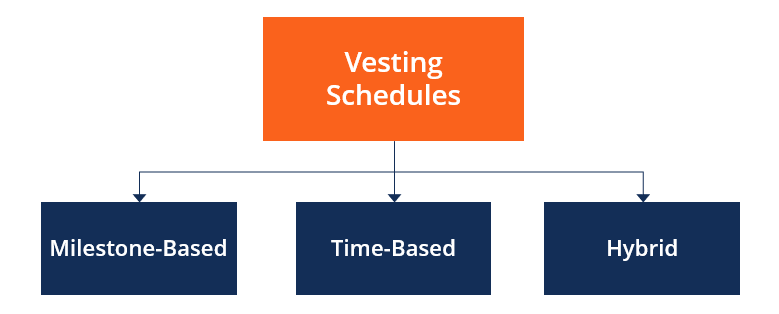
    A vesting schedule is a timeline over which a founder or employee earns their equity. The standard in India’s startup ecosystem is a 4-year vesting period with a 1-year cliff — meaning no equity is earned in the first year, and after that, shares vest monthly or quarterly. If a co-founder leaves in month eight, they walk away with nothing. Without a vesting clause? They keep 100% of their shares and potentially block your next funding round.

    A quick example: two Bengaluru-based SaaS founders split equity 50-50 on Day 1 with no vesting. Six months later, one leaves for a corporate job. The remaining founder has to raise a Series A with a co-founder who’s no longer involved holding half the company. Most investors in India will simply walk away from that table. Vesting prevents this scenario entirely.

    2)Anti-Dilution Protection
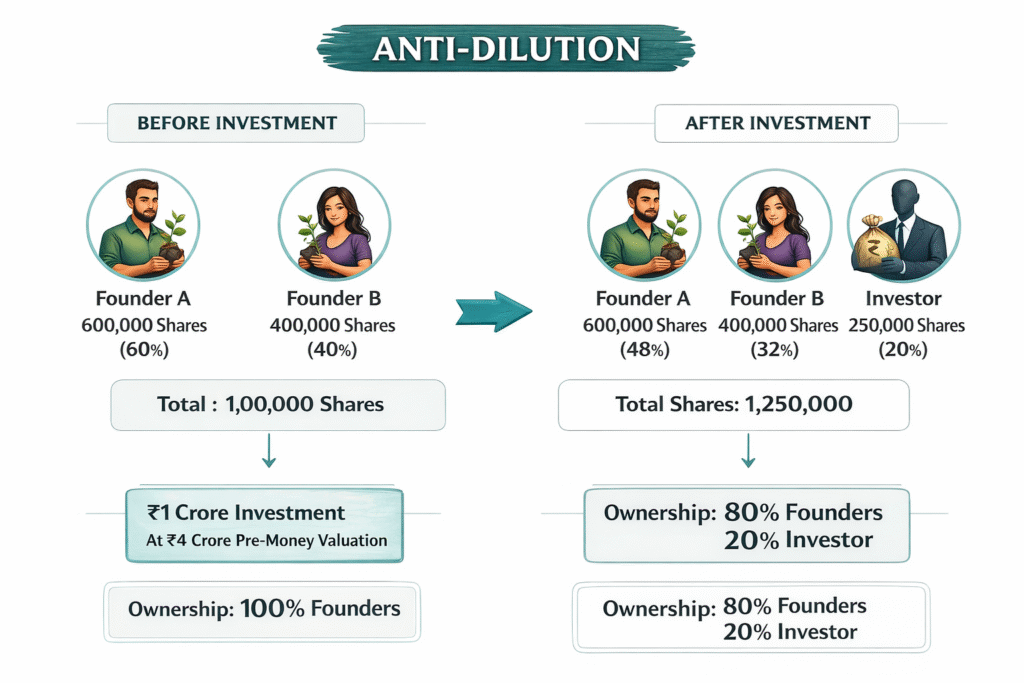
    Anti-dilution clauses protect early investors (and sometimes founders) if the company raises a future round at a lower valuation — what’s called a “down round.” There are two main types: full ratchet (the investor’s price resets entirely to the new lower price — aggressive, investor-friendly) and weighted average (a proportionate adjustment based on the amount of new capital raised — fairer for founders). Always negotiate for weighted average. Full ratchet can wipe out a founder’s stake overnight after one bad quarter.

    Clause 3 & 4: Right of First Refusal (ROFR) and Share Transfer Restrictions

    Imagine waking up to discover that your co-founder sold their stake to a competitor. This isn’t a hypothetical — it’s happened to real Indian startups, and it’s exactly what ROFR and share transfer restrictions are designed to prevent. According to Bridge Counsels’ analysis of Indian SHA disputes, share transfer clauses are among the most heavily negotiated provisions in early-stage agreements.

    Right of First Refusal (ROFR) means that if a shareholder wants to sell their shares, they must first offer them to existing shareholders at the same price being offered by an external buyer. If existing shareholders decline, the seller can go to the third party — but on terms no more favourable than what was offered internally.

    A closely related mechanism, the Right of First Offer (ROFO), flips this slightly: the seller must first approach existing shareholders before even approaching external parties. ROFO is generally more seller-friendly; ROFR is more buyer-friendly. Your SHA should specify which applies, and in what sequence.

    Let’s break this down. Share transfer restrictions serve a second purpose beyond just keeping competitors out: they let you control who becomes a shareholder. New shareholders change the dynamics of board votes, information rights, and exit decisions. Including a clause that requires written consent from existing shareholders (or a defined percentage of them) before any transfer happens is standard practice for any well-structured Indian startup.

    Clause 5 & 6: Drag-Along and Tag-Along Rights

    These two clauses sound similar but protect completely different parties — and both need to be in your SHA
    1)Drag-Along Rights (Investor/Majority Protection)

    A drag-along clause allows majority shareholders (typically investors or founders with large stakes) to force minority shareholders to join in a sale of the company under the same terms. Why does this matter?

    Because if a strategic acquirer wants to buy 100% of your startup, a minority shareholder who refuses to sell can kill the entire deal. Drag-along rights eliminate that veto. They’re standard in Companies Act, 2013-governed private limited companies and are explicitly negotiated in almost every VC-backed Indian startup’s SHA.

    2)Tag-Along Rights (Minority Protection)

    Tag-along rights work in reverse — they protect minority shareholders. If a majority shareholder agrees to sell their stake to a third party, tag-along rights allow minority shareholders to “tag along” and sell their shares on the same terms.

    Without this, a new majority owner could walk in, change the board, and effectively strand early investors or employee shareholders who had no say in the transaction. In Mumbai and Delhi-NCR where PE and VC activity is highest, tag-along clauses are non-negotiable from an investor’s perspective.

    Clause 7: Reserved Matters and Board Governance

    Not every business decision should be made by whoever has the most shares. Reserved matters are a list of decisions that require approval beyond a simple majority — often unanimous consent or a supermajority (say, 75% or more).

    Think of it as a veto list for important decisions. Common reserved matters in Indian startup SHAs include: changes to the AoA, issuing new shares, taking on debt above a specified threshold, acquiring or merging with another company, changing the core business, and winding up the company.

    Board governance clauses go hand in hand with this. Your SHA should clearly specify: how many board seats exist, who appoints them (founders vs. investors), what constitutes a quorum for board meetings, and how decisions are made when there’s a deadlock.

    Speaking of deadlocks — include a deadlock resolution mechanism. “Texas Shoot-Out” (where one party names a price and the other must buy or sell at that price) and “Russian Roulette” provisions are recognised in Indian commercial contracts and give both parties a clean exit from a governance stalemate.

    You can structure your entire startup legal foundation — from incorporation to SHA — online, without ever visiting a CA’s office. Getting the governance structure right from Day 1 saves months of renegotiation later.

    Clause 8: IP Ownership, Non-Compete, and Dispute Resolution

    These three provisions often get lumped into a “miscellaneous” section and under-negotiated. That’s a mistake — especially for tech startups in Bengaluru, Hyderabad, or Chennai where intellectual property (IP) is the company’s primary asset.

    1)IP Ownership

    Every piece of technology, code, brand, design, or process created by founders or employees must be assigned to the company — not remain with the individual. Your SHA should explicitly state this.

    Without a clear IP assignment clause, a departing co-founder could legally claim ownership of the core product they built. If you’re building a tech startup and haven’t yet protected your brand, trademark registration should run parallel to your SHA drafting.

    2)Non-Compete and Non-Solicit

    A non-compete clause restricts departing shareholders from starting or joining a competing business for a defined period (typically 1–2 years after exit). A non-solicit clause prevents them from poaching employees or clients. In a July 2025 ruling — Paul Deepak Rajaratnam & Ors. v. Surgeport Logistics Pvt. Ltd. 

    The Delhi High Court upheld the enforceability of restrictive covenants in SHAs, confirming that interim injunctions can be granted to prevent breaches of non-compete terms under Section 27 of the Indian Contract Act, 1872.

    3)Dispute Resolution

    Litigation in Indian courts is expensive and slow. Almost every well-drafted SHA in India includes an arbitration clause — specifying that disputes will be resolved through private arbitration under the Arbitration and Conciliation Act, 1996, rather than civil court proceedings.

    Specify the seat of arbitration (Mumbai and Delhi are most common), the governing law (Indian law), the number of arbitrators, and the language. This one clause can save years and crores in legal fees if a dispute escalates.

    Frequently Asked Questions

    Q: Is a shareholders’ agreement mandatory for Indian startups?

    A: No, a shareholders’ agreement (SHA) is not mandatory under Indian law. However, it is strongly advisable for any startup with more than one shareholder. Without an SHA, disputes over equity, exits, and governance are governed only by the Articles of Association and the Companies Act, 2013 — which often don’t reflect what founders and investors actually agreed upon verbally or informally.

    Q: What is the difference between an SHA and the Articles of Association in India?

    A: The Articles of Association (AoA) is a public document filed with the Registrar of Companies and governs the company’s internal affairs. The SHA is a private, confidential contract between shareholders that covers rights and obligations in more detail. Under Indian law, any SHA clause that conflicts with the AoA may be unenforceable against the company — which is why lawyers always recommend aligning both documents when drafting an SHA.

    Q: When should a startup sign its shareholders’ agreement?

    A: Ideally, before the first external investment is brought in — or at the time of incorporating the company if there are multiple co-founders. Waiting until the first VC term sheet arrives means you’ll be negotiating SHA terms under time pressure and with far less leverage. The earlier you formalise equity, vesting, and governance, the cleaner your cap table looks to investors.

    Q: Can a shareholders’ agreement override the Companies Act, 2013?

    A: No. An SHA must comply with the Companies Act, 2013, and any provision that contradicts a statutory requirement will be void. For example, the Act sets minimum requirements for holding AGMs, maintaining registers, and filing returns with the MCA — none of these can be contracted away through an SHA. The SHA works within the statutory framework, not around it.

    Q: Does a shareholders’ agreement need to be stamped in India?

    A: Yes. Under applicable stamp laws in India, an SHA must be duly stamped before or at the time of execution to be admissible as evidence in court. Stamp duty rates vary by state — Maharashtra, Karnataka, and Delhi each have different rates. An unstamped or under-stamped SHA can be challenged in legal proceedings, so always stamp it correctly before any party signs.

    Q: What happens if a co-founder leaves without a vesting clause in the SHA?

    A: Without a vesting clause, a departing co-founder retains 100% of their equity regardless of how early they leave. This can make your startup uninvestable — most VC and angel investors in India will not fund a company where a non-contributing ex-founder holds significant equity. Worse, that founder still has shareholder rights, including voting rights and the right to information. A vesting schedule with a cliff period prevents exactly this scenario.

    Ready to protect your startup with a legally sound SHA?
    Lawizer’s experts handle everything — shareholders’ agreement drafting, company incorporation, and trademark registration — fully online, starting at just ₹1,999. No CA visit needed.Get Your Startup Legal Documents Sorted →


  • NDA for Startups: When You Need One, What It Should Say, and What It Can’t Do

    NDA for Startups: When You Need One, What It Should Say, and What It Can’t Do

    NDA for Startups: When You Need One, What It Should Say, and What It Can’t Do

    Every week, somewhere in Bengaluru, Mumbai, or Delhi, a founder shares their product roadmap with a potential investor — without an NDA. Sometimes nothing happens. Sometimes that “investor” builds the same product six months later. An NDA won’t guarantee you never face that situation, but signing one correctly — before the conversation — means you have legal standing if things go wrong. Not signing one means you don’t.

    Here’s the thing: most startup NDAs in India are either never signed, signed too late, or drafted so vaguely they wouldn’t survive a courtroom. This guide fixes all three problems.

    📌 TL;DR: An NDA (Non-Disclosure Agreement) is a legally binding contract under the Indian Contract Act, 1872 that prevents the receiving party from disclosing or misusing your confidential information. For Indian startups, NDAs are essential before sharing details with employees, contractors, vendors, co-founders, or potential investors. A valid NDA must clearly define what counts as confidential, set a reasonable duration, include exclusions, and specify dispute resolution. Critically, an NDA cannot protect information already in the public domain, stop a genuine whistleblower, or substitute for broader IP protection like patents or trademarks. Lawizer can draft a watertight, India-specific NDA for your startup quickly and affordably.

    Legal Checklist for Founders Before ...

    What You’ll Learn

    • What an NDA actually is under Indian law — and the two main types startups use
    • Exactly when your startup needs one, and with whom
    • Every clause a strong, India-specific NDA must include to be enforceable
    • What an NDA legally cannot do — the limits most founders don’t know about
    • Common NDA drafting mistakes that make the agreement worthless in court

    What Is an NDA and How Does It Work Under Indian Law?

    An NDA — Non-Disclosure Agreement — is a legally binding contract between two or more parties that establishes a confidential relationship. The receiving party agrees not to disclose or misuse specific information shared by the disclosing party. In India, NDAs are governed primarily by the Indian Contract Act, 1872 — which means for your NDA to hold up in court, it must satisfy the basic conditions of a valid contract under Section 10: a clear offer and acceptance, lawful consideration (can be a simple promise of mutual benefit), free consent from all parties, and a legal purpose.

    Indian courts do uphold NDAs — but only when the terms are specific, reasonable, and don’t restrain trade. This is where Section 27 of the Indian Contract Act comes in. It prohibits agreements that unreasonably restrain a person’s right to carry on a trade or profession. So an NDA that says “you can never work in fintech again” will likely be struck down. An NDA that says “you cannot share our proprietary payment algorithm with third parties for three years” stands on much firmer ground. The distinction matters enormously when drafting.

    Unilateral vs. Mutual NDA — Which One Does Your Startup Need?

    A unilateral NDA (one-way) binds only one party — typically used when a startup shares information with an employee, contractor, or vendor. A mutual NDA (bilateral) binds both parties — used when two startups are exploring a partnership, merger, or collaboration and both sides are sharing sensitive information. For most early-stage Indian startups, unilateral NDAs cover the majority of situations: hiring, freelancer engagements, vendor negotiations, and early investor conversations.


    When Does Your Startup Actually Need an NDA?

    Not every conversation requires an NDA. But there are specific situations where skipping one is a serious legal risk. Let’s break this down by relationship type.

    Employees and Co-Founders

    Every full-time employee who will have access to your codebase, customer data, pricing models, or business strategy should sign an NDA before or on their first day — ideally as part of their employment agreement. Co-founders are trickier. Many founders assume trust eliminates the need for a formal agreement. What most founders miss: if a co-founder exits and later joins a competitor, a signed NDA is the only instrument that legally prevents them from taking your trade secrets with them. Pair the NDA with a solid founders’ agreement and legal structure from day one.

    Freelancers and Contractors

    A Bengaluru-based startup that hires a Mumbai freelancer to build their MVP is sharing source code, architecture decisions, and possibly user data. NDAs signed with freelancers or contractors in India are legally enforceable if the terms are clear and signed digitally or physically. One important addition: for contractors who are creating work for you, add an IP assignment clause alongside the NDA — clarifying that all work product belongs to your startup. Without it, the contractor could legally retain IP rights to code they wrote for you.

    Vendors and Third-Party Service Providers

    If a vendor — say, a payment gateway integration partner or a data analytics firm — will access your backend systems or customer data, an NDA is necessary. This is also relevant when you’re onboarding accounting firms, HR consultants, or legal advisors who will see sensitive financial information. The NDA in these cases should define exactly what data is being shared, for what purpose, and what happens to it after the engagement ends.

    Investors — With an Important Caveat

    Here’s an honest reality most legal blogs won’t tell you: most early-stage investors — angels and VCs in India — will refuse to sign an NDA at the pitch stage. They receive hundreds of pitches and signing individual NDAs for each creates legal liability. Pushing for an NDA before a first meeting can signal inexperience and may cost you the conversation. The practical approach: share only what you’re comfortable making public at the pitch stage, keep your “secret sauce” out of the first deck, and introduce an NDA once due diligence begins and a term sheet is on the table.

    Legal Compliances for Startups in India ...

    What a Strong NDA Must Include: Clause by Clause

    A vague NDA is nearly useless. Indian courts have struck down confidentiality agreements where terms were ambiguous, the duration was unreasonable, or the definition of confidential information was too broad to be meaningful. Here is every clause your NDA needs to be enforceable.

    1. Identification of Parties
    State the full legal names and addresses of both the Disclosing Party (your startup) and the Receiving Party. If your startup is a Private Limited Company, use the exact registered name as it appears in your Certificate of Incorporation. Mismatches between the NDA and your company registration documents create grounds for challenging enforceability.

    2. Definition of Confidential Information
    This is the most critical clause — and the one most often drafted poorly. A good definition should include: business plans and financial projections, software source code and technical architecture, customer and vendor lists, proprietary processes and formulas, and marketing strategies. Specify how information can be marked as confidential — in writing, verbally (confirmed in writing within 30 days), or by its nature. If it isn’t defined, it isn’t protected.

    3. Exclusions from Confidentiality
    Every enforceable Indian NDA must list what is not covered: information already in the public domain through no fault of the receiving party; information the receiving party already knew before signing; information independently developed by the receiving party; information received from a third party without restriction; and information that must be disclosed under a court order or law. These exclusions are what make the NDA reasonable.

    4. Obligations of the Receiving Party
    Specify what the receiving party must do: keep the information confidential, use it only for the agreed purpose, limit internal access to those who need to know, and apply the same standard of care they would use to protect their own confidential information. For tech startups, also prohibit reverse engineering or using the information to develop a competing product.

    5. Duration
    The standard duration for most startup NDAs is 2 to 5 years. For trade secrets specifically, you can specify that confidentiality obligations survive “for as long as the information remains a trade secret.” Keep this distinction explicit in the agreement.

    6. Consequences of Breach and Dispute Resolution
    Include the right to seek an injunction, monetary damages, and recovery of legal costs. Include an arbitration clause — governed by the Arbitration and Conciliation Act, 1996 — which is faster and more private than going to court.

    7. Governing Law and Jurisdiction
    Specify that the agreement is governed by the laws of India, and name the specific city where disputes will be adjudicated. Also ensure that digital signatures are treated as valid execution under the IT Act, 2000.


    What an NDA Cannot Do — The Limits Founders Must Understand

    This is the section most NDA guides skip. An NDA is a powerful tool — but treating it as a complete shield is a dangerous mistake.

    • It cannot protect information already public. Once information is in the public domain, an NDA cannot put it back. Courts will not enforce confidentiality over publicly accessible information.
    • It cannot stop a genuine whistleblower. If an employee discloses information to expose fraud or illegal activity within your startup, Indian law protects that disclosure. An NDA clause attempting to silence a whistleblower will be unenforceable.
    • It cannot replace a patent, trademark, or copyright. An NDA protects confidential information between specific parties. It does not give you ownership over an invention, brand, or creative work. Trademark and patent registrations are separate instruments — and the strongest protection combines both.
    • It cannot prevent someone from using general skills and knowledge. Your ex-CTO can go work at a competing startup. What they cannot do is take your specific codebase or client list with them.
    • It cannot protect what you failed to keep secret internally. Courts have declined to enforce NDAs where the startup had poor internal data controls — no access restrictions, unencrypted storage, or unrestricted internal sharing of the “confidential” information.

    Common NDA Mistakes Indian Startups Make

    • Signing after the conversation: An NDA only covers information shared after it is signed. Always execute the NDA before any sensitive disclosure.
    • Using a generic international template: A US or UK NDA template may not align with the Indian Contract Act, the Specific Relief Act, 1963, or the IT Act, 2000. Jurisdiction clauses, consideration structures, and enforcement mechanisms differ significantly.
    • Confusing NDA with non-compete: An NDA restricts disclosure. A non-compete restricts who someone can work for. Post-employment non-compete clauses are extremely difficult to enforce under Indian law. Don’t bundle them into your NDA expecting the non-compete to hold.
    • No return or destruction clause: When an employee leaves or a contractor’s engagement ends, your NDA should specify that all confidential materials — including digital copies — must be returned or destroyed.

    Frequently Asked Questions

    Q: Is an NDA legally enforceable in India?
    Yes, NDAs are legally enforceable in India under the Indian Contract Act, 1872, the Specific Relief Act, 1963, and — in cases involving digital data — the IT Act, 2000. Courts uphold NDAs when the terms are specific, the duration is reasonable, and the agreement does not unreasonably restrain trade under Section 27. Vague definitions of confidential information and overly broad restrictions are the most common reasons Indian courts decline to enforce an NDA.

    Q: Should I ask investors to sign an NDA before my pitch?
    In most cases, no — not at the very first meeting. Early-stage investors in India typically decline to sign NDAs at the pitch stage because they review hundreds of decks across similar sectors. The practical approach is to share only high-level information in the initial pitch, reserve proprietary details for due diligence, and introduce a mutual NDA once a term sheet or letter of intent is on the table.

    Q: Can I use a digital signature on an NDA in India?
    Yes. Digital signatures are legally valid for NDAs in India under the IT Act, 2000. A digitally signed NDA carries the same legal weight as a physically signed one, provided the signature is applied through a recognized e-signature platform. The NDA should explicitly state that electronic execution is valid and binding, and platforms using a Digital Signature Certificate (DSC) provide an audit trail useful in any future dispute.

    Q: How long should an NDA last for a startup in India?
    For most startup relationships — contractors, vendors, early employees — a duration of 2 to 5 years is standard and likely to be upheld by Indian courts. For trade secrets, you can specify that confidentiality obligations last “for as long as the information remains a trade secret.” Indefinite NDAs covering general business information are viewed with suspicion by courts and should be avoided.

    Q: Does an NDA protect my startup idea from being stolen?
    An NDA protects specific confidential information shared with a named party — it does not protect an idea in the abstract. Under Indian law, ideas alone cannot be patented or fully protected; only their concrete implementation can be. If a third party independently develops the same idea without access to your confidential information, an NDA gives you no claim against them. For stronger protection, pair an NDA with appropriate IP registration such as a patent or trademark.

    Q: What happens if someone breaches an NDA in India?
    You have two primary legal remedies. First, you can seek an injunction under the Specific Relief Act, 1963 — a court order directing the other party to stop the disclosure or use of your confidential information. Indian courts are generally quicker to grant injunctions than to award damages, making this the more immediate remedy. Second, you can sue for monetary damages. Including a pre-agreed penalty clause in your NDA and an arbitration clause speeds up the entire process significantly.


    Ready to protect your startup’s confidential information?
    Lawizer’s legal experts draft India-specific NDAs, employment confidentiality agreements, and full startup legal packages — fully online, starting at just ₹999. No CA visit, no lengthy back-and-forth.
    Get Your Startup NDA Drafted by Lawizer → lawizer.com/startup-businesslegal