Category: Legal Education

  • Employment Agreement in India: What Employers and Employees Must Know

    Employment Agreement in India: What Employers and Employees Must Know

    Introduction

    The foundation of any successful professional relationship is clarity. Whether you are a fast-growing startup bringing on your first hire or a seasoned professional evaluating a new job offer, the employment agreement is the most critical document you will handle.

    It dictates not just what you do and how much you get paid, but also your rights, obligations, and protections under Indian labour laws.

    A poorly drafted employment contract can lead to costly legal disputes, unprotected intellectual property, or unfair working conditions.

    In this comprehensive guide, we will break down everything both employers and employees need to know about employment agreements in India, including the legality of restrictive clauses, IP ownership, and how to ensure your contracts are airtight.

    We shall also discuss about Lawizer, a legal-tech platform that simplifies this process through expert legal support and technology-driven solutions.


    Is a Written Employment Agreement Legally Mandatory in India?

    Under the Indian Contract Act, 1872, a contract can technically be oral or written. However, in employment, an oral agreement is highly risky and practically unenforceable.

    Various state-specific Shops and Establishments Acts require employers to provide a formal appointment letter or written contract to employees.

    Therefore, despite central law allowing oral agreements, a written employment contract is essential for compliance, clarity, and legal protection.


    Essential Clauses Every Employment Agreement Needs

    A well-drafted employment agreement must clearly define all key terms to avoid disputes.

    • Designation and Scope of Work: Defines job role, reporting structure, and responsibilities.
    • Compensation and CTC Breakdown: Includes salary structure, allowances, deductions, and bonuses.
    • Probation Period: Typically 3–6 months with different notice terms.
    • Notice Period and Termination: Specifies exit terms and grounds for termination.
    • Leave Policy: Covers earned, sick, and casual leaves as per state laws.

    Restrictive Clauses: Non-Compete and Non-Solicitation

    Restrictive clauses protect business interests but must comply with Indian law.

    • Non-Compete Clauses: Post-employment non-competes are generally unenforceable under Section 27 of the Indian Contract Act. However, restrictions during employment are valid.
    • Non-Solicitation Clauses: Prevent employees from poaching clients or staff and are enforceable if reasonable.

    ESOP Provisions and Vesting Schedules

    Employee Stock Option Plans (ESOPs) are common in startups and must be clearly defined.

    • Grant: Number of options offered.
    • Vesting Schedule: Typically includes a 1-year cliff followed by phased vesting.
    • Exercise Price: Cost to convert options into shares.
    • Exit Conditions: Treatment of options on resignation or termination.

    IP Ownership and Moonlighting Rules

    Intellectual Property (IP)

    Employment contracts must include a Work for Hire and IP assignment clause to ensure all work created belongs to the employer.

    Moonlighting

    Dual employment is restricted under several Indian laws. Employers should include an Exclusivity Clause to prevent unauthorized secondary work.


    What Employees Must Check Before Signing

    1. Notice Period Symmetry: Ensure fairness for both parties.
    2. Hidden Salary Conditions: Verify bonus and performance-linked pay.
    3. Bond Clauses: Check for repayment obligations and ensure reasonableness.

    Draft Compliant Employment Agreements with Lawizer

    Using generic templates can lead to legal risks and unenforceable clauses.

    Lawizer helps businesses create legally compliant and customized employment agreements.

    Why Choose Lawizer?

    • State-Specific Compliance
    • Industry-Based Customization
    • Legally Enforceable Clauses
    • Fast Turnaround
    • Emergency Legal Support
    • Free Consultation
    • Transparent Pricing

    Secure your workforce with legally sound employment agreements today.


    Conclusion

    An employment agreement is the legal foundation of any professional relationship.

    For employers, it safeguards business interests and intellectual property. For employees, it ensures clarity, rights, and job security.

    With proper legal drafting and expert guidance, both parties can avoid disputes and build a transparent working relationship.


    Frequently Asked Questions

    Can an employer terminate an employee without notice?

    A: Yes, but only in cases of serious misconduct. Otherwise, notice or payment in lieu is required.

    Are employment bonds valid in India?

    A: They are enforceable only if reasonable and backed by actual training costs.

    What if I refuse to sign an employment agreement?

    A: Employers may withdraw the offer or initiate termination if terms are not accepted.

    Are digital signatures valid?

    A: Yes, under the Information Technology Act, 2000.

    Can employers change contract terms unilaterally?

    A: No, changes require mutual consent.

    What is Lawizer?

    A: Lawizer is a legal-tech platform that simplifies legal documentation and assistance.

    Is Lawizer legitimate?

    A: Yes, it is a reliable and technology-driven legal platform.

    Is Lawizer a law firm?

    A: No, it is a legal-tech platform, not a traditional law firm.
  • SECOND MARRIAGE REGISTRATION IN INDIA: PROCEUDURE & DOCUMENTS (2025)

    SECOND MARRIAGE REGISTRATION IN INDIA: PROCEUDURE & DOCUMENTS (2025)

    Introduction:

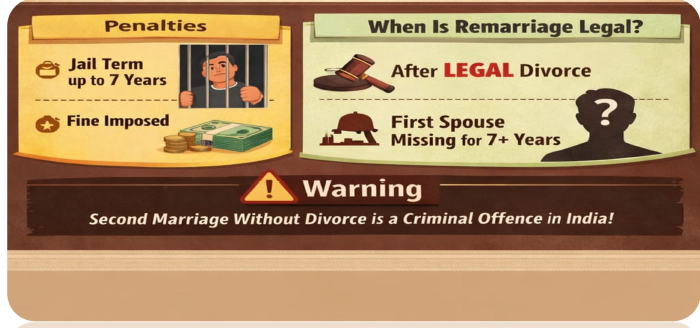
    A Second Marriage in India refers to the marriage which is being contracted by a person which has been lawfully dissolved or either the husband or wife has died.

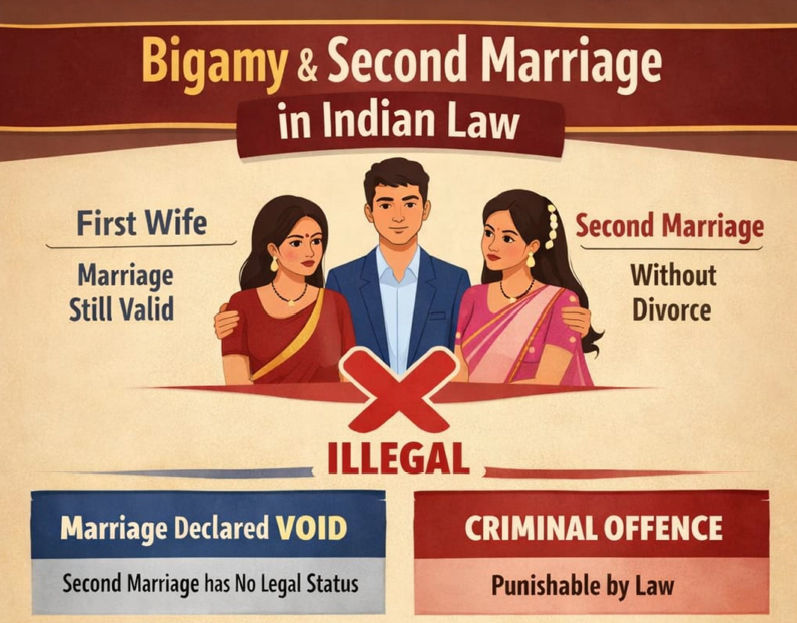
    Otherwise the second marriage would be held void or it may condemn a criminal liability. This provision comes under the Hindu Marriage Act, 1955.

    Registration Procedure For Second Marriage:

    • The First marriage has to be lawfully ended which is mandatory eligibility criteria for this procedure.
    • The intended party must submit an affidavit which clarifies that the previous marriage has been dissolved.
    • An application is mandatory to be filed with the Marriage Registrar or local Sub-Registrar Office
    • Verification is required by the registrar who will act as a conclusive proof towards the marriage.
    • For the verification purpose some necessary documents are required such as identity proof, proof of the previous marriage to be dissolved (certificate),passport size photo

    Applicability Of Second Marriage Under Special Marriage Act, 1954:

    Penalties of Remarriage & its legalities
    Penalties of Remarriage & its legalities
    • Both the parties have free will to marry under this act only if the previous marriage has been dissolved or lawfully ended.
    • A 30 Day notice period is required as per the act for registration purpose.

    Common Legal Issues:

    1) If the First marriage is in subsistence then the second marriage would be
    condemned to void under the Hindu Marriage Act, 1954.
    2) If the intended party fails to provide previous marriage valid divorce
    certificate or death certificate that it can lead to major issues towards legal
    disputes.
    3) The parties should have proper consent towards each other mutual decision otherwise it creates procedural irregularities.
    4) In aspect of the child inheritance there have been major issues from the
    second marriage.
    5) While registration procedure there have been many a times legal Compliance issue or delays in documentation process.

    Recent Judgement Passed On Kerala High Court:

    A Muslim man had fallen in love with other women while being in
    existence of his first marriage. He claimed for a plea stating that he married
    for the second time only with the consent of his first wife.

    The court said that the marriage registration officer can hear and will let the Muslim women give an opportunity of hearing when the husband re marry.

    Later on the plea was dismissed.
    This clarifies that the second marriage is not invalid only if the legal
    requirement of the first marriage is being dissolved.

    Documentation Required For Second Marriage Registration:

    • ID/Adhere proofs.
    • Previous Divorce Decree/Death Certificate.
    • Address proof.
    • An Affidavit which states about the previous marriage decree or dissolution of marriage.
    • Three Witnesses (If the marriage is being solemnized Under Special Marriage Act,1954)

    Conclusion:

    Thus we conclude that the procedure for registration for Second Marriage Act which comes under the Hindu Marriage Act strictly restrict if first marriage is in existence, it will claim to be void and a criminal act.

    The law is abide by it rule and it does not overpower it though its strict legislative procedure it protects and creates liability towards the society so that there must be no issues of child inheritance or bigamy.

    This act is abiding by to protect its dignity to the overall aspect of marriage and makes a clear understanding that are sought for clarity.

    Remarriage comes with specific legal prerequisites regarding divorce decrees or death certificates of previous spouses. Ensure your new union is legally valid and fully compliant with Indian laws by consulting our specialists. Consult on Remarriage Laws with India’s top lawyers.

    Frequently Asked Questions:

    Q1. Does the registrar verify or check the documents?

    Yes, rigorous verification is mandatory. For a second marriage, the verification process is stricter than for a first marriage. The Marriage Officer (or Sub-Registrar) is legally obligated to verify the eligibility of both parties to ensure no fraud or bigamy is being committed. They specifically check:
    The Death Certificate of the previous spouse (if widowed).
    The Decree of Divorce (if divorced) to ensure the appeal period has passed.
    Age and identity proofs.

    Q2. To whom are the affidavits needed to be submitted?

    The affidavits must be submitted to the Marriage Registrar or the Sub-Divisional Magistrate (SDM) of the district where you are applying. Both parties must file separate affidavits stating:
    Current Marital Status (e.g., “Divorcee” or “Widower”).
    Date of the previous marriage’s dissolution (Death or Divorce).
    A declaration that they are not related to each other within the “prohibited degree of relationship.”

    Q3. Is it obligatory to end the first marriage in order to for
    first marriage?

    Absolutely Yes. Under Indian laws (Section 5(i) of the Hindu Marriage Act and Section 4(a) of the Special Marriage Act), a second marriage is legal only if the first marriage is dissolved.
    If you marry without a legal divorce or death certificate, the second marriage is Void (invalid) ab initio.
    You can also be prosecuted for Bigamy (Section 494 IPC), which carries a prison sentence of up to 7 years. Mere separation is not enough; a court decree is mandatory.

  • SPECIAL MARRIAGE ACT 1954: A STEP-BY-STEP REGISTRATION GUIDE FOR COUPLES

    SPECIAL MARRIAGE ACT 1954: A STEP-BY-STEP REGISTRATION GUIDE FOR COUPLES

    Introduction:

    In Indian Society, Marriage holds a sacred place and the Special Marriage Act promotes a framework how individual can marry through a civil procedure which is irrespective of religion, caste or creed.

    The Act permits individuals to marry outside their faith by laying down conditions relating to age, eligibility, soundness of mind and safeguarding towards the individual rights.

    Moreover, the Act creates certain complexities; it actively drives progressive social change by encouraging inter-caste and inter-faith marriages.

    Evolution and legislative Framework:

    The Legislature enacted this provision in newly independent India to establish an effective legislative framework.

    The Special Marriage act, 1954 was intended to regulate a special type of marriage by though a compulsory registration and certification which is an essential aspect in order to legalize the aspect of marriage.

    This act is applicable to all the Indian whether they live in India or outside.


    Basic Requirements For Registration:

    1) Both the parties must be Indian Citizen
    2) The parties must be in full consent of the marriage
    3) If any of the parties had an n earlier marriage then it has to been legally dissolved.
    4) The age limit of the male should be 21years and female should be at least eighteen years.

    5) The marriage is too solemnized in front of the marriage officer and three witnesses.
    6) Should have a copy for marriage notice book.

    Special Marriage Act
    Special Marriage Act

    Special Marriage Act Procedure:

    Why Does Registration Of Marriage Matter So Much Under The Special Marriage Act?

    This is an eminent step towards entering in to recognition of registration of the marriage which also symbolizes as secure and protection towards the couple.

    An application will be duly mandatory for both the parties in order to refrain from any objections of marriage.

    A marriage officer will be appointed and will give a notice period of 30 days as a mandatory enquiry.

    Now, within this period if any issue arises from any of the parties , then the marriage cannot be solemnized and therefore it might led to for an enquiry which will be conducted by the marriage officer.


    Legal Problems That Are Being Faced Under This Provision:

    1) This act compels both the parties to wait for the Mandatory one month notice period for any objection as per mentioned in section 5 of the act.

    The problem that arises is that the law provides an intimation of the parties which sometimes led to violation of privacy as the notice will be displayed publicly outside the Marriage Officers.

    Under such circumstances, this can lead to the individual’s life jeopardized and harm personal liberty.

    2) Another important issue that arises as per section 7 that any person may object before the expiration of thirty days’ notice period.

    This sometimes led to confusions, societal pressure which might cause insufficient and weak towards the existing protection. This creates a negative aspect to the socio culture belief leading to emotional coercion.

    3) Special Marriage acts aims to provide with a vision of secular marriage so that through this act so it does not create tension between the individual.

    However, a substantial segment of the population is unaware of the measures which lead to socio cultural oppression.

    4) Procedural regulation is often delayed which causes objections, regulations, lack of uniformity, harassment to both the intended parties.

    5) Last but not the least due to issuance of the notice of 30 days period publicly creates an objection towards infringement of Right to Privacy under article 21 of Constitution , were the disclosure of personal information such data of the individuals breaks the limits provided in section 5 and 7.


    Recent Legal Issues:


    FORGERY OF THE CERTIFICATE: Recently, in Allahabad High Court passed an
    order stating that a marriage which is being held under this act is only valid if there is no unlawful conversion of certificate.

    If one of the intended parties illegally found in conversion of certificate then the marriage will not be held valid.

    PIL FILLED AGAINST 30 DAYS NOTICE PERIOD: A Public Interest litigation
    was filled under Special Marriage Act, 1954 stating that the parties who intended to marry must obey the one month notice before solemnizing the marriage.

    This PIL was filled in Supreme Court, 2020. Later on the Petition was heard and dismissed as they found no such reason to be discussed upon.

    However, in April 2023 D Y CHANDRACHUD confronted and stated about the Provision to be “Patriarchal”.

    The major concern about this notice is that it raises a regime to privacy infringement and safety concern of the couple which are being exposed to public officially during the 30 days period.


    Conclusion:


    As we reach the end, we can conclude that The Special Marriage Act provides an exhaustive details relating the institution of marriage, promotes secular and empowers the people to believe in inter- caste and inter – faith marriages but also lacks in procedural segments that undermines privacy, safety and personal wellbeing to the individual parties.

    Planning an inter-faith or civil marriage? Don’t let bureaucratic hurdles delay your special day. We assist couples with document verification and the 30-day notice period to ensure a hassle-free registry marriage.

    Simplify Your Marriage Registration:

    Frequently Asked Questions:


    Q`1. Why does 30 days notice period is considered so essential and does it affect to an individual privacy?

    When the Special Marriage Act was enacted in 1954, the lawmakers intended to create a secular law for inter-faith or inter-caste couples. The 30-day notice (under Section 5 and 6) was designed as a public fraud-check mechanism.
    Public Scrutiny: The law requires the Marriage Officer to display a notice containing the couple’s names, addresses, photos, and occupation on a public board for 30 days.
    Inviting Objections: The purpose is to allow anyone to object if the marriage violates the law. The specific grounds for objection are:
    Bigamy: If one party is already married.
    Prohibited Relationship: If the parties are related by blood (incest).
    Age: If the groom is under 21 or the bride is under 18.
    Unsound Mind: If one party is mentally unfit to consent.

    Q2. How does this act provides protection and privacy to the couples?

    The Special Marriage Act (SMA) primarily protects couples by allowing them to marry without religious conversion, preserving their individual identities.
    It serves as a secular legal shield that overrides family objections and validates inter-faith unions.
    Regarding privacy, while the original law required a 30-day public notice, recent
    High Court rulings (like Safiya Sultana) have held that couples can opt out of this display to prevent harassment.
    Additionally, an SMA application acts as legal proof to secure immediate police protection and access to safe houses if the couple faces threats of violence.

    Q3. How procedural lapses causes unnecessary delays in this
    provision?

    Procedural lapses primarily stem from bureaucratic overreach. Marriage Officers sometimes demand documents not required by law (like parental no-objection certificates) or delay the process to investigate frivolous objections raised by the public under Section 8.
    Since the Act mandates an inquiry for every objection, a simple administrative lapse or a false claim can pause the marriage for an additional 30 days.
    Furthermore, minor clerical errors in the Notice of Intended Marriage often force couples to restart the entire notice period.

  • INDIAN CRIMINAL JURISPUDENCE

    INDIAN CRIMINAL JURISPUDENCE

    What is the criminal Law in India?

    From the antiquity the Indian society has always been governed by specific set of law like the i.e. Harappan Civilization but it differs in terms of its regulations from time to time

    Ancient:

    In the ancient times laws were often linked with divine origin for their validation it was often unjust and biased but people did not have enough exposure to rectify the problems.

    There was altogether no uniform system and religious text use to guide the citizens. Dharma which prescribed the moral and legal duty. Manusmriti, Arthashastra.

    Crime was seen as adharma. And the criminal procedures were often conducted in royal courts and by royal officers.

    Medieval:

    Things started to become complex with the advent of monarchial rule being established because this time the last verdict was not rational but the decision of the king.

    More often the monarch tried to provide their subject justice but not always it was carried out. The punishments were also arbitrary and with no mercy considered.

    Pre Independence Era:

    With the inception of the British colony in India and overthrow existing norms they tried to impose their form of law on our society as there was not uniform law whatsoever with the regional difference taken in account.

    Under the law commission of British India headed by lord Thomas Babington Macaulay the first uniform legal codes were enacted through governor general Lord canning in 1860 the Indian Penal Code, Criminal Procedure code and the Indian Evidence act.

    As been mentioned previously law in India was followed in accordance with the divinity, to make things more systematic the British enforced these laws.

    Post Independence:

    Even after independence the government of the countries restructured the pre-established law according to our country and enforced it only.

    Contemporary Situations:

    The situations change altogether, as to remove all the leftovers of the British government the old criminal laws were replaced with the new ones in 2023. IPC was changed into Bharatiya Nyaya Sanhita

    CrPC was replaced with Bharatiya Nagarik Suraksha Sanhita, further the Indian evidence act was replaced with Bhartiya sakshya adhiniyam to deal with the changing and diverse society of ours.

    IPC:

    IPC refers to as Indian Penal Code. That came in effect in 1860 under the British raj the main purpose of introduction of this particular law was to prevail a unifying criminal justice system.

    IPC is enacted when the crime is already committed and the offender is already been convicted in the judicial process.

    It was drafted by the first Law commission of India (1834) which was headed and chaired by lord Thomas Babington Macaulay, and it was enforced by governor general lord canning.

    Even after partition both of the country’s government took its form of IPC, restructured and modified according to their country. After serving the country till 2023 with 511 section and 23 chapter it was finally replaced with BNS.

    CrPC:

    The Code of Criminal Procedure, commonly called Criminal Procedure Code (CrPC), was the main legislation on procedure for administration of substantive criminal law in India.

    It was enacted in 1973 and came into force on 1 April 1974.

    It provides the machinery for the investigation of crime, apprehension of suspected criminals, collection of evidence, determination of guilt or innocence of the accused person and the determination of punishment of the guilty.

    It also deals with public nuisance, prevention of offences and maintenance of wife, child and parents.

    On 11 August 2023, a Bill to replace the CrPC with the Bharatiya Nagarik Suraksha Sanhita (BNSS) was introduced in the Lok Sabha. On 26 December 2023, it was replaced with Bharatiya Nagarik Suraksha Sanhita (BNSS).

    IEA:

    The Indian Evidence Act, originally passed in India by the Imperial Legislative Council in 1872 during the British Raj, contains a set of rules and related provisions governing the admissibility of evidence in Indian courts of law.

    The India Evidence Act was replaced by the Bharatiya Sakshya Adhiniyam on 1 July 2024.

    The enactment and adoption of the Indian Evidence Act was a significant development in India, transforming the system of rules regarding the admissibility of evidence in Indian courts of law.

    Until then, the rules of evidence were based on the traditional legal systems of different social groups and communities of India and were different for different people depending on caste, community, faith and social position.

    The Indian Evidence Act introduced a standard set of law applicable to all Indians.

    The law is mainly based upon the firm work by Sir James Fitzjames Stephen, who could be called the founding father of this comprehensive piece of legislation.

    In some Islamic-majority legal systems, such as Palestinian law and Iranian law, commercial law still well into the 21st century, relies heavily on testimonial evidence or customary law, rather than documentary evidence.

    The New Criminal Law:

    BNS:

    The Bharatiya Nyaya Sanhita (BNS), 2023 (Bhartiya Nyaya Sanhita Indian Justice Code (IJC), 2023) is the new criminal code of India. It came into effect on 01 July 2024, after being passed by the Parliament in December 2023, replacing the colonial-era Indian Penal Code of 1860 (IPC).

    In the BNS, 20 new offences have been added to and 19 provisions in the repealed IPC have been dropped.

    The punishment of imprisonment has been increased for 33 offences, and fines have been increased for 83 offences.

    A mandatory minimum punishment has been introduced for 23 offences. A sentence of community service has been introduced for six offences.

    • Offences against the body: The BNS retains the provisions of the IPC on murder, abetment of suicide, assault and causing grievous hurt. It adds new offences such as organized crime, terrorism, and murder or grievous hurt by a group on certain grounds.
    • Sexual offences against women: The BNS retains the provisions of the IPC on rape, voyeurism, stalking and insulting the modesty of a woman. It increases the threshold for the victim to be classified as an adult, in the case of gang rape, from 16 to 18 years of age.
    • Offences against property: The BNS retains the provisions of the IPC on theft, robbery, burglary and cheating. It adds new offences such as cybercrime and financial fraud.
    • Offences against the state: The BNS removes sedition as an offence. Instead, there is a new offence for acts endangering India’s sovereignty, unity and integrity.
    • Offences against the public: The BNS adds new offences such as environmental pollution and human trafficking.

    BNSS:

    The Bharatiya Nagarik Suraksha Sanhita (BNSS), 2023 (Bhartiya Nagarik Suraksha Sanhita Indian Citizen Safety Code (ICSC), 2023), is the main legislation on procedure for administration of substantive criminal law in India

    Consolidating and simplifying the law: The BNSS consolidates and simplifies the law by repealing and amending a number of provisions of the CrPC.

    Strengthening the rights of the accused: The BNSS strengthens the rights of the accused by providing for safeguards, such as the right to a lawyer of choice during interrogation, though not throughout the interrogation, and the right to a fair trial.

    Every police officer or other person arresting any person without warrant shall forthwith communicate to him full particulars of the offence for which he is arrested or other grounds for such arrest.

    When any person is arrested, he shall be examined by a medical officer in the service of the Central Government or a State Government, and in case the medical officer is not available, by a registered medical practitioner soon after the arrest is made.

    Improving the efficiency of the criminal justice system: The BNSS seeks to improve the efficiency of the criminal justice system by streamlining procedures and reducing delays.

    The following are some of the key changes made in the BNSS:

    Arrest: The BNSS expands the grounds for arrest and allows for arrest without a warrant in a wider range of cases.

    Investigation: The BNSS gives the police more powers to investigate crimes and requires them to complete investigations within a specified time period.

    Trial: The BNSS streamlines the trial process and requires courts to dispose of cases within a specified time period.

    BSA:

    The Bharatiya Sakshya Adhiniyam (BSA), 2023 Bhartiya Saskya Adhiniyam Indian Evidence Act (IEA), 2023) is an Act of the Parliament of India.

  • WHAT IS CRIMINAL LAW? A COMPLETE GUIDE

    WHAT IS CRIMINAL LAW? A COMPLETE GUIDE

    Introduction

    Criminal law is a branch of law that deals with crimes, punishment, and the legal procedures used to prosecute individuals accused of committing offences. It is designed to protect society by defining actions that are considered harmful or dangerous and prescribing penalties for those who violate these rules.

    Criminal law helps maintain public order, safety, and justice by ensuring that individuals who commit offences face legal consequences through established judicial processes.


    What Is Criminal Law?

    Criminal law refers to a body of rules and regulations that define criminal offences and prescribe punishments for those who commit them.

    Activities that harm individuals, threaten public safety, or endanger society are classified as crimes. When such laws are violated, the offender may face penalties such as fines, imprisonment, or in extreme cases, the death penalty.

    In most democratic countries, including India, criminal laws are created and enforced through a structured system involving different branches of government.

    • Legislature: Enacts laws by passing legislation.
    • Executive: Enforces the laws through police and administrative authorities.
    • Judiciary: Interprets the law and delivers justice when violations occur.

    Theories of Punishment in Criminal Law

    Various theories explain the purpose and justification of punishment within criminal law. Some of the major theories include:

    Retributive Theory of Justice

    The retributive theory is based on the concept of “an eye for an eye.” In ancient societies, the punishment given to an offender often mirrored the harm caused by the crime. Although historically common, this approach is considered harsh and less acceptable in modern legal systems.

    Preventive Theory of Justice

    The preventive theory focuses on preventing future crimes by restricting or incapacitating the offender. In earlier societies, offenders were often isolated or removed from the community to protect the rest of the population.

    Deterrent Theory of Justice

    The deterrent theory aims to discourage crime by imposing strict and severe punishments. The idea is that harsh consequences will discourage both the offender and others from committing similar crimes in the future.

    Reformative Theory of Justice

    The reformative theory emphasizes rehabilitation rather than punishment. It seeks to reform offenders by providing opportunities for education, counseling, and social reintegration. This theory is widely accepted in modern criminal justice systems.


    History of Criminal Law

    The criminal law system we see today developed gradually over centuries and was not present in early human societies.

    In primitive civilizations, there was little distinction between civil and criminal matters. Societies were largely nomadic and lacked structured governance. Disputes and crimes were often resolved through direct retaliation.

    The first known codified legal systems appeared in ancient Mesopotamian civilizations. Although these laws were strict and sometimes unequal due to class distinctions, they represented an early attempt to regulate social conduct.

    In the Indian subcontinent, early legal frameworks can be traced back to around 200 BCE through texts such as Manusmriti and Kautilya’s Arthashastra during the Mauryan Empire.

    Later, Greek and Roman civilizations made significant contributions to legal development. They introduced formal judicial procedures, state-administered justice, and important legal concepts such as mens rea (the intention behind committing a crime).

    Roman law greatly influenced modern legal systems by clearly distinguishing between criminal offences and civil wrongs while promoting principles like the presumption of innocence and fair trials.

    During the medieval period, legal systems in many regions became harsh and arbitrary under monarchic rule, often involving severe punishments and torture.

    With the emergence of the modern era, legal systems began to focus more on rational governance, human behavior, and the rule of law. Arbitrary state power was gradually restricted, and structured legal institutions were established.

    During colonial periods, many colonial powers imposed their own legal codes in occupied territories. After gaining independence, many nations reformed or restructured these laws to better suit their social, cultural, and constitutional frameworks.

    Today, criminal law continues to evolve as societies change, with increasing emphasis on fairness, human rights, and rehabilitation.


    Conclusion

    Understanding criminal law is essential for recognizing how societies maintain order and justice. The evolution of criminal law reflects humanity’s effort to balance punishment, deterrence, and rehabilitation.

    If you are facing legal uncertainties or require clarification regarding criminal charges or procedures, seeking professional legal advice can help you better understand your rights and available legal remedies.

    Get a Free Legal Consultation


    Frequently Asked Questions

    How are criminal law cases handled by Lawizer?

    Lawizer connects individuals with experienced criminal law advocates who specialize in handling criminal cases and providing legal guidance.

    What is the difference between a cognizable offence and a non-cognizable offence?

    A cognizable offence (such as murder, rape, or dowry death) allows the police to arrest an accused person without a warrant and begin an investigation without prior court approval.

    A non-cognizable offence (such as minor assault or certain forgery cases) requires a warrant for arrest and court permission before an investigation can begin.

    Can I get bail before arrest?

    Yes, a person who fears arrest may apply for anticipatory bail. This is a legal provision where the court directs that the individual be released on bail in the event of an arrest.

    Anticipatory bail is often used when a person believes they may be falsely implicated in a criminal case.