Starting a business is exciting, but choosing the right legal structure is one of the first important decisions an entrepreneur has to make.
For startups, growing businesses and founders who may want to raise investment in the future, private limited registration is one of the most popular business registration options in India.
A Private Limited Company is a separate legal entity from its shareholders. It can own property, enter into contracts, open bank accounts, raise capital and conduct business in its own name. The Companies Act, 2013 permits two or more persons to form a private company by subscribing to its memorandum and complying with the applicable incorporation requirements.
But how exactly does private limited registration work?
What documents are required? How many directors and shareholders are needed? Is GST mandatory? Can you register the company yourself? And is a Private Limited Company better than an LLP or OPC?
This guide explains the private limited registration process in India, the documents required, basic eligibility, costs, post-incorporation requirements and the most common questions founders ask before registering their company.
What is a Private Limited Company?
A Private Limited Company is a company incorporated under the Companies Act, 2013 and is treated as a separate legal entity from its members.
The word “Private” means that the company’s shares are subject to restrictions prescribed by law and its Articles of Association, and the company does not invite the public to subscribe to its securities in the same manner as a public company.
For entrepreneurs, one of the biggest advantages is limited liability. Generally, the liability of shareholders is limited to the amount unpaid on the shares held by them.
A Private Limited Company can also provide a more structured ownership framework for businesses that intend to bring in co-founders, investors or employees through equity-based arrangements.
Who Can Register a Private Limited Company?
Generally, a Private Limited Company requires at least:
- 2 shareholders
- 2 directors
- 1 resident director meeting the applicable residency requirement
- A registered office address in India
- A proposed company name
- A lawful business object
The shareholders and directors can be the same individuals.
For example, two founders can incorporate a company where both founders are shareholders and both are appointed as directors.
A person who wants to operate completely alone may instead consider an One Person Company (OPC), subject to the applicable eligibility requirements.
Why Choose a Private Limited Company?
Private limited registration is particularly popular among startups and businesses that expect to grow.
1. Limited liability
One of the primary advantages is limited liability protection for shareholders, subject to the applicable provisions of law.
This creates a separation between the company’s liabilities and the personal assets of its shareholders in ordinary circumstances.
2. Separate legal identity
The company has its own legal identity.
It can enter into agreements, own assets, borrow money and conduct business independently from its individual shareholders.
3. Better structure for fundraising
If your business plans to raise angel investment, venture capital or other equity funding, a Private Limited Company is often a suitable structure because ownership can be represented through shares.
Investors can acquire shares in the company without the business necessarily having to change its fundamental legal structure.
4. Easier ownership structuring
A Private Limited Company allows founders to clearly document their ownership through shareholding.
This can be particularly useful when there are multiple founders or when investors may join later.
5. Professional credibility
Registration as a company can provide a formal corporate structure when dealing with customers, vendors, banks, investors and other stakeholders.
However, registration alone does not guarantee credibility. Proper accounting, taxation and annual compliance remain essential.
6. Continuity
A company has a legal existence independent of changes in its individual shareholders or directors, subject to applicable law.
This makes the structure more suitable for businesses intended to continue beyond the involvement of one particular founder.
Private Limited Registration: Basic Eligibility and Requirements
Before starting the incorporation process, founders should check a few basic requirements.
Minimum shareholders
A Private Limited Company generally requires at least two members.
There is no requirement that every shareholder must also be a director.
Minimum directors
A Private Limited Company generally requires at least two directors.
The directors must satisfy the requirements under the Companies Act, 2013 and related rules.
Resident director
The company must have at least one director who satisfies the applicable requirement of staying in India for the prescribed period.
Founders should check the residency requirement applicable to their incorporation circumstances rather than assuming that any director automatically qualifies.
Registered office
The company must have a registered office capable of receiving official communications.
A residential property can potentially be used as the registered office if the relevant address and supporting documents satisfy the applicable requirements.
Proposed name
The company needs a name that complies with the naming requirements under the Companies Act and related rules.
A proposed name may be rejected if it is too similar to an existing company or LLP, conflicts with a registered trademark or otherwise violates the applicable naming requirements.
Documents Required for Private Limited Registration
The exact documents can vary depending on the promoters, registered office and circumstances of incorporation.
For Indian individual promoters, the commonly required documents include:
For directors and shareholders
- PAN card
- Identity proof
- Address proof
- Recent photograph
- Mobile number
- Email address
- Residential address details
- Digital Signature Certificate where required
Acceptable identity and address documents should be checked against the current MCA requirements before filing.
For the registered office
Commonly required documents may include:
- Proof of ownership or authorised occupancy
- Recent utility bill or other prescribed address proof
- Rent or lease agreement, where applicable
- No-objection certificate from the owner, where applicable
The registered office documentation should match the address provided in the incorporation application.
Step-by-Step Private Limited Registration Process
The incorporation process is primarily completed through the MCA’s online incorporation framework.
Step 1: Decide the business structure
Before filing anything, decide whether a Private Limited Company is actually suitable for your business.
Consider:
- Number of founders
- Planned investment
- Ownership structure
- Compliance requirements
- Expected turnover
- Future fundraising
- Employee stock options
- Whether outside investors may join
A Private Limited Company is not automatically the best structure for every business.
Step 2: Finalise the proposed company name
Choose a suitable company name and check whether it is likely to be available.
The name should comply with the applicable MCA naming rules and should also be checked from a trademark perspective.
A company name being available on the MCA portal does not necessarily mean that the corresponding trademark is available.
Step 3: Obtain Digital Signature Certificates
Digital signatures are used for electronically signing incorporation documents and related filings.
The applicable subscribers and directors may need valid DSCs depending on the filing structure.
Step 4: File SPICe+ Part A
SPICe+ is the MCA’s electronic incorporation framework.
Part A is used for name reservation.
The applicant provides details such as the proposed company name and business activity/NIC classification.
Where applicable, supporting documents may also need to be submitted.
Step 5: Complete SPICe+ Part B
Once the incorporation application proceeds to Part B, detailed information regarding the proposed company is submitted.
This can include:
- Company structure
- Registered office
- Subscribers
- Directors
- Share capital
- PAN and TAN information
- Other incorporation details
- Required declarations and attachments
The MCA’s SPICe+ documentation divides Part B into multiple sections covering company structure, address, subscribers/directors, stamp duty, PAN/TAN, attachments and declarations.
Step 6: File linked forms
Depending on the company and its circumstances, linked forms can include:
- e-MOA
- e-AOA
- AGILE-PRO-S
- INC-9, where applicable
The MCA’s current SPICe+ FAQs specify the sequence for uploading the relevant linked forms.
Step 7: Pay government fees and stamp duty
The applicable government fees and stamp duty depend on factors such as the company’s authorised capital and the state in which the registered office is situated.
Therefore, there is no single government fee applicable to every Private Limited Company.
Step 8: MCA examination and approval
After submission, the Registrar of Companies examines the incorporation application.
If the application satisfies the applicable requirements, the company is incorporated.
If there are deficiencies, the application may require correction or resubmission.
Step 9: Receive the Certificate of Incorporation
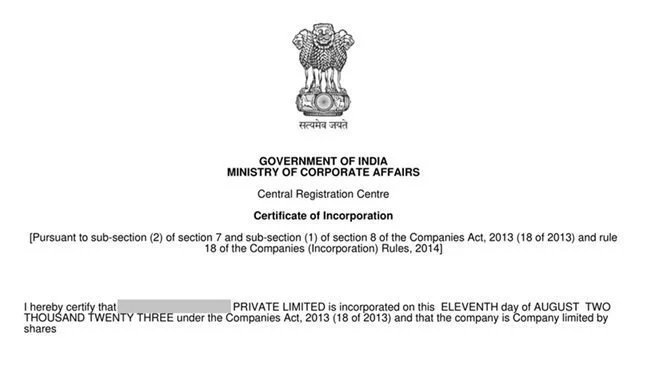
Once approved, the company receives its Certificate of Incorporation (COI).
The company is then legally incorporated and receives its Corporate Identity Number (CIN).
PAN and TAN are also integrated into the incorporation process where applicable.
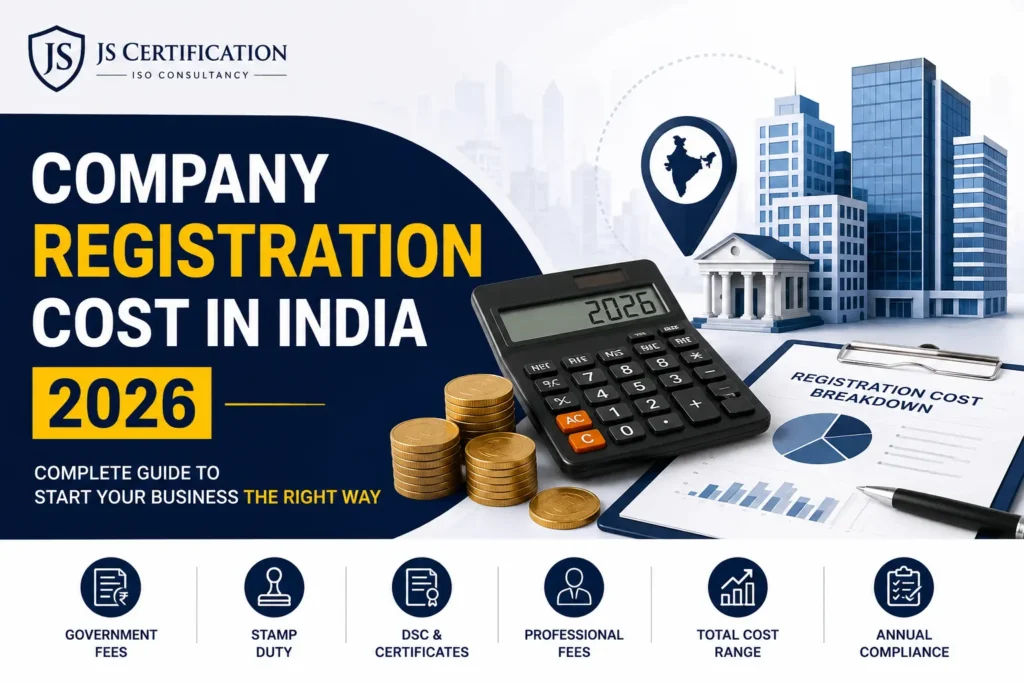
How Much Does Private Limited Registration Cost?
The cost of private limited registration generally consists of several components rather than one universal amount.
These can include:
- Government filing fees
- State stamp duty
- Digital Signature Certificate charges
- Professional or facilitation fees
- Any additional services requested by the founders
The government component can vary depending on factors such as authorised capital and the state of incorporation.
Therefore, founders should compare the total cost, not just an advertised professional fee.
It is also important to check whether government charges, DSC charges and additional services are included in a quoted package.
Is GST Mandatory for a Private Limited Company?
No. GST registration is not automatically mandatory simply because a business is incorporated as a Private Limited Company.
GST applicability depends on the nature of the business, turnover, supplies, state and other conditions prescribed under GST law.
For example, a newly incorporated company may exist without immediately becoming liable for GST registration if the applicable conditions for mandatory registration are not triggered.
However, certain businesses may require GST registration even in circumstances where the general turnover threshold would otherwise be relevant.
Therefore, GST should be evaluated separately after incorporation rather than treating it as an automatic consequence of company registration.
Can I Register a Private Limited Company Myself?
Yes, it is possible to initiate and complete incorporation through the MCA’s online system if you understand the applicable requirements and can correctly prepare the forms and supporting documents.
However, incorporation involves more than simply filling out an online form.
You need to correctly handle:
- Name selection
- Business activity classification
- Share capital
- Director details
- Registered office documentation
- MOA and AOA
- Digital signatures
- Linked forms
- Declarations
- Government fees
- Resubmission, if required
A mistake in the incorporation application can result in rejection, resubmission or unnecessary delays.
For founders unfamiliar with MCA filings, professional assistance can simplify the process and reduce documentation errors.
Private Limited Company vs LLP: Which is Better?
There is no universally better structure. The right choice depends on your business model.
Private Limited Company
Generally more suitable when you:
- Want to raise equity investment
- Expect multiple investors
- Want a share-based ownership structure
- Plan to build a scalable startup
- May consider ESOPs
- Want a conventional corporate structure
LLP
An LLP can be attractive where:
- Partners want operational flexibility
- The business is professional or partnership-oriented
- Equity investment is not the immediate objective
- The founders prefer an LLP structure
If your long-term plan includes venture capital or significant equity fundraising, a Private Limited Company is often the more practical structure to evaluate.
Private Limited Company vs OPC
An OPC is designed for a single-member structure, while a Private Limited Company generally requires at least two members.
An OPC can be useful for a solo entrepreneur who wants a corporate form without immediately bringing in another shareholder.
A Private Limited Company may be more suitable where:
- There are two or more founders
- You expect investors
- You want multiple shareholders
- You may issue or transfer shares
- You expect the business to scale significantly
The decision should be based on the founder’s current structure as well as future plans.
Private Limited Company vs Limited Company
A “Limited Company” can refer broadly to a company with limited liability, but in common Indian business usage, entrepreneurs often use “Private Limited Company” to distinguish it from a public limited company.
A Private Limited Company generally has restrictions on the transfer of shares and does not invite the public to subscribe to its securities.
A public company has a different legal and regulatory framework and may be more appropriate for businesses that require access to public capital markets, subject to the applicable requirements.
For most early-stage startups and privately held businesses, Private Limited registration is generally the more relevant structure to consider.
What Happens After Private Limited Registration?
Getting the Certificate of Incorporation is not the end of the compliance process.
It is the beginning.
After incorporation, founders should consider:
1. Open the company’s bank account
The company should operate through its own bank account rather than mixing company transactions with personal accounts.
2. Bring in subscribed capital
The subscribers should contribute the capital they have agreed to contribute to the company.
3. Check commencement requirements
Companies having share capital are required to comply with the applicable declaration regarding commencement of business and exercising borrowing powers under Section 10A and the prescribed form.
The MCA’s INC-20A framework provides for the commencement declaration and specifies the applicable filing timeline.
4. Appoint the first auditor
The company must comply with the applicable requirements relating to appointment of its auditor.
5. Maintain statutory records
Companies need to maintain appropriate registers, books and corporate records.
6. Complete annual ROC compliance
Private Limited Companies have continuing annual compliance obligations.
Depending on the company and its circumstances, these can include financial statement filing, annual return filing, income-tax compliance, auditor-related compliance and other applicable filings.
Incorporation is therefore not a one-time compliance event.
Common Mistakes to Avoid During Private Limited Registration
Choosing a name without checking trademarks
MCA name approval and trademark protection are separate issues.
Before finalising your company name, conduct an appropriate trademark search.
Using incorrect registered office documents
An incorrect address, outdated proof or missing consent documentation can create problems during incorporation.
Selecting the wrong business activity
The company’s business activity and NIC classification should accurately reflect its proposed operations.
Ignoring post-incorporation compliance
Some founders believe that receiving the Certificate of Incorporation means all legal work is finished.
It does not.
A company must continue complying with applicable corporate, tax and regulatory requirements.
Looking only at the cheapest registration package
The lowest advertised incorporation fee may not represent the lowest total cost.
Always check what is included and whether government charges, DSCs and post-incorporation assistance are covered.
Frequently Asked Questions
Who is the owner of a Private Limited Company?
A Private Limited Company is owned by its shareholders.
The shareholders own shares in the company, while directors are responsible for managing the company’s affairs in accordance with the Companies Act, the Articles of Association and applicable decisions of the company.
The person running the company is therefore not necessarily its “owner”.
For example, a founder may be both a shareholder and director, but the legal ownership of the company is represented through shareholding.
Can one person start a Private Limited Company?
A conventional Private Limited Company generally requires at least two members.
If an individual wants to establish a company alone, an OPC may be an alternative subject to applicable eligibility requirements.
Is GST mandatory for a Private Limited Company?
No.
Private limited registration by itself does not automatically make GST registration mandatory.
GST registration depends on the applicable GST provisions, including turnover, nature of supply and other prescribed conditions.
Can I register a Private Limited Company myself?
Yes.
The MCA provides an online incorporation mechanism through SPICe+.
However, the process requires careful preparation of company details, documents, declarations and linked forms.
Professional assistance can be useful if you are unfamiliar with MCA incorporation procedures.
Who is eligible to register a Private Limited Company?
Generally, two or more persons can form a Private Limited Company subject to the requirements of the Companies Act, 2013 and applicable rules.
The proposed directors and shareholders must satisfy the relevant legal and documentation requirements.
Which is better: LLP or Private Limited Company?
It depends on the business.
An LLP may be suitable for businesses seeking partnership-style flexibility, while a Private Limited Company is often preferred by startups expecting equity investment, multiple shareholders or significant scaling.
Which company is better: Limited or Private Limited?
The answer depends on your objectives.
A Private Limited Company is generally suitable for privately held startups and growing businesses, whereas a public company follows a different regulatory framework and may be appropriate for businesses seeking public investment, subject to eligibility.
How many members are there in a Private Limited Company?
A Private Limited Company generally requires at least two members.
The maximum number of members is generally 200, subject to the applicable provisions of the Companies Act, 2013.
Is a Private Limited Company better than an OPC?
Not necessarily.
An OPC can be appropriate for a single founder, while a Private Limited Company can be more suitable when there are multiple founders or when the business expects to bring in investors and shareholders.
Can a Private Limited Company become an OPC?
A company cannot simply be treated as an OPC whenever it wants.
The applicable conversion and eligibility provisions must be examined based on the company’s circumstances and the Companies Act and rules in force at that time.
What is the difference between an LLC and a Private Limited Company?
LLC generally refers to a Limited Liability Company, a business structure commonly associated with jurisdictions such as the United States.
India has its own corporate structures, including Private Limited Companies and LLPs.
Therefore, an entrepreneur in India should generally compare a Private Limited Company with an LLP or other Indian business structures rather than treating an American LLC and an Indian Private Limited Company as identical entities.
What are the disadvantages of a Private Limited Company?
Some common disadvantages include:
- More compliance than an informal business structure
- Annual ROC filings
- Maintenance of corporate records
- Accounting and audit-related obligations
- Restrictions and procedures around share transfers
- Additional professional and compliance costs
For a business intending to scale, however, these obligations may be justified by the benefits of the corporate structure.
Final Thoughts
Private limited registration can provide a strong legal foundation for entrepreneurs who want to build a scalable and professionally structured business.
It offers limited liability, separate legal identity and a share-based ownership structure that can be useful for bringing in co-founders and investors.
But incorporation should not be treated as merely obtaining a Certificate of Incorporation.
The right company name, correct documentation, appropriate business structure, accurate incorporation forms and post-incorporation compliance all matter.
If you are unsure whether a Private Limited Company, LLP or OPC is right for your business, it is better to evaluate your business model and future plans before filing.
Start Your Business With Lawizer
From choosing the right business structure to incorporation and ongoing compliance, Lawizer helps entrepreneurs navigate the legal side of starting and growing a business.
Need help with Private Limited Company registration?
Get professional assistance with the incorporation process and start your business on a stronger legal foundation.
Get Started with Private Limited Company Registration →
Disclaimer: This article is intended for general informational purposes and does not constitute legal, tax or professional advice. Company incorporation requirements, fees, forms and regulatory requirements may change. Always verify the current requirements applicable to your company before filing.