India added roughly 4 million creators between 2020 and 2024. That marks a 322% increase. Many learned about their legal obligations the hard way. Some received GST notices. Others found TDS mismatches in Form 26AS. Many also saw brand deals stall because they had no invoice to raise.
Creator economy law in India isn’t optional paperwork anymore. It’s the difference between a channel that scales and one that gets an income tax notice mid-growth.
Here’s the thing: nobody hands new creators a checklist. Brands, MCNs, and even CAs assume you already know what to register. You don’t have to guess.
📌 TL;DR: Under creator economy law in India, YouTubers and influencers must register for GST once turnover crosses ₹20 lakh (₹10 lakh in special category states), file ITR-3 or ITR-4 using profession code 16021, and follow ASCI disclosure rules on every paid post. Brands also deduct TDS under Sections 194R, 194J, or 194C depending on the deal structure. Lawizer handles GST, MSME (Udyam), and trademark registration for creators end-to-end, online.
What You’ll Learn
When GST registration becomes mandatory for creators, and how the 18% rate applies
How TDS under Sections 194R, 194J, and 194C hits your brand deal payouts
Why trademarking your channel name protects your personal brand
When Udyam (MSME) registration and even a Private Limited company make sense
GST Registration: The First Real Compliance Trigger
The moment your annual turnover from brand deals, ad revenue, affiliate income, and even bartered products crosses ₹20 lakh (₹10 lakh in special category states like Assam or Himachal Pradesh), GST registration under the GSTN portal stops being optional. Content creation is classified as a supply of service under the CGST Act, and it attracts 18% GST — same rate as most professional services.
Most founders overlook one important rule. GST turnover includes non-cash income. A ₹2 lakh gadget hamper counts at its market value. It counts even if no money changes hands. That value also contributes to your GST registration threshold.
That value contributes to your GST registration threshold. After registering, you must issue GST-compliant tax invoices for every brand collaboration. Many brands now require these invoices before releasing payment.
Brand deals with foreign companies can qualify as “export of services” — zero-rated GST, if you file a Letter of Undertaking (LUT)
Once registered, you can claim Input Tax Credit (ITC) on equipment, software, and studio expenses.
Missing GST invoices on brand collaborations risks penalties during scrutiny
Founders juggling multiple income streams — YouTube AdSense, Instagram deals, coaching — often set up their business registration at the same time as GST, since lenders and brands both ask for it.
TDS: What Gets Deducted Before You See the Money
The short answer: it depends on how the brand structures the deal. Section 194J applies 10% TDS on professional fees — the most common category for sponsored posts and endorsements. Section 194C applies a lower 1-2% TDS when you’re treated as a contractor executing a defined project.
Section 194R is the one that catches creators off guard: if a brand gives you products, hotel stays, or gadgets worth more than ₹20,000 in a year, they must deduct 10% TDS on the fair market value — even though you never received cash.
Profession Code 16021 in ITR Filing: How to Choose the Right ITR Form
From FY 2024-25 (Assessment Year 2025-26) onward, the Income Tax Department introduced a dedicated profession code — 16021 — specifically for social media influencers and content creators. If you’re filing under this code with detailed books of accounts, ITR-3 is the correct form.
If you’d rather declare a fixed percentage of income under presumptive taxation instead of maintaining detailed books, ITR-4 (Sugam) applies.
What most founders miss here: mixing personal and business expenses is the fastest way to draw scrutiny. Only expenses directly tied to content creation — camera gear, editing software, internet bills, studio rent — qualify as deductions. A family vacation dressed up as a “travel content shoot” won’t survive an audit.
Foreign income (YouTube AdSense in USD, international brand deals) must be reported under Schedule FA
Late filing attracts a flat ₹5,000 penalty under Section 234F
Under-reported income can attract a 50-200% penalty under Section 270A
Creators who also run e-commerce alongside content — merch, digital courses — often benefit from lining up their income tax return filing with proper business registration from the start, rather than retrofitting compliance after brands start asking for GSTINs and PANs.
Trademark Your Channel Name Before Someone Else Does
Here’s what catches creators off guard: your channel name, logo, or catchphrase isn’t automatically yours in law just because you built the audience.
Anyone can file for trademark registration with the CGPDTM (Controller General of Patents, Designs and Trademarks) on an identical or similar name, and if they register first, you could be the one forced to rebrand — after years of building recognition.
This matters more once merchandise, digital products, or a personal app enters the picture. A registered trademark also strengthens your position in brand negotiations and licensing deals, since it proves exclusive ownership over your name and likeness in commerce.
Creators expanding into merch or courses typically pair trademark registration with their channel launch rather than waiting until a copycat account forces the issue.
MSME (Udyam) Registration and When to Incorporate
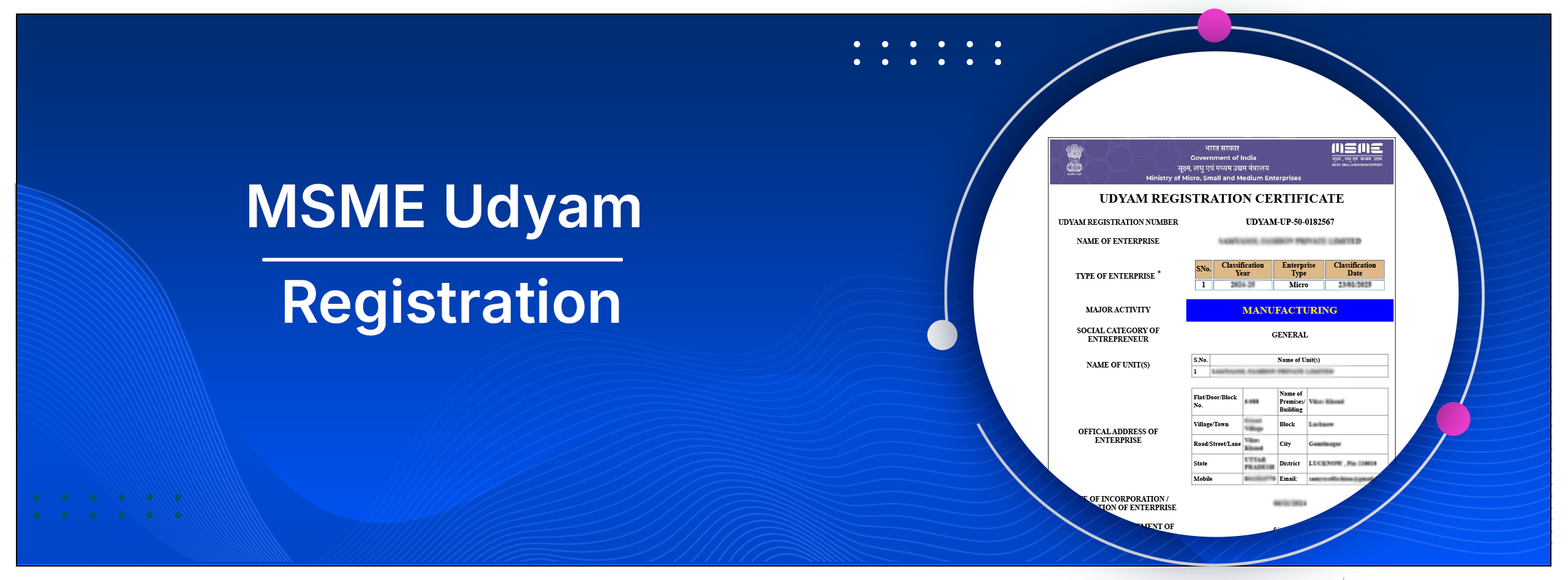
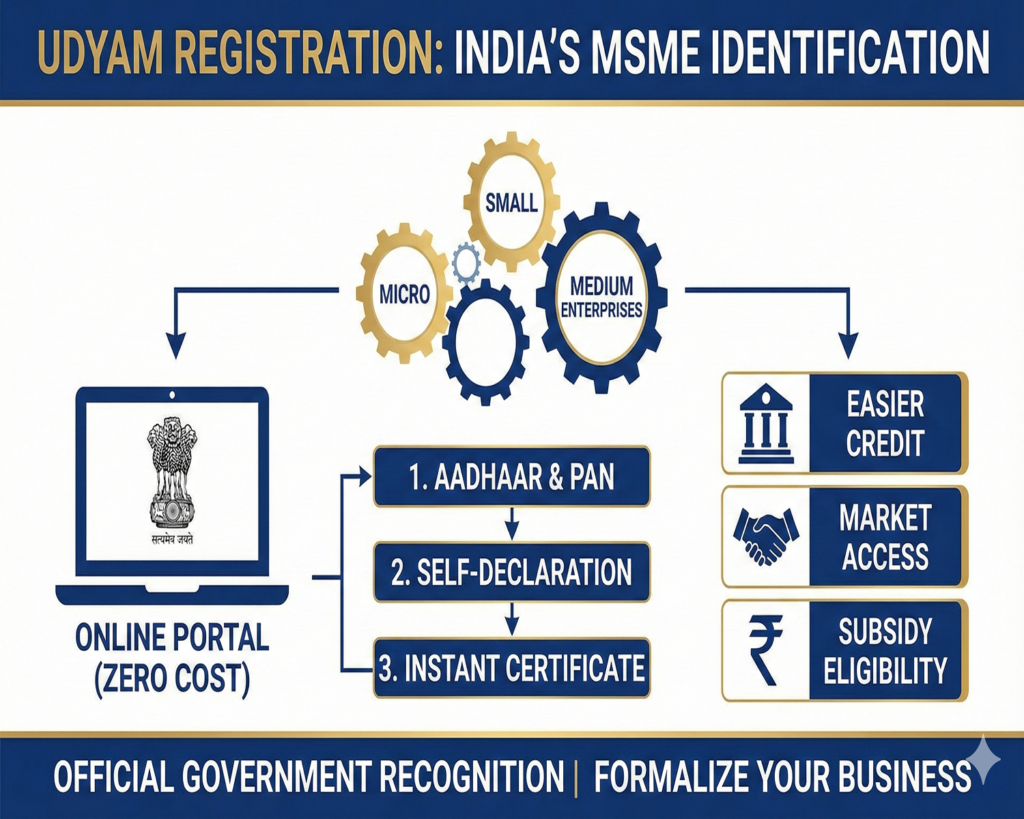
Once you’re running a studio, employing editors, or operating as a small media business rather than a solo creator, Udyam (MSME) registration opens up collateral-free loans, priority payment protections against brands, and government tender eligibility. It’s free, done entirely online through the Udyam portal, and takes minutes once your PAN and Aadhaar are ready.
When creators should consider incorporating a company
What most founders miss: at a certain income level, operating as an individual professional starts costing more in tax than incorporating a Private Limited company or LLP under the Companies Act, 2013. Incorporation also separates personal liability from business liability — useful once you’re signing large brand contracts, hiring a team, or bringing in investors for a media business.
Udyam registration: ideal for solo creators scaling into a small studio or team
Private Limited/LLP: better once annual income consistently crosses ₹50-75 lakh or you’re hiring full-time staff
Founders scaling past solo-creator income levels often register through MSME Udyam registration before they need it, so brand contracts and bank credit lines aren’t held up later.
ASCI Disclosure Rules: Compliance Requirements for Brands
The Advertising Standards Council of India (ASCI) processed over 1,400 influencer violations through November 2025, with 94% involving disclosure failures — undisclosed paid posts hidden behind a dozen unrelated hashtags.
ASCI’s April 2025 update tightened these rules across all categories. The Consumer Protection Act now enforces them with government penalties, not just industry warnings.
Let’s break this down: if you receive cash, free products, travel, or even an affiliate commission for content, disclosure is mandatory — prominent, immediate, and impossible to miss, not buried in a caption.
Finance and health creators face an even stricter Addendum 2: finfluencers must display SEBI registration or CA credentials, and health influencers must show their medical qualifications, or stick to personal experience with a clear disclaimer.
Non-compliance carries serious risks. Brands may withhold payment or end contracts. They may also flag violations, making future partnerships harder to secure.
Frequently Asked Questions
Q: Do I need GST registration if I only make money from YouTube AdSense?
A: Yes, once your total annual turnover — including AdSense, brand deals, and affiliate income combined — crosses ₹20 lakh (₹10 lakh in special category states). AdSense income counts toward this threshold the same as any other revenue stream.
Q: What happens if a brand sends free products instead of paying cash?
A: If the products are worth more than ₹20,000 in a financial year, the brand must deduct 10% TDS under Section 194R based on the fair market value. You’ll also need to declare this as taxable income, even though you didn’t receive cash.
Q: Which ITR form should influencers file?
A: Most creators file ITR-3 using profession code 16021, especially if they maintain detailed books of accounts. If you prefer the presumptive taxation scheme under Section 44AD instead of maintaining full books, ITR-4 (Sugam) applies.
Q: Can someone else trademark my channel name if I haven’t registered it?
A: Yes. Trademark rights in India generally go to whoever files first, not whoever built the audience first. Registering early with the CGPDTM protects your channel name, logo, and tagline from being claimed by someone else.
Q: Do I need to disclose every sponsored post, even small gifting collaborations?
A: Yes. Under ASCI guidelines, disclosure is required whenever you receive any benefit — cash, free products, travel, or affiliate commission — in exchange for content, regardless of follower count or the size of the deal.
Ready to formalize your creator business?
Lawizer’s experts handle everything — GST registration, MSME Udyam registration, and trademark filing for your channel — fully online, starting at just ₹999. No CA visit needed.
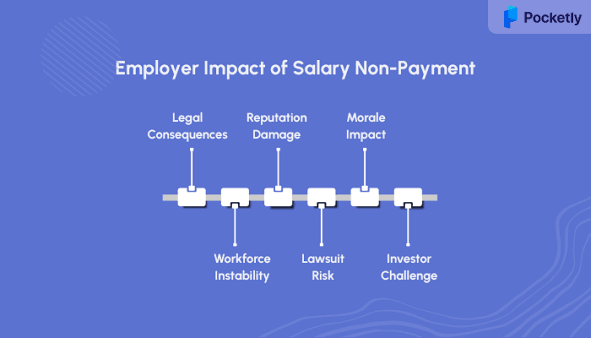
₹20,722.5 crore. That’s the combined FY25 loss reported by 45 loss-making Indian startups so far. When the runway gets short, payroll is often the first casualty. Missing even one salary cycle may seem like a temporary cash-flow issue to a founder. Legally, however, it isn’t.
The moment payday passes without payment, the issue goes beyond a simple delay. You begin accumulating legal liability under at least three separate laws.
📌 TL;DR: Delaying or skipping employee salaries in India isn’t just a cash-flow issue — it’s a compliance breach under the Payment of Wages Act, and in serious cases can trigger criminal proceedings, Companies Act liability, or an insolvency petition under the IBC. Founders who act early — with written communication, structured settlement plans, and proper documentation — significantly reduce their legal exposure. Lawizer helps startups stay compliant on payroll, ROC filings, and labour law so a rough quarter never becomes a legal crisis.
What You’ll Learn
Whether delaying salary is actually illegal in India, and by how many days
The specific laws that apply — Payment of Wages Act, IPC/BNS, Companies Act, IBC
What your employees can legally do if you miss payroll
How unpaid salaries can escalate into an insolvency petition against your company
Practical steps to protect the company (and yourself, personally) before it gets there
Is It Actually Illegal to Delay Employee Salaries?
Yes — and most founders underestimate by how much. Employers must pay wages before the 7th day of the following month in smaller establishments and before the 10th day in larger ones, as required by the Payment of Wages Act, 1936. There’s no grace period for “waiting on the next funding tranche.”
Here’s the thing: this Act currently covers employees earning up to ₹24,000 a month, which includes the vast majority of early-career hires at most startups — support staff, junior developers, sales executives, and operations teams.
Employees who earn above that threshold still receive legal protection and can pursue civil recovery through a summary suit or, in senior roles, file a straightforward money recovery claim.
What most founders miss: a company doesn’t need to formally “refuse” to pay to be in breach. Simply missing the statutory deadline — even by a few days, even with a WhatsApp message promising payment “next week” — is a compliance violation the moment it happens.
The Laws That Kick In When Payroll Is Missed
Salary non-payment in India isn’t governed by one law — it’s a stack of them, and each one gets more serious than the last.
1. Payment of Wages Act, 1936 — the civil layer
This is the first trigger point. Delayed wages entitle the employee to file a claim with the labour authority, and courts have the power to order payment of the dues plus compensation, on top of the original amount owed.
2. Criminal liability for intentional non-payment
For example, if a startup records salaries as “paid” in its books but never transfers the money to employees, it does more than delay payment—it misrepresents the facts. Authorities can prosecute this conduct as cheating or criminal breach of trust under criminal law, in addition to any labour-related claims.
3. Companies Act, 2013 — fraud provisions
If a company combines unpaid salaries with falsified financial records—for example, by recording payroll as disbursed in books submitted for audit or fundraising while employees remain unpaid—Section 447 of the Companies Act treats the conduct as corporate fraud. This offence carries far more severe consequences than a simple wage dispute.
4. The new Labour Codes
India’s four consolidated labour codes came into force on November 21, 2025, replacing 29 older laws.
Under the new framework, authorities continue to penalize payment delays, and employers can no longer use payroll structures that artificially reduce statutory contributions. Basic pay must now account for at least 50% of total compensation, directly increasing gratuity and provident fund (PF) liability calculations.
What Employees Can Legally Do If You Miss Payroll
The short answer: more than most founders assume, and faster than most founders expect. A typical sequence looks like this:
Send a formal legal notice demanding payment within a fixed window, usually 7–15 days
File a complaint with the jurisdictional Labour Commissioner, who can summon the employer for reconciliation
Escalate to the Labour Court if the complaint isn’t resolved, with claims filed within one year of default
Pursue a civil recovery suit for managerial or senior staff not covered under the Payment of Wages Act
File as an operational creditor under the Insolvency and Bankruptcy Code if dues cross ₹1 lakh
Let’s break this down further with the piece founders underestimate most: once a legal notice lands, the clock is already running publicly. A response — or lack of one — becomes evidence in any future proceeding.
This is exactly the kind of documentation gap that proper business compliance support is built to close before it becomes a liability.
How Missed Salaries Can Trigger Insolvency Proceedings
Here’s the escalation path founders genuinely don’t see coming. Under the Insolvency and Bankruptcy Code, an employee owed ₹1 lakh or more in unpaid wages qualifies as an “operational creditor” — the same legal category as an unpaid vendor.
The process starts with a demand notice. If the company doesn’t respond or settle within the specified period, employees can collectively petition the NCLT, which can trigger appointment of a resolution professional and formation of a creditors’ committee.
If the company fails to resolve the issue, creditors can push it into liquidation—a legal outcome that began with a missed payday.
A quick example shows why documentation matters: courts have repeatedly ruled that employers cannot arbitrarily withhold earned wages, and employees remain entitled to recover them even when the employment arrangement contains procedural irregularities.
Clean records protect both the company and the employee. Clean records protect the company as much as they protect the employee.
How Founders Can Protect Themselves Before It Escalates
The good news: almost every escalation on this list is avoidable with early, documented communication. What actually works:
Communicate delays in writing before the due date, not after — silence is what triggers legal notices
Never show salary as “paid” internally or to auditors if it hasn’t actually been disbursed
Prioritise partial payments over zero payments — courts and employees respond very differently to good-faith effort
Put a written settlement plan in place with dates, even if amounts are staggered
Keep statutory filings — PF, ESIC, TDS on salary — current even when gross pay is delayed, since these carry separate penalties
If your startup is also behind on tax filings or MSME-linked payment obligations during a cash crunch, those compliance gaps compound fast — each one is a separate legal exposure, not a single combined problem.
Frequently Asked Questions
Q: Is it illegal for a startup to delay salary by a few days?
A: Yes. Under the Payment of Wages Act, 1936, employers must pay wages within 7 days after the wage period ends for smaller establishments and within 10 days for larger ones.Any delay beyond this, even without malicious intent, is technically a violation founders should treat seriously.
Q: Can an employee file a criminal case against a startup for not paying salary?
A: Yes, in cases involving intentional deception — such as salary shown as disbursed in records but never actually transferred. Authorities can pursue this as cheating or criminal breach of trust, separately from the labour claim for the unpaid amount.
Q: Can unpaid employee salary lead to my startup being taken to insolvency court?
A: Yes. Under the IBC, an employee owed ₹1 lakh or more can file as an operational creditor. If the company doesn’t respond to a demand notice, employees can collectively petition the NCLT, which can ultimately lead to liquidation proceedings.
Q: What should a founder do first if the company genuinely can’t make payroll?
A: Communicate the delay in writing before the due date, offer a partial payment if possible, and put a dated settlement plan on record. The law treats documented, proactive communication very differently from silence that forces employees to escalate the issue on their own.
Q: Do the new labour codes change the penalties for salary delays?
A: Yes. India’s four consolidated labour codes took effect on November 21, 2025, and payment delays remain fully punishable under the new framework. Additionally, employers must keep basic pay at or above 50% of total compensation, changing how they calculate PF and gratuity liabilities even before a payment delay occurs.
Ready to get your startup’s payroll and compliance airtight?
Lawizer’s experts handle payroll compliance reviews, statutory filings, and labour law documentation — fully online, starting at just ₹1,999. No CA visit needed.
78% of Indian startups now offer ESOPs, up from just 59% in 2021. And yet, most founders get the paperwork wrong on the first try. Common mistakes include choosing the wrong pool size, skipping the cliff clause, or filing Form SH-6 months late.
An ESOP helps startups retain employees only when founders structure it correctly from day one.
Get it wrong, and you could dilute the founders more than necessary. You might also give your best engineer an ESOP grant with a weak legal foundation. Here’s how to build it properly.
📌 TL;DR: Setting up an ESOP for startup employees in India means creating a pool (typically 10–15% of equity), getting board and shareholder approval under Section 62(1)(b) of the Companies Act 2013, and drafting a scheme with a clear vesting schedule — usually 4 years with a 1-year cliff. Lawizer handles the drafting, filings, and compliance so founders don’t lose deals or grants to paperwork errors.
What You’ll Learn
How to size and create your ESOP pool without over-diluting founders
How vesting, cliffs, and exercise price actually work in practice
Which MCA filings and board resolutions you cannot skip
How Employees Pay Tax on ESOPs and What Founders Should Explain Upfront
What Is an ESOP and Why Indian Startups Use It
An ESOP (Employee Stock Option Plan) gives an employee the right — not the obligation — to buy company shares at a fixed price in the future. It’s not ownership on day one. It’s a promise: stay, contribute, and you’ll earn the right to buy in at today’s price, even if the company’s value climbs many times over by the time you exercise.
Here’s the thing. Cash-strapped early-stage startups in Bengaluru, Mumbai, and Delhi cannot always match the salaries offered by large tech companies. Instead, they use ESOPs to attract the same engineers and product professionals. They offer equity instead of, or alongside, cash compensation.
Under the Companies Act, 2013 (Section 62(1)(b)), private limited companies can issue ESOPs following Ministry of Corporate Affairs rules, and DPIIT-recognised startups get added flexibility, including the ability to grant options to promoters and directors, which other private companies can’t do.
What most founders miss: an ESOP works as a retention tool only if employees actually understand it. A grant letter full of jargon with no explanation of vesting or tax impact does very little for morale, however generous the number of options looks on paper.
How to Set Up an ESOP Pool the Right Way
An ESOP pool is a portion of the company’s equity that founders reserve specifically for employees. Most Indian startups create the pool before a funding round so founders absorb most of the dilution instead of incoming investors. Investors also expect startups to follow this approach.
Seed stage: around 10% of fully diluted equity
Series A and beyond: 12–15%, and growing further at later stages as senior hires join
Approval needed: board resolution plus special resolution from shareholders
A quick example: if you set a 10% pool pre-Series A and the new investor takes a 25% stake, your pool dilutes proportionally too. Founders often “top up” the pool back to the original target right after the round closes, so there’s enough room for the next 18–24 months of hiring.
If you’re incorporating your startup and structuring equity at the same time, handle company incorporation and compliance together. This approach lets you build the ESOP pool into your cap table from the start instead of adding it later.
Vesting Schedule, Cliff, and Exercise Price
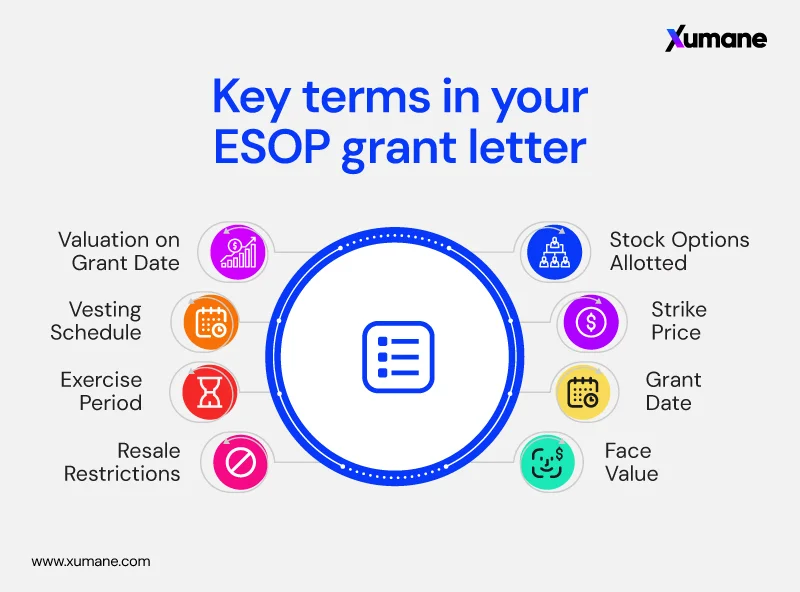
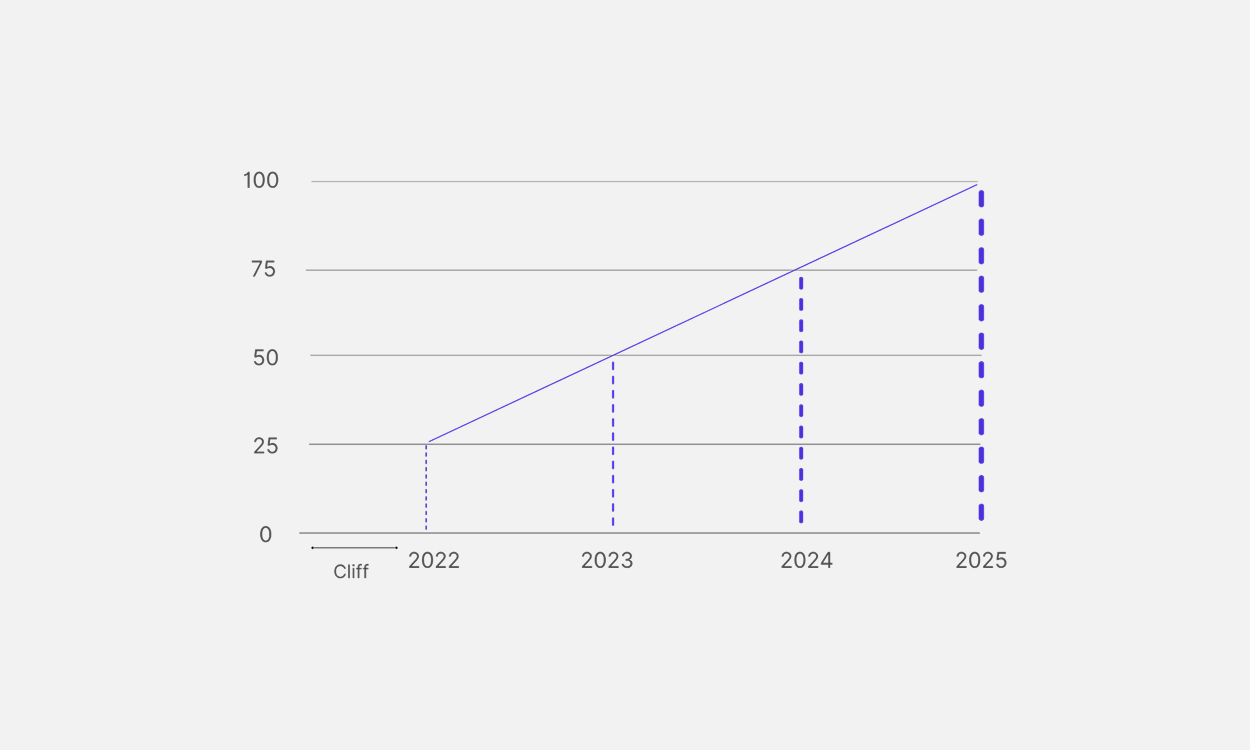
This is where most ESOP confusion lives, both for founders drafting the scheme and employees trying to figure out what they actually own. The standard structure across Indian startups is a 4-year vesting period with a 1-year cliff.
In simple terms, employees do not receive any vested options during the first 12 months. Leave before that, and the entire grant lapses — this is the cliff, and Indian rules treat one year as the minimum. Cross the cliff, and 25% vests immediately.
The remaining 75% typically vests monthly or quarterly over the next three years, allowing the employee to become fully vested by month 48.
Exercise price, explained
The exercise price (also called strike price) is what an employee pays per share when they exercise vested options — locked in at the Fair Market Value (FMV) on the grant date, determined by a registered valuer. If the company’s FMV rises later, the employee still pays the old, lower price. That gap is the wealth-creation part of the deal.
Vested options: employee CAN exercise, hasn’t yet
Exercised options: employee has paid and now holds shares
Post-termination exercise window: Employees usually have 90 days after leaving the company to exercise their vested options. Most people consider a window of less than 30 days unfair to employees.
The Legal Documents and MCA Filings You Cannot Skip
Let’s break this down. An ESOP isn’t a verbal promise or a line in an offer letter — it needs a documented, board-and-shareholder-approved scheme to hold up legally and to survive due diligence at your next funding round.
ESOP scheme document: objective, eligibility, pool size, vesting terms, exercise price formula, and what happens on termination or acquisition
Board and shareholder resolutions: approving the scheme and each subsequent grant
Individual grant letters: signed by company and employee, specifying number of options and vesting schedule
File Form SH-6: within 60 days of shareholder approval to disclose the ESOP scheme.
Register of Employee Stock Options: maintained by the company for every grant issued
Founders who skip the SH-6 filing or fail to keep grant letters signed often find out the hard way — during Series A due diligence, when the investor’s legal team flags every gap and stalls the term sheet until it’s fixed.
How ESOPs Are Taxed in India
ESOP taxation catches almost every first-time recipient off guard, so it’s worth explaining to your team before they exercise, not after. Tax hits at two separate points.
At exercise: the difference between the FMV on the exercise date and the exercise price is treated as perquisite income and taxed as salary, at the employee’s slab rate. At sale: any further gain is taxed as capital gains — short-term or long-term depending on the holding period.
DPIIT-recognised startups get a meaningful exception here: eligible employees can defer the perquisite tax until they sell the shares, leave the company, or five years pass from allotment, whichever comes first. That removes the cash-flow problem of owing tax on shares you haven’t sold yet.
If your startup qualifies, this deferral is worth building into how you communicate ESOP value at the offer stage — and it’s worth getting your tax filing and compliance sorted around it so neither the company nor the employee gets caught off guard at assessment time.
Common ESOP Mistakes Founders Make
A few patterns show up again and again in early-stage Indian startups, and they’re avoidable with a bit of planning upfront.
Creating a pool without a hiring plan — leads to either an underused pool or a mid-year restructuring scramble
No clawback clause — makes it hard to recover unvested equity when someone exits early
Arbitrary exercise price — not backed by a re
istered valuer’s FMV report, which creates tax and compliance risk
Over-diluting too early — giving away a large pool before the company has proven traction, which complicates future rounds
Poor communication — employees who don’t understand vesting or tax rarely value the grant the way founders expect them to
The upside of getting this right is real: over a dozen Indian startups ran ESOP buybacks in 2025, helping more than 9,200 employees unlock actual wealth from options that were structured, documented, and communicated properly from the start.
Frequently Asked Questions
Q: How much equity should a startup set aside for ESOPs in India?
A: Most Indian startups reserve 10–15% of fully diluted equity for their ESOP pool. Seed-stage companies typically start around 10%, increasing to 12–15% by Series A as leadership hires join. The right number depends on your hiring plan for the next 18–24 months.
Q: What happens to my ESOP if I leave before one year?
A: If you leave before completing the one-year cliff, all granted options lapse and you receive nothing. This is standard under Indian ESOP practice and exists to protect the company from granting equity to employees who don’t stay long enough to contribute meaningfully.
Q: Can the exercise price be changed after the grant is made?
A: No. The exercise price is fixed at the Fair Market Value on the grant date and cannot be reduced or altered retroactively without triggering tax complications. This is exactly why the exercise price should be based on a formal valuer’s report, not an internal estimate.
Q: Are ESOPs taxed twice in India?
A: Yes. Tax applies once at exercise, when the gap between FMV and exercise price is taxed as salary income, and again at sale, when further gains are taxed as capital gains. DPIIT-recognised startups can offer eligible employees a deferral on the exercise-stage tax.
Q: Do I legally need board approval to grant ESOPs, or can I just issue them informally?
A: Board approval, and in most cases shareholder approval, is mandatory under Section 62(1)(b) of the Companies Act, 2013. Grants made without proper resolutions and Form SH-6 filings can be challenged later and often surface as red flags during investor due diligence.
Q: Can promoters or founders receive ESOPs too?
A: Generally, promoters and directors holding over 10% equity are excluded from ESOP eligibility. DPIIT-recognised startups get an exception for the first 10 years from incorporation, allowing them to grant ESOPs to promoters and directors as well.
Ready to set up your ESOP the right way?
Lawizer’s experts handle ESOP scheme drafting, board and shareholder resolutions, and Form SH-6 filing — fully online, starting at just ₹4,999. No CA visit needed.
May 13, 2027 isn’t a suggestion. It’s the hard deadline for full DPDP Act compliance, and unlike most Indian regulatory rollouts, there’s no extended grace period baked in this time. If your startup collects a customer’s email, phone number, or even a device ID, this law already applies to you — whether you’ve got 200 users or 2 lakh.
Most founders think this is a “big company” problem. It isn’t. Penalties run up to ₹250 crore per violation, and they stack.
📌 TL;DR: The Digital Personal Data Protection (DPDP) Act 2023 and its Rules 2025 apply to every Indian startup that processes personal data, with full compliance mandatory by May 13, 2027. There’s no revenue or size exemption — a two-person SaaS team has the same core obligations as a listed company. Lawizer helps founders build DPDP-ready consent flows, privacy notices, and grievance mechanisms before the deadline hits.
What You’ll Learn
What the DPDP Act and DPDP Rules 2025 actually require of startups
The exact phased timeline — November 2025, November 2026, and May 2027
What “Significant Data Fiduciary” means and whether it applies to you
A practical, founder-friendly compliance checklist
What Is the DPDP Act 2023 and Why the Rules 2025 Change Everything
The Digital Personal Data Protection Act, 2023 (DPDP Act) is India’s first comprehensive data privacy law, rooted in the Supreme Court’s Puttaswamy judgment that recognised privacy as a fundamental right. For years it sat unenforced because the government hadn’t notified the operational rules.
That changed on November 13, 2025, when the Ministry of Electronics and Information Technology (MeitY) notified the final DPDP Rules 2025, which convert the Act’s broad principles into specific, enforceable obligations.
Here’s the thing: the Act calls your startup a Data Fiduciary the moment you decide why and how personal data is collected — even if a third-party tool actually stores it.
Your users are Data Principals, and any vendor processing data on your behalf (your CRM, your analytics tool, your cloud host) is a Data Processor. You stay accountable for what they do with that data, not them.
The Compliance Timeline: Three Phases Every Founder Should Have on Their Calendar
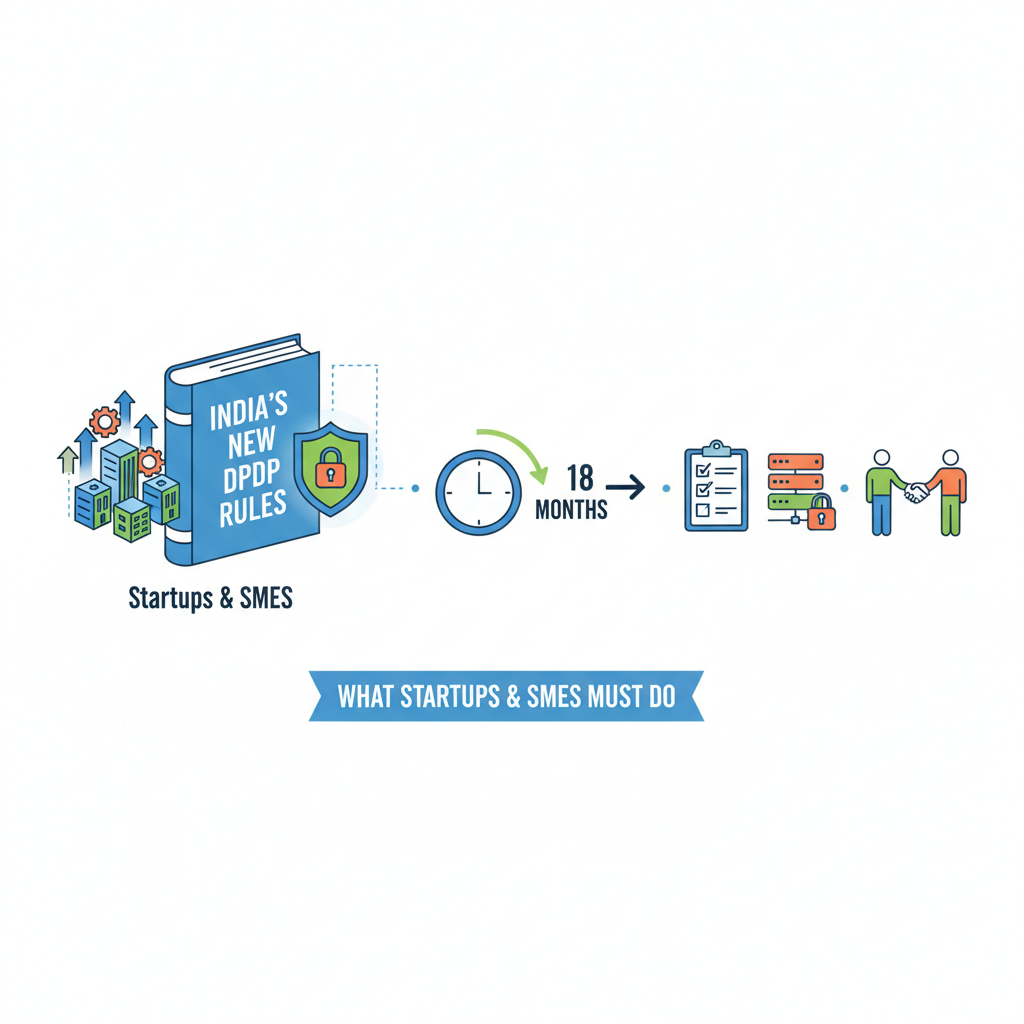
What most founders miss: the DPDP rollout isn’t a single deadline — it’s a phased 18-month clock that started ticking the day the Rules were notified
Phase 1 — November 13, 2025 (already live): The Data Protection Board of India (DPB) is operational and accepting complaints. Procedural provisions are in force.
Phase 2 — November 13, 2026: Consent Manager registration opens. If you plan to rely on a third-party consent platform, vendor due diligence needs to start well before this.
Phase 3 — May 13, 2027 (the real deadline): Every remaining obligation kicks in at once — consent notices, breach reporting, data principal rights, retention and erasure rules, and grievance redressal.
The short answer: 2026 is your build year. Waiting until early 2027 to start means compressing a 12–18 month compliance programme into a few months — and rebuilding consent flows or data architecture under pressure rarely goes well.
What Your Startup Must Actually Do Before May 2027
Let’s break this down into what actually needs building, not just legal language.
1. Redesign your consent flow
Consent under DPDP must be free, specific, informed, and given through a clear affirmative action — not inferred from continued app use. A standalone privacy notice separate from your Terms of Service is mandatory, and withdrawing consent must be as easy as giving it.
2. Map every place personal data flows through your systems
You can’t protect what you haven’t inventoried. Map every entry point — signup forms, payment gateways, support tickets, analytics SDKs — and log which vendors touch that data.
3. Build breach notification protocols
Under Section 8(6) of the Act and Rule 7 of the Rules, a breach must be reported to the Data Protection Board without unreasonable delay, followed by a detailed report within 72 hours. If your startup doesn’t have an incident response checklist today, this is the moment to write one.
4. Set retention and erasure policies
Data must be deleted once its purpose is served or consent is withdrawn. Erasure requests must be honoured within 90 days, and this applies to data sitting with your processors too — not just your own servers.
5. Handle children’s data with extra care
If your product could reasonably be used by anyone under 18, verifiable parental consent is required, and behavioural tracking or targeted advertising to minors is prohibited outright.
If your startup is still setting up its legal foundation, organize your core business legal documentation first. A clear entity structure and well-drafted contracts make it much easier to create privacy policies and consent frameworks.
Penalties: What Happens If You Don’t Comply
The short answer: this isn’t a slap-on-the-wrist regime. Failure to maintain reasonable security safeguards can attract penalties up to ₹250 crore. Delayed breach notification and violations involving children’s data can each attract penalties up to ₹200 crore.
General non-compliance can still cost up to ₹50 crore. Since penalties are imposed per violation, a single incident can trigger multiple penalty categories at the same time.
For example, a startup that suffers a data breach may delay reporting it. If it also has weak security safeguards, one incident could lead to three separate penalty categories. There’s no small-business carve-out in the fine structure — the DPB assesses based on the violation, not your headcount.
Does “Significant Data Fiduciary” Status Apply to You?
What most founders miss here: the Act distinguishes between ordinary Data Fiduciaries and Significant Data Fiduciaries (SDFs), a tier the government notifies based on the volume of data you process, its sensitivity, and potential for harm.
SDFs carry heavier obligations — appointing a Data Protection Officer based in India, conducting annual Data Protection Impact Assessments, and independent audits.
Most early-stage startups won’t be classified as SDFs at launch. But if you’re scaling fast — particularly in fintech, healthtech, or any platform handling sensitive personal data at volume — it’s worth tracking MeitY notifications closely, since SDF status can change your compliance obligations overnight.
Startups formalising their MSME registration as they scale should build this monitoring into their broader compliance calendar.
A Practical DPDP Compliance Checklist for Indian Startups
Appoint a privacy lead or focal point, even if it’s a founder wearing multiple hats
Map all personal data flows across your product, team, and vendors
Draft a standalone privacy notice, separate from your Terms of Service
Rebuild consent capture so it’s affirmative, specific, and easily withdrawable
Set up a grievance redressal mechanism with a published contact point
Encrypt stored and transferred data, and review access controls
Review every vendor contract for DPDP-compliant data processing clauses
Define retention and deletion timelines for every data category you hold
India’s startup ecosystem is already responding — as Inc42 reported, a wave of privacy-tech startups and platforms are building consent management and compliance tooling specifically for this law, which tells you how seriously the market is treating the May 2027 deadline.
Frequently Asked Questions
Q: Is my small startup exempt from the DPDP Act if we only have a few hundred users?
A: No. There is currently no statutory revenue or user-count exemption for startups or MSMEs under the DPDP Act. If you collect personal data such as names, emails, or phone numbers, core compliance obligations apply regardless of your size.
Q: What is the actual deadline for DPDP compliance in India
A: May 13, 2027 is the full compliance deadline, 18 months after the DPDP Rules were notified on November 13, 2025. Some provisions, like Consent Manager registration, become active earlier, in November 2026.
Q: What happens if my startup doesn’t comply by the deadline?
A: The Data Protection Board of India can impose penalties of up to ₹250 crore depending on the violation, and these penalties can stack if a single incident breaches multiple provisions. There is no grace period built into the penalty framework after May 2027.
Q: Do I need a Data Protection Officer for my startup?
A: Only if the government designates your startup as a Significant Data Fiduciary. Other Data Fiduciaries need a grievance redressal mechanism and a clear contact point for data principals, but not a formally appointed DPO.
Q: Does the DPDP Act apply if my startup is based outside India but has Indian users?
A: Yes. The Act has extra-territorial application and covers any organisation processing personal data in connection with offering goods or services to individuals located in India, regardless of where the company itself is incorporated.
Q: Can cookies count as personal data under DPDP?
A: Neither the Act nor the Rules explicitly mention cookies, but personal data is defined broadly enough to include any data relating to an identifiable individual. Where cookies can be linked back to a person, directly or combined with other data, they likely fall within scope.
Ready to get DPDP-ready before the 2027 deadline?
Lawizer’s experts handle everything — privacy policy drafting, consent framework design, and compliance documentation — fully online, starting at just ₹4,999. No CA visit needed.
The MCA sends back roughly one in three company name applications filed through its portal on the first attempt. If the MCA rejected your company name, you are not alone—you likely ran into one of the common, predictable mistakes that founders make every day.
The good news? Every single rejection reason is fixable in five minutes once you know what the Central Registration Centre (CRC) is actually checking for.
📌 TL;DR: A company name gets rejected by MCA mainly for four reasons — it’s too similar to an existing company, LLP, or trademark; it uses a restricted word like Bank or India without approval; it’s too generic to have any distinct identity; or it doesn’t match the business activity stated in the application. Run a name search on the MCA and trademark portals before filing, and most rejections are entirely avoidable. Lawizer’s incorporation team checks all three layers — MCA database, trademark register, and Companies Act compliance — before you ever submit.
What You’ll Learn
The exact rules MCA uses to approve or reject a name (Rule 8 and Rule 8A)
The five most common rejection triggers, with real examples
How to pick a name that survives the SPICe+ Part A or RUN check on the first try
How MCA Actually Decides — Rule 8 and Rule 8A
When you submit a company name through SPICe+ (Simplified Proforma for Incorporating Company Electronically Plus — MCA’s online incorporation form) or RUN (Reserve Unique Name — the standalone name reservation service), the Ministry of Corporate Affairs (MCA) screens it against the Companies (Incorporation) Rules, 2014. Specifically, Rule 8 and Rule 8A of the MCA framework lay out what makes a name “undesirable.”
Here’s the thing: this isn’t a human reviewer making a judgment call on vibes. It’s a rules-based check against three databases — existing companies, existing LLPs, and the trademark register — plus a list of restricted words. If your name trips any one of these, it gets flagged for resubmission or outright rejection.
Reason 1: Your Name Is Too Similar to an Existing One
This is the single biggest reason names bounce back. MCA doesn’t just block identical names — it blocks names that “too nearly resemble” an existing company, LLP, or registered trademark. That includes phonetic similarity. If “TechVista Private Limited” already exists, “TekVista” or “TechVysta” will likely be rejected even though the spelling is different.
What most founders miss: changing the prefix isn’t enough if the core distinctive word is identical. “New TechVista” or “TechVista India” still carries a high rejection risk because the dominant, memorable part of the name hasn’t actually changed.
Search the exact name on MCA’s Company/LLP Master Data tool
Search variations and phonetic near-matches, not just the exact spelling
Cross-check the same name against the trademark register, since a clean MCA search doesn’t mean a clean trademark search
Reason 2: You Used a Restricted or Regulated Word
Certain words trigger an automatic flag unless you have prior regulatory approval attached to your application. Government-sounding words — National, Central, Union, Federal, President, Parliament — imply state patronage and get rejected outright.
Regulated-sector words — Bank, Insurance, Mutual Fund, Stock Exchange, Securities — need a no-objection from RBI, IRDAI, or SEBI before MCA will even look at the name.
A quick example: scale-implying words also have capital thresholds attached. Words like International, Continental, or Hindustan require at least ₹1 crore in authorised capital, while India, Indian, or Corporation need a minimum of ₹5 lakh. Use these words without meeting the threshold, and rejection is close to guaranteed.
Reason 3: The Name Is Too Generic
The short answer: if your name doesn’t have a distinctive word, MCA will reject it for lacking identity. “Super Enterprises Private Limited” or “Best Business Private Limited” tell the registrar nothing about who you are — they’re generic enough to apply to thousands of companies, which is exactly the problem.
Words like Industry, Udyog, Enterprises, Products, or Manufacturing are only allowed when your business genuinely spans multiple activities. A single-product company using “Manufacturing” in its name without a broad object clause is an easy rejection.
A simple fix
Add a brand-specific, invented, or coined word as your prefix — something that wouldn’t show up in a dictionary search. It’s the fastest way to clear the “distinctive identity” bar.
Reason 4: Your Name Doesn’t Match Your Business Activity
Let’s break this down: when you file SPICe+ Part A, you also declare your main business objects. If the name and the objects contradict each other, the CRC flags it. A company named “ABC Manufacturing Private Limited” that lists business consultancy as its main activity is a textbook example — the object word “Manufacturing” misleads anyone reading the name.
This trips up a lot of first-time founders registering a private limited company who pick an aspirational name before finalising what the company actually does. Lock in your business objects first, then build the name around them.
Reason 5: You Skipped the Trademark Check
What most founders miss: a name can be completely free on the MCA database and still get rejected because it’s registered as a trademark in a relevant class. The CRC cross-checks proposed names against the trademark register maintained by CGPDTM (Controller General of Patents, Designs and Trademarks)
If you genuinely want to use a name that’s trademarked by someone else, you’ll need the trademark owner’s consent — typically a board resolution and KYC documents if the owner is a company. Without that, don’t bother filing; it’s an automatic rejection. Before you commit to a brand name, it’s worth running it through a proper trademark registration search alongside your MCA check.
What Happens After a Rejection
If both names in your SPICe+ Part A application get rejected, you typically get one free resubmission opportunity with corrected names — no extra fee, as long as you resubmit within the allowed window. If the second attempt also fails, you’ll need to file a fresh application with new fees.
Under RUN, the process is similar but slightly more forgiving on resubmission. Either way, the CRC’s rejection remarks tell you exactly which rule you broke — read them carefully instead of guessing at a new name.
Frequently Asked Questions
Q: Why did MCA reject my company name even though it wasn’t identical to any existing company?
A: MCA rejects names that are phonetically similar, not just identical ones. If your proposed name sounds like an existing company or LLP name when spoken aloud, the CRC treats it as too close and rejects it under Rule 8.
Q: How many times can I resubmit a rejected company name?
A: You generally get one free resubmission after an initial rejection in SPICe+ Part A. If the resubmitted names are also rejected, you’ll need to file a completely new application with fresh fees.
Q: Can I use the word “India” or “Bharat” in my company name?
A: Yes, but only if your authorised capital meets the minimum threshold, generally ₹5 lakh for words like India or Indian, and only if the scale of your business genuinely justifies it. MCA rejects these words for small-scale companies that don’t meet the threshold.
Q: Does a clean MCA name search guarantee approval?
A: No. A name can be completely unused on the MCA database and still get rejected if it matches a registered trademark in a relevant class. You need to check both the MCA database and the trademark register before filing.
Ready to register your company without the name-rejection headache?
Lawizer’s experts handle everything — MCA name search, SPICe+ filing, and full incorporation — fully online, starting at just ₹1,499 + Govt. Fee. No CA visit needed.
📌 TL;DR: A founder vesting schedule in India means promoters earn their shares over time — typically 4 years with a 1-year cliff — instead of receiving 100% ownership on day one. It protects the company from “dead equity” if a co-founder exits early, signals discipline to investors, and is enforced through a shareholders’ agreement rather than directly under the Companies Act, 2013. Lawizer drafts founders’ agreements with vesting built in from incorporation, not retrofitted after a dispute.
What You’ll Learn
What founder vesting actually means and why it differs from employee ESOP vesting
The standard 4-year, 1-year cliff structure Indian investors expect to see
How reverse vesting works for founders who already hold shares
Which clauses your founders’ agreement or SHA must include
What happens to unvested equity when a co-founder leaves
What Is a Founder Vesting Schedule?
A vesting schedule is the timeline over which a founder “earns” full legal ownership of the shares allotted to them, rather than owning everything outright the moment the company incorporates. Here’s the key point: once a company allots shares under the Companies Act, 2013, the shareholder becomes their legal owner.
Vesting does not change ownership directly. Instead, it operates through a contractual mechanism in the founders’ agreement or Shareholders’ Agreement (SHA). This provision requires a departing founder to sell back any unvested shares.
The term “reverse vesting” refers to an arrangement where the founder already holds the shares and must transfer the unearned portion back if they exit early. Unlike an employee, who earns options that vest over time, the founder starts with the shares and gives back the unearned portion if they leave before the vesting period ends.
Many founders believe vesting only benefits investors. In reality, it also protects co-founders from day one. It safeguards both the founders and the company’s cap table. A four-year vesting period with a one-year cliff is now the standard in India and globally. A cliff is the initial period during which no equity vests.
Why Indian Founders Can’t Afford to Skip It
What’s the real cost of skipping vesting? Picture an equal three-way split with no agreement. One founder leaves after eight months. The remaining two now need that person’s consent for almost every shareholder-level decision — share issuance, a new funding round, even routine governance — because they still legally hold their full stake.
This isn’t a rare scenario. Disputes over undocumented equity promises and dormant cap table entries are among the most common founder-side legal issues Indian startups bring to law firms once a funding round is in motion. A co-founder who went passive — moved abroad, became inactive, or simply stopped contributing — can still hold pre-emptive and anti-dilution rights that block a Series A from closing on time.
The short answer: A founder vesting schedule turns a potential equity dispute into a pre-agreed contractual outcome. Without it, founders often face legal disputes later. These cases may end up before the National Company Law Tribunal (NCLT) under Sections 241–242 of the Companies Act, 2013.
The Standard Structure: 4-Year Vesting, 1-Year Cliff
Let’s break this down. The structure almost every Indian startup and investor expects looks like this:
Year 0–1 (the cliff):No shares vest. If a founder leaves before the 12-month mark, they walk away with nothing.
End of Year 1: 25% of the founder’s shares vest in one go.
Year 1–4: The remaining 75% vests monthly, in equal instalments — roughly 1/36th each month.
Year 4 : The founder becomes fully vested and owns their entire allotted stake outright.
Founders who complete significant pre-incorporation work can negotiate vesting credit, allowing them to start partially vested on day one instead of beginning at zero. This is reasonable when documented, but it should be the exception, agreed in writing, not assumed.
Acceleration Clauses Worth Knowing
Acceleration speeds up vesting if a specific event occurs, usually an acquisition. Double-trigger acceleration offers a more balanced approach because it requires both an acquisition and a termination without cause before equity accelerates. This structure prevents founders from cashing out immediately after a deal closes and walking away, while still protecting them if the new owner later terminates them without cause.
Drafting It Right: What Your Founders’ Agreement Must Cover
A vesting clause that’s vague is almost as risky as having none. A quick example: an agreement that says shares vest “over time” without defining the cliff, the monthly schedule, or what counts as a “good leaver” versus a “bad leaver” leaves every term open to dispute later.
At minimum, your founders’ agreement or SHA should define:
Exact vesting schedule: cliff length, total vesting period, and vesting frequency (monthly is most common).
Good Leaver vs. Bad Leaver: The company repurchases unvested shares at fair value when a founder qualifies as a good leaver (for example, due to resignation, health reasons, or mutual agreement). However, the company repurchases those shares at face value or nil value when a founder becomes a bad leaver because of termination for cause or a breach of the agreement.
Valuation mechanism for buyback: who values the unvested shares, and by when. Without this, parties default to Rule 11UA of the Income Tax Rules, 1962 — a method built for tax compliance, not equitable founder buyouts.
IP assignment: a separate but related clause ensuring all IP built by founders, including pre-incorporation work, sits with the company, not the individual.
Deadlock resolution: what happens if co-founders can’t agree on a reserved matter, including a forced transfer trigger for serious breaches.
Getting these clauses drafted correctly at incorporation is far cheaper than fixing them later. Lawizer’s company incorporation services include founders’ agreement drafting with vesting built in from day one, so you’re not retrofitting protection after a co-founder relationship has already gone sideways.
Founder Vesting vs ESOP Vesting: Don’t Confuse the Two
Here’s a distinction that trips up a lot of founders. Section 62(1)(b) of the Companies Act, 2013, along with Rule 12 of the Companies (Share Capital and Debentures) Rules, 2014, governs Employee Stock Option Plans (ESOPs) in India.
Rule 12 generally prohibits promoters and directors holding more than 10% equity from receiving ESOPs. However, companies recognised as startups under the Startup India initiative by DPIIT can grant ESOPs to these individuals, as the exemption remains available for up to 10 years from the date of incorporation.
In contrast, founder vesting does not operate under an ESOP scheme. Instead, founders receive their shares through a separate ownership arrangement. It’s a contractual obligation in the founders’ agreement or SHA that applies to shares already allotted to promoters at incorporation. The two mechanisms achieve a similar goal — earning equity over time — but they sit in completely different legal frameworks, and confusing them in your documentation is a common drafting mistake.
If you’re also setting up an employee option pool alongside founder vesting, make sure your MSME and compliance registrations are in place first — investors will check both during diligence.
What Happens When a Co-Founder Leaves Early
A quick example to make this concrete: a founder holding 30% equity leaves at the end of Year 2, with a standard 4-year/1-year-cliff schedule in place. They’ve vested 25% (the cliff) plus 12 months of monthly vesting — roughly 50% of their total grant.
The other 50% reverts to the company, typically at face value or nil consideration as specified in the buyback clause, and can be reallocated to a replacement co-founder, added to the ESOP pool, or held by the company.
What most founders miss: if the agreement is silent on the buyback price for unvested shares, the default valuation route is Rule 11UA — net asset value or discounted cash flow — which was designed for income tax compliance, not for a fair founder exit. Specifying the valuation method and timeline in writing at the start avoids a costly negotiation later.
When Should You Set Up Vesting?
The short answer: at incorporation, before any institutional money comes in. Investors increasingly check for a vesting schedule and a documented founders’ agreement during diligence, and discovering its absence mid-term-sheet negotiation is a red flag that can delay or derail a round.
If you’ve already incorporated without one, it’s not too late — but it does require every co-founder to agree to retroactively place their existing shares under a vesting arrangement, which is a harder conversation than setting it up on day one. Either way, this sits alongside your other founder-stage filings, including your company’s annual income tax return filing and trademark protection for your brand.
Frequently Asked Questions
Q: Is founder vesting legally required in India?
A: No, the Companies Act, 2013 does not mandate founder vesting. It’s a contractual protection built into your founders’ agreement or SHA, not a statutory requirement. However, most institutional investors will insist on it before closing a funding round.
Q: What’s the difference between vesting and reverse vesting?
A: Vesting typically refers to options or shares granted to employees that they earn over time before receiving them. Reverse vesting applies to founders who already hold their shares; if they leave early, the unvested portion is sold back to the company. Founder agreements almost always use reverse vesting.
Q: Can founders negotiate a shorter vesting period than 4 years?
A: Yes. A 2-3 year vesting schedule with a shorter cliff is more founder-friendly and is sometimes accepted by early-stage investors, especially if the founder has already demonstrated significant traction. The 4-year, 1-year-cliff structure remains the default investors expect, so any deviation should be clearly justified and documented.
Q: What happens to unvested shares if a co-founder is asked to leave for cause?
A: This depends entirely on your “bad leaver” clause. Most agreements specify that unvested shares are forfeited at nil or face value in a for-cause termination, while vested shares may still be repurchased at fair value or retained, depending on the agreement’s terms. Without this clause defined in writing, the company has no automatic right to claw back shares.
Q: Does vesting reset when the startup raises a new funding round?
A: Generally no — founder equity is diluted as new shares are issued, but the original vesting timeline continues unchanged unless all parties specifically negotiate otherwise. Series A investors sometimes ask for renegotiated or restarted vesting as a condition of the round, which founders should review carefully before agreeing.
Q: Can a solo founder skip vesting entirely?
A: A solo founder has no co-founder to protect against, but investors will still often require founder vesting before funding, since it protects them against the founder leaving the company early post-investment. It’s worth setting up even for a single-founder startup if outside funding is on the roadmap.
Ready to protect your founder equity the right way?
Lawizer’s experts handle everything — founders’ agreement drafting, vesting schedule structuring, and full company incorporation — fully online, starting at just ₹1,499. No CA visit needed.
Three founders. One equal 33% split. No vesting schedule. Eighteen months later, one co-founder stops contributing but still owns one-third of the company. Many founders make the mistake of skipping a founder vesting schedule. At Lawizer, we have seen this happen often. This single document helps prevent future ownership disputes.
Eighteen months later, one co-founder stops contributing. However, they still own one-third of the company. Many founders make the mistake of skipping a founder vesting schedule.cision you make.
📌 TL;DR: A founder vesting schedule in India means promoters earn their shares over time — typically 4 years with a 1-year cliff — instead of receiving 100% ownership on day one. It protects the company from “dead equity” if a co-founder exits early, signals discipline to investors, and is enforced through a shareholders’ agreement rather than directly under the Companies Act, 2013. Lawizer drafts founders’ agreements with vesting built in from incorporation, not retrofitted after a dispute.
What You’ll Learn
What founder vesting actually means and why it differs from employee ESOP vesting
The standard 4-year, 1-year cliff structure Indian investors expect to see
How reverse vesting works for founders who already hold shares
Which clauses your founders’ agreement or SHA must include
What happens to unvested equity when a co-founder leaves
What Is a Founder Vesting Schedule?
A vesting schedule is the timeline over which a founder “earns” full legal ownership of the shares allotted to them, rather than owning everything outright the moment the company incorporates. Here’s the key point: once a company allots shares under the Companies Act, 2013, the shareholder becomes their legal owner.
Vesting does not change ownership directly. Instead, it operates through a contractual mechanism in the founders’ agreement or Shareholders’ Agreement (SHA). This provision requires a departing founder to sell back any unvested shares.
The term “reverse vesting” refers to an arrangement where the founder already holds the shares and must transfer the unearned portion back if they exit early. Unlike an employee, who earns options that vest over time, the founder starts with the shares and gives back the unearned portion if they leave before the vesting period ends.
Many founders believe vesting only benefits investors. In reality, it also protects co-founders from day one. It safeguards both the founders and the company’s cap table. A four-year vesting period with a one-year cliff is now the standard in India and globally. A cliff is the initial period during which no equity vests.
Why Indian Founders Can’t Afford to Skip It
What’s the real cost of skipping vesting? Picture an equal three-way split with no agreement. One founder leaves after eight months. The remaining two now need that person’s consent for almost every shareholder-level decision — share issuance, a new funding round, even routine governance — because they still legally hold their full stake.
This isn’t a rare scenario. Disputes over undocumented equity promises and dormant cap table entries are among the most common founder-side legal issues Indian startups bring to law firms once a funding round is in motion. A co-founder who went passive — moved abroad, became inactive, or simply stopped contributing — can still hold pre-emptive and anti-dilution rights that block a Series A from closing on time.
The short answer: A founder vesting schedule turns a potential equity dispute into a pre-agreed contractual outcome. Without it, founders often face legal disputes later. These cases may end up before the National Company Law Tribunal (NCLT) under Sections 241–242 of the Companies Act, 2013.
The Standard Structure: 4-Year Vesting, 1-Year Cliff
Let’s break this down. The structure almost every Indian startup and investor expects looks like this:
Year 0–1 (the cliff):No shares vest. If a founder leaves before the 12-month mark, they walk away with nothing.
End of Year 1: 25% of the founder’s shares vest in one go.
Year 1–4: The remaining 75% vests monthly, in equal instalments — roughly 1/36th each month.
Year 4 : The founder becomes fully vested and owns their entire allotted stake outright.
Founders who complete significant pre-incorporation work can negotiate vesting credit, allowing them to start partially vested on day one instead of beginning at zero. This is reasonable when documented, but it should be the exception, agreed in writing, not assumed.
Acceleration Clauses Worth Knowing
Acceleration speeds up vesting if a specific event occurs, usually an acquisition. Double-trigger acceleration offers a more balanced approach because it requires both an acquisition and a termination without cause before equity accelerates. This structure prevents founders from cashing out immediately after a deal closes and walking away, while still protecting them if the new owner later terminates them without cause.
Drafting It Right: What Your Founders’ Agreement Must Cover
A vesting clause that’s vague is almost as risky as having none. A quick example: an agreement that says shares vest “over time” without defining the cliff, the monthly schedule, or what counts as a “good leaver” versus a “bad leaver” leaves every term open to dispute later.
At minimum, your founders’ agreement or SHA should define:
Exact vesting schedule: cliff length, total vesting period, and vesting frequency (monthly is most common).
Good Leaver vs. Bad Leaver: The company repurchases unvested shares at fair value when a founder qualifies as a good leaver (for example, due to resignation, health reasons, or mutual agreement). However, the company repurchases those shares at face value or nil value when a founder becomes a bad leaver because of termination for cause or a breach of the agreement.
Valuation mechanism for buyback: who values the unvested shares, and by when. Without this, parties default to Rule 11UA of the Income Tax Rules, 1962 — a method built for tax compliance, not equitable founder buyouts.
IP assignment: a separate but related clause ensuring all IP built by founders, including pre-incorporation work, sits with the company, not the individual.
Deadlock resolution: what happens if co-founders can’t agree on a reserved matter, including a forced transfer trigger for serious breaches.
Getting these clauses drafted correctly at incorporation is far cheaper than fixing them later. Lawizer’s company incorporation services include founders’ agreement drafting with vesting built in from day one, so you’re not retrofitting protection after a co-founder relationship has already gone sideways.
Founder Vesting vs ESOP Vesting: Don’t Confuse the Two
Here’s a distinction that trips up a lot of founders. Section 62(1)(b) of the Companies Act, 2013, along with Rule 12 of the Companies (Share Capital and Debentures) Rules, 2014, governs Employee Stock Option Plans (ESOPs) in India.
Rule 12 generally prohibits promoters and directors holding more than 10% equity from receiving ESOPs. However, companies recognised as startups under the Startup India initiative by DPIIT can grant ESOPs to these individuals, as the exemption remains available for up to 10 years from the date of incorporation.
In contrast, founder vesting does not operate under an ESOP scheme. Instead, founders receive their shares through a separate ownership arrangement. It’s a contractual obligation in the founders’ agreement or SHA that applies to shares already allotted to promoters at incorporation. The two mechanisms achieve a similar goal — earning equity over time — but they sit in completely different legal frameworks, and confusing them in your documentation is a common drafting mistake.
If you’re also setting up an employee option pool alongside founder vesting, make sure your MSME and compliance registrations are in place first — investors will check both during diligence.
What Happens When a Co-Founder Leaves Early
A quick example to make this concrete: a founder holding 30% equity leaves at the end of Year 2, with a standard 4-year/1-year-cliff schedule in place. They’ve vested 25% (the cliff) plus 12 months of monthly vesting — roughly 50% of their total grant.
The other 50% reverts to the company, typically at face value or nil consideration as specified in the buyback clause, and can be reallocated to a replacement co-founder, added to the ESOP pool, or held by the company.
What most founders miss: if the agreement is silent on the buyback price for unvested shares, the default valuation route is Rule 11UA — net asset value or discounted cash flow — which was designed for income tax compliance, not for a fair founder exit. Specifying the valuation method and timeline in writing at the start avoids a costly negotiation later.
When Should You Set Up Vesting?
The short answer: at incorporation, before any institutional money comes in. Investors increasingly check for a vesting schedule and a documented founders’ agreement during diligence, and discovering its absence mid-term-sheet negotiation is a red flag that can delay or derail a round.
If you’ve already incorporated without one, it’s not too late — but it does require every co-founder to agree to retroactively place their existing shares under a vesting arrangement, which is a harder conversation than setting it up on day one. Either way, this sits alongside your other founder-stage filings, including your company’s annual income tax return filing and trademark protection for your brand.
Frequently Asked Questions
Q: Is founder vesting legally required in India?
A: No, the Companies Act, 2013 does not mandate founder vesting. It’s a contractual protection built into your founders’ agreement or SHA, not a statutory requirement. However, most institutional investors will insist on it before closing a funding round.
Q: What’s the difference between vesting and reverse vesting?
A: Vesting typically refers to options or shares granted to employees that they earn over time before receiving them. Reverse vesting applies to founders who already hold their shares; if they leave early, the unvested portion is sold back to the company. Founder agreements almost always use reverse vesting.
Q: Can founders negotiate a shorter vesting period than 4 years?
A: Yes. A 2-3 year vesting schedule with a shorter cliff is more founder-friendly and is sometimes accepted by early-stage investors, especially if the founder has already demonstrated significant traction. The 4-year, 1-year-cliff structure remains the default investors expect, so any deviation should be clearly justified and documented.
Q: What happens to unvested shares if a co-founder is asked to leave for cause?
A: This depends entirely on your “bad leaver” clause. Most agreements specify that unvested shares are forfeited at nil or face value in a for-cause termination, while vested shares may still be repurchased at fair value or retained, depending on the agreement’s terms. Without this clause defined in writing, the company has no automatic right to claw back shares.
Q: Does vesting reset when the startup raises a new funding round?
A: Generally no — founder equity is diluted as new shares are issued, but the original vesting timeline continues unchanged unless all parties specifically negotiate otherwise. Series A investors sometimes ask for renegotiated or restarted vesting as a condition of the round, which founders should review carefully before agreeing.
Q: Can a solo founder skip vesting entirely?
A: A solo founder has no co-founder to protect against, but investors will still often require founder vesting before funding, since it protects them against the founder leaving the company early post-investment. It’s worth setting up even for a single-founder startup if outside funding is on the roadmap.
Ready to protect your founder equity the right way?
Lawizer’s experts handle everything — founders’ agreement drafting, vesting schedule structuring, and full company incorporation — fully online, starting at just ₹1,499. No CA visit needed.
India has 7.86 crore registered MSMEs employing over 34 crore people — and yet thousands of eligible business owners still haven’t claimed their Udyam Registration. That one free certificate unlocks collateral-free loans up to ₹5 crore, government tender preferences, tax exemptions, and legal protection against delayed payments.
If your business qualifies and you haven’t registered yet, you’re leaving real money — and real protection — on the table.
📌 TL;DR: Udyam Registration is a free, fully online MSME certification issued by the Government of India that gives your business access to collateral-free loans, priority government tenders, tax benefits, and payment protection under the MSMED Act 2006. Any micro, small, or medium enterprise in manufacturing or services can apply in under 15 minutes at udyamregistration.gov.in — all you need is your Aadhaar and PAN. Lawizer can help you complete and verify the process without errors.
What You’ll Learn
What Udyam Registration is and how it replaced Udyog Aadhaar
Exact MSME eligibility criteria and classification limits (updated April 2025)
Every major benefit your business gets after registration
Step-by-step process to apply online and get your certificate instantly
Common mistakes founders make and how to avoid them
What Is Udyam Registration? (And Why Udyog Aadhaar No Longer Counts)
The Ministry of Micro, Small and Medium Enterprises launched the Udyam portal on July 1, 2020, replacing the older Udyog Aadhaar Memorandum (UAM) system entirely. If you registered under UAM before July 2020, that certificate is no longer valid for most benefits — you need to migrate to Udyam.
Here’s the thing. Udyam isn’t just a piece of paper. It’s your business’s formal identity in India’s lending, procurement, and compliance ecosystem. Banks verify your Udyam Registration Number (URN) before approving priority-sector loans
. Government departments check it before issuing tender preferences. And the MSME Samadhaan portal — the government’s delayed payment dispute system — requires a valid URN before you can file a complaint against a buyer who hasn’t paid. Without it, none of that is accessible.
The registration is completely free, paperless, and self-declaration based. You don’t upload any physical documents. The system cross-verifies your details automatically using your PAN and GST data linked to Income Tax records.
What most founders miss: the certificate has lifetime validity, so you register once and you’re covered as long as you update your details annually.
MSME Eligibility: Who Can Apply for Udyam Registration?
Any business in India — manufacturing or services — can apply for Udyam Registration if it falls within the classification limits set by the government. The criteria were updated effective April 1, 2025, expanding the thresholds to reflect how businesses actually scale today.
Retail and wholesale traders were also made fully eligible from July 2021 onward, which was a major change that most small shop owners in cities like Kolkata, Mumbai, and Chennai are still unaware of.
Updated MSME Classification Limits (w.e.f. April 1, 2025)
Enterprise Type
Investment in Plant & Machinery
Annual Turnover
Micro
Up to ₹1 crore
Up to ₹5 crore
Small
Up to ₹10 crore
Up to ₹50 crore
Medium
Up to ₹50 crore
Up to ₹250 crore
A quick example: a Bengaluru-based SaaS service firm with ₹8 crore in equipment investment and ₹40 crore in annual turnover qualifies as a Small Enterprise. It can register on Udyam and access enhanced credit guarantees introduced under Budget 2025.
Note that export turnover is excluded when calculating your threshold — only domestic turnover counts. And if your business grows and crosses limits, reclassification happens automatically — no penalty, as long as you’ve been reporting honestly.
Any business structure is eligible — sole proprietorships, partnerships, LLPs, private limited companies, OPCs, and even Hindu Undivided Families (HUFs). The only businesses that can’t apply are those exceeding the medium enterprise limits, non-profits, government departments, and fully informal freelancers with no structured operations.
Key Benefits of Udyam Registration for Your Business
Let’s break this down. Once you have your Udyam certificate, you’re not just “registered” — you get access to a stack of financial, legal, and market benefits that most unregistered businesses have zero access to.
🏦
1. Collateral-Free Loans Under CGTMSE
The Credit Guarantee Fund Trust for Micro and Small Enterprises (CGTMSE) allows registered MSMEs to access collateral-free loans up to ₹5 crore, with guarantee coverage of up to 85% for eligible categories. Since inception, over ₹9.80 lakh crore in credit guarantees have been approved — and in FY 2024-25 alone, the government extended ₹3 lakh crore worth of guarantees. For a small founder who can’t mortgage property, this is transformative.
📉
2. Priority Sector Lending and Lower Interest Rates
Banks are mandated by the Reserve Bank of India to lend to the MSME sector as part of Priority Sector Lending (PSL) requirements. This means registered MSMEs often get faster loan approvals, lower interest rates, and a 1% exemption on interest for bank overdraft (OD) facilities. Under the Pradhan Mantri Mudra Yojana (PMMY), over ₹33.65 lakh crore has been sanctioned across 52.37 crore Mudra loans since inception.
⚖️
3. Protection Against Delayed Payments
The MSMED Act gives you a legal right to receive payments within 45 days of delivering goods or services. If a buyer delays, they owe you compound interest at three times the bank rate. You can file a complaint on the MSME Samadhaan portal — routed to a Micro and Small Enterprises Facilitation Council (MSEFC) in your state. This protection is only available to Udyam-registered businesses.
📋
4. Government Tender Preferences
No global tenders are invited for government procurement contracts valued up to ₹200 crore — reserving a huge pool of contracts exclusively for Indian MSMEs. Registered businesses also get a price preference of up to 15% in government procurement under the Public Procurement Policy. If your business sells products or services that government departments buy, this single benefit can transform your revenue pipeline.
💸
5. Tax Benefits and Subsidies
Udyam-registered businesses are eligible for subsidies on patent registration, trademark fees, and industrial promotion. Several state governments also offer reduced electricity tariffs and stamp duty exemptions. If you’ve already registered your trademark, Lawizer’s trademark registration services can help you combine those savings with your MSME status for maximum benefit.
How to Apply for Udyam Registration Online: Step-by-Step
Aadhaar number of the proprietor, managing partner, or authorised director (linked to a working mobile number for OTP)
PAN card of the business or individual
GSTIN (mandatory if your turnover exceeds the GST threshold)
Bank account details and NIC (National Industrial Classification) code for your business activity
Step-by-Step Application Process
1
Visit the PortalGo to udyamregistration.gov.in and click “For New Entrepreneurs who are not Registered yet as MSME”
2
Aadhaar ValidationEnter your Aadhaar number and name, then validate via OTP sent to your Aadhaar-linked mobile
3
PAN VerificationEnter your PAN — the system auto-verifies with the Income Tax database instantly
4
Fill Enterprise DetailsBusiness name, activity type (manufacturing/service/trade), address, bank details, investment amount, turnover, employee count, and 2-digit NIC code
5
SubmitThe portal cross-verifies your data with GST and ITR records automatically — no manual upload needed
6
Download CertificateYour Udyam Registration Certificate with unique URN and QR code is issued instantly
Common Mistakes to Avoid During Udyam Registration
Most errors during Udyam registration come from small oversights — but they can delay benefits or cause classification mismatches. Here are the ones that come up most often.
❌ Using an unlinked Aadhaar: Your Aadhaar must be linked to your current mobile number. If it’s not, update your mobile at the nearest Aadhaar Seva Kendra before starting the application.
❌ Entering wrong investment figures: Investment refers to the value of plant, machinery, or equipment — not land or buildings. Many applicants accidentally include property values and get classified in a higher tier.
❌ Including export turnover: Export sales must be excluded from your annual turnover calculation. Including them inflates your figure and may push you into a higher MSME category unnecessarily.
❌ Registering through paid agents on unofficial portals: The government process is 100% free. Many third-party websites charge ₹500–₹2,000 for a form you can fill in 10 minutes on the official portal. Always use udyamregistration.gov.in.
❌ Not updating figures annually: If your investment or turnover has grown, failing to update means you’re in the wrong MSME category — which can affect your benefit eligibility.
Frequently Asked Questions
Q) Is Udyam Registration free or do I need to pay a government fee?
Udyam Registration is completely free on the official government portal at udyamregistration.gov.in. There is no government fee at any stage of the application. If any website is charging you for registration, it is a private agent — not the official process. You only pay if you choose to hire a professional to assist with the filing.
Q) Can a private limited company or LLP apply for Udyam Registration?
Yes. Any business entity — sole proprietorship, partnership firm, LLP, private limited company, OPC, or HUF — can apply for Udyam Registration, provided it falls within the investment and turnover limits for micro, small, or medium enterprises. The Aadhaar used for verification should belong to the authorised signatory — the proprietor, a managing partner, or a director — depending on the business structure.
Q) What is the difference between Udyam Registration and Udyog Aadhaar?
Udyog Aadhaar (UAM) was the older MSME registration system discontinued on July 1, 2020. It has been fully replaced by Udyam Registration. Businesses that registered under UAM must migrate to the new Udyam portal to continue receiving MSME benefits. The Udyam system is more robust — it cross-verifies data with PAN, GST, and Income Tax records automatically, making classification more accurate and fraud-resistant.
Q) Does Udyam Registration need to be renewed every year?
No. Udyam Registration has lifetime validity — there is no annual renewal required. However, you are expected to update your investment and turnover figures on the Udyam portal at the end of each financial year to ensure your MSME classification remains accurate. Failing to update does not cancel your registration, but it may result in incorrect classification over time.
Q) Can retail and wholesale traders apply for Udyam Registration?
Yes. Since July 2, 2021, retail and wholesale traders have been eligible to register under Udyam, provided their investment and turnover fall within MSME classification limits. This change opened access to MSME benefits — including priority sector lending and payment protection — to a much larger group of businesses that was previously excluded from the scheme
Q) How long does it take to get the Udyam Registration Certificate after applying?
The certificate is issued instantly after successful submission of the application on the Udyam portal. Once your Aadhaar is verified via OTP and the system validates your PAN and GST data, your Udyam Registration Number (URN) and downloadable certificate are generated immediately. You can download and reprint the certificate at any time by logging in with your URN and Aadhaar OTP.
Ready to get your Udyam Registration done right?
Lawizer’s experts handle everything — MSME registration, business incorporation, and startup compliance — fully online, starting at just ₹499. No CA visit needed.
ndia filed over 5.5 lakh trademark applications in FY 2024–25. This reflects a 20% jump compared to the previous year, according to the CGPDTM Annual Report 2024–25.
Yet most first-time founders still don’t know whether their brand name is even available. Many also have no idea how the registration process actually works.
If you’ve built something worth protecting, this guide gives you the full picture — no legalese, no guesswork.
📌 TL;DR: Trademark registration in India protects your brand name, logo, or tagline from being copied or misused. You file the application through the IP India portal (ipindia.gov.in). The process is governed by the Trade Marks Act, 1999.It typically takes 12–18 months. For individuals and startups, the cost is ₹4,500–₹5,000 per class Lawizer helps founders complete the entire trademark registration process online — from availability search to filing — starting at ₹1,499.
What You’ll Learn
What a trademark actually protects — and what it doesn’t
The step-by-step trademark registration process in India
How to pick the right trademark class (this is where most founders go wrong)
Exact fees, realistic timelines, and what TM™ vs ® actually means
What happens if you get an objection or opposition
What Is a Trademark — And What Exactly Does It Protect?
A trademark is any mark — a word, name, logo, slogan, colour, or even a sound — that distinguishes your goods or services from everyone else’s.
Under the Trade Marks Act, 1999, registering a trademark gives you exclusive rights to use it. You can use that mark only for your registered category of business.
Here’s the thing: trademark protection is narrow by design. It doesn’t protect your entire business — it protects a specific mark in a specific category of goods or services.
That’s why a clothing brand and a software company can both use the same word as their name. They just need to operate in different trademark classes.
What a trademark does protect you against is someone else in your industry riding on your brand’s goodwill — copying your logo, launching a near-identical name, or confusing your customers. Once you register, you can sue for infringement, seek damages, and get counterfeit products seized at customs.
TM™ vs ® — What’s the Difference?
This confuses a lot of founders. The ™ symbol means you’re claiming rights over the mark — anyone can use it, even without registration.
The ® symbol is legally reserved for marks that have received a registration certificate from the CGPDTM (Office of the Controller General of Patents, Designs and Trade Marks — the government body that manages all IP filings in India). Using ® before your registration is complete is actually a punishable offence under the Trade Marks Act.
Step-by-Step: How Trademark Registration in India Works
Let’s break this down. The process runs through five broad stages, and knowing each one helps you avoid the delays that catch most first-time applicants off guard.
Step 1: Trademark Search
Before you file anything, run a search on the IP India public search portal to check if your mark — or anything confusingly similar — is already registered or pending.
What most founders miss: searching for an identical name isn’t enough. The Trade Marks Act also blocks marks that are “deceptively similar,” so a slight spelling variation or phonetically similar name can still get your application rejected.
Step 2: Choose Your Trademark Class
India follows the Nice Classification system — an international framework that divides all goods and services into 45 classes (Classes 1–34 for goods, Classes 35–45 for services). You must file your application under the specific class that covers what your business sells.
A quick example: a SaaS startup would typically file under Class 42 (software and technology services), while a food brand would file under Class 30 or Class 43. Getting this wrong means your trademark won’t protect you where it actually matters.
Step 3: File Your Application
Applications are filed online through the IP India portal using Form TM-A. You’ll need your applicant details, a clear representation of the mark, the class(es) you’re applying under, and a list of goods or services.
The fee is paid at the time of filing. The moment you submit, you receive an allotment number — this lets you track your application status online, and from this date, your trademark rights are considered to have priority.
Step 4: Examination by the Trade Marks Registry
An examiner at the Trade Marks Registry reviews your application. They may raise objections — called an Examination Report — if the mark is too generic, descriptive, or conflicts with an existing mark.
You have one month from receiving the report to file a reply. If you respond well, the examiner accepts the application. If not, a hearing is scheduled.
Step 5: Publication in the Trademark Journal
Once accepted, the mark is published in the official Trademark Journal. This opens a 4-month window for third parties to oppose your registration.
If no opposition is filed (or if opposition is overcome), you receive your registration certificate and can legally use the ® symbol.
Trademark Registration Fees in India (2025)
The short answer: it’s more affordable than most founders assume. The official government fee structure is tiered based on applicant type. Here’s what you’ll pay per class:
Individuals, Startups, and Small Enterprises: ₹4,500 per class (online filing)
Companies, LLPs, and Partnerships: ₹9,000 per class (online filing)
Add professional fees (₹3,000–₹8,000 if you use an agent or service), and the total typically lands between ₹7,500 and ₹18,000 for a single-class application. With Lawizer’s trademark registration service, you get expert filing support starting at ₹1,499, so you’re not paying CA-level fees for something that can be handled online.
How Long Does Trademark Registration Take in India?
Realistically, 12–18 months for an uncontested application — and longer if there’s an objection or opposition. The good news: you don’t have to wait for registration to use your brand commercially.
The moment you file and receive your allotment number, your priority date is established — meaning you have legal standing to challenge anyone who files a similar mark after you.
A quick example: two startups both want to register “Zelo” as a brand name. Startup A files in January, Startup B files in March. Even if Startup A’s registration takes 18 months, their January filing date gives them priority over Startup B — regardless of who gets the certificate first.
What Happens If You Get a Trademark Objection?
Don’t panic — it’s more common than you think. An Examination Report (objection) from the Trade Marks Registry typically flags one of two things: the mark is too descriptive or generic, or it’s confusingly similar to an existing mark.
Here’s the thing: an objection is not a rejection. You have one month to file a detailed written reply explaining why your mark is distinctive and should be registered.
If the examiner isn’t satisfied with the written response alone, they’ll call for a hearing. Founders who work with experienced IP professionals at this stage have significantly better outcomes.
If a third party files an opposition during the 4-month Trademark Journal publication window, that’s a separate (and more serious) proceeding. Both sides present evidence and arguments to the Trade Marks Registry.
Opposition proceedings can add 1–3 years to the timeline, which is why a thorough search before filing is non-negotiable.
Who Needs Trademark Registration — And When Should You File?
The honest answer is: if you’re building a brand you plan to grow, register as early as possible. India is a first-to-file system, which means the person who files first generally wins the rights — not the person who used the name first (unlike the US, which has a first-to-use system).
A competitor, copycat, or even a trademark troll can file your brand name before you do and create a legal headache that costs far more to resolve than the original registration would have.
Practically speaking, you should consider filing your trademark when you’ve finalised your brand name or logo, even before your product launches. You can file as an individual, a startup, an MSME (under the Udyam Registration framework), an LLP, or a private limited company.
Startups registered under the Startup India scheme also get a 50% concession on official trademark fees — a significant saving worth claiming.
If you’re also thinking about protecting your business structure itself — like choosing between an OPC, LLP, or Pvt Ltd — the Lawizer startup legal hub covers all of that in one place.
Frequently Asked Questions
Q: How many trademark classes do I need to register under?
A: It depends on your business. India follows the 45-class Nice Classification system, and your trademark only protects you within the classes you’ve registered under. If your startup sells both a physical product and a software service, you’ll likely need two separate class filings — each with its own fee. A trademark agent or legal service like Lawizer can help you identify the right class(es) based on what your business actually does
Q: What if someone copies my brand name before I register?
A: Without a registered trademark, your legal options are limited to a “passing off” claim — a common law remedy that requires you to prove established goodwill, misrepresentation, and damage. It’s expensive and difficult to win. With a registered trademark, you have much stronger grounds: you can file an infringement suit, seek an injunction, and claim damages.
Q: How long is a registered trademark valid in India?
A: A registered trademark in India is valid for 10 years from the date of application. It can then be renewed indefinitely for successive 10-year periods by paying the renewal fee. If you miss the renewal deadline, there’s a 6-month grace period with a surcharge — but after that, the mark can lapse and become available for others to register.
Q: Can a freelancer or individual (not a company) register a trademark in India?
A: Yes, absolutely. Under Section 18 of the Trade Marks Act, 1999, any person claiming to be the proprietor of a trademark can file an application — this includes individuals, freelancers, sole proprietors, startups, and companies. Individuals and startups also pay the lower government fee of ₹4,500 per class (online), compared to ₹9,000 for companies.
Q: What documents do I need to file a trademark application in India?
A: For most applicants, the core documents are: a clear image of the trademark (JPG format, under 500KB), the applicant’s name and address, a list of goods or services under the chosen class, and identity/address proof. If you’re a startup claiming the 50% government fee concession, you’ll also need your DPIIT Startup India recognition certificate.