Starting a business in India involves more than choosing a name and opening a bank account. The legal structure you choose can affect liability, taxation, fundraising, compliance and long-term growth. For many startups and growing businesses, a Private Limited Company offers a practical structure because it creates a separate legal entity and limits shareholder liability, subject to applicable law.
Private limited company registration is completed through the Ministry of Corporate Affairs (MCA) under the prescribed incorporation process. This guide covers eligibility, documents, the MCA process, costs, taxation, GST, compliance and the differences between a Private Limited Company and an LLP.
What Is a Private Limited Company?
A Private Limited Company is a company incorporated under the Companies Act, 2013. It has a legal identity separate from its shareholders. The company can own property, enter contracts, open bank accounts and conduct business in its own name.
A major benefit is limited liability. Generally, shareholders are liable only to the extent of their agreed contribution or unpaid amount on their shares, subject to the Companies Act and the facts of a particular case.
Key Features of a Private Limited Company
- It has a separate legal identity.
- Shareholders generally receive limited liability protection.
- An ordinary private company requires at least two members and two directors.
- At least one director must satisfy the statutory residence requirement.
- Ownership is represented through shares.
- The company has perpetual succession.
- Transfer of shares is subject to restrictions under applicable law and the Articles of Association.
- A private company cannot invite the public to subscribe to its securities.
This structure is often suitable for startups, growing businesses and founders who expect to raise equity investment or bring additional shareholders into the business.
However, incorporation is not the only option. A founder with a different ownership or compliance requirement can also compare LLP registration or One Person Company registration.
Who Is Eligible for Private Limited Company Registration?
An ordinary private company generally requires at least two members and two directors. The members own shares in the company, while the directors manage its affairs within the framework of company law and the company’s constitutional documents.
Minimum Requirements
- Members: At least two.
- Directors: At least two.
- Resident director: At least one director must satisfy the statutory residence requirement.
- Registered office: The company must have a registered office in India.
- Company name: The proposed name must comply with applicable MCA naming rules.
The same person can be both a shareholder and a director. Therefore, two founders can generally satisfy both roles without appointing four separate people.
Can NRIs or Foreign Nationals Become Directors or Shareholders?
NRIs and foreign nationals can participate in Indian companies, subject to applicable company law, foreign exchange regulations and documentation requirements.
Additional formalities may apply to documents executed outside India. These can include notarisation, apostille or consularisation, depending on the country and circumstances. Foreign investment rules may also apply to the proposed business activity.
Is There a Minimum Capital Requirement?
There is no general minimum paid-up capital requirement for incorporating an ordinary private company. Founders should still decide the authorised capital and initial subscription based on the proposed ownership structure and funding needs.
Capital planning is important because changes to share capital later may require additional corporate documentation and filings.
Documents Required for private limited company registration
Preparing accurate documents is one of the most important parts of incorporation. Incorrect names, mismatched addresses or incomplete proofs can result in queries or resubmission.
Documents Required from Directors and Shareholders
- PAN or applicable identity document.
- Proof of residential address.
- Recent photograph, where required.
- Email address and mobile number.
- Digital Signature Certificate, where required.
- Additional documents for foreign subscribers or directors, where applicable.
Documents Required for the Registered Office
The exact documents depend on whether the premises are owned, rented, leased or being used with the owner’s consent.
Common documents can include:
- Proof of ownership or possession.
- Recent utility bill or accepted address proof.
- Rent or lease agreement, where applicable.
- No-objection certificate from the owner, where required.
A commercial office is not necessarily required simply because the business is incorporated as a private company. A residential or rented premises may be used as the registered office if the applicable requirements are satisfied.
Founders can also review Lawizer’s company registration and incorporation guides for related documentation and compliance topics.
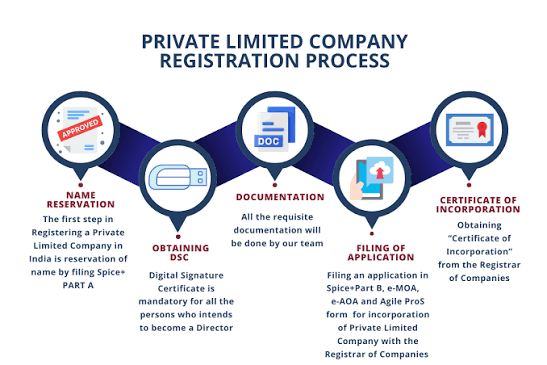
How to Register a Private Limited Company in India
The incorporation process is largely electronic. Applications are submitted through the MCA’s prescribed systems, with the exact forms and supporting requirements depending on the proposed company and its subscribers or directors.
Step 1: Obtain the Required Digital Signatures
Company incorporation documents are filed electronically. The individuals required to sign the relevant forms therefore need the appropriate digital signing facility.
A Digital Signature Certificate, or DSC, is used to authenticate electronic documents. The exact DSC requirements depend on the filing.
Step 2: Decide the Company’s Basic Structure
Before filing, the founders should agree on the proposed name, business objects, registered office, directors, shareholders, authorised capital and initial shareholding.
The shareholding ratio should be discussed carefully. A clear founder structure can prevent disagreements over ownership later.
Where there are multiple founders, a founder-focused business legal service can also help identify related documentation needs.
Step 3: Choose and Reserve the Company Name
The proposed name must comply with the Companies Act and applicable incorporation rules. It should not be deceptively similar to an existing company or LLP, or improperly conflict with a protected trademark.
Company-name approval and trademark registration are different processes. MCA approval does not by itself give the company exclusive trademark rights over a brand.
Founders should therefore conduct both company-name and trademark checks before finalising a brand.
Step 4: Prepare the MOA and AOA
The Memorandum of Association, or MOA, sets out important details about the company’s constitution and objects. The Articles of Association, or AOA, contain rules governing internal management.
These documents should reflect the actual business structure and the founders’ intended ownership arrangement.
Step 5: File the Incorporation Application with MCA
The SPICe+ system is used for company incorporation. The application captures information about the proposed company, subscribers, directors, registered office and other required particulars.
Linked forms and electronic versions of the MOA and AOA may also form part of the incorporation process.
Step 6: Respond to MCA Queries, If Any
The MCA reviews the application. If there is an issue with the proposed name, documents, declarations or other information, the application may require clarification or resubmission.
Careful preparation can reduce avoidable errors. Founders should ensure that names, addresses, identification documents and declarations are consistent across the application.
Step 7: Receive the Certificate of Incorporation
After approval, the company receives its Certificate of Incorporation and Corporate Identity Number, or CIN. PAN and TAN are also allotted through the integrated incorporation process where applicable.
The Certificate of Incorporation confirms that the company has been incorporated as a legal entity.
Step 8: Complete Post-Incorporation Formalities
Incorporation does not end the company’s legal responsibilities. Depending on the company and its activities, founders may need to complete requirements concerning the bank account, share capital, commencement of business, GST, accounting and other registrations.
Where Section 10A of the Companies Act applies, the company must also comply with the prescribed commencement-of-business declaration within the applicable statutory period.
Can I Register a Pvt Ltd Company by Myself?
Yes, founders can handle much of the incorporation process themselves because the MCA system is online. However, the process includes forms, declarations, electronic signatures and supporting documents.
Some filings or documents may also require professional certification or involvement, depending on the circumstances. Therefore, DIY incorporation does not necessarily mean that professional involvement can be avoided in every case.
DIY Registration vs Professional Assistance
- DIY: potentially lower professional cost, but the founder manages documents, forms, payments and follow-ups.
- Professional assistance: useful for document checks, filing, MCA queries and resubmissions.
Professional assistance can be particularly useful where there are foreign shareholders, multiple founders, complex ownership arrangements or unusual business activities.
Lawizer provides Private Limited Company incorporation support for founders who want assistance with the process.
How Much Does Private Limited Company Registration Cost in India?
The total cost is not identical for every company. It can include MCA filing fees, stamp duty, name-reservation charges where applicable, PAN and TAN-related charges, and professional or facilitation fees.
MCA Name Approval Fees
If a proposed company name is reserved separately through SPICe+ Part A, MCA’s published guidance specifies a ₹1,000 name-reservation fee.
Government fees can change. Founders should verify the amount displayed on the MCA portal before making payment.
Government Incorporation Fees
MCA fees can depend on the authorised share capital and applicable rules. State stamp duty can also vary according to the state in which the company is incorporated.
MCA guidance provides a zero filing-fee concession for eligible companies with authorised capital up to ₹15 lakh. Applicable stamp duty still needs to be considered.
This is why a quoted incorporation package should not automatically be treated as the complete government cost for every company.
Professional or Facilitation Fees
Professional charges vary according to the service provider and the complexity of the incorporation.
Before paying, check whether the quoted amount includes DSC, government charges, stamp duty, document preparation and post-incorporation assistance.
Lawizer’s startup and business legal services cover incorporation and several related registrations.
How Do I Pay MCA Fees?
MCA fees are generally paid electronically during the filing process. A consolidated challan is generated for applicable charges.
Founders should retain the payment acknowledgement and challan with the company’s incorporation records.
Which Is Better: Pvt Ltd or LLP?
There is no universal answer. The better structure depends on the founders, funding plans, ownership model, business activity and compliance requirements.
When a Private Limited Company May Be Better
- You plan to raise equity investment.
- You need a clear shareholding structure.
- You expect to add investors or shareholders.
- You want a structure suited to a scalable startup.
- You may introduce employee equity arrangements.
When an LLP May Be Better
- The business is partner-driven.
- The founders prefer partnership-style operational flexibility.
- The business does not currently require an equity-investment structure.
- The founders want a different compliance framework.
Lawizer also provides LLP registration services for businesses considering this alternative.
Which Is Better: Pvt Ltd or LLC?
“LLC” generally refers to a Limited Liability Company structure used in countries such as the United States. It is not the standard Indian equivalent of a Private Limited Company.
For an Indian business, the more relevant comparison is usually between a Private Limited Company and an LLP. If the business will operate overseas, local legal and tax rules should be reviewed before selecting an entity.
What Are the Disadvantages of a Private Limited Company?
A private company offers useful benefits, but it also creates continuing compliance responsibilities.
- More statutory compliance than informal business structures.
- Annual corporate and financial filings.
- Maintenance of statutory records and registers.
- Professional accounting, audit and filing costs.
- Formal procedures for changes in directors and shareholding.
- Potential additional fees or penalties for missed compliance.
These obligations may be worthwhile for a startup seeking investment or rapid growth. For a very small business with no plans for external investment, another structure may sometimes be more appropriate.
How Much Income Tax Does a Pvt Ltd Company Pay?
Incorporation does not itself create a fixed income-tax payment. The company is taxed on its taxable income under the applicable corporate tax provisions.
For AY 2026-27, official Income Tax Department guidance lists different rates for domestic companies depending on the applicable regime and eligibility. These can include 22% under Section 115BAA, 25% in specified cases and 30% where the concessional provisions do not apply. Surcharge and health and education cess may also apply.
The 22% Section 115BAA regime has conditions. A company should therefore evaluate its eligibility before choosing it.
Company Tax and Founder Tax Are Different
A company is a separate taxpayer. A founder may have separate tax consequences on salary, remuneration, interest, dividends or capital gains received from the company.
Therefore, founders should not compare corporate tax with personal income tax by looking at one headline rate.
Who Pays More Tax: Pvt Ltd or LLP?
For AY 2026-27, an LLP is generally taxable at 30%, subject to applicable surcharge and cess. A domestic company can fall under different corporate tax regimes.
This does not automatically mean that one structure is always more tax-efficient. The final outcome depends on profits, deductions, distributions, remuneration, compliance costs and the business model.
Is GST Mandatory for a Private Limited Company?
No. Incorporating a Private Limited Company does not automatically mean that GST registration is required.
GST registration depends on factors such as aggregate turnover, the nature of supplies, the location of the business and situations where registration becomes compulsory under GST law.
Who Is Eligible for GST Registration?
Businesses that cross the applicable GST registration threshold may need to register. Certain categories can also require registration under compulsory-registration provisions even when turnover is below a normal threshold.
Lawizer provides GST registration assistance for businesses that need help with the application and documentation.
What Is the GST Turnover Threshold?
The commonly quoted ₹20 lakh threshold should not be treated as a universal rule for every business.
For many suppliers of services, the threshold is ₹20 lakh, subject to applicable rules. A higher ₹40 lakh threshold can apply to eligible suppliers of goods in specified states. Special-category states and compulsory-registration situations can have different rules.
The nature of the supply matters. Founders should check the current GST provisions before relying on a threshold exemption.
Do I Need to Pay GST If Turnover Is Below ₹20 Lakhs?
Not necessarily. If the applicable threshold has not been crossed and no compulsory-registration provision applies, GST registration may not be required solely because the business is incorporated as a company.
However, interstate supplies, specified categories of suppliers and other statutory conditions can change the position.
Can I File GST Without a CA?
Yes. A taxpayer can apply for GST registration through the GST portal without necessarily appointing a CA for the application.
Professional assistance can still be useful when the business has complex transactions, multiple registrations, input-tax-credit questions or other compliance issues.
How Much Does a CA Charge for GST Registration?
There is no single government-fixed professional fee for GST registration. CA and other professional charges vary according to the provider, location, documentation and complexity.
Before engaging a professional, ask for a clear breakdown of professional fees and government charges.
How Much GST Is Applicable on ₹10 Lakhs?
GST is not calculated from turnover alone. The applicable rate depends on the goods or services supplied and whether those supplies are taxable, exempt or zero-rated.
For example, if ₹10 lakh represents taxable supplies that are entirely subject to an 18% GST rate and ₹10 lakh is exclusive of GST, the output GST would be ₹1.8 lakh before eligible input tax credit.
If ₹10 lakh is already GST-inclusive at 18%, the GST component would be approximately ₹1.53 lakh. These are illustrations, not a calculation for every business.
What Happens After Company Incorporation?
Receiving the Certificate of Incorporation is the beginning of the company’s compliance journey. Founders should establish systems for accounting, tax, corporate records and statutory filings from the start.
Important Post-Incorporation Tasks
- Open and operate the company’s bank account.
- Complete applicable share-capital formalities.
- Complete commencement-of-business requirements where applicable.
- Set up bookkeeping and accounting systems.
- Apply for GST registration if required.
- Consider Startup India registration if the business qualifies.
- Consider MSME/Udyam registration if eligible.
- Protect the business name and brand through trademark registration.
Annual Compliance for a Private Company
Private companies have continuing obligations under company law. These can include maintaining statutory records, holding required meetings, preparing financial statements, obtaining an audit where applicable and filing prescribed ROC forms.
Companies also need to meet their applicable income-tax and GST obligations.
Lawizer provides an annual compliance service for Private Limited Companies covering recurring corporate compliance and filing support.
Frequently Asked Questions About Private Limited Company Registration
Who Is Eligible for a Private Limited Company?
Generally, at least two members and two directors are required for an ordinary private company. The company must also satisfy registered-office, name and documentation requirements.
Can I Register a Pvt Ltd Company by Myself?
Yes, founders can complete much of the online process themselves. However, certain filings may require professional certification or prescribed involvement. Professional assistance can also reduce documentation and filing errors.
How Do I Register a Pvt Ltd Company on MCA?
The process generally involves deciding the company structure, preparing the name and founder details, obtaining required digital signatures, filing the SPICe+ incorporation application, submitting supporting documents, responding to MCA queries if necessary and receiving the Certificate of Incorporation after approval.
What Are the MCA Name Approval Fees?
If a proposed name is reserved separately through SPICe+ Part A, MCA guidance specifies a ₹1,000 name-reservation fee. Always verify the current amount on the MCA portal before payment.
Which Is Better: Pvt Ltd or LLP?
A Pvt Ltd company is often suitable for startups seeking equity investment and a share-based ownership structure. An LLP may suit partner-driven businesses that prefer a different compliance and management framework.
Which Is Better: Pvt Ltd or LLC?
For an Indian business, LLP is generally the more relevant comparison. LLC is primarily a business structure used in jurisdictions such as the United States and has different legal and tax rules.
What Are the Disadvantages of a Private Limited Company?
The main disadvantages are higher compliance, annual filings, statutory records, audit requirements where applicable and ongoing accounting or professional costs.
Who Pays More Tax: Pvt Ltd or LLP?
There is no universal answer. For AY 2026-27, LLPs are generally taxed at 30%, while domestic companies may fall under different corporate tax regimes. The appropriate structure depends on the business’s circumstances.
How Much Income Tax Does a Pvt Ltd Company Pay?
For AY 2026-27, domestic companies can fall under rates such as 22% under Section 115BAA, 25% in specified cases or 30% under applicable general provisions, before surcharge and cess. Eligibility and conditions should be checked before selecting a regime.
Is GST Mandatory for a Pvt Ltd Company?
No. Incorporation does not automatically require GST registration. GST depends on turnover, the nature of supplies and other mandatory-registration provisions.
Can I File GST Without a CA?
Yes. A taxpayer can generally apply through the GST portal without appointing a CA. Professional help may still be useful for complex registrations and compliance.
How Much Does a CA Charge for GST Registration?
There is no universal CA fee. Professional charges vary according to the provider, location, documentation and complexity of the registration.
Do I Need to Pay GST If Turnover Is Below ₹20 Lakhs?
Not automatically. If the applicable threshold has not been crossed and no compulsory-registration rule applies, GST registration may not be required. The nature of the business and supplies must also be considered.
How Much Turnover Is GST-Free?
There is no single GST-free turnover limit for every business. Common thresholds include ₹20 lakh for many suppliers of services and, where applicable, ₹40 lakh for eligible suppliers of goods in specified states. Exceptions and compulsory-registration rules can apply.
How Much GST Is Applicable on ₹10 Lakhs?
The applicable GST depends on the rate for the relevant goods or services. At an illustrative 18% rate on ₹10 lakh of taxable value exclusive of GST, the output tax would be ₹1.8 lakh before eligible input tax credit.
Ready to Register Your Company?
Choosing the right legal structure at the beginning can help avoid unnecessary restructuring later. A Private Limited Company can be a strong option for founders who want limited liability, formal shareholding, investor readiness and a structure designed for growth.
However, incorporation should be considered alongside taxation, GST, intellectual-property protection and ongoing compliance.
Ready to start? Get assistance with Private Limited Company registration through Lawizer and get support with incorporation, documentation and related business registrations.
You can also explore Lawizer’s startup and business legal services, annual compliance support, trademark registration and business-law guides as your company grows.
Disclaimer: Company law, tax and GST rules can change. This article provides general educational information and should not be treated as personalised legal, tax or financial advice. Verify the current requirements applicable to your business before filing.
Lawizer Private Limited Company Registration