Tag: copyright registration

  • Copyright Registration in India : Cost & Process

    Copyright Registration in India : Cost & Process

    Copyright registration in India is an important way for creators, founders and businesses to document ownership of original creative work. Books, software, photographs, artwork, music, films, website content and other eligible works can have significant commercial value.

    Under Indian copyright law, copyright generally arises automatically when an original eligible work is created. Registration is therefore not mandatory for copyright to exist. However, registration can provide an official record and serve as useful prima facie evidence concerning ownership in a dispute.

    This guide explains what copyright protects, whether registration is compulsory, how to apply online, the applicable government fees, the documents generally required, the registration timeline and practical ways to protect your creative work.

    What Is Copyright Registration in India?

    Copyright protects original expression in qualifying creative works. The Copyright Act, 1957 covers literary, dramatic, musical and artistic works, cinematograph films and sound recordings. Computer programmes are treated as literary works under the Act.

    For a business, copyright may be relevant to assets such as:

    • Website articles and original written content
    • Software and source code
    • Photographs and illustrations
    • Advertising videos
    • Training manuals and educational material
    • Music and sound recordings
    • Books and other literary works

    Copyright protects the original expression of an idea rather than the idea itself. This distinction is important when deciding whether a work is suitable for registration.

    If you also want to protect your business name, logo or other brand identifier, consider Trademark Registration with Lawizer. Copyright and trademark protection address different types of intellectual property.

    Is Copyright Registration Mandatory in India?

    No. Copyright registration is not mandatory for copyright protection to arise.

    The official IP India guidance states that copyright protection generally arises automatically when an eligible original work is created. Registration is not a prerequisite for acquiring copyright.

    However, registration has an important evidentiary benefit. An entry in the Register of Copyrights can serve as prima facie evidence in court regarding particulars recorded in the register.

    In simple terms:

    • Copyright protection: Can arise automatically when an eligible original work is created.
    • Copyright registration: Creates an official record that may help establish ownership and other particulars.

    For commercially valuable work, registration may therefore be worth considering even though it is not compulsory.

    What Can Be Copyrighted in India?

    Section 13 of the Copyright Act, 1957 identifies the principal categories of works in which copyright may subsist.

    These include:

    • Literary works
    • Dramatic works
    • Musical works
    • Artistic works
    • Cinematograph films
    • Sound recordings

    Can Software Be Protected by Copyright?

    Yes. Computer programmes are treated as literary works for copyright purposes. Software developers and technology businesses can therefore consider copyright protection for eligible original software and source code.

    Because software ownership can involve founders, employees, freelancers and contractors, businesses should also maintain clear written ownership arrangements.

    Lawizer’s startup legal services can help businesses organise their broader legal documentation and compliance requirements.

    Can Books and Written Content Be Copyrighted?

    Yes. Original literary works can qualify for copyright protection. This can include books, articles, manuals, training material and other qualifying written works.

    Authors and publishers should also keep evidence of authorship, creation and ownership. Contracts become particularly important when a work is created or edited by multiple people.

    Can Photographs, Artwork and Designs Be Copyrighted?

    Original artistic works may qualify for copyright protection. This can include photographs, drawings, paintings, illustrations, diagrams and other qualifying artistic creations.

    However, copyright protection should not be confused with design registration or trademark protection. The appropriate form of intellectual property protection depends on the nature and intended use of the asset.

    Can Music, Sound Recordings and Films Be Copyrighted?

    Yes. Musical works, sound recordings and cinematograph films are recognised categories under the Copyright Act.

    Businesses in music, advertising, film and digital media should pay particular attention to contracts because several people may contribute to the final work.

    What Is Not Protected by Copyright?

    Copyright protects original expression. It does not generally protect an idea, procedure, method of operation or mathematical concept as such.

    For example, suppose an entrepreneur has an idea for a food-delivery application. The general idea of delivering food through an app is not itself protected by copyright.

    However, original elements created to implement that idea, such as qualifying software code, photographs, written material and artwork, may receive copyright protection.

    Are Names and Titles Protected by Copyright?

    Names, titles and short phrases generally do not receive copyright protection merely because they have been created by someone.

    If you want to protect a distinctive business name, logo or brand identifier, trademark law may be more appropriate.

    Read Lawizer’s guide on Trademark Registration in India to understand how trademark protection differs from copyright.

    How to Get Copyright Registration in India

    The Copyright Office provides an online filing facility for copyright applications. The application is made using the prescribed form and supporting particulars.

    Step 1: Identify the Work

    First, determine the category of work you want to register.

    • Literary work
    • Artistic work
    • Musical work
    • Dramatic work
    • Sound recording
    • Cinematograph film

    The category matters because the filing requirements and statutory fee can differ.

    Step 2: Identify the Author and Copyright Owner

    The author and copyright owner are not always the same person.

    For example, a startup may hire a freelancer to create its website illustrations or source code. The business should review its contract to determine how ownership and rights have been addressed.

    Where intellectual property is created by founders, employees or contractors, a properly drafted IP assignment agreement can help document the intended transfer of rights.

    This issue is particularly important during investment or due diligence because investors may want evidence that the company actually owns the intellectual property it relies upon.

    Step 3: Prepare Form XIV

    Applications for copyright registration are made using Form XIV, together with the applicable Statement of Particulars and, where required, Statement of Further Particulars.

    The official Form XIV requires information about the applicant, the work, the copyright interest and the prescribed fee.

    You can review the official Form XIV issued by the Copyright Office.

    Step 4: Prepare the Work and Supporting Documents

    The material submitted depends on the category of work.

    Applicants should generally keep ready:

    • Details of the applicant
    • Details of the author, where different
    • Details of ownership or interest in the work
    • Copy or specimen of the work as applicable
    • Publication details, where applicable
    • Identity or other supporting documents where required
    • Power of Attorney or authorisation, where an agent is filing on behalf of the applicant

    The exact requirements should be checked against the current Copyright Office instructions before filing.

    Step 5: File the Application Online

    The Copyright Office provides an online filing system through which applicants can submit the application and supporting material.

    After submission and payment of the applicable fee, a Diary Number is generated. The Diary Number is useful for tracking the application and future correspondence.

    Use the official Copyright Office e-filing portal for the current filing process.

    Step 6: Wait Through the Objection Period

    After the application receives a Diary Number, there is a mandatory 30-day period during which objections may be filed against the application.

    If an objection is filed, the Registrar may give the concerned parties an opportunity of being heard before deciding whether the work should be registered.

    Step 7: Examination and Rectification

    If no objection is filed, the application proceeds to examination.

    If the examiner identifies a discrepancy, the applicant may be asked to address it. The official IP India FAQ states that an applicant is ordinarily given 45 days to remove discrepancies identified during examination.

    The overall timeline can therefore vary depending on the application, objections, discrepancies and the applicant’s response.

    Step 8: Copyright Registration Certificate

    If the Registrar is satisfied with the application and the applicable requirements are completed, the work can be entered in the Register of Copyrights.

    The applicant can then receive the copyright registration certificate. The registration record can be useful as documentary evidence concerning the registered work and recorded ownership particulars.

    Can I Register My Copyright Online in India?

    Yes. Online filing is available through the Copyright Office.

    The basic process involves:

    1. Creating or accessing an account on the Copyright Office portal.
    2. Selecting the relevant copyright registration option.
    3. Completing Form XIV and the applicable statements.
    4. Uploading the required material.
    5. Paying the prescribed government fee.
    6. Receiving the Diary Number.
    7. Responding to any objection or examination query, if applicable.

    Applicants should use the current official portal and instructions because filing requirements can change.

    If you prefer professional assistance, Lawizer’s Copyright Registration service provides online facilitation for the registration process.

    What Is the Cost of Copyright Registration in India?

    The government fee depends on the type of work. The Copyright Office’s current fee details list the following registration fees:

    Type of WorkGovernment Fee
    Literary, dramatic, musical or artistic work₹500 per work
    Literary or artistic work used or capable of being used in relation to goods or services₹2,000 per work
    Cinematograph film₹5,000 per work
    Sound recording₹2,000 per work

    These are statutory government fees. If you use a lawyer or legal service provider, professional or facilitation charges are separate.

    Always verify the current fee on the official Copyright Office fee page before filing.

    Can You Get Copyright for Free?

    There is an important difference between copyright protection and copyright registration.

    Copyright protection can arise automatically when an original eligible work is created. You do not have to pay a registration fee simply for copyright to come into existence.

    However, if you choose to register the work with the Copyright Office, the prescribed government fee applies.

    Therefore, copyright protection may arise without registration, but copyright registration is a paid statutory filing process.

    How Does Copyright Protect Your Work?

    Copyright gives the owner certain exclusive rights recognised by the Copyright Act. Depending on the type of work, these rights can include reproduction, issuing copies, communication to the public, adaptation and translation.

    For a business, these rights can have direct commercial value.

    For example:

    • A software company may own copyright in qualifying source code.
    • A publishing business may own rights in original written content.
    • A design studio may own rights in original artwork.
    • A production company may hold rights in audiovisual material.

    Registration does not automatically guarantee success in every infringement dispute. Instead, it can provide useful documentary evidence of the registered particulars and ownership claim.

    How Do I Protect My Book From Being Copied?

    A book can qualify as a literary work when it satisfies the requirements of copyright law.

    Authors can take several practical steps:

    • Keep dated drafts and manuscripts.
    • Preserve emails and files showing the development of the work.
    • Record who contributed to the work.
    • Use written agreements with publishers, editors and collaborators.
    • Clearly define ownership and licensing rights.
    • Consider copyright registration for commercially important work.

    If a publisher, freelancer or other third party is involved, the contract should clearly address intellectual property ownership.

    Lawizer also provides documentation support through its business legal services.

    Can I Publish My Book Without Copyright Registration?

    Yes. Copyright registration is not generally a prerequisite to publishing an original book.

    Copyright can arise automatically in an eligible original literary work.

    However, authors should make sure they have the necessary rights in all material included in the book. Photographs, illustrations, music, quotations and other third-party content may involve separate rights.

    Publishing without registration does not mean that someone else can lawfully copy the book. The important issue is whether the work is protected and who owns the relevant rights.

    Can I Print a Book and Sell It Without Copyright Registration?

    If you own the copyright or have the necessary rights to reproduce and distribute the book, registration is not generally a legal prerequisite to selling copies.

    The situation is different if the book belongs to someone else. Printing and selling another person’s copyrighted work without the required permission can amount to infringement.

    The absence of a registration certificate does not make another person’s protected work free to copy.

    Which Books Have No Copyright?

    Copyright protection has a limited statutory term. For many literary works, the general rule is the author’s lifetime plus 60 years, subject to the provisions and exceptions under the Copyright Act.

    After the applicable term expires, the work may enter the public domain.

    However, an old book is not automatically free to reproduce. You should consider the copyright status of the particular work, translation, adaptation, illustrations and edition before reproducing it commercially.

    What Author Was Rejected 23 Times?

    Frank Herbert’s Dune is commonly cited in publishing discussions as having faced 23 rejections before publication.

    This anecdote is unrelated to the legal requirements for copyright registration. A publisher’s rejection does not determine whether an author’s original work qualifies for copyright protection.

    An author can have copyright in an eligible original work even before finding a publisher.

    Copyright Registration vs Trademark Registration

    Copyright and trademark protection are different forms of intellectual property protection.

    CopyrightTrademark
    Protects qualifying original creative expressionProtects distinctive brand identifiers
    Can cover books, artwork, software, music and filmsCan cover names, logos, slogans and other marks
    Protection generally arises automatically for eligible original worksRegistration provides statutory rights in the registered mark
    Useful for creative and content assetsUseful for brand identity

    A startup may need both types of protection.

    For example, a fashion business may consider trademark protection for its brand name and logo while separately assessing copyright protection for its original photographs, website content and artwork.

    See Lawizer’s Trademark Registration service for more information about protecting a business brand.

    Common Copyright Registration Mistakes to Avoid

    Trying to Register an Idea

    Copyright protects qualifying expression, not an idea or concept by itself.

    Confusing Copyright With Trademark Protection

    A business name and an original creative work are different intellectual property assets. Depending on the circumstances, you may need copyright registration, trademark registration or both.

    Ignoring IP Ownership Agreements

    If a freelancer, employee, contractor or agency creates work for your business, do not assume that payment alone resolves every ownership question.

    Use appropriate written agreements that clearly address intellectual property ownership, assignment and permitted use.

    Lawizer’s guide to freelance contracts in India also explains why IP ownership clauses matter when founders work with freelancers.

    Submitting Incorrect or Incomplete Material

    Different categories of copyright works have different filing requirements. Review the current Copyright Office instructions before submitting the application.

    Assuming Registration Guarantees Every Dispute

    Registration can provide important evidence, but it does not eliminate the need to establish the relevant facts if a dispute arises.

    Frequently Asked Questions About Copyright Registration in India

    Is it mandatory to register copyright in India?

    No. Copyright generally arises automatically when an eligible original work is created. Registration is optional, although registration can provide useful documentary evidence of ownership.

    Can copyright be claimed without registration?

    Yes. Registration is not a prerequisite for acquiring copyright in an eligible original work. However, registration may provide additional evidentiary value.

    Can I register my copyright online in India?

    Yes. The Copyright Office provides an online e-filing facility. Applicants can complete the prescribed application, upload the required material, pay the applicable fee and receive a Diary Number.

    What are the five things that can be copyrighted?

    A simplified list often mentions literary, dramatic, musical, artistic and audiovisual works. Legally, the principal categories under Section 13 include literary, dramatic, musical and artistic works, cinematograph films and sound recordings.

    What is not allowed in copyright?

    Copyright does not generally protect ideas, procedures, methods of operation or mathematical concepts as such. It protects qualifying original expression.

    Which item is not protected by copyright?

    Ideas, facts, methods and procedures are generally not protected merely as such. Names, titles and short phrases also generally do not receive copyright protection on their own.

    How do I protect my book from being copied?

    Maintain evidence of creation and ownership, use appropriate contracts, consider registration and ensure that third-party content is used only with the necessary permission or licence.

    Can I publish my book without copyright registration?

    Yes. Registration is not generally required before publication. Copyright can arise automatically in an eligible original literary work.

    Can I just print a book and sell it?

    You can generally reproduce and sell a book if you own the relevant rights or have permission to do so. You cannot assume that another person’s work is free to reproduce simply because it has not been registered.

    Which books have no copyright?

    Books whose copyright term has expired may be in the public domain. However, the status of a particular translation, adaptation, edition or illustration should be checked separately.

    What author was rejected 23 times?

    Frank Herbert’s Dune is commonly cited as having been rejected 23 times before publication. The anecdote does not affect the copyright status of an author’s original work.

    How do I get a copyright registration certificate?

    File the prescribed application with the required work and supporting information, pay the applicable statutory fee and complete the examination process. If the application is approved, the work is entered in the Register of Copyrights and the registration certificate is issued.

    What is the cost of copyright registration in India?

    The government fee depends on the type of work. The current official schedule lists ₹500 for literary, dramatic, musical or artistic works, ₹2,000 for certain literary or artistic works used or capable of being used in relation to goods or services, ₹5,000 for cinematograph films and ₹2,000 for sound recordings.

    How long does copyright registration take?

    There is a mandatory 30-day period after the Diary Number during which objections may be filed. If there is no objection, the application proceeds to examination. The overall timeline can vary depending on discrepancies, objections and responses.

    The official IP India FAQ states that, in the normal course, registration may take around 2 to 3 months, although individual applications can take longer depending on the circumstances.

    Can software be registered under copyright law?

    Yes. Computer programmes are treated as literary works for copyright purposes. Applicants should follow the current Copyright Office requirements for submitting software and source-code material.

    Protect Your Creative Work With Lawizer

    Your intellectual property can become one of the most valuable assets of your business. Whether you are a founder, author, designer, software developer, musician or content creator, documenting ownership early can help reduce avoidable disputes later.

    Copyright registration is not mandatory for copyright to exist. However, registration can create an official record and provide useful evidence concerning the registered work and recorded ownership particulars.

    If you need help understanding eligibility, preparing documents or filing an application, explore Lawizer’s Copyright Registration service.

    If your business also needs brand protection, you can explore Trademark Registration.

    For agreements dealing with ownership, confidentiality and commercial use of intellectual property, explore Lawizer’s business documentation and legal services.

    You can also read more practical guidance in the Lawizer legal blog.

    Related Lawizer resources:

    Official Sources

    This article is provided for general informational purposes and does not constitute legal advice. Copyright law, government fees, forms and filing requirements may change. Always verify the latest requirements with the Copyright Office before filing.
  • Trademark vs Copyright vs Patent

    Trademark vs Copyright vs Patent

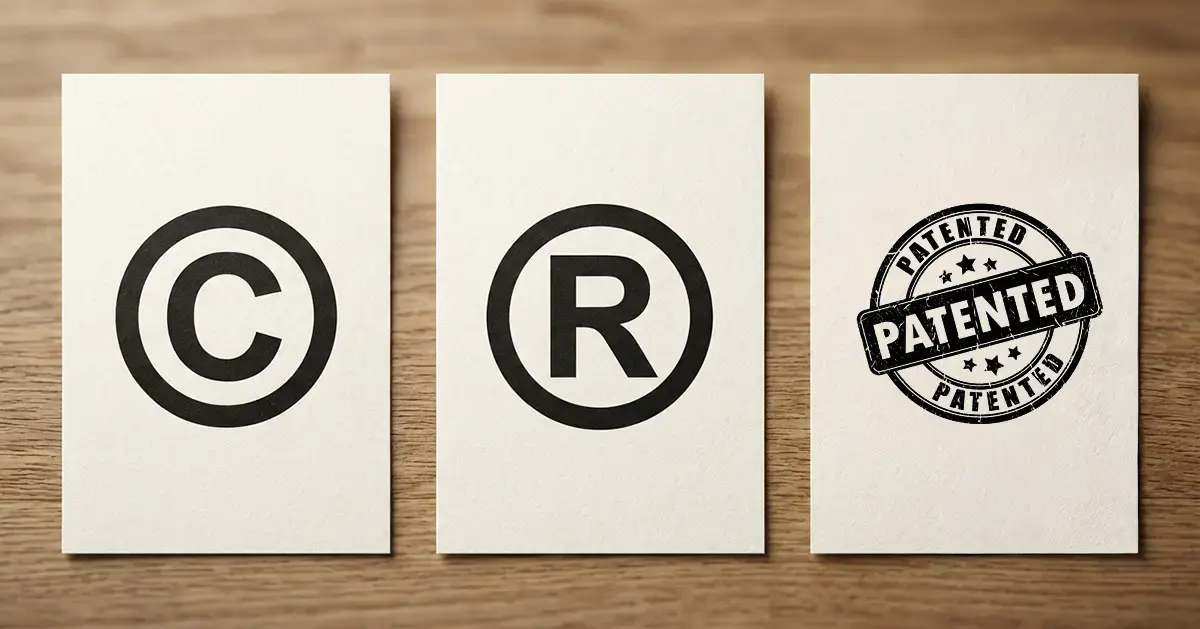
    Trademark vs Copyright vs Patent: Key Differences

    Trademark vs copyright vs patent is an important distinction for Indian founders and small-business owners who want to protect their brand, creative work, product design or invention. Although all three are forms of intellectual property protection, they protect different kinds of assets and give different legal rights.

    A trademark generally protects a distinctive sign used to identify and distinguish goods or services. Copyright protects original creative expression, such as writing, artwork, music, films and computer programs. A patent protects a qualifying invention that satisfies the legal requirements for patentability.

    Understanding the difference before launching a product, building a brand or publicly disclosing an invention can help a business choose the right protection. In some cases, one business may need more than one form of intellectual property protection.

    Trademark vs Copyright vs Patent: What Is the Difference?

    The simplest way to understand the difference is to ask what exactly you are trying to protect.

    • Trademark: Protects distinctive signs that identify and distinguish goods or services.
    • Copyright: Protects original creative expression in qualifying works.
    • Patent: Protects qualifying inventions that meet the requirements of patent law.

    For example, if a startup creates a new brand name, the name may be considered for trademark protection. Its website articles, photographs, videos and original software may be protected by copyright if the statutory requirements are met. If the startup develops a genuinely new technical invention that satisfies patentability requirements, patent protection may also be relevant.

    These rights are not interchangeable. The appropriate protection depends on the nature of the intellectual property, how it is used and the legal requirements applicable to it.

    Trademark vs Copyright vs Patent in India

    In India, trademarks are primarily governed by the Trade Marks Act, 1999. Copyright is governed by the Copyright Act, 1957, while patents are governed by the Patents Act, 1970.

    The official IP India patent guidance explains the basic principles of patent protection. The official IP India trademark guidance provides information on trademarks and their renewal. For copyright matters, businesses can refer to the official Copyright Office website.

    While these laws all fall within the broader field of intellectual property, their objectives are different. A trademark is closely connected with commercial source identification. Copyright is concerned with original expression. Patent law is concerned with qualifying inventions and the temporary exclusive rights granted to their owners.

    What Does a Trademark Protect?

    A trademark helps distinguish the goods or services of one business from those of another. Depending on the circumstances and applicable law, a trademark can include a word, name, logo, symbol, slogan, shape or other distinctive sign.

    For a business, a trademark is closely connected to brand identity. Customers may recognise a company through its name, logo, tagline or other distinctive branding.

    Examples of Assets That May Need Trademark Protection

    • Business or brand names
    • Logos and distinctive symbols
    • Slogans and taglines
    • Distinctive marks used in relation to goods or services

    Trademark protection is connected to the goods or services for which the mark is registered. Choosing the appropriate class and describing the goods or services carefully are therefore important parts of a trademark application.

    If you are preparing to launch a new brand, consider conducting a trademark search before investing heavily in packaging, advertising, websites and other brand assets.

    Lawizer provides trademark registration services for businesses and founders looking to protect their brand identity.

    What Does Copyright Protect?

    Copyright protects original expression rather than an idea by itself. Under the Copyright Act, 1957, copyright can apply to original literary, dramatic, musical and artistic works, as well as cinematograph films and sound recordings.

    The Copyright Office also recognises computer programs within the statutory category of literary works. This can be particularly relevant to technology businesses, software developers, agencies and digital businesses.

    What Are Three Things That Can Be Copyrighted?

    There are many categories of copyrightable works. Three straightforward examples are:

    • Written content: Articles, books, reports and other original literary works.
    • Visual works: Original artwork, photographs, drawings and other artistic works.
    • Software: Computer programs and source code can qualify for copyright protection as literary works.

    Other examples include music, films and sound recordings, subject to the requirements of the Copyright Act.

    Copyright protection generally arises automatically when an original work is created. Registration is not a prerequisite for copyright to exist. However, registration can create an official record and may provide useful evidence in disputes concerning ownership.

    You can learn more about copyright registration through Lawizer.

    What Does a Patent Protect?

    A patent protects a qualifying invention. Under Indian patent law, an invention generally needs to satisfy requirements such as novelty, inventive step and industrial applicability, while also falling within patentable subject matter under the Patents Act.

    IP India describes a patent as an exclusive right granted for an invention. In India, the term of a patent is generally twenty years from the date of filing, subject to the provisions of the Patents Act and applicable renewal requirements.

    Examples of Things That May Be Considered for Patent Protection

    • A new technical product
    • A qualifying new manufacturing process
    • A technical improvement that satisfies patentability requirements
    • A technological solution to a technical problem

    Not every new idea qualifies for a patent. Patentability has to be assessed against the statutory requirements and exclusions under Indian patent law.

    Founders should also be careful about publicly disclosing a potentially patentable invention before obtaining appropriate advice. The timing of disclosure can be important to patent strategy.

    Trademark vs Copyright vs Patent: Comparison Table

    Feature Trademark Copyright Patent
    Main purpose Protects brand identifiers Protects original creative expression Protects qualifying inventions
    Typical examples Brand name, logo, slogan Writing, artwork, music, films, software New product or technical process
    Registration Registration provides statutory trademark rights Copyright exists automatically; registration is available Patent rights arise through the statutory grant process
    Indian law Trade Marks Act, 1999 Copyright Act, 1957 Patents Act, 1970
    General duration 10 years per registration period, renewable Varies according to the type of work Generally 20 years from filing
    Best suited for Brand identity Creative content and expression Qualifying technical inventions

    The exact scope and duration of protection can depend on the asset and applicable statutory provisions. The table is therefore a practical overview rather than a substitute for legal advice.

    Is Coca-Cola a Trademark or Copyright?

    A brand such as Coca-Cola illustrates why different intellectual property rights should not be confused.

    The brand name and distinctive branding are primarily relevant to trademark protection. At the same time, particular creative materials associated with a brand, such as original advertising artwork, photographs or videos, may attract copyright protection if the statutory requirements are satisfied.

    This means that one business can have several forms of intellectual property protection covering different assets. The trademark does not automatically protect every creative work produced by the business.

    What Is the Most Famous Trademark?

    There is no single legally defined “most famous trademark”. Many international and Indian businesses have highly recognisable marks.

    For a founder, however, fame is not the main issue. A more important question is whether the proposed mark is distinctive, available for registration and appropriate for the goods or services you provide.

    A strong trademark strategy begins before a brand becomes widely known. Searching for conflicting marks before filing can help identify potential problems at an early stage.

    Is McDonald’s a Registered Trademark?

    McDonald’s is a globally recognised brand and its name and other brand elements are associated with trademark protection in multiple jurisdictions.

    However, trademark protection is jurisdiction-specific. A business should not assume that a mark is protected everywhere simply because it is famous internationally. Registration details, classes and rights can differ between countries.

    For an Indian business, the relevant question is whether the proposed mark is protected or available under Indian trademark law and in the relevant classes.

    Do I Need Copyright If I Have a Trademark?

    Possibly. Trademark and copyright protect different things.

    Suppose a startup creates a logo. The logo may have relevance under both trademark and copyright law, depending on the circumstances. Trademark protection can help protect the logo as a brand identifier, while copyright may protect qualifying original artistic expression in the logo.

    Similarly, a business name may be relevant to trademark law, while the website articles, photographs, illustrations and software created by the business may raise separate copyright issues.

    Therefore, having a trademark does not automatically protect all of the company’s creative content.

    Can Someone Steal My Logo If It Is Not Trademarked?

    Trademark registration is not the only legal issue that can arise when someone copies a logo. Depending on the facts, a logo may also involve copyright, passing off or other legal rights.

    However, failing to register a valuable brand asset can make enforcement more complicated. Trademark registration can provide statutory rights and evidence of the registered proprietor’s rights.

    Before launching an important brand, businesses should consider both trademark availability and ownership of the underlying creative work.

    Which Is Cheaper: Trademark or Copyright?

    There is no single answer because costs depend on the type of protection, applicant category, number of classes or works and other factors.

    Copyright protection itself does not require registration to come into existence. A business may nevertheless choose to register important works for evidentiary and commercial reasons.

    Trademark registration involves an application and prescribed government fees. Professional service fees may also apply if an applicant uses a lawyer, agent or legal service provider.

    Instead of choosing purely on price, founders should first identify the asset they are trying to protect. The least expensive option is not necessarily the appropriate form of protection.

    How Do You File for Copyright in India?

    Copyright registration applications can be submitted through the prescribed process of the Copyright Office. The Copyright Office provides online filing facilities and requires applicants to provide relevant application details and supporting material.

    For example, a computer program has specific requirements concerning the work submitted for registration. The Copyright Office provides guidance for registration of computer programs as literary works.

    The process broadly involves:

    • Identifying the work and the relevant category.
    • Preparing the prescribed application.
    • Providing the required details and supporting documents.
    • Paying the applicable statutory fee.
    • Responding to any objection or procedural issue, if applicable.

    For current forms, procedures and fees, applicants should verify the latest information on the official Copyright Office website.

    How Much Does It Cost to Get a Trademark?

    Trademark registration costs are not identical for every applicant. Government fees depend on factors such as the applicant category and number of classes involved.

    Professional service fees may also apply if an applicant engages an attorney, agent or legal service provider.

    Because government fees and procedures can change, founders should verify the current fee schedule before filing. Lawizer’s trademark registration service can assist with the filing process and related documentation.

    Can You Lose Copyright If You Do Not Protect It?

    Copyright does not generally disappear simply because the owner has not registered the work. Under Indian law, copyright protection arises automatically when an original work satisfies the statutory requirements.

    However, failing to document ownership can create practical difficulties when a dispute arises. Businesses should maintain records showing when works were created, who created them and how ownership was transferred or assigned.

    For businesses working with employees, freelancers, designers or agencies, written agreements can also be important for establishing ownership and permitted use of intellectual property.

    What Are Three Things Not Protected by Copyright?

    Copyright protects expression, not every form of information or idea. Examples of material that generally falls outside copyright protection include:

    • Ideas by themselves: A general idea or concept is not the same as protected expression.
    • Methods or procedures: Copyright does not ordinarily give a monopoly over a method of operation.
    • Short names and titles by themselves: A short name or phrase may not qualify for copyright protection merely because it is written down.

    The Copyright Office explains that copyright does not protect ideas, procedures, methods of operation or mathematical concepts as such. Other forms of intellectual property protection may sometimes be relevant depending on the circumstances.

    What Are Five Things That Can Be Copyrighted?

    Five common examples of works that may qualify for copyright protection in India are:

    • Original articles and written content
    • Original photographs and artwork
    • Music and musical works
    • Films and videos
    • Computer programs and software code

    Copyright protection depends on the statutory requirements and the nature of the particular work. Simply putting information into a document does not automatically make every element of that document copyrightable.

    Can You Protect the Same Business Asset With More Than One IP Right?

    Yes. Intellectual property rights can overlap in some situations.

    Consider a technology startup that develops a smart device. Its brand name may be protected through trademark law. Original website content, photographs and software code may be protected by copyright. A qualifying technical invention may be considered for patent protection. The visual appearance of a product may also raise industrial design considerations.

    The key point is that intellectual property protection should be asset-specific. Instead of asking which single registration protects the entire business, founders should identify each important asset and consider the legal protection that may apply.

    Which IP Protection Does Your Business Need?

    • Brand name or logo – Trademark
    • Article, artwork, video or software – Copyright
    • New technical invention – Patent
    • Multiple assets – More than one IP right may apply

    This simple framework can help founders begin an intellectual property audit. The correct protection may depend on the asset, how it is used, whether it has already been disclosed and the commercial objectives of the business.

    How Should a Startup Protect Its Intellectual Property?

    IP protection should not begin only when a dispute arises. Founders can take practical steps from the early stages of the business.

    1. Identify Your IP Assets

    Make a list of your brand names, logos, content, software, designs, inventions, domain names and confidential information.

    This helps you identify which assets may need registration and which require contractual or confidentiality protection.

    2. Keep Ownership Clear

    If founders, employees or freelancers create intellectual property, ownership should be documented appropriately.

    Businesses should avoid assuming that paying a freelancer automatically resolves every ownership issue. Written agreements should clearly address ownership, licences, permitted use and delivery of source files where relevant.

    3. Search Before You File

    For trademarks and patents, searches can help identify existing rights and potential conflicts before substantial money is spent on a filing or product launch.

    4. Avoid Unnecessary Public Disclosure

    If an invention may be patentable, founders should obtain appropriate advice before publicly disclosing technical details. Patent strategy can be affected by what has already been made public.

    5. Maintain Evidence

    Keep dated drafts, source files, invoices, contracts, development records and other evidence showing how and when intellectual property was created and who owns it.

    Trademark vs Copyright vs Patent: Which One Should You Choose?

    There is no universal answer. The right choice depends on what your business has created.

    If your primary asset is a brand identity, trademark protection is likely to be important. If your business creates original content, artwork, photographs, music, films or software, copyright may be relevant. If your business has developed a new technical invention, patent protection may need to be considered.

    Many businesses need a combination rather than just one form of protection.

    For example, a software startup may need trademark protection for its product name, copyright protection for its source code and website content, and potentially patent advice if it has developed a patentable technical invention.

    Frequently Asked Questions

    Is trademark the same as copyright?

    No. A trademark protects a distinctive identifier used to distinguish goods or services, while copyright protects qualifying original creative expression.

    Is a patent the same as a trademark?

    No. A patent protects qualifying inventions. A trademark protects distinctive signs associated with goods or services.

    Is copyright automatic in India?

    Generally, yes. Copyright protection arises automatically when an original work satisfies the statutory requirements. Registration is available but is not a prerequisite for copyright to exist.

    Do I need to register my trademark?

    If you want the statutory benefits associated with registered trademark rights, registration is important. Unregistered marks may have other legal protection in appropriate circumstances, but the nature of those rights differs from registered trademark protection.

    Can software be copyrighted in India?

    Yes. Computer programs are included within the definition of literary work under the Copyright Act, 1957. The Copyright Office provides a registration route for computer programs.

    Can an idea be copyrighted?

    Copyright generally protects the expression of an idea, not the idea itself. Other forms of intellectual property protection may be relevant depending on the nature of the idea and the circumstances.

    Can one product have trademark, copyright and patent protection?

    Yes, potentially. Different aspects of the same product or business can qualify for different forms of intellectual property protection.

    Which is better for a startup: trademark, copyright or patent?

    It depends on the startup’s assets. A brand-focused business may prioritise trademark protection. A content or software business may need copyright protection. A technology business developing a qualifying invention may need patent advice as well.

    Protect Your Business With the Right IP Strategy

    Understanding trademark vs copyright vs patent is the first step. The next step is identifying which intellectual property assets matter most to your business and choosing protection accordingly.

    Lawizer can assist founders and businesses with intellectual property-related services, including trademark registration and copyright registration.

    You can also read Lawizer’s guide on trademark registration in India, including cost, process and timeline and its guide to filing a trademark objection reply in India.

    If your business is unsure whether it needs trademark, copyright, patent or a combination of protections, getting advice at an early stage can help prevent avoidable disputes and protect valuable business assets.

    Need help protecting your intellectual property? Consult Lawizer for practical legal support tailored to your business.

  • How to Register a Copyright in India: Process, Cost, and What It Protects

    How to Register a Copyright in India: Process, Cost, and What It Protects

    Introduction

    Whether you are writing a novel, designing a logo, coding a new app, or producing music, your creative output is a valuable asset.

    In an age where digital theft and content scraping are rampant, protecting your intellectual property is no longer optional.

    Navigating intellectual property laws can feel intimidating, but understanding your rights is the first step to securing your work.

    Here is a complete guide on how to register a copyright in India, the costs involved, and the protections it guarantees and also how Lawizer can make the process easier.


    What is Copyright and What Types of Works are Automatically Protected?

    Copyright is a legal right granted to creators, giving them exclusive control over the use and distribution of their original work.

    Under the Indian Copyright Act, 1957, copyright is established automatically the moment an original work is created and fixed in a tangible medium.

    The law automatically protects:

    • Books, articles, and poems
    • Computer software and code
    • Paintings, photographs, and architectural designs
    • Musical compositions and song lyrics
    • Movies and audio recordings

    Why You Should Still Register Despite Automatic Protection

    If copyright is automatic, why go through the hassle of registering it? While you own the rights the moment you create the work, enforcing those rights without a certificate is difficult.

    Here is why registration is crucial:

    • Legal Evidence: A copyright certificate serves as prima facie evidence in court.
    • Statutory Damages: Easier to claim compensation in infringement cases.
    • Commercial Power: Required for licensing, selling, or transferring rights.

    Step-by-Step Copyright Registration Process

    Registering your work in India is done through the official government portal.

    1. Create an Account: Register on the portal.
    2. Fill Form XIV: Provide details of the work and author.
    3. Upload Work: Submit digital or physical copies.
    4. Pay Fees: Generate a diary number.
    5. Waiting Period: 30 days for objections.
    6. Examination: Review by authority.
    7. Registration: Certificate issued.

    Classes of Copyright Work

    Your work must fall under one of these categories:

    • Literary Works: Books, blogs, software.
    • Artistic Works: Logos, paintings, photographs.
    • Dramatic Works: Scripts and plays.
    • Musical Works: Compositions.
    • Sound Recordings: Audio tracks.
    • Cinematograph Films: Videos and films.

    Documents Required and Fees

    You will generally need:

    • Copies of the work
    • No Objection Certificate (if applicable)
    • Power of Attorney (if filed via agent)

    Government Fees

    • Literary/Artistic Works: ₹500
    • Logos (commercial use): ₹2,000
    • Films: ₹5,000
    • Sound Recordings: ₹2,000

    How Long Does Registration Take?

    The process typically takes 6 to 12 months due to the mandatory waiting period and examination process.


    Rights of a Copyright Owner

    As an owner, you get exclusive rights:

    • Reproduction: Make copies
    • Adaptation: Modify or translate
    • Communication: Share publicly
    • Moral Rights: Claim authorship and protect integrity

    How Lawizer Helps You

    The registration process can be complex. Lawizer simplifies it with expert assistance.

    Why Choose Lawizer?

    • End-to-End Filing
    • Document Preparation
    • Objection Handling
    • Status Tracking
    • Emergency Legal Support

    Protect your creative work with confidence.


    Conclusion

    Your creative work is valuable and deserves protection.

    While copyright exists automatically, registration strengthens your legal position and enables commercialization.

    With the right support, the process becomes simple and efficient.


    Frequently Asked Questions

    How long does copyright last in India?

    A: Lifetime of the author plus 60 years.

    Can I copyright an idea?

    A: No, only the expression of an idea is protected.

    What is Lawizer?

    A: Lawizer is a legal-tech platform simplifying legal services.

    Is Lawizer legitimate?

    A: Yes, it is a reliable platform.

    Is Lawizer a law firm?

    A: No, it is a legal-tech solution.