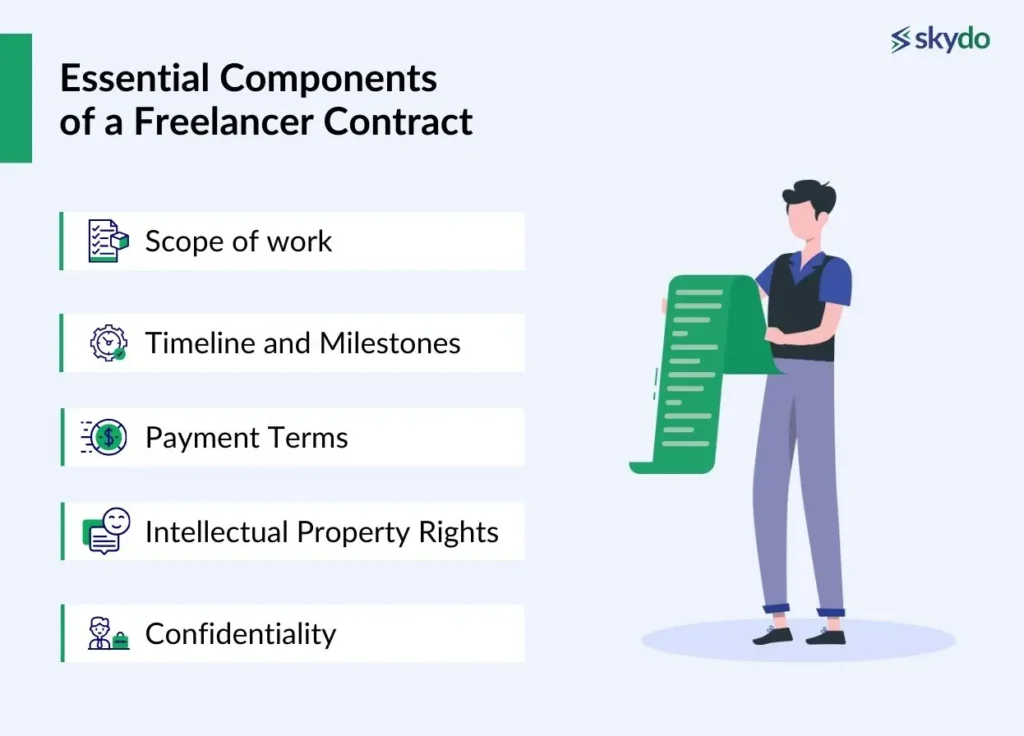
India now has over 11.2 million gig workers — and that number is climbing fast. Yet most founders who hire freelancers do it on a WhatsApp message and a handshake. When things go wrong — missed deadlines, stolen designs, unpaid invoices — there’s nothing to stand on. A proper freelance contract in India is the only thing that changes that.
No contract means no leverage. Here’s exactly what to put in one.
What You’ll Learn
- Why a freelance contract in India is a legal document — not just a formality
- The 8 clauses every founder must include before work begins
- How to handle tax, IP, and dispute clauses the right way under Indian law
- Common mistakes founders make — and how to avoid them
Why a Freelance Contract Is a Legal Document, Not a Formality
Here’s the thing. A freelance contract in India isn’t just paperwork you send out of habit — it’s a binding agreement governed by the Indian Contract Act, 1872. The moment both parties agree on consideration (the payment), scope, and deliverables, that contract becomes enforceable in an Indian court. That means if your UI designer walks off mid-project with your brand assets, or if a client in Mumbai refuses to pay after 3 months of work, you have legal recourse — but only if you have a signed agreement.
What most founders miss: verbal agreements and Slack confirmations count for almost nothing when there’s a real dispute. The Code on Social Security, 2020 — which came into force in November 2025 — formally defines “gig workers” for the first time in Indian law, but it primarily protects platform workers, not direct freelance hires. For the Bengaluru design agency that hires a Kolkata-based content writer directly, the contract is still the only safety net.
If you’re still building the legal groundwork for your startup, getting your freelance agreements in order is as foundational as your incorporation documents.

Clause 1 & 2: Scope of Work and Deliverables
Let’s break this down. The most common reason freelance disputes happen in India is not money — it’s vagueness. “Build me a website” means completely different things to a founder and a developer. Your contract must define deliverables with surgical precision: how many pages, which features, what tech stack, how many revision rounds.
The scope of work clause should answer these questions without ambiguity:
- What exactly will be delivered? Name every output — files, formats, dimensions, word counts
- What is explicitly excluded? If SEO isn’t included in a content project, say so
- How many revision rounds are included? Unlimited revisions = unlimited scope creep
- What are the project milestones and deadlines? Include specific dates, not “ASAP”
A quick example: a Delhi-based D2C brand hiring a Figma designer should state “5 screens, mobile + desktop, 2 rounds of revisions, delivered as .fig and .png files by [date]” — not just “design the app.”
Clause 3 & 4: Payment Terms and Late Payment Penalties
The short answer: always define payment structure, due dates, and what happens when payment is late — all in the contract itself. According to Razorpay’s freelancer agreement guide, a freelance contract must include the compensation amount, payment schedule, any additional service fees, and a late payment clause. Skipping any one of these is how founders end up chasing invoices for months.
Here’s what your payment clause should cover:
- Payment structure: Fixed fee, milestone-based, or hourly — pick one and commit
- Advance payment: Asking for 25–50% upfront is standard practice and protects both sides
- Payment due date: “Net 15” or “Net 30” from invoice date — never “when convenient”
- Late payment penalty: A monthly interest rate (typically 1.5–2%) kicks in after the due date passes
- Payment method: Bank transfer, Razorpay, or UPI — and the currency (INR vs USD for cross-border)
One thing many Mumbai-based startups hiring international freelancers overlook: if payment is in foreign currency, you’ll need to factor in FEMA (Foreign Exchange Management Act) compliance for outward remittances above certain thresholds.
Clause 5: Intellectual Property and Ownership Rights
This is the clause that founders get wrong most often — and it can cost the most. By default under Indian law, the creator of a work owns it. That means if your contract is silent on IP, the logo your designer made, the code your developer wrote, and the copy your writer produced could technically belong to them — not you. Ownership transfers to the client only when the contract explicitly says so, and typically only after full payment.
Your IP clause needs to spell out:
- When does ownership transfer? Specify it’s upon receipt of final payment
- What’s included? All source files, working files, and final deliverables
- Can the freelancer showcase the work? Define portfolio rights explicitly
- What about pre-existing IP? If the freelancer uses their own templates or code libraries, state that clearly
What most founders miss: even if you’ve paid in full, if your contract doesn’t include an IP assignment clause, proving ownership in a dispute is complicated. Get this in writing before work starts.

Clause 6: Confidentiality (NDA) and Non-Compete
If your freelancer is working on an unreleased product, accessing customer data, or seeing your pricing models — you need a confidentiality clause. This is essentially a lightweight NDA (Non-Disclosure Agreement) built into the freelance contract. It prevents the freelancer from sharing your business information with competitors, discussing project details publicly, or using proprietary information to pitch to your rivals.
The confidentiality clause should define what counts as confidential (business plans, source code, client lists, financial data), how long the obligation lasts (usually 2–3 years after project end), and what the consequences of a breach are.
A quick note on non-competes: Indian courts have historically been reluctant to enforce overly broad non-compete clauses for freelancers, since Section 27 of the Indian Contract Act, 1872 restricts agreements that restrain trade. Keep any non-compete narrow — specific client names or a defined geographic region — rather than a blanket “you can’t work in this industry.”
Clause 7: Tax Obligations — TDS and GST
Tax is where Indian freelance contracts quietly fall apart. There are two key obligations founders must address: TDS (Tax Deducted at Source) and GST (Goods and Services Tax). Getting either wrong exposes both the founder and the freelancer to compliance issues.
TDS Under Section 194J
Under Section 194J of the Income Tax Act, if you’re paying a freelancer for professional or technical services and the total payment exceeds ₹50,000 in a financial year, you must deduct TDS — typically at 10%. The contract should state which party is responsible for TDS, and the freelancer’s PAN must be collected for compliance. If you’re filing ITR filing for your business, TDS deducted on freelance payments must be reported correctly.
GST Registration Threshold
If a freelancer’s annual turnover exceeds ₹20 lakh (₹10 lakh in some special category states), they must register for GST and charge 18% GST on services. Your contract should state whether the quoted fee is inclusive or exclusive of GST, and if it’s exclusive, who bears that cost. Always ask for the freelancer’s GSTIN before signing.
Clause 8: Termination and Dispute Resolution
Projects go sideways. Founders change direction. Freelancers disappear. Your termination clause should cover what happens in each scenario — who keeps what money, who owns partially completed work, and how much notice either side must give. A standard notice period of 7–14 days is common for short projects; 30 days for longer retainers.
The dispute resolution clause is equally critical. Define:
- Jurisdiction: Which city’s courts govern the contract (e.g., “Courts in Bengaluru shall have exclusive jurisdiction”)
- Arbitration first: Many contracts include a clause requiring arbitration before litigation — it’s faster and cheaper
- Governing law: Always “Laws of India” — important for cross-border freelance arrangements
A quick example: if your startup is in Hyderabad but the freelancer is in Pune, pick one city as the jurisdiction — don’t leave it blank and fight over it later.
Frequently Asked Questions
Q: Is a freelance contract legally valid in India?
A: Yes. A freelance contract is legally enforceable in India under the Indian Contract Act, 1872, provided it meets the basic requirements of a valid contract — offer, acceptance, lawful consideration, and competent parties. A written and signed agreement (including digitally signed ones under the IT Act, 2000) carries strong evidentiary weight in Indian courts and can be used to claim payment or seek damages for breach.
Q: Do I need to deduct TDS when I pay a freelancer in India?
A: If you’re paying a freelancer for professional or technical services and the total payment crosses ₹50,000 in a financial year, you must deduct TDS at 10% under Section 194J of the Income Tax Act. You’ll need the freelancer’s PAN to do this, and you must deposit the deducted amount with the government and issue a TDS certificate (Form 16A) to the freelancer.
Q: Who owns the work a freelancer creates — the founder or the freelancer?
A: Under Indian copyright law, the creator of a work is the default owner. Unless your contract explicitly includes an intellectual property assignment clause, the freelancer technically retains ownership of what they create — even if you’ve paid for it. Always include a clause stating that IP transfers to you upon full payment, and list all deliverables (including source files) within the scope of that transfer.
Q: Can a freelance contract be signed digitally in India?
A: Yes. Digital signatures are legally valid in India under the Information Technology Act, 2000 (IT Act). You can use tools like DocuSign, Adobe Sign, or even a scanned signature on a PDF for standard freelance agreements. For high-value contracts, a digitally signed document with a trusted third-party certificate adds extra enforceability.
Q: What happens if a freelancer doesn’t deliver and refuses to return the advance?
A: If your contract includes a clear scope of work, payment terms, and a termination clause, you have grounds to pursue recovery through a civil court or consumer forum, or through arbitration if the contract specifies it. Without a written contract, proving the terms of the arrangement becomes very difficult. This is why drafting the agreement before any advance is paid is non-negotiable.
Q: Does a freelancer in India need to charge GST?
A: A freelancer must register for GST and charge 18% GST on services only if their annual turnover exceeds ₹20 lakh (₹10 lakh in special category states like Manipur, Mizoram, and Nagaland). Below this threshold, GST registration is optional. Your contract should always clarify whether fees are GST-inclusive or exclusive, and request the freelancer’s GSTIN if they are registered.
Ready to draft a legally sound freelance agreement?
Lawizer’s experts handle everything — contract drafting, legal review, and startup compliance — fully online, starting at just ₹999. No CA visit needed.