Tag: equity vesting

  • Shareholders’ Agreement for Startups: 8 Clauses You Cannot Afford to Skip

    Shareholders’ Agreement for Startups: 8 Clauses You Cannot Afford to Skip

    India now has over 1.64 lakh DPIIT-recognised startups — yet most founders spend more time debating their pitch deck font than reading the one document that decides who controls their company when things go wrong. A shareholders’ agreement (SHA) is that document. And a poorly drafted one has ended more promising Indian startups than bad markets ever have.

    Eight clauses. Get them right, and your startup has a rulebook that works for you at every stage — from first hire to first exit

    📌 TL;DR: A shareholders’ agreement (SHA) for startups in India is a private, legally binding contract between company shareholders that governs equity, voting rights, exits, and dispute resolution — separate from the publicly filed Articles of Association (AoA). The 8 non-negotiable SHA clauses include vesting schedules, anti-dilution protection, ROFR, drag-along and tag-along rights, reserved matters, IP ownership, non-compete, and dispute resolution. Lawizer’s legal experts can draft a founder-ready SHA fully online, without a single CA visit.

    What You’ll Learn

    • What a shareholders’ agreement is and why it’s different from your AoA
    • The 8 clauses every Indian startup SHA must include — and what each one actually protects
    • Common mistakes Indian founders make and how courts in India have ruled on SHA disputes
    • What to do before your next funding round to make sure your SHA holds up legally

    What Is a Shareholders’ Agreement — and Why It’s Not the Same as Your AoA

    A Shareholders’ Agreement (SHA) is a private, confidential contract between the shareholders of a company. It’s governed by the Indian Contract Act, 1872, and typically signed after the company is incorporated under the Companies Act, 2013.

    Unlike the Articles of Association (AoA) — which is a public document filed with the Registrar of Companies — the SHA stays between the parties. Nobody outside your shareholder group needs to see it.

    Here’s the thing: the AoA and SHA often overlap, and that overlap can get you into trouble. The Supreme Court of India ruled in V.B. Rangaraj v. V.B. Gopalakrishnan that SHA clauses are only enforceable against the company if they’re also reflected in the AoA.

    In other words, a beautifully drafted SHA that contradicts or isn’t backed up by your AoA can be legally worthless when you need it most. Always ensure both documents are harmonised — this is step one before any investor signs.

    What most founders miss: the SHA isn’t just an investor protection tool. It’s the founders’ rulebook too. It decides how equity is split, who can vote on what, what happens when a co-founder wants to leave, and who gets paid first when the company exits. Skipping it — or copying a template from the internet — is how co-founder disputes become courtroom dramas.

    Clause 1 & 2: Vesting Schedule and Anti-Dilution Protection

    These two clauses do the heavy lifting in every early-stage SHA, and they’re almost always the ones founders regret skipping.

    1)Vesting Schedule
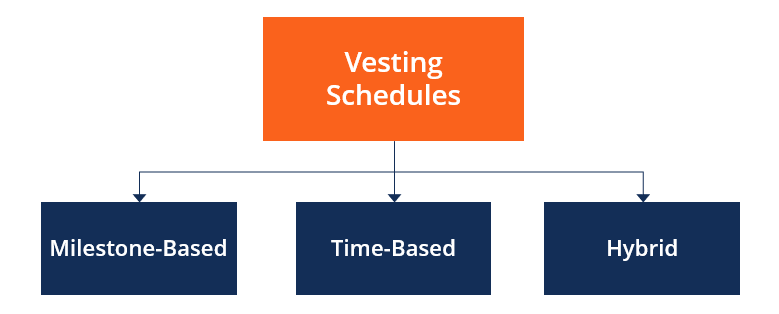
    A vesting schedule is a timeline over which a founder or employee earns their equity. The standard in India’s startup ecosystem is a 4-year vesting period with a 1-year cliff — meaning no equity is earned in the first year, and after that, shares vest monthly or quarterly. If a co-founder leaves in month eight, they walk away with nothing. Without a vesting clause? They keep 100% of their shares and potentially block your next funding round.

    A quick example: two Bengaluru-based SaaS founders split equity 50-50 on Day 1 with no vesting. Six months later, one leaves for a corporate job. The remaining founder has to raise a Series A with a co-founder who’s no longer involved holding half the company. Most investors in India will simply walk away from that table. Vesting prevents this scenario entirely.

    2)Anti-Dilution Protection
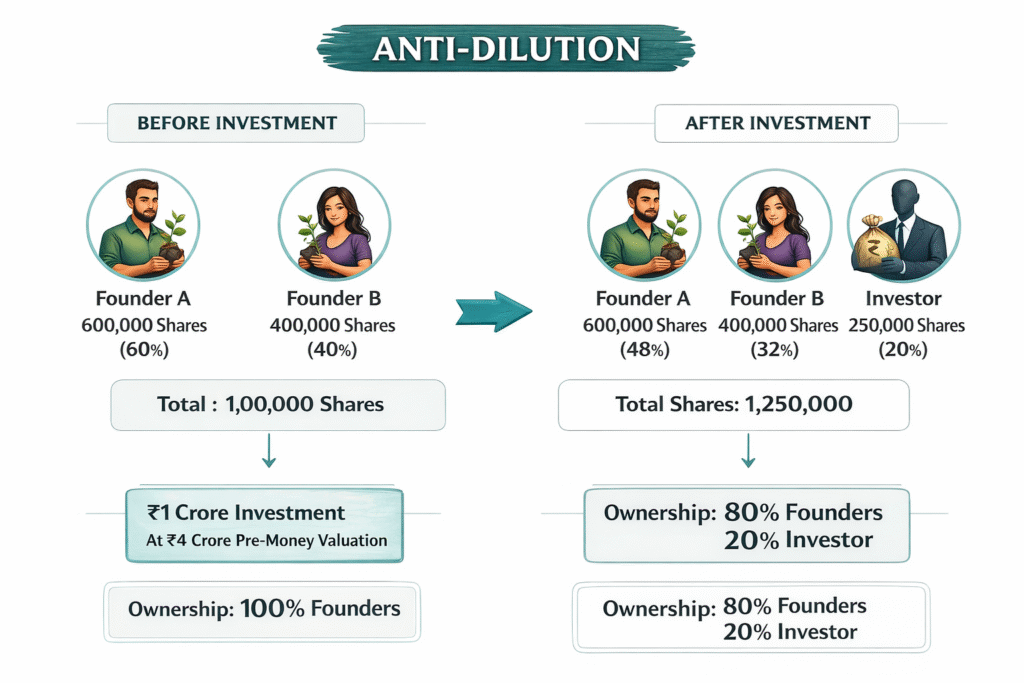
    Anti-dilution clauses protect early investors (and sometimes founders) if the company raises a future round at a lower valuation — what’s called a “down round.” There are two main types: full ratchet (the investor’s price resets entirely to the new lower price — aggressive, investor-friendly) and weighted average (a proportionate adjustment based on the amount of new capital raised — fairer for founders). Always negotiate for weighted average. Full ratchet can wipe out a founder’s stake overnight after one bad quarter.

    Clause 3 & 4: Right of First Refusal (ROFR) and Share Transfer Restrictions

    Imagine waking up to discover that your co-founder sold their stake to a competitor. This isn’t a hypothetical — it’s happened to real Indian startups, and it’s exactly what ROFR and share transfer restrictions are designed to prevent. According to Bridge Counsels’ analysis of Indian SHA disputes, share transfer clauses are among the most heavily negotiated provisions in early-stage agreements.

    Right of First Refusal (ROFR) means that if a shareholder wants to sell their shares, they must first offer them to existing shareholders at the same price being offered by an external buyer. If existing shareholders decline, the seller can go to the third party — but on terms no more favourable than what was offered internally.

    A closely related mechanism, the Right of First Offer (ROFO), flips this slightly: the seller must first approach existing shareholders before even approaching external parties. ROFO is generally more seller-friendly; ROFR is more buyer-friendly. Your SHA should specify which applies, and in what sequence.

    Let’s break this down. Share transfer restrictions serve a second purpose beyond just keeping competitors out: they let you control who becomes a shareholder. New shareholders change the dynamics of board votes, information rights, and exit decisions. Including a clause that requires written consent from existing shareholders (or a defined percentage of them) before any transfer happens is standard practice for any well-structured Indian startup.

    Clause 5 & 6: Drag-Along and Tag-Along Rights

    These two clauses sound similar but protect completely different parties — and both need to be in your SHA
    1)Drag-Along Rights (Investor/Majority Protection)

    A drag-along clause allows majority shareholders (typically investors or founders with large stakes) to force minority shareholders to join in a sale of the company under the same terms. Why does this matter?

    Because if a strategic acquirer wants to buy 100% of your startup, a minority shareholder who refuses to sell can kill the entire deal. Drag-along rights eliminate that veto. They’re standard in Companies Act, 2013-governed private limited companies and are explicitly negotiated in almost every VC-backed Indian startup’s SHA.

    2)Tag-Along Rights (Minority Protection)

    Tag-along rights work in reverse — they protect minority shareholders. If a majority shareholder agrees to sell their stake to a third party, tag-along rights allow minority shareholders to “tag along” and sell their shares on the same terms.

    Without this, a new majority owner could walk in, change the board, and effectively strand early investors or employee shareholders who had no say in the transaction. In Mumbai and Delhi-NCR where PE and VC activity is highest, tag-along clauses are non-negotiable from an investor’s perspective.

    Clause 7: Reserved Matters and Board Governance

    Not every business decision should be made by whoever has the most shares. Reserved matters are a list of decisions that require approval beyond a simple majority — often unanimous consent or a supermajority (say, 75% or more).

    Think of it as a veto list for important decisions. Common reserved matters in Indian startup SHAs include: changes to the AoA, issuing new shares, taking on debt above a specified threshold, acquiring or merging with another company, changing the core business, and winding up the company.

    Board governance clauses go hand in hand with this. Your SHA should clearly specify: how many board seats exist, who appoints them (founders vs. investors), what constitutes a quorum for board meetings, and how decisions are made when there’s a deadlock.

    Speaking of deadlocks — include a deadlock resolution mechanism. “Texas Shoot-Out” (where one party names a price and the other must buy or sell at that price) and “Russian Roulette” provisions are recognised in Indian commercial contracts and give both parties a clean exit from a governance stalemate.

    You can structure your entire startup legal foundation — from incorporation to SHA — online, without ever visiting a CA’s office. Getting the governance structure right from Day 1 saves months of renegotiation later.

    Clause 8: IP Ownership, Non-Compete, and Dispute Resolution

    These three provisions often get lumped into a “miscellaneous” section and under-negotiated. That’s a mistake — especially for tech startups in Bengaluru, Hyderabad, or Chennai where intellectual property (IP) is the company’s primary asset.

    1)IP Ownership

    Every piece of technology, code, brand, design, or process created by founders or employees must be assigned to the company — not remain with the individual. Your SHA should explicitly state this.

    Without a clear IP assignment clause, a departing co-founder could legally claim ownership of the core product they built. If you’re building a tech startup and haven’t yet protected your brand, trademark registration should run parallel to your SHA drafting.

    2)Non-Compete and Non-Solicit

    A non-compete clause restricts departing shareholders from starting or joining a competing business for a defined period (typically 1–2 years after exit). A non-solicit clause prevents them from poaching employees or clients. In a July 2025 ruling — Paul Deepak Rajaratnam & Ors. v. Surgeport Logistics Pvt. Ltd. 

    The Delhi High Court upheld the enforceability of restrictive covenants in SHAs, confirming that interim injunctions can be granted to prevent breaches of non-compete terms under Section 27 of the Indian Contract Act, 1872.

    3)Dispute Resolution

    Litigation in Indian courts is expensive and slow. Almost every well-drafted SHA in India includes an arbitration clause — specifying that disputes will be resolved through private arbitration under the Arbitration and Conciliation Act, 1996, rather than civil court proceedings.

    Specify the seat of arbitration (Mumbai and Delhi are most common), the governing law (Indian law), the number of arbitrators, and the language. This one clause can save years and crores in legal fees if a dispute escalates.

    Frequently Asked Questions

    Q: Is a shareholders’ agreement mandatory for Indian startups?

    A: No, a shareholders’ agreement (SHA) is not mandatory under Indian law. However, it is strongly advisable for any startup with more than one shareholder. Without an SHA, disputes over equity, exits, and governance are governed only by the Articles of Association and the Companies Act, 2013 — which often don’t reflect what founders and investors actually agreed upon verbally or informally.

    Q: What is the difference between an SHA and the Articles of Association in India?

    A: The Articles of Association (AoA) is a public document filed with the Registrar of Companies and governs the company’s internal affairs. The SHA is a private, confidential contract between shareholders that covers rights and obligations in more detail. Under Indian law, any SHA clause that conflicts with the AoA may be unenforceable against the company — which is why lawyers always recommend aligning both documents when drafting an SHA.

    Q: When should a startup sign its shareholders’ agreement?

    A: Ideally, before the first external investment is brought in — or at the time of incorporating the company if there are multiple co-founders. Waiting until the first VC term sheet arrives means you’ll be negotiating SHA terms under time pressure and with far less leverage. The earlier you formalise equity, vesting, and governance, the cleaner your cap table looks to investors.

    Q: Can a shareholders’ agreement override the Companies Act, 2013?

    A: No. An SHA must comply with the Companies Act, 2013, and any provision that contradicts a statutory requirement will be void. For example, the Act sets minimum requirements for holding AGMs, maintaining registers, and filing returns with the MCA — none of these can be contracted away through an SHA. The SHA works within the statutory framework, not around it.

    Q: Does a shareholders’ agreement need to be stamped in India?

    A: Yes. Under applicable stamp laws in India, an SHA must be duly stamped before or at the time of execution to be admissible as evidence in court. Stamp duty rates vary by state — Maharashtra, Karnataka, and Delhi each have different rates. An unstamped or under-stamped SHA can be challenged in legal proceedings, so always stamp it correctly before any party signs.

    Q: What happens if a co-founder leaves without a vesting clause in the SHA?

    A: Without a vesting clause, a departing co-founder retains 100% of their equity regardless of how early they leave. This can make your startup uninvestable — most VC and angel investors in India will not fund a company where a non-contributing ex-founder holds significant equity. Worse, that founder still has shareholder rights, including voting rights and the right to information. A vesting schedule with a cliff period prevents exactly this scenario.

    Ready to protect your startup with a legally sound SHA?
    Lawizer’s experts handle everything — shareholders’ agreement drafting, company incorporation, and trademark registration — fully online, starting at just ₹1,999. No CA visit needed.Get Your Startup Legal Documents Sorted →

  • Co-Founder Disputes: How to Legally Protect Yourself
Before They Happen?

    Co-Founder Disputes: How to Legally Protect Yourself Before They Happen?

    Over 11,000 Indian startups shut down in 2025 alone. That’s more than 30 closures every single day. CB Insights research consistently finds team and co-founder conflict among the top reasons startups fail — and in India’s high-stakes ecosystem, it shows up in boardroom battles, equity freezes, and IP ownership wars that end careers and companies alike.

    The painful truth? Most of those disputes were entirely preventable. The problem wasn’t the fight — it was the absence of a written agreement before the fight arrived.


    📌 TL;DR: Co-founder disputes are one of the leading causes of Indian startup failure, yet most founding teams sign nothing before they start building. The fix is a legally binding Co-Founders Agreement — executed under the Indian Contract Act, 1872 — that locks in equity splits, vesting schedules, IP ownership, roles, exit terms, and a dispute resolution mechanism before money or conflict enters the picture. Lawizer helps you draft and execute this document fully online, so your startup is protected from Day 1.


    What You’ll Learn

    • Why co-founder disputes are so destructive — and why they’re almost always preventable
    • The 5 legal protections every Indian founding team must put in place at formation
    • How equity vesting and “reverse vesting” actually work in Indian company law
    • What an IP assignment agreement covers and why it matters more than most founders think
    • How to resolve deadlocks before they become courtrooms
    • Answers to the questions founders search for but rarely ask their lawyers

    Why Co-Founder Disputes Are Deadlier Than Market Failure

    India is the world’s 3rd largest startup ecosystem, with nearly 1.97 lakh DPIIT-registered startups as of late 2025. And yet 90% of Indian startups fail within five years — a rate worse than the United States (80%) and far worse than the United Kingdom (60%).

    Team conflict — co-founder disputes, cultural misalignment, and governance breakdowns — is consistently listed among the top causes.

    The pattern is almost always the same. Two or three founders start with goodwill, a shared vision, and a verbal understanding of who does what and who owns what. The company grows. Stakes increase. One founder works longer hours. Another pivots priorities. A third wants to exit. Suddenly, the absence of a written framework is not an inconvenience — it is catastrophic.

    India has seen this publicly. When a property-listing unicorn’s board removed a co-founder in 2015, the governance terms were thin enough to turn a business disagreement into a public battle. When a fintech lender’s co-founder exited in 2022 amid a governance review, the dispute turned on vesting and what a departing founder was entitled to keep.

    These are the cases that made headlines. Thousands more play out quietly every year — in Bengaluru co-working spaces, Mumbai offices, and Hyderabad tech parks — and they never get written up.

    Here’s the thing. A verbal agreement between co-founders may technically be enforceable under the Indian Contract Act, 1872 — if it satisfies the basic requirements of offer, acceptance, and consideration. But enforcing it in practice is nearly impossible. Equity splits, IP ownership, and exit rights require written, signed documentation to be actionable in any Indian court or investor due diligence process.

    The solution isn’t pessimism about your co-founder. It’s the same kind of clear documentation that every serious business relationship deserves.


    Legal Protection #1 — The Co-Founders Agreement

    A Co-Founders Agreement (also called a Founders Agreement) is a private contract between the founding team that fixes — before money or conflict arrives — how equity is split, how shares vest, who does what, who owns the intellectual property, and what happens when a founder exits.

    It is enforceable as a contract under Section 10 of the Indian Contract Act, 1872. It should be executed on stamp paper appropriate for the state of execution (Maharashtra, Karnataka, Delhi, and Tamil Nadu each have different stamp duty rates for agreements). While registration is not mandatory, it adds evidentiary weight.

    What most founders miss: the agreement should be signed before incorporation or within the first 30 days after incorporating. Waiting until investors arrive forces retroactive structuring — and sophisticated investors will demand it anyway, often at terms that no longer favour the founders.

    The agreement needs to cover nine core areas. Every other clause is a sub-point of these nine:

    Equity split — the percentage each founder holds and on what basis (capital, idea, work, or a combination).

    Vesting and leaver provisions — how and when shares are earned over time, and what happens when someone leaves (more on this in the next section).

    Roles, responsibilities, and time commitment — who is CEO, CTO, or CMO; what each founder is expected to contribute; and whether this is a full-time engagement or part-time.

    Decision-making and deadlock — how day-to-day and strategic decisions are made, including voting thresholds, reserved matters, and what happens when founders cannot agree.

    IP assignment — that all intellectual property created by founders belongs to the company, not to the individual.

    Confidentiality — what information is confidential and what the obligations are after a founder exits.

    Non-compete and non-solicitation — reasonable restrictions on joining competitors or poaching employees. Under Indian law, overly broad non-competes are often unenforceable; keep them to 12–24 months and limit the scope to the company’s specific business area.

    Exit and termination — the conditions for a voluntary or involuntary exit and the consequences for each.

    Dispute resolution — the agreed mechanism for resolving disagreements (discussed separately below).


    Legal Protection #2 — Equity Vesting (And How It Works in India)

    Equity vesting is the mechanism that makes co-founder equity a reward for ongoing contribution rather than a windfall for showing up early. It is the single most protective clause in any founders agreement.

    A quick example: Suppose a two-founder startup splits equity 50-50 at incorporation. One founder departs after six months, keeping all 50%. The remaining founder now runs the entire company — and owns only half of it. Every investor they pitch will see this as a structural problem. That’s the scenario vesting prevents.

    The standard structure used by Indian startups (aligned with global investor expectations) is a four-year vesting schedule with a one-year cliff. This means:

    • No shares vest in the first twelve months (the cliff period)
    • On the one-year anniversary, 25% of the founder’s shares vest at once
    • The remaining 75% vest in monthly or quarterly installments over the next three years

    Here’s the thing about Indian company law: unlike US-style stock options, Indian private companies issue shares at formation rather than granting them over time. Vesting is therefore implemented through a contractual mechanism called reverse vesting — written into the Co-Founders Agreement or Shareholders Agreement. A founder who exits before their shares fully vest must transfer the unvested portion back to the company or remaining founders at nominal value.

    Good leaver vs bad leaver clauses go one step further. A good leaver — someone who resigns in good faith, retires, or leaves due to serious illness — typically gets to retain their vested shares at fair market value.

    A bad leaver — someone terminated for cause or a breach of the agreement — may be required to sell back shares at a discount or forfeit unvested equity entirely. These distinctions must be drafted with legal precision, because “cause” is exactly the word both sides will dispute in court.

    Investors — especially early-stage VCs and angels on platforms like Mumbai-based early-stage funds — routinely ask for vesting provisions during due diligence. A founding team without vesting structures signals governance risk before the first term sheet is issued.


    Legal Protection #3 — IP Assignment Agreement

    This is the most underestimated document in any early-stage startup, and the one that causes the most damage when it’s missing.

    Let’s break this down. Before a company is incorporated, founders typically spend months — sometimes years — building the core product, writing code, designing the brand, developing the algorithm.

    All of that work is done by individuals, not by a legal entity. Unless there is a written IP Assignment Agreement transferring ownership of that pre-incorporation work to the company, the intellectual property belongs to the individual who created it.

    What that means in practice: if that individual later leaves the company — voluntarily or otherwise — they may be able to claim ownership of the core technology, the codebase, or the brand that the entire business is built on. No investor will fund a company where the key IP is not clearly owned by the company. Many early-stage due diligence processes in India begin with exactly this question.

    An IP Assignment Agreement should cover: all pre-incorporation work transferred to the company at or before incorporation, all future work created by founders in connection with the business, proprietary algorithms, source code, designs, domain names, trademarks, and trade secrets, and a specific clause on AI-generated work (increasingly relevant for tech startups in 2025–26).

    This agreement is separate from the Co-Founders Agreement, though the two are typically executed together at formation. It should be signed by every founder and every early employee, contractor, or advisor who contributes to the product. Lawizer’s startup legal services include IP assignment as part of a complete legal protection package for founders — entirely online, without a CA or lawyer visit.

    If you’re building a product with any kind of brand identity, you should also think about trademark registration at the earliest stage. The Trademark Registration service on Lawizer lets you file online and tracks your application through CGPDTM (the Controller General of Patents, Designs and Trade Marks).


    Legal Protection #4 — Decision-Making Rules and Deadlock Resolution

    Two founders with equal equity and no decision-making framework is a recipe for paralysis. Every significant decision — a new hire, a pivot, accepting a term sheet, changing the product roadmap — can become a standoff.

    What most founders miss: the time to agree on how you’ll disagree is before you actually disagree. Once a deadlock happens, neither side wants to give ground. The agreement you signed when you trusted each other completely is the only mechanism that works.

    Decision-making provisions in a founders agreement typically operate in tiers:

    Day-to-day operational decisions fall within each founder’s defined role and don’t require a vote. Significant business decisions — hiring above a certain salary threshold, entering new markets, spending above a defined amount — require a simple majority of founders.

    Reserved matters — issuing new shares, amending the articles of association, acquiring or selling the business — require unanimous consent or a supermajority.

    For deadlocks on reserved matters, the agreement should specify a resolution mechanism. Common options include: a structured mediation process using a mutually agreed neutral party; escalation to an independent third-party expert; and finally, arbitration under the Arbitration and Conciliation Act, 1996. An arbitration clause in a founders agreement should specify the seat (typically Delhi, Mumbai, or Bengaluru), the institutional rules (DIAC, MCIA, or ad hoc), the number of arbitrators, and the language of proceedings.

    Arbitration keeps disputes confidential — critical for startups where public litigation damages investor confidence and press coverage. Under Section 11 of the Arbitration and Conciliation Act, 1996, if the agreed appointment process fails, a High Court can appoint an arbitrator on application.


    Legal Protection #5 — Exit and Termination Clauses

    Every co-founder will eventually exit. The only question is whether the terms are agreed in advance or fought over in real time.

    Exit clauses must address three situations:

    Voluntary resignation — the process by which a founder can leave, the notice period required, transition obligations, and how their shares are handled depending on good leaver or bad leaver status.

    Involuntary removal — the conditions under which co-founders can remove one another from their role or directorship, including the threshold required (typically a majority of founders), the procedures to follow under the Companies Act, 2013, and the share consequences that follow.

    Death or incapacity — what happens to a founder’s shares if they pass away or are unable to continue. This should align with the company’s Articles of Association (AoA), since share-related provisions bind the company only when written into the AoA as well as the founders agreement.

    A lock-in provision is also worth considering — a minimum period during which founders may not transfer their shares to third parties without the consent of remaining founders. This protects the founding team from having an unknown third party inherit a founder’s equity stake through a personal transaction.

    The short answer on timing for all of this: sign everything before you raise your first rupee of external funding. Once investors are at the table, the dynamics shift. They will negotiate from a position of leverage, and the terms they impose will reflect their interests, not yours.


    Common Mistakes Founding Teams Make

    Treating the agreement as a formality. Many founders sign a boilerplate template without walking through it clause by clause. If every founder can’t explain what their own agreement says about exit terms and IP ownership, it won’t guide behaviour when it matters.

    Assuming friendship is enough. The most destructive co-founder disputes in India have happened between people who were college friends, siblings, or long-time colleagues. Goodwill doesn’t survive equity fights. A written agreement does.

    Delaying until “after we’ve figured things out.” The longer you wait, the more each founder has invested — emotionally and financially — in their interpretation of the implicit deal. Sign when you still agree on everything.

    Ignoring the Articles of Association. Share-related vesting and transfer provisions in a founders agreement are enforceable as contract terms between founders. But they only bind the company itself when they’re also reflected in the company’s AoA, filed with the Registrar of Companies (ROC). This is a step most founders miss entirely.

    Broad non-competes. Indian courts regularly refuse to enforce non-compete clauses that are unreasonably wide in scope, geography, or duration. A clause preventing a departing founder from working in “technology” for five years anywhere in India is likely unenforceable. Keep it specific: 12–24 months, limited to the company’s direct business area.


    Frequently Asked Questions

    Q: Is a verbal co-founders agreement enforceable in India?

    A: Technically, a verbal agreement may satisfy the basic requirements of a contract under the Indian Contract Act, 1872 — offer, acceptance, and consideration. But in practice, enforcing it is extremely difficult. Equity splits, IP ownership, vesting schedules, and exit rights all require written, signed documentation to be actionable in court or during investor due diligence. A verbal agreement is effectively no agreement at all when a dispute arises.

    Q: When is the right time to sign a co-founders agreement?

    A: Before incorporation, or within the first 30 days after incorporating. Founders tend to agree most easily before funding pressure, user growth, or operational stress sets in. Waiting until investors arrive forces retroactive structuring — at terms investors control. Waiting until conflict arises defeats the purpose entirely. Sign when you still agree on everything.

    Q: What is reverse vesting and how does it work in India?

    A: Reverse vesting is the contractual mechanism through which Indian startups implement equity vesting. Because Indian company law issues shares at formation rather than granting them over time, vesting is structured as an obligation for a departing founder to transfer unvested shares back to the company or remaining founders at nominal value. It is implemented through the Co-Founders Agreement or Shareholders Agreement and must be drafted carefully to be enforceable.

    Q: What happens to IP if there’s no assignment agreement?

    A: Without a written IP Assignment Agreement, intellectual property created by an individual founder — including code, designs, algorithms, and brand elements — belongs to that individual, not to the company. If that founder exits, they can potentially claim ownership of the technology the business runs on. No serious investor will fund a company where IP ownership is unclear. This is why an IP assignment must be executed at or before incorporation.

    Q: Is a founders agreement different from a shareholders agreement?

    A: Yes. A Co-Founders Agreement is an early, personal document between the founding team — typically signed before or at incorporation — covering roles, equity, vesting, IP, and exit terms. A Shareholders Agreement (SHA) comes later, usually when external investors join, and governs the relationship between all shareholders including those investors. The two documents should be consistent with each other and with the company’s Articles of Association.

    Q: Can a co-founders agreement be amended after signing?

    A: Yes. A founders agreement can be amended at any time by mutual written consent of all founders. It’s a good practice to revisit the agreement at each major milestone — a funding round, a significant pivot, or a change in a founder’s role. The agreement should be treated as a living document, not a one-time formality.


    Ready to Protect Your Startup From Day 1?

    Lawizer’s experts handle your complete startup legal foundation — co-founders agreement, IP assignment, trademark registration, and company incorporation — all online, starting at just ₹1,499. No CA visits, no confusing paperwork.

    Get your startup legally protected today →

    Building a brand alongside your company structure? Protect your trademark with Lawizer before someone else files it first.