Tag: GST compliance

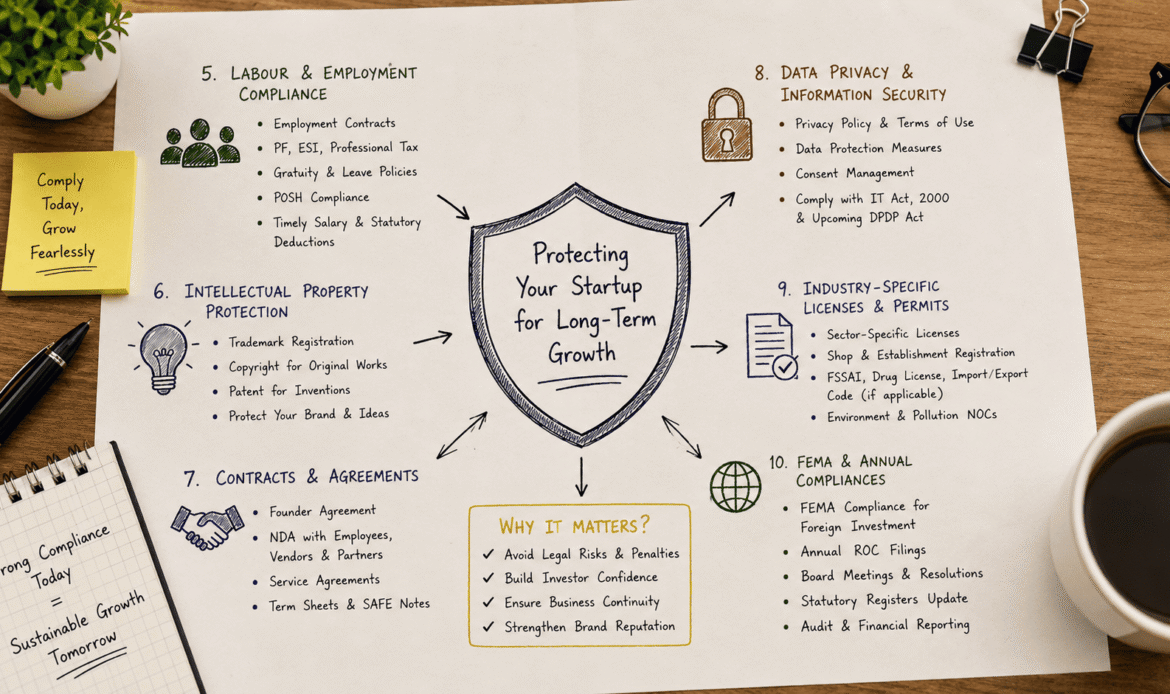
  • Why Compliance Gaps Kill Startup Funding Rounds in India

    Why Compliance Gaps Kill Startup Funding Rounds in India

    A 2025 study on Indian fintech due diligence found that 73% of failed deals traced back to regulatory gaps — missed licences, KYC lapses, and messy cross-border filings. If you’re heading into a funding round, compliance gaps are the single most preventable reason term sheets fall apart.

    Investors don’t walk away because your product is weak. They walk away because your paperwork doesn’t match your story.

    📌 TL;DR: Indian startups routinely lose funding rounds over compliance gaps like missed MCA filings, unassigned IP, undocumented ESOPs, and a cap table that doesn’t match the Registrar of Companies’ records. Investors treat these as governance red flags, not paperwork errors, and they either cut valuation, add protective clauses, or exit the deal entirely. Lawizer helps founders fix these gaps — incorporation, GST, MSME, and ROC filings — before an investor’s lawyer finds them first.

    What You’ll Learn

    • The specific compliance gaps that most often derail Indian startup funding rounds
    • Why investors treat small filing lapses as governance red flags, not clerical mistakes
    • A practical checklist to get your startup diligence-ready before term sheet stage

    Why Investors Treat Compliance Gaps as Deal-Breakers

    Here’s the thing: investors aren’t auditing your paperwork for fun. A missed filing tells them something bigger — that operational discipline is missing somewhere else too.

    Legal due diligence reports from Indian VC-backed deals show that more than half of failed rounds involve issues around revenue recognition, burn-rate reporting, or undocumented liabilities, not just product or market concerns.

    What most founders miss: compliance records aren’t a formality you clean up before a round. They’re evidence. When your Ministry of Corporate Affairs (MCA) filings, GST returns, and internal cap table all line up without explanation, it shortens diligence timelines and protects your valuation. When they don’t, investors either delay closing, demand indemnities, or walk.

    The Five Compliance Gaps That Kill Indian Funding Rounds

    The short answer: most funding rounds don’t die over one catastrophic issue. They die over a pattern of small, avoidable gaps that pile up in the data room. These are the ones that show up again and again in Indian startup due diligence.

    • Missed ROC filings: AOC-4, MGT-7, and DIR-3 KYC are annual, non-negotiable filings under the Companies Act, 2013. Recent MCA data shows nearly 18% of active startups missed at least one annual form in FY 2024–25, and each miss adds daily penalties plus a red flag in your compliance history.
    • Cap table mismatches: If your internal cap table doesn’t match the Register of Members filed in Form MGT-7, investors treat it as a serious discrepancy — not a typo.
    • Unassigned IP: Under Indian law, intellectual property created by a founder or freelancer belongs to the creator unless it’s formally assigned to the company. Missing IP assignment agreements are one of the most common reasons diligence stalls.
    • Undocumented ESOPs: An ESOP scheme approved informally, without a shareholder special resolution filed via Form MGT-14, is technically unauthorised — and investors will ask you to fix it as a closing condition.
    • GST and TDS mismatches: Delayed GST returns or input tax credit discrepancies trigger automated notices, and investors now expect at least two years of clean tax filing history before they commit.

    How Compliance Gaps Actually Cost You Money and Time

    Let’s break this down. A single missed DPT-3 filing or a deactivated Director Identification Number (DIN) from a skipped DIR-3 KYC doesn’t just cost a penalty. It stalls the entire round while your lawyers scramble to fix it mid-negotiation — and every week of delay is a week where the investor can renegotiate terms or lose interest.

    A quick example: founders preparing for Series A routinely discover, right in the middle of diligence, that unpaid vendor dues weren’t reflected in the books, or that a director loan was never reported on Form DPT-3. Each of these is fixable on its own.

    Together, three or four of them signal weak financial control, and that’s what actually erodes valuation — not the individual filing.

    This is also where MSME Udyam registration matters more than founders expect — investors check it as part of vendor payment compliance, since companies with unresolved MSME dues beyond 45 days face mandatory half-yearly disclosure under Form MSME-1.

    Building a Diligence-Ready Compliance Spine

    What separates startups that close rounds smoothly from those that don’t isn’t luck — it’s a compliance routine that runs quietly in the background, independent of fundraising timelines. Founders who pass due diligence on the first attempt tend to share the same habits.

    Quarterly, not annual, compliance check-ins

    Waiting until a term sheet lands to review your MCA and GST status means you’re fixing years of gaps under time pressure. A quarterly review catches issues while they’re still cheap to correct.

    Every founder and freelancer signs an IP assignment

    This should happen at the point of hiring, not right before a data room goes out. It’s a one-page fix that removes one of the most common deal-breakers investors flag.

    Trademark and brand protection early

    Investors also check whether your core brand assets are actually yours to defend. A trademark registration filed early, through the IP India portal, signals that your intangible assets are protected — something diligence teams increasingly flag when it’s missing.

    Clean, filed tax history

    Investors typically review at least two years of income tax filings during due diligence. Keeping your ITR filings current, alongside GST returns on the GSTN portal, removes an entire category of objections before they surface.

    What to Fix Before Your Next Funding Conversation

    If a round is even loosely on your roadmap for the next six months, start with the three areas that carry the most weight in diligence: your cap table, your IP assignments, and your top statutory filings. These are where ownership and control actually sit, and they’re where investors look first.

    Founders who go through company incorporation and compliance the right way from day one rarely face this scramble. If you incorporated quickly and deferred the paperwork, now is the point to close the gap — before an investor’s counsel finds it for you.

    Frequently Asked Questions

    Q: Can a startup really lose a funding round just because of missed MCA filings?

    A: Yes. Missed filings like AOC-4 or DIR-3 KYC signal weak governance to investors, and combined with other gaps, they can lead to reduced valuation, added protective clauses, or a walked deal. Investors view MCA filing history as a direct proxy for how disciplined a founding team is.

    Q: What compliance documents do investors ask for first?

    A: Investors typically start with MCA incorporation and filing records, the cap table with supporting Form PAS-3 filings, board meeting minutes, IP assignment agreements, and GST or income tax filing history. These form the baseline before deeper legal and financial due diligence begins.

    Q: How early should we start compliance clean-up before raising funds?

    A: Most advisors recommend starting three to six months before you plan to raise, since fixing statutory gaps, reconciling cap tables, and completing IP assignments takes time. Startups that maintain investor-ready records year-round avoid this scramble entirely.

    Q: Is an unregistered trademark actually a funding risk?

    A: Yes, especially for consumer or brand-led startups. Investors want assurance that your core brand identity is legally defensible, and an unregistered trademark leaves your most valuable intangible asset exposed to disputes or copycats after the round closes.

    Q: Do informal ESOP promises to early employees cause problems during diligence?

    A: Yes. ESOP grants issued without a shareholder-approved scheme filed with the MCA are technically unauthorised, and investors will require you to ratify or restructure them before closing, which adds time and legal cost to the round.

    Ready to make your startup diligence-ready?
    Lawizer’s experts handle company incorporation, GST filing, MSME registration, and trademark protection — fully online, starting at just ₹1,999. No CA visit needed.


    Get your compliance in order →

  • India’s Legaltech Boom: What $793M in Funding Means for You

    India’s Legaltech Boom: What $793M in Funding Means for You

    India’s legaltech sector has attracted $793 million in cumulative funding. In 2025, the industry recorded a 781% year-on-year increase, marking the largest single-year funding surge in its history. That’s not a rounding error. That’s investors betting big money that Indian founders are done doing legal paperwork the old way.

    If you’re a founder who still emails PDFs back and forth with a CA for GST filing or MSME registration, things are about to change. This legaltech boom is redefining what “normal” looks like for business compliance.

    📌 TL;DR: India’s legaltech industry has raised $793 million across roughly 960 companies, with 2025 funding up 781% year-on-year — the sector’s biggest jump on record. For founders, this means faster, cheaper, more reliable online options for company incorporation, GST, trademark, and MSME compliance instead of slow offline processes. Platforms like Lawizer are part of this shift, handling incorporation and compliance fully online so founders can skip the CA-office runaround.

    What You’ll Learn

    • Why $793 million is flowing into Indian legaltech right now
    • What’s actually driving the 781% funding surge in 2025
    • How this changes company incorporation, GST, and compliance for founders
    • What to watch for before picking a legaltech platform

    The Numbers Behind India’s Legaltech Boom

    Here’s the thing. Legaltech used to be the sleepy corner of Indian startup investing — the sector fintech and edtech investors barely glanced at. That’s flipped.According to data from Tracxn’s startup database, India is home to around 960 legaltech companies. Among them, 86 have secured funding, and one has achieved unicorn status.

    The real story is the pace. Legaltech funding in India has grown from about $107 million to a cumulative $793 million. In 2025, the sector recorded a 781% year-on-year increase, marking its highest annual investment to date.

    A quick example: SpotDraft, a contract automation platform, alone raised over $113 million across multiple rounds, including backing from Qualcomm Ventures. That’s the scale of confidence investors now have in Indian legal technology.

    Why Now?

    • India’s regulatory load keeps growing — DPDPA, GST updates, Companies Act 2013 amendments, and sector-specific rules all add compliance work
    • AI-powered document review and drafting cut turnaround time dramatically, making automation commercially viable
    • Millions of MSMEs and startups need affordable, scalable legal access that traditional law firms and CAs can’t deliver at volume

    What This Means for Company Incorporation

    Let’s break this down. Company incorporation in India runs through SPICe+ (Simplified Proforma for Incorporating Company Electronically Plus — MCA’s online incorporation form), filed on the MCA21 portal.

    On paper, it’s already digital. In practice, most founders still end up stuck answering DIN queries, chasing digital signature certificates, or waiting on a CA who’s juggling twenty other clients.

    What most founders miss: the legaltech money isn’t just building flashy AI tools for law firms. A meaningful chunk is going into founder-facing platforms that handle the entire incorporation-to-compliance journey — private limited company registration, LLP setup, GST registration, and ongoing filings — without the founder ever stepping into a CA’s office. That’s the direct benefit of this funding wave reaching your desk.

    If you’re incorporating a company or setting up your compliance stack from scratch, Lawizer’s business registration services are built exactly for this shift — online-first, no repeated office visits, transparent pricing

    GST, Trademark, and MSME: The Everyday Wins

    The short answer: automation is finally reaching the parts of compliance founders actually dread — recurring GST filings, trademark status tracking, and MSME/Udyam renewals. These aren’t glamorous problems, but they’re the ones that eat a founder’s Tuesday afternoon every single month.

    GST compliance, tracked through GSTN’s own systems, has traditionally meant founders relying on their CA to remember filing deadlines. As more legaltech investment flows into compliance automation, platforms now send proactive reminders. They also auto-populate returns and flag mismatches before they turn into legal notices.

    A trademark filed through the Controller General of Patents, Designs and Trademarks (CGPDTM) can now be tracked in real time. Founders no longer need to call their lawyer every few weeks to ask, “Any update?”

    Same logic applies to brand protection and MSME benefits. If you have not registered your trademark yet, do it early to protect your brand name. Early registration also reduces the risk of a competitor claiming it first. Lawizer’s trademark registration service handles the entire CGPDTM filing process from start to finish.

    And if you qualify for MSME status, Udyam registration through Lawizer unlocks collateral-free loans, delayed payment protection, and tender benefits that most founders don’t even know exist.

    What to Watch Before You Pick a Legaltech Platform

    A funding boom brings good tools — and also a lot of noise. Not every platform that raised money is built for a first-time founder in Bengaluru registering a two-person startup, versus an enterprise legal team in Mumbai managing thousand-contract portfolios. Here’s what actually matters when you’re evaluating options:

    • Does it handle India-specific requirements — MCA21 filings, state-wise GST rules, Aadhaar-based e-sign — or is it a generic tool adapted for India?
    • Is pricing transparent upfront, or do “starting from” prices balloon once you add government fees and follow-up filings?
    • Can you actually talk to a real compliance expert when something goes wrong, or is it a chatbot loop?

    What most founders miss: the platform’s funding size says nothing about whether it fits your stage. A well-capitalized enterprise CLM (Contract Lifecycle Management) tool is overkill if all you need is to file your first ITR (Income Tax Return). For income tax filing done right the first time, Lawizer’s ITR filing service keeps it simple and founder-focused.

    Where This Is Headed

    A quick example of the trajectory: the Indian legaltech market is projected to cross $1.28 billion in 2026, growing at roughly 15.2% CAGR — a pace faster than the global average. That growth is driven by a simple fact — India’s regulatory load isn’t shrinking.

    Between DPDPA, evolving GST rules, and Companies Act compliance, founders will need more automated help, not less.

    Here’s the thing: this isn’t really about the funding number. It’s about what it buys founders — faster incorporation, fewer missed deadlines, and compliance that doesn’t require a law degree to understand. That’s the actual dividend of $793 million landing in this sector.

    Frequently Asked Questions

    Q: How much funding has India’s legaltech sector raised so far?

    A: India’s legaltech sector has raised a cumulative $793 million in venture capital and private equity across roughly 960 companies. 2025 alone saw a 781% year-on-year rise in funding compared to the previous year, marking the highest annual investment the sector has recorded so far.

    Q: Does the legaltech boom actually help small founders, or just big law firms?

    A: Both, but founder-facing platforms are a major part of the investment. A large share of legaltech funding is going into tools for company incorporation, GST filing, trademark tracking, and MSME registration — the everyday compliance work small founders deal with, not just enterprise contract management.

    Q: Is online company incorporation in India actually reliable now?

    A: Yes. Company incorporation runs through MCA’s SPICe+ form on the MCA21 portal, and legaltech platforms have built layers on top of it to handle document prep, DIN and DSC processing, and follow-up queries without the founder needing to visit an office. This is one of the most mature use cases in the current funding wave.

    Q: What should I check before choosing a legaltech platform for my startup?

    A: Check whether the platform handles India-specific requirements like state-wise GST rules and Aadhaar e-sign, confirm pricing is transparent with no hidden government-fee markups, and make sure you can reach a real compliance expert if an issue comes up. A platform’s total funding doesn’t tell you whether it’s built for your specific stage or need.

    Q: Why is India’s legaltech funding growing faster than other sectors right now?

    A: Growth is driven by increasing regulatory complexity — DPDPA, GST updates, and Companies Act compliance all create continuous demand — combined with AI tools that make automated drafting and review commercially viable at scale. India’s legaltech market is projected to grow faster than the global average through 2030.

    Ready to skip the compliance runaround?
    Lawizer’s experts handle everything — company incorporation, GST registration, trademark filing — fully online, starting at just ₹1,999. No CA visit needed.
    Start your registration with Lawizer →

  • GST Registration for Startups: Everything Founders Wish They Knew Earlier

    GST Registration for Startups: Everything Founders Wish They Knew Earlier

    India now has over 1.97 lakh DPIIT-recognised startups — and a surprising number of them get hit with GST penalties in their first two years, not because they ignored the law, but because nobody explained it clearly from the start.

    GST registration for startups isn’t just a tax formality. It’s what separates a business that can legally invoice clients, claim input credits, and sell across state lines from one that can’t.

    Miss the window, and you’re looking at penalties of up to 10% of the tax due — or 100% if the GST officer decides non-payment was intentional. Here’s everything you need to know before that happens to you.

    📌 TL;DR: GST registration for startups in India is mandatory once your annual turnover crosses ₹40 lakhs (goods) or ₹20 lakhs (services) — but if you sell online, supply interstate, or want to claim Input Tax Credit, you need it from Day 1 regardless of turnover.

    The process is fully online via the GST portal (gst.gov.in) and typically takes 7–10 working days. Lawizer handles end-to-end GST registration for startups so you can stay focused on building your product.

    What you’ll learn

    • Exactly when your startup must register for GST
    • Documents needed and mistakes that cause rejections
    • Step-by-step registration process on the GST portal
    • Post-registration compliance — returns, ITC, e-invoicing
    • The Composition Scheme — should your startup opt in?

    Who actually needs GST registration? (The real answer)

    Let’s break this down. Most founders assume GST registration is only needed once you’re “big enough.” That’s partly right — and partly what gets startups into trouble. Under the CGST Act, registration becomes mandatory when your aggregate turnover crosses ₹40 lakhs for goods or ₹20 lakhs for services. For special category states like Manipur, Mizoram, Tripura, and Nagaland, the limit drops to ₹10 lakhs.

    Here’s the thing — turnover thresholds are only one trigger. Several startup scenarios make GST registration mandatory from the very first sale:

    • Interstate supply: Selling to customers in another state? You need a GSTIN immediately — no turnover limit applies.
    • E-commerce sellers: Listing on Amazon, Flipkart, or Meesho? GST registration is compulsory before your first order ships.
    • E-commerce operators: Running a marketplace platform? Also covered under mandatory registration rules.
    • Reverse charge mechanism: Purchasing services from unregistered vendors where you’re liable to pay GST directly.
    • Casual taxable persons: Taking a contract in a state where you don’t have a fixed place of business.

    What most founders miss: even if none of the above apply, voluntary GST registration lets you issue proper tax invoices, claim ITC on purchases, and appear credible to B2B clients who won’t work with unregistered vendors.

    Documents required — the complete checklist

    For Private Limited companies and LLPs

    • PAN card of the company or LLP
    • Certificate of Incorporation from MCA
    • MOA/AOA for Pvt Ltd; LLP Agreement for LLPs
    • PAN and Aadhaar of all directors or designated partners
    • Board resolution authorising the signatory
    • Proof of principal place of business — rent agreement + electricity bill
    • Bank account details — cancelled cheque or bank statement
    • DSC or Aadhaar-based e-sign for authentication

    For sole proprietorships and partnerships

    • PAN and Aadhaar of proprietor or all partners
    • Partnership deed (for partnership firms)
    • Proof of business address
    • Bank account proof

    A quick example: if your startup is in a co-working space in Bengaluru, you’ll also need an NOC from the operator along with their rent agreement and electricity bill.

    How to register for GST: step-by-step

    1. Generate a TRN — Go to gst.gov.in → Services → Registration → New Registration. Enter PAN, email, and mobile. Verify OTPs to receive your Temporary Reference Number. Valid for 15 days.
    2. Fill Part B — Log in with TRN. Complete all 10 sections: business details, promoter info, authorised signatory, business address, goods/services (HSN/SAC codes), and bank details. Save after each section.
    3. Submit with DSC or Aadhaar e-sign — Companies and LLPs must use a DSC. Proprietors and partnerships can use Aadhaar OTP. You’ll receive an ARN confirming your application is under review.
    4. Receive your GSTIN — Approved within 7 working days if the application is complete. Your 15-digit GSTIN and Form GST REG-06 are issued. Queries come via Form GST REG-03 with 7 days to respond.

    The Composition Scheme: should your startup opt in?

    The Composition Scheme is a simplified tax option — flat rate on turnover, quarterly filing, lower compliance burden. But it comes with a major trade-off.

    Who can opt in?

    • Turnover up to ₹1.5 crore (goods) or ₹50 lakhs (services)
    • Flat tax rates: 1% traders, 2% manufacturers, 5% restaurants, 6% service providers
    • File CMP-08 quarterly and GSTR-4 annually

    The big trade-off

    Composition dealers cannot issue tax invoices or collect GST from customers. Your B2B clients can’t claim ITC on what they pay you — making you less attractive as a vendor. You also can’t make interstate supplies. For a SaaS startup in Mumbai selling to enterprise clients in Delhi, Composition Scheme is a non-starter.

    Post-registration compliance: what comes next

    GST return filing schedule

    • GSTR-1 (outward supplies): Monthly by 11th, or quarterly under QRMP scheme (turnover ≤ ₹5 crore)
    • GSTR-3B (summary return + tax payment): Monthly or quarterly
    • GSTR-9 (annual return): Due December 31st of following financial year

    Input Tax Credit (ITC) — the real financial benefit

    ITC lets you offset the GST paid on purchases against GST collected from clients. A quick example: ₹18,000 GST paid on purchases + ₹30,000 collected from clients = only ₹12,000 remitted to the government. You can only claim ITC if your supplier has filed their own GSTR-1 correctly.

    E-invoicing requirements

    Mandatory if your turnover exceeds ₹5 crore. Every B2B invoice must go through the Invoice Registration Portal (IRP) and carry an IRN and QR code. Invoices without a valid IRN can’t be used for ITC claims.

    Common mistakes that get startups into trouble

    • Registering too late: Must register within 30 days of crossing the threshold. Penalty: ₹10,000 minimum or 100% of tax due.
    • Wrong business address: Virtual office without proper NOC documentation triggers rejection or cancellation.
    • Wrong HSN/SAC codes: Picking the wrong code means charging the wrong GST rate — creating a liability later.
    • Ignoring nil returns: Even zero-sales months require a nil GSTR-3B. Missing it attracts ₹20/day late fee.
    • Not updating after changes: New director, new office, new branch — update on GST portal within 15 days via Form GST REG-14.

    Frequently asked questions

    Q: My startup’s turnover is below ₹20 lakhs. Do I still need GST registration?

    A: Not necessarily — but it depends on how you operate. If you only sell within your state to end consumers, you can legally operate without it. However, if you sell to B2B clients who need ITC, supply interstate, or sell through any e-commerce platform, registration is compulsory regardless of turnover.

    Q: How long does GST registration take in India?

    A: If your application is complete, the GST officer approves it within 7 working days. End-to-end with professional help typically takes 7–10 business days. Incomplete applications can push this to 3–4 weeks.

    Q: Can I get GST registration if my startup operates from a co-working space?

    A: Yes. You’ll need an NOC from the operator, plus their electricity bill or rent agreement as address proof. Make sure the name and address on the NOC exactly match what you submit — any mismatch is a common rejection trigger.

    Q: What happens if I don’t file GST returns after registration?

    A: Late fees apply immediately — ₹50/day for returns with tax liability, ₹20/day for nil returns. Consistent non-filing can lead to GSTIN suspension, meaning you can no longer legally collect GST or issue tax invoices.

    Q: Is GST registration the same as DPIIT Startup India recognition?

    A: No — they are separate. GST registration gives you a GSTIN for tax compliance. DPIIT recognition provides access to tax exemptions under Section 80IAC, self-certification under labour laws, and easier public procurement access. Many founders benefit from having both.

    Q: Can I cancel my GST registration if my startup shuts down?

    A: Yes, via Form GST REG-16 on the portal. The officer processes cancellation within 30 days. All pending returns must be filed and outstanding dues cleared before cancellation is approved.