Tag: GST registration

  • GST, MSME & Trademark Together: The Founder’s Compliance Bundle :-

    GST, MSME & Trademark Together: The Founder’s Compliance Bundle :-

    Most Indian founders register their GST when they have to, file for MSME when someone tells them to, and think about trademark “later.” By the time “later” arrives, a competitor has already filed your brand name. In 2024 alone, India saw over 5.4 lakh trademark applications — a 9.3% jump year-on-year — and a growing share of those are from D2C brands and small businesses who finally woke up to brand theft.

    Here’s what nobody tells you: GST registration, MSME Udyam registration, and trademark filing aren’t three separate tasks. They’re one bundle — and doing them together saves you money, time, and a whole lot of future pain.

    📌 TL;DR: Indian founders who complete GST registration, MSME Udyam registration, and trademark filing together unlock a 50% discount on trademark government fees (₹4,500 per class instead of ₹9,000), reduced GST thresholds, and full legal protection for their brand from day one. This GST-MSME-trademark compliance bundle is the smartest first move any startup founder can make in India — and Lawizer helps you do all three online without a CA visit.

    What You’ll Learn

    • Why GST, MSME, and trademark work better as a bundle than as separate registrations
    • The exact 50% trademark fee concession you get as an MSME — and how to claim it
    • Step-by-step: what to do first, second, and third
    • The real costs involved in 2025, with no surprises
    • Answers to the most common founder questions about this compliance bundle

    Why These Three Registrations Belong Together

    Let’s break this down. Most founders treat compliance as a checklist — get GST when the accountant says so, register MSME someday, trademark when the budget allows. That approach costs you more in the long run.

    Here’s the thing: your MSME Udyam Registration Certificate is the key that unlocks a 50% discount on trademark government fees. Without it, a private limited company pays ₹9,000 per trademark class. With a valid Udyam certificate, that drops to ₹4,500 per class.

    File two classes for your brand name and logo — which most founders need — and you’ve saved ₹9,000 in government fees alone, just by getting MSME done first.

    GST registration matters too, not just for tax compliance. When you file for MSME Udyam registration, the portal asks for your GSTIN (GST Identification Number). It isn’t always mandatory for businesses below the threshold, but having it makes the Udyam process smoother and positions your business as a credible, tax-compliant entity — something that matters when you’re applying for loans, government tenders, or payment gateway accounts with platforms like Razorpay.

    The three registrations also reinforce each other for brand protection. Your GST certificate proves business existence. Your MSME certificate reduces your trademark filing cost. Your trademark protects the brand you’ve built. That’s the full compliance bundle — and it’s most powerful when done in order.

    Step 1: GST Registration — What You Actually Need to Know

    GST (Goods and Services Tax) is India’s unified indirect tax, introduced on 1 July 2017, replacing a maze of earlier taxes including VAT, service tax, and excise duty. If you’re selling goods or services in India beyond a certain threshold, you need to register on the GSTN (GST Network) portal.

    As of 2025, the GST Council revised the mandatory registration threshold upward: ₹50 lakhs annual turnover for goods (previously ₹40 lakhs) and ₹25 lakhs for services (previously ₹20 lakhs). This change is expected to benefit over 1.2 million small businesses that previously had to comply unnecessarily.

    That said, voluntary registration is often smart — it lets you claim input tax credit and signal credibility to B2B clients.

    What most founders miss: even if you’re below the threshold, registering voluntarily gives your business a GSTIN, which makes the Udyam registration process cleaner, and signals to larger buyers and marketplaces that you’re a formal business.

    You’ll need your PAN, Aadhaar, proof of business address, and bank account details to apply through the GST portal.

    The Composition Scheme is also worth knowing: businesses with turnover up to ₹2 crore can now file returns annually instead of quarterly, reducing compliance load significantly. If you’re an early-stage founder in Bengaluru or Mumbai running a product business, this can save you hours every quarter. Lawizer’s compliance team handles GST registration and filing — from application to return filing — fully online.

    How to Register a Startup in India: Step-by-Step Guide

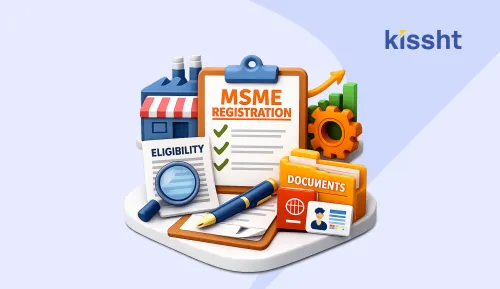
    Step 2: MSME Udyam Registration — Your Compliance Multiplier

    MSME stands for Micro, Small, and Medium Enterprise — a classification under the MSMED Act, 2006. As of 1 April 2025, the revised thresholds under Notification S.O. 1364(E) are as follows:

    • Micro Enterprise: Investment up to ₹2.5 crore and annual turnover up to ₹10 crore
    • Small Enterprise: Investment up to ₹25 crore and annual turnover up to ₹100 crore
    • Medium Enterprise: Investment up to ₹125 crore and annual turnover up to ₹500 crore

    Both the investment and turnover conditions must be met at the same time. Exceed either, and you lose MSME classification — along with its benefits. Registration happens through the Udyam Registration portal and is completely free of cost. You’ll need your Aadhaar, PAN, and GSTIN. The certificate is valid indefinitely and doesn’t need annual renewal.

    A quick example: a D2C skincare startup in Kolkata with ₹15 lakh investment and ₹60 lakh annual turnover qualifies as a Micro Enterprise. Registering takes under 30 minutes online and immediately unlocks priority lending from banks, protection against delayed payments under the MSMED Act, and — crucially — the 50% trademark fee concession.

    What most founders miss: Udyog Aadhaar (the older system, discontinued in 2020) does not qualify for the trademark fee concession. You need the Udyam Registration Certificate specifically. If you registered under the old system, migrate on the Udyam portal before you file your trademark. You can complete your MSME Udyam registration through Lawizer’s guided process — document collection, form filling, and certificate in hand, fully online.

    Step 3: Trademark Registration — Protect What’s Yours at Half the Cost

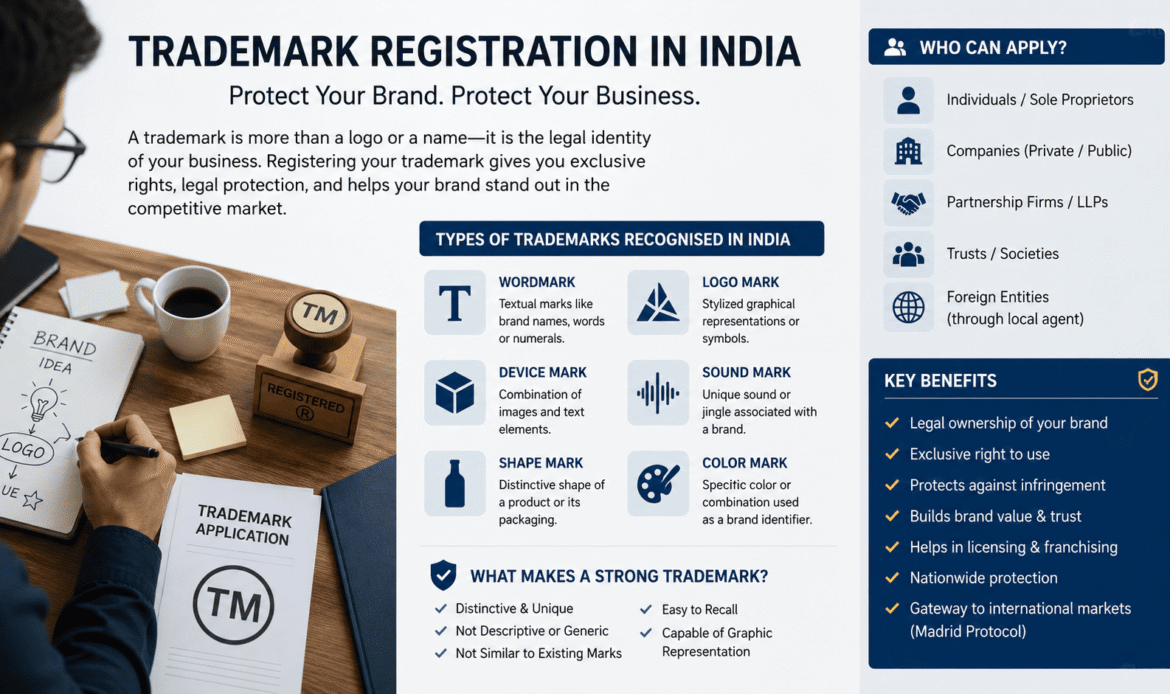
    A trademark is the exclusive legal right to your brand name, logo, tagline, or any unique identifier — granted under the Trade Marks Act, 1999 and regulated by the CGPDTM (Controller General of Patents, Designs and Trade Marks) through the IP India portal. Here’s where your MSME certificate earns its keep.

    Trademark Fee: MSME vs. Non-MSME (2025)

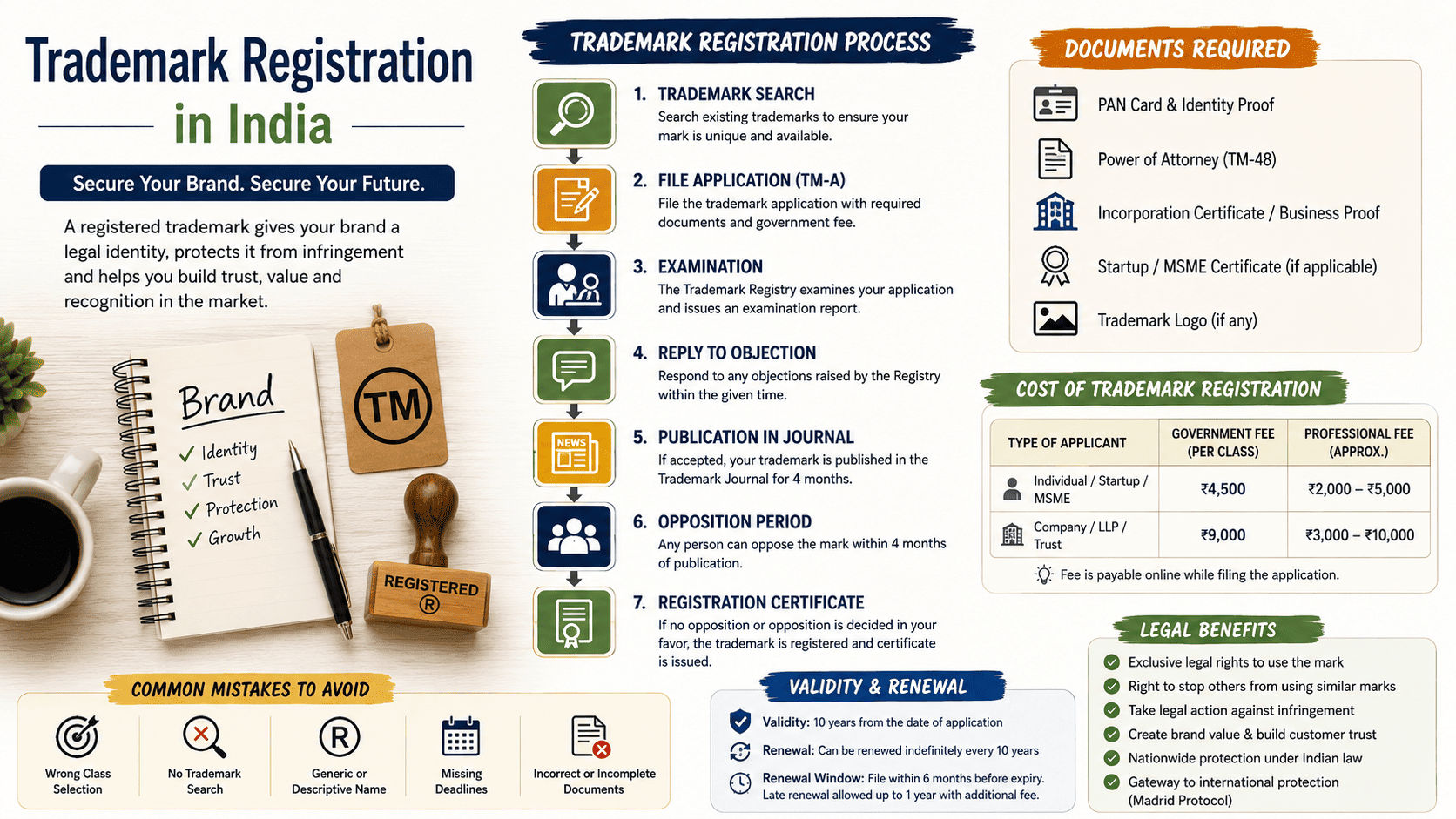
    • With MSME/Udyam certificate: ₹4,500 per class (e-filing)
    • Without MSME (Pvt Ltd, LLP, Partnership): ₹9,000 per class (e-filing)

    That’s a straight 50% saving on government fees — applied at the time of filing, not as a reimbursement. You simply attach your Udyam certificate when submitting Form TM-A on the IP India portal. Let’s say you’re a food brand in Delhi filing under Class 29 (processed foods) and Class 30 (spices). With MSME: ₹4,500 × 2 = ₹9,000 in government fees. Without MSME: ₹9,000 × 2 = ₹18,000. Same protection, half the cost.

    The TM symbol (™) can be used from the day you file. The ® symbol is only permitted after the registration certificate is issued — typically 18 to 24 months after filing under 2025 timelines, subject to examination and opposition. Note: professional fees charged by trademark agents are subject to 18% GST. Always confirm whether a service provider’s quoted price is GST-inclusive or GST-exclusive. For end-to-end filing, explore Lawizer’s trademark registration service — class selection, filing, and objection response included.

    Trademark Registration in India

    The Right Order: What to Do First, Second, Third

    Sequence matters. Here’s the order that makes the most financial and legal sense:

    • First — Get GST registration. Even if voluntary, your GSTIN is needed for cleaner Udyam filing and signals business formality to banks and buyers.
    • Second — Get MSME Udyam registration. Free, takes under 30 minutes, and unlocks your 50% trademark fee concession. You need this certificate in hand before you file your trademark.
    • Third — File your trademark. With your Udyam certificate attached, you file at ₹4,500 per class instead of ₹9,000. Legal protection for your brand name dates back to the day of filing.

    The entire bundle — GST + MSME + Trademark — can be completed in under a week if your documents are in order. Documents you’ll need across the three: PAN card, Aadhaar card, bank account details, proof of business address, and a clear JPEG or PNG of your logo (for trademark filing).

    Frequently Asked Questions

    Q: Do I need GST registration before I can apply for MSME Udyam?

    A: GST registration is not strictly mandatory for Udyam registration, especially if your turnover is below the GST threshold of ₹50 lakhs (goods) or ₹25 lakhs (services). However, having a GSTIN makes the Udyam application smoother and more complete. Voluntarily registering for GST before filing Udyam is strongly recommended, especially if you plan to file a trademark next.

    Q: How much does the MSME trademark fee discount actually save me?

    A: The discount cuts the government filing fee from ₹9,000 to ₹4,500 per trademark class for MSME-registered businesses. If you’re filing in two classes — which most brands need for their name and logo — that’s a direct saving of ₹9,000. The concession is applied at the time of filing Form TM-A by attaching your Udyam Registration Certificate.

    Q: Can a private limited company get the MSME trademark fee discount?

    A: Yes — if the company holds a valid Udyam Registration Certificate and its investment and turnover fall within the MSME classification thresholds. Entity type alone doesn’t determine eligibility; the Udyam certificate does. A private limited company that qualifies as a small enterprise under the MSMED Act 2006 is entitled to the ₹4,500 e-filing rate per class.

    Q: What happens if I file a trademark without MSME registration?

    A: You pay the full ₹9,000 government fee per class instead of ₹4,500. There’s no way to claim a retroactive refund on this difference after filing. Get your Udyam certificate first — it’s free, fast, and the savings on trademark fees alone justify the effort.

    Q: How long does the entire GST + MSME + Trademark bundle take?

    A: GST registration typically takes 7–10 working days after document submission. Udyam registration is almost instantaneous — the certificate is generated on the same day in most cases. Trademark filing can be done within a day of Udyam certificate receipt. The TM symbol is available from the day you file. Full trademark registration takes 18–24 months depending on examination and opposition, but your legal rights date back to the filing date.

    Q: Is there any government subsidy for MSME trademark fees beyond the 50% discount?

    A: Yes. The MSME IPR (Intellectual Property Rights) scheme provides reimbursement of 50% of the official filing fee actually paid, up to a specified ceiling. This is separate from the reduced fee concession and is not automatic — you need to submit a separate application with your fee receipt. Many founders miss this because they aren’t aware it exists. Check the MSME Ministry’s current scheme notifications for the latest ceiling amounts.

    Ready to complete your compliance bundle in one go?
    Lawizer’s experts handle everything — GST registration, MSME Udyam filing, and trademark registration — fully online, starting at just ₹999. No CA visit needed.

    Get your GST + MSME + Trademark bundle done today →

  • GST Registration for Startups: Who Needs It and How to Apply

    GST Registration for Startups: Who Needs It and How to Apply

    GST registration for startups in India trips up more founders than almost any other compliance step. Turnover thresholds, mandatory categories, e-commerce exceptions — there’s a lot to unpack, and the penalty for getting it wrong starts at ₹10,000.

    Here’s the thing: not every startup needs to register for GST immediately. But some do, regardless of how much revenue they’ve made. Knowing which camp you’re in is the first call to make.


    📌 TL;DR: GST registration for startups in India is mandatory once your annual turnover crosses ₹40 lakhs (goods) or ₹20 lakhs (services) in most states — but certain startups, including those selling interstate or through e-commerce platforms, must register regardless of turnover. The application is filed online through the GSTN portal (gstn.gov.in) and typically processed within 3–7 working days. Lawizer helps startups complete the entire registration process without a CA visit.

    What You’ll Learn

    • Exactly when GST registration becomes mandatory for your startup
    • Which categories must register even before crossing the turnover limit
    • The documents you need and the step-by-step application process
    • Why voluntary registration sometimes makes more financial sense than waiting

    What Is GST Registration and Why Does It Matter for Startups

    GST — Goods and Services Tax — is India’s unified indirect tax on the supply of goods and services, introduced through the CGST Act, 2017 (Central Goods and Services Tax Act). Before GST, businesses had to navigate VAT, service tax, and excise duty separately. GST replaced all of that with a single, destination-based tax collected at each stage of the supply chain.

    For startups, GST registration does more than make you tax-compliant. It gives you a GSTIN (GST Identification Number), a 15-digit tax identity that signals legitimacy to clients, vendors, and banks. Registered businesses can issue tax invoices, collect GST from customers, and — crucially — claim Input Tax Credit (ITC), which means the GST you paid on your purchases offsets the GST you owe on your sales. That’s real money back in your working capital.

    The GSTN portal (gstn.gov.in) is the government’s centralised platform where all registration, return filing, and payment happens. The Central Board of Indirect Taxes and Customs (CBIC) oversees administration. Every startup founder should know both.

    What most founders miss: being unregistered when you should be registered isn’t just a compliance gap — under Section 122 of the CGST Act, it’s listed as one of 21 chargeable offences, with penalties starting at 10% of the tax due or ₹10,000, whichever is higher.


    Who Needs GST Registration: The Turnover-Based Rule

    Section 22 of the CGST Act lays down the baseline: if your aggregate annual turnover crosses the prescribed threshold, registration is mandatory. The short answer on thresholds is this — it depends on what you sell and where you’re based.

    For goods-only businesses in most Indian states: mandatory once turnover exceeds ₹40 lakhs per financial year. For service-based startups — SaaS companies, consulting firms, digital agencies, freelancers — the threshold is lower at ₹20 lakhs. For startups operating out of special category states (Arunachal Pradesh, Manipur, Meghalaya, Mizoram, Nagaland, Sikkim, Tripura, and Uttarakhand), the thresholds drop further: ₹20 lakhs for goods and ₹10 lakhs for services.

    One point founders often overlook: aggregate turnover is calculated on a PAN-India basis, not state by state. If you have operations in Mumbai and Bengaluru, you add those revenues together. GST taxes, cess collected from customers, and non-GST supplies are excluded from the calculation — only your actual sales income counts.

    A quick example: a Kolkata-based software consultancy billing ₹18 lakhs this year is below the ₹20 lakh services threshold and technically doesn’t need to register. But if it crosses ₹20 lakhs mid-year, it must apply for registration within 30 days of the date it crossed the limit.

    GST Registration for Startups in India: Process, Benefits (2025 Guide)

    Mandatory Registration Regardless of Turnover: Section 24 Categories

    Here’s where many startups get blindsided. Under Section 24 of the CGST Act, certain businesses must register for GST the moment they commence operations — turnover limits simply don’t apply to them.

    The categories most relevant to Indian startups are:

    Interstate supply of goods or services: If your startup sells across state lines — a Delhi-based D2C brand shipping to Maharashtra, or a Bengaluru SaaS firm billing a client in Hyderabad — you must register, even if your total revenue is ₹5 lakhs. This is one of the most commonly missed triggers.

    E-commerce sellers: Selling through Amazon, Flipkart, Meesho, or any other e-commerce operator? Mandatory registration applies from your first sale, regardless of revenue. The platform itself needs your GSTIN to process payments correctly and deduct Tax Collected at Source (TCS).

    E-commerce operators: If you run a marketplace or aggregator platform, you must register separately as an operator under GST.

    Importers of services (Reverse Charge Mechanism): Startups using international SaaS tools — AWS, Google Workspace, Zoom, Salesforce — may be liable to pay GST under the Reverse Charge Mechanism (RCM), where the recipient, not the supplier, pays the tax. This triggers mandatory registration.

    Casual taxable persons: If your startup participates in trade fairs or exhibitions in states where you don’t have a permanent office, you need to register as a Casual Taxable Person before each such event.

    For a full list of mandatory categories and how they apply to DPIIT-recognised startups, the CBIC’s official guidance on gstn.gov.in remains the most reliable reference.


    Why Voluntary GST Registration Often Makes Business Sense

    Voluntary registration — choosing to register even when you’re below the threshold — is more than just an option. For many early-stage startups, it’s a financially intelligent move.

    The primary reason is Input Tax Credit. Every rupee of GST you pay on office rent, cloud subscriptions, equipment, and professional services can be claimed back against your GST liability. If you’re purchasing extensively to build your product but aren’t yet registered, that credit is simply lost.

    Beyond ITC, there’s the matter of B2B credibility. Most corporate clients and government procurement systems require vendors to be GST-registered. Without a GSTIN, you’re locked out of a large segment of potential revenue. Banks and NBFCs also treat GST returns as a proxy for financial health — your GSTR-3B filings often form part of loan assessment at platforms like Razorpay Capital or traditional lenders.

    A quick example: a two-person UX design studio in Pune, billing ₹15 lakhs annually, is below the threshold. But their biggest prospective client — a fintech company in Mumbai — insists on a tax invoice with GSTIN. Voluntary registration solves that immediately, and the studio starts recovering ITC on software subscriptions at the same time.

    If your startup is at a stage where you’re actively pitching enterprise clients or seeking funding, voluntary GST registration via Lawizer’s startup legal and compliance services is a step worth taking early.


    Documents Required for GST Registration

    Let’s break this down. The document list for GST registration isn’t long, but every item needs to be accurate — mismatches between your PAN, Aadhaar, and incorporation documents are the most common reason applications get rejected or delayed.

    For a Private Limited Company or LLP:

    Business PAN card (mandatory for all entities — individual PAN won’t work for a company). Certificate of Incorporation or LLP Agreement. PAN and Aadhaar of all directors or designated partners. Proof of the principal place of business — a rent agreement plus an electricity bill, or property tax receipt if the premises are owned. Bank account details — a cancelled cheque or bank statement with the account number and IFSC. Board Resolution or Authorisation Letter designating the authorised signatory. Photographs of directors and the authorised signatory. Digital Signature Certificate (DSC) for companies.

    For a Sole Proprietorship or Partnership, the documents are simpler: individual PAN, Aadhaar, business address proof, and bank account details.

    One thing that catches founders off guard: the proof of business address must match your registered office address exactly. If you’re operating from a co-working space in Bengaluru or Delhi, you’ll typically need an NOC (No Objection Certificate) from the space provider alongside your rental agreement.


    How to Apply for GST Registration: Step-by-Step

    The entire process runs on the GSTN portal — no physical visits, no intermediary required. Here’s how it works.

    • Step 1 — Visit gstn.gov.in and navigate to Services > Registration > New Registration. Select “Taxpayer” as the registration type.
    • Step 2 — Fill Part A of Form GST REG-01. Enter your PAN, mobile number, and email. An OTP will be sent to both for verification. Once verified, you’ll receive a Temporary Reference Number (TRN).
    • Step 3 — Log in with your TRN and complete Part B of the application. This is where you upload all the documents listed above, provide details of your business activity, and select the correct commodity or service codes (HSN codes for goods, SAC codes for services).
    • Step 4 — Submit the application. For companies, this requires signing with a DSC. For proprietorships, an Aadhaar-based e-signature suffices.
    • Step 5 — You’ll receive an Application Reference Number (ARN). The GST officer reviews your application. If documents are complete and consistent, registration is approved and a GSTIN is issued — typically within 3–7 working days. If the officer raises queries, you’ll receive a notice in Form GST REG-03 and must respond within 7 working days.

    The GSTN portal now runs an automated approval system that can issue registration significantly faster in straightforward cases. That said, any mismatch in documents resets the clock.

    If you’d prefer to skip the back-and-forth and get it right the first time, you can use Lawizer’s online compliance platform to complete GST registration with expert guidance — fully online.


    Frequently Asked Questions

    Q: Does my startup need GST registration before it starts earning revenue?

    A: Not necessarily based on turnover rules — but yes, if you fall under a mandatory category. If you plan to sell through an e-commerce platform like Amazon or Meesho, or if you’ll be supplying goods or services across state lines from day one, you must register for GST before your first transaction. If you’re a service-based startup operating locally and expect to stay below ₹20 lakhs for the first year, you can defer registration until you cross the threshold.

    Q: What is the GST registration threshold for service startups in India?

    A: For service-based startups operating in most Indian states, GST registration becomes mandatory once annual aggregate turnover exceeds ₹20 lakhs in a financial year. In special category states (Arunachal Pradesh, Manipur, Meghalaya, Mizoram, Nagaland, Sikkim, Tripura, and Uttarakhand), the threshold is ₹10 lakhs. Turnover is calculated on a PAN-India basis under Section 22 of the CGST Act, 2017.

    Q: Can I sell on Flipkart or Amazon without a GST number?

    A: No. Selling through any e-commerce operator in India — Amazon, Flipkart, Meesho, Zomato, Swiggy, or similar platforms — requires mandatory GST registration under Section 24(ix) of the CGST Act, regardless of your revenue. The platform deducts Tax Collected at Source (TCS) and needs your GSTIN to process payouts. Your seller account cannot be activated without one.

    Q: What is the penalty if a startup operates without GST registration when it’s mandatory?

    A: Under Section 122 of the CGST Act, failure to obtain mandatory GST registration is a listed offence. The penalty is 10% of the tax amount due, with a minimum of ₹10,000. In cases where the non-registration was deliberate and involved tax evasion, the penalty can be 100% of the tax evaded, and prosecution including imprisonment becomes possible for larger amounts.

    Q: Is voluntary GST registration worth it for a startup below the threshold?

    A: Yes, in most cases. Voluntary registration lets you claim Input Tax Credit (ITC) on GST paid on purchases — software subscriptions, office equipment, professional services — reducing your net tax burden. It also signals credibility to B2B clients, many of whom require a tax invoice with a valid GSTIN to process vendor payments. The trade-off is the compliance burden: you’ll need to file GSTR-1 and GSTR-3B returns monthly or quarterly.

    Q: How long does GST registration take in India?

    A: Once you submit a complete application on the GSTN portal, registration is typically processed within 3 to 7 working days. The automated approval system introduced in late 2025 can issue a GSTIN faster in cases where documents are clean and consistent. If the GST officer raises a query (Form GST REG-03), you have 7 working days to respond, which extends the timeline. Using a service like Lawizer reduces the risk of errors that trigger queries.


    Ready to Get GST-Registered Without the Back-and-Forth?

    Lawizer’s compliance experts handle your GST registration end-to-end — document prep, GSTN portal filing, officer queries — fully online. No CA visit needed. You can also explore our full range of startup legal and compliance services covering company incorporation, trademark registration, MSME/Udyam, and more.

    Get GST-registered today →

  • Building a D2C Brand in India? Here Are the 6Legal Boxes You Must Tick First:

    Building a D2C Brand in India? Here Are the 6Legal Boxes You Must Tick First:


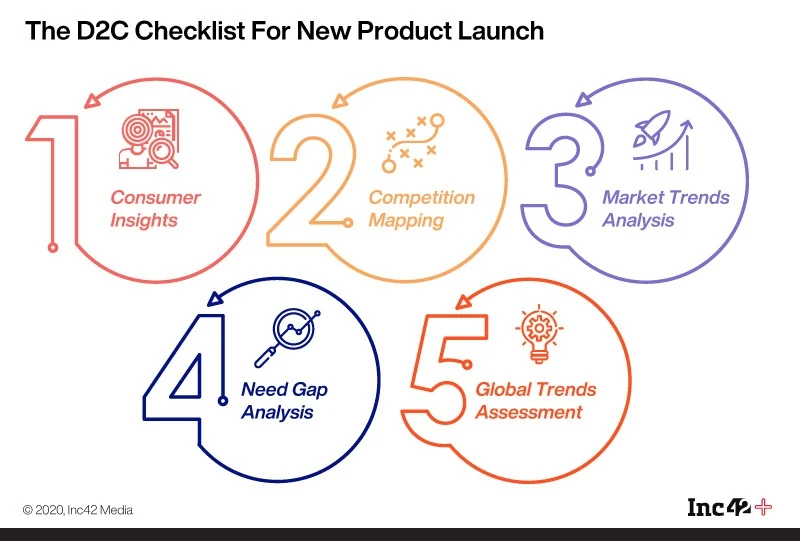
    India’s D2C market crossed $60 billion in 2025. Mamaearth, boAt, Lenskart — the proof of concept is well-established. What’s less discussed is the compliance stack sitting beneath every one of those brands, and what happens when a new founder skips it.

    The answer: seized shipments, forced rebrands, marketplace de-listings, and penalty notices that arrive long after your first sale. The six requirements below aren’t optional extras — they’re the legal floor your D2C brand must be built on before the first order ships.


    📌 TL;DR: Every D2C brand operating in India needs a registered business entity, GST registration, a trademark application, product-specific licences (FSSAI, BIS, or CDSCO depending on your category), Legal Metrology-compliant labelling, and Consumer Protection E-Commerce Rules compliance. Miss any one of these and you’re trading on borrowed time. Lawizer helps D2C founders get all of it done — fully online, from incorporation to trademark — without needing a CA in the room.


    What You’ll Learn

    • Why GST registration is mandatory even if your turnover is ₹0
    • What the Legal Metrology Act means for your product packaging and your website listing
    • Which product-specific licence your category actually needs
    • How the DPDP Act, 2023 changes what your checkout page must look like
    Is Direct-to-Consumer (D2C) the only way to go in 2024? -

    Box 1: Register the Right Business Entity

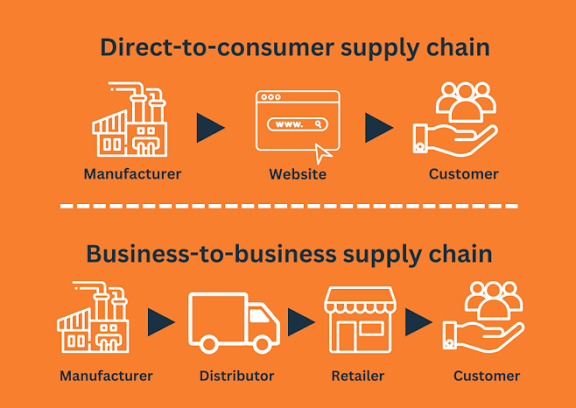
    Most D2C founders start as sole proprietors and immediately run into a wall — payment gateways require a registered entity, marketplace onboarding is smoother with a PAN in the company’s name, and investors won’t touch a proprietorship.

    A Private Limited Company is the recommended structure for any D2C brand with growth ambitions. It gives you limited liability, a clean cap table for future fundraising, and immediate credibility with marketplace category managers.

    If you’re a bootstrapped solo founder testing a single SKU category, an LLP is a leaner starting point — lower compliance cost than a Pvt Ltd, more structure than a proprietorship. Either way, registration happens through the MCA’s SPICe+ form and typically takes 10–15 working days. This is always Step 1 because every subsequent registration — GST, trademark, bank account, payment gateway — flows from your Certificate of Incorporation and company PAN.

    Lawizer handles startup and business legal registration end-to-end, including entity structuring advice if you’re undecided between Pvt Ltd and LLP.


    Box 2: GST Registration — Mandatory from Sale Day One

    Here’s the rule most D2C founders get wrong: the ₹40 lakh turnover threshold that exempts small businesses from GST does not apply to e-commerce sellers. Under Section 24 of the CGST Act, 2017, every person supplying goods through an e-commerce operator must register for GST regardless of turnover. If you’re selling on Amazon, Flipkart, Nykaa, or Meesho — even if you’ve made zero sales — you need a GSTIN before your first listing goes live.

    If you sell only through your own D2C website with turnover under the threshold, the exemption technically applies — but the moment you list on any third-party marketplace, that window closes. Given that most D2C brands use a mix of owned and marketplace channels, the practical answer is: register for GST immediately after incorporation.

    Your ongoing GST obligations include filing GSTR-1 (outward supply details), GSTR-3B (monthly summary return), and GSTR-9 (annual return), plus reconciling platform TCS (Tax Collected at Source) deductions from marketplaces against your actual liability. If your D2C brand stores inventory in warehouses across multiple states, you’ll also need GST registrations in each of those states — a requirement that catches fast-scaling brands off-guard.


    Box 3: File Your Trademark Early

    A trademark is the cheapest insurance a D2C brand can buy. At ₹4,500 per class for small enterprises (under the current fee schedule), it protects your brand name and logo from being registered by a competitor — and in the D2C world, copycats move fast. Beyond legal protection, a registered trademark (or even a pending application with an acknowledgment number) is required for Amazon Brand Registry, which unlocks A+ content, brand analytics, and counter-counterfeiting tools that directly affect your conversion rate.

    File in the right classes from day one. Common classes for D2C brands: Class 25 (clothing and footwear), Class 30 (food and beverages), Class 3 (cosmetics and personal care), Class 35 (online retail services). Most D2C brands need at least two classes — one for the product category and one for retail services. Registration takes 6–18 months from filing, but your protection date runs from the application date, not the registration date. File now.

    Trademark Registration in India

    Box 4: Product-Specific Licences — FSSAI, BIS, CDSCO

    This is where D2C founders most often underestimate their compliance surface area.

    FSSAI licence — mandatory for any brand selling food, beverages, dietary supplements, protein powders, health drinks, nutraceuticals, or even pet food. The licence tier depends on your annual turnover: registration for businesses up to ₹12 lakh turnover, state licence for ₹12 lakh to ₹20 crore, and central licence for above ₹20 crore or cross-state e-commerce. Operating without an FSSAI licence attracts a penalty of up to ₹5 lakh under Section 63 of the Food Safety and Standards Act, 2006. The 14-digit FSSAI licence number must appear on every product label and your website.

    BIS certification — required for electronics, electrical goods, and certain consumer products covered under mandatory BIS product orders. If your D2C brand sells LED lights, power banks, helmets, or kitchen appliances, BIS certification (and the ISI mark) is non-negotiable before you list a single unit.

    CDSCO approval — required for cosmetics under the Drugs and Cosmetics Act, 1940, as amended by the Cosmetics Rules, 2020. The key risk here: the moment your product makes a therapeutic claim (“reduces melanin production,” “treats acne”), it crosses from cosmetic to drug territory — triggering stricter regulations, and penalties including product seizure and imprisonment up to one year for misclassification.


    Box 5: Legal Metrology Act Compliance — The One Every Category Misses

    Most D2C founders associate compliance with the licences above. The Legal Metrology (Packaged Commodities) Rules, 2011 apply to every pre-packaged product sold in India — food, skincare, electronics, clothing, home décor, stationery, pet products. There are no exceptions for small businesses or D2C brands.

    Every product package must display: product name, net quantity in standard units, MRP inclusive of all taxes (preceded by “MRP ₹”), manufacturer or packer name and registered address, month and year of manufacture, consumer care contact details (name, address, phone, and email), and country of origin for imported goods.

    Critically, for e-commerce sellers, these declarations must appear not just on the physical packaging but also on the product listing page itself. Non-compliance carries a penalty of ₹25,000 to ₹50,000 per offence — and legal metrology officers can and do inspect marketplace listings.

    One additional obligation that’s quietly become an enforcement focus in 2025: Extended Producer Responsibility (EPR) registration under plastic and e-waste rules. If your D2C brand uses plastic packaging, your EPR registration number must appear on the packaging. Failure to register is treated as a serious violation under solid waste and plastic management rules.


    Box 6: Consumer Protection E-Commerce Rules, 2020 — and the DPDP Act, 2023

    The Consumer Protection (E-Commerce) Rules, 2020 apply to every D2C brand selling online. Your website or app must display: complete product details with a total price breakdown (no hidden fees), your return and refund policy, cancellation terms, delivery timelines, and seller identity.

    You are required to appoint a Grievance Officer, display that officer’s name and contact details on your platform, and resolve consumer complaints within 30 days. Violation attracts penalties under the Consumer Protection Act, 2019.

    Layered on top of this is the Digital Personal Data Protection (DPDP) Act, 2023 — which changes what your checkout and data collection flows must look like. D2C brands collect significant customer data: names, addresses, payment information, browsing behaviour.

    Under the DPDP Act, you must collect only what is necessary, provide a clear privacy policy, obtain explicit consent before collecting data, and enable customers to request data deletion. The penalty for non-compliance scales up to ₹250 crore — which is why building DPDP-compliant data practices into your website from launch is far cheaper than retrofitting them after a notice.

    MSME or Udyam registration is also worth completing at this stage — it’s quick, free, and unlocks priority credit, marketplace benefits, and government tender eligibility as your brand scales.

    Top D2C ECommerce Brands In India - A Case Study

    How Long Does This All Take?

    Company incorporation, GST, and Udyam registration can run in parallel — typically 15–20 working days combined. File your trademark application the same week as incorporation. Product-specific licences (FSSAI, BIS) run concurrently but may take longer depending on your category.

    Total time from zero to first compliant sale: 30–60 days, with a total compliance cost typically between ₹15,000 and ₹50,000 depending on the entity structure and licences required.

    The brands that build this foundation correctly don’t just avoid penalties — they get marketplace approvals faster, onboard payment gateways without delays, and walk into investor conversations with clean corporate records.


    Frequently Asked Questions

    Q: Is GST registration mandatory for a D2C brand that hasn’t made any sales yet? A: Yes, if you intend to sell through any third-party e-commerce platform. Section 24 of the CGST Act removes the turnover exemption for e-commerce sellers entirely. You need a GSTIN before your first listing goes live on any marketplace, regardless of whether any sales have occurred.

    Q: Do I need a trademark even if I’m just starting out and unsure the brand will succeed? A: Yes — and the earlier the better. Trademark protection dates back to your application date, not your registration date. Filing early costs the same as filing later, but protects you from a copycat who registers your brand name while you’re waiting to see traction. An acknowledgment number from the IP India portal is also sufficient for Amazon Brand Registry.

    Q: My D2C brand sells skincare. Do I need CDSCO approval or FSSAI? A: CDSCO (under the Drugs and Cosmetics Act, 1940 and Cosmetics Rules, 2020) governs cosmetics like serums, creams, and shampoos. FSSAI governs edible products. The critical line: if your skincare product makes a therapeutic claim (treats a condition, alters a biological process), it shifts from cosmetic to drug regulation — with significantly higher compliance requirements and penalties for misclassification.

    Q: Does the Legal Metrology Act apply to my D2C website listing, or just the physical packaging? A: Both. Under amendments to the Legal Metrology (Packaged Commodities) Rules, e-commerce entities must display all mandatory declarations — MRP, net quantity, manufacturer details, and consumer care contacts — on the product listing page itself, not just on the physical label. Marketplace listings that omit these are actively flagged during inspections.

    Q: What does the DPDP Act, 2023 require from a D2C brand’s website? A: The Digital Personal Data Protection Act, 2023 requires D2C brands to collect only data that is necessary for the stated purpose, display a clear and accessible privacy policy, obtain explicit consent before collecting personal data, and provide customers with a mechanism to request correction or deletion of their data. Non-compliance penalties scale up to ₹250 crore — making early implementation far more cost-effective than corrective compliance after a notice.

    Q: Can Lawizer handle all six of these registrations as a single project? A: Yes. Lawizer handles company incorporation, GST registration, trademark filing, FSSAI licensing, and Udyam registration — fully online, with no CA visit required. Starting your business registration correctly from day one means you’re eligible for marketplace onboarding, payment gateway integration, and investor due diligence from launch.


    Ready to launch your D2C brand on solid legal ground? Lawizer gets your company registered, GST filed, trademark applied, and sector licences in place — fully online, starting at ₹4,999. No office visits, no missed boxes.

    Start your D2C brand registration →

  • Solopreneur to Startup: When Exactly Should You Formally Incorporate?

    Solopreneur to Startup: When Exactly Should You Formally Incorporate?

    Most Indian freelancers cross ₹20 lakh in billings before they’ve even opened a current account for the business. That’s the exact point the law starts asking questions — and it’s usually the point founders start googling “when to incorporate company in India” at 1 a.m.

    Here’s the thing. Incorporating too early wastes money on compliance for a business that hasn’t proven itself. Incorporating too late costs you a client, a co-founder, or an investor. There’s a narrow window where it actually makes sense — and it’s rarely “day one.”

    📌 TL;DR: You don’t need to incorporate on day one — a sole proprietorship is legal, requires no registration, and works fine until you hit specific triggers: ₹20 lakh in annual turnover (GST becomes mandatory), an investor writing a cheque, a co-founder wanting a formal equity split, or an enterprise client demanding a company PAN. Below that point, incorporating a private limited company just adds ₹35,000–₹60,000 a year in compliance cost for a business that hasn’t earned it yet. Lawizer can set up the right structure — Pvt Ltd, OPC, or LLP — once you actually hit one of these signals.

    What You’ll Learn

    • Why registering a Pvt Ltd too early actually costs you money
    • The exact revenue, client, and funding signals that mean it’s time
    • Sole proprietorship vs OPC vs LLP vs Pvt Ltd — which fits your stage
    • Where GST and MSME registration fit into this timeline

    The Real Cost of Incorporating Too Early

    A lot of first-time founders register a Private Limited Company (a separate legal entity recognised by the Ministry of Corporate Affairs, or MCA) in their very first month, often because a CA friend suggested it or a WhatsApp forward made proprietorships sound risky.

    What most founders miss: a Pvt Ltd requires a statutory auditor from day one, annual ROC filings, ITR-6 returns, and DIN renewal — regardless of whether the company made ₹5 lakh or ₹0 in revenue that year.

    Realistic annual compliance for a small Pvt Ltd runs close to ₹35,000–₹60,000, even before you’ve validated whether anyone wants what you’re building. Compare that to a sole proprietorship, which needs no formal registration at all — you can start invoicing clients under your own PAN the same day you decide to freelance seriously.

    The short answer: build first, prove the business works, then incorporate. A structure doesn’t make a business real — revenue does.

    The Signals That Actually Mean It’s Time

    Instead of a calendar date, use triggers. Here’s what most founders who incorporate at the right time have in common:

    • You’re nearing ₹20 lakh in annual turnover. That’s the GST registration threshold for service providers in most states (₹40 lakh for goods, ₹10 lakh in special category states). Past this point, you’re a taxable entity whether or not you’ve incorporated.
    • A co-founder wants a documented equity split. You can’t issue shares without a company. This is the single most common reason two-person teams incorporate earlier than solo founders.
    • An investor is ready to wire money. Angel or institutional investors need a company bank account and a cap table — neither exists without incorporation.
    • An enterprise client’s procurement team asks for a “company PAN.” Large B2B buyers frequently can’t onboard an individual vendor, regardless of your Udyam or GST status.
    • You’re hiring employee #1 and want to offer ESOPs. Employee stock options only exist within a company structure.

    Notice what’s not on this list: having an idea, building an MVP, or making your first few sales. None of that requires a registered entity yet.

    Sole Proprietorship, OPC, LLP, or Pvt Ltd — Which Fits Your Stage

    Let’s break this down by what you’re actually doing right now, not what you plan to do eventually.

    Solo, under ₹20 lakh, no funding plans

    Stay a sole proprietor. You pay tax under your individual slab rate, not a flat corporate rate, and there’s no separate compliance calendar to track. A Udyam (MSME) registration is worth getting even at this stage — it costs almost nothing, helps you open a current account, and qualifies you for priority-sector lending later.

    Solo, corporate or international clients, liability-sensitive work

    Consider a One Person Company (OPC) — a company structure built specifically for single founders that still gives you limited liability and a distinct legal identity. IT consultants, SaaS builders, and agency owners working with larger clients often move here before they ever bring on a co-founder.

    Two or more founders, no funding yet

    An LLP (Limited Liability Partnership) is usually the better first move. It gives you a formal ownership split and limited liability without the statutory audit requirement that applies to Pvt Ltds from day one — LLPs only need an audit once turnover crosses ₹40 lakh.

    Raising money or planning to issue ESOPs

    This is when a Private Limited Company earns its cost. It’s the only structure investors will fund, the only one that supports employee stock options cleanly, and it comes with a genuine tax upside: domestic companies opting for the concessional regime under Section 115BAA of the Income Tax Act pay an effective rate of 25.17%, against individual slab rates that hit 30% plus cess well before ₹15 lakh in profit.

    Where GST and MSME Registration Fit In

    Incorporation and tax registration aren’t the same decision, and mixing them up is where a lot of founders get confused. You need GST registration once your turnover crosses ₹20 lakh (₹10 lakh in special category states) for services, regardless of whether you’re a proprietor, an LLP, or a Pvt Ltd.

    MSME (Udyam) registration is separate again — it’s not mandatory, but it’s fast, free, and worth doing early since it plugs into your income tax filings automatically.

    If you’re planning to apply for DPIIT recognition under the Startup India scheme — for the three-year tax exemption under Section 80IAC, or access to the Seed Fund Scheme — note that only Private Limited Companies and LLPs are eligible.

    Sole proprietorships and OPCs don’t qualify for this particular benefit, which is worth factoring in if government schemes are part of your growth plan.

    Making the Switch Without Losing Time

    Once you’ve hit a genuine trigger, converting from proprietor to a registered company isn’t a same-day process — it typically takes 7 to 21 business days depending on name approval and documentation.

    The company needs to formally take over your existing contracts, assets, and client relationships through a business transfer agreement, and your GST, PAN, and bank accounts all need updating to the new entity’s name.

    What most founders miss here: starting this conversion a few weeks before you actually need it — before the investor’s cheque is due, before the enterprise contract’s start date — saves you from scrambling. A company incorporation that’s rushed under deadline pressure is where documentation errors creep in.

    Frequently Asked Questions

    Q: Do I need to register my business before I start freelancing in India?

    A: No. You can invoice clients, accept payments, and pay income tax under your own PAN as a sole proprietor without any formal registration. You only need to register for GST once your turnover crosses ₹20 lakh a year (₹10 lakh in a few special category states).

    Q: What’s the minimum revenue before I should think about a Pvt Ltd?

    A: There’s no fixed number, but most founders find it makes sense once they’re consistently earning ₹1–1.5 lakh a month, are approaching the ₹20 lakh GST threshold, or have a specific trigger like investor funding or an enterprise contract. Below that, a Pvt Ltd’s compliance cost usually outweighs the benefit.

    Q: Can I convert my sole proprietorship into a private limited company later?

    A: Yes. You incorporate a new Pvt Ltd and then transfer the existing business’s assets, liabilities, and contracts to it through a business transfer agreement. The process usually takes 7–21 business days, and losses from the proprietorship generally can’t be carried forward into the new company.

    Q: Is a one person company (OPC) better than a sole proprietorship?

    A: An OPC gives you limited liability and a separate legal identity, which a sole proprietorship doesn’t — useful if you work with corporate clients or carry contractual risk. But it comes with more compliance than a proprietorship, so it’s usually a step you take once liability protection actually matters to your business.

    Ready to incorporate at the right time?
    Lawizer’s experts handle Pvt Ltd, OPC, and LLP incorporation, GST registration, and MSME/Udyam registration — fully online, starting at just ₹1,999. No CA visit needed.

    Get your business incorporated →

  • GST Registration for Startups: Everything Founders Wish They Knew Earlier

    GST Registration for Startups: Everything Founders Wish They Knew Earlier

    India now has over 1.97 lakh DPIIT-recognised startups — and a surprising number of them get hit with GST penalties in their first two years, not because they ignored the law, but because nobody explained it clearly from the start.

    GST registration for startups isn’t just a tax formality. It’s what separates a business that can legally invoice clients, claim input credits, and sell across state lines from one that can’t.

    Miss the window, and you’re looking at penalties of up to 10% of the tax due — or 100% if the GST officer decides non-payment was intentional. Here’s everything you need to know before that happens to you.

    📌 TL;DR: GST registration for startups in India is mandatory once your annual turnover crosses ₹40 lakhs (goods) or ₹20 lakhs (services) — but if you sell online, supply interstate, or want to claim Input Tax Credit, you need it from Day 1 regardless of turnover.

    The process is fully online via the GST portal (gst.gov.in) and typically takes 7–10 working days. Lawizer handles end-to-end GST registration for startups so you can stay focused on building your product.

    What you’ll learn

    • Exactly when your startup must register for GST
    • Documents needed and mistakes that cause rejections
    • Step-by-step registration process on the GST portal
    • Post-registration compliance — returns, ITC, e-invoicing
    • The Composition Scheme — should your startup opt in?

    Who actually needs GST registration? (The real answer)

    Let’s break this down. Most founders assume GST registration is only needed once you’re “big enough.” That’s partly right — and partly what gets startups into trouble. Under the CGST Act, registration becomes mandatory when your aggregate turnover crosses ₹40 lakhs for goods or ₹20 lakhs for services. For special category states like Manipur, Mizoram, Tripura, and Nagaland, the limit drops to ₹10 lakhs.

    Here’s the thing — turnover thresholds are only one trigger. Several startup scenarios make GST registration mandatory from the very first sale:

    • Interstate supply: Selling to customers in another state? You need a GSTIN immediately — no turnover limit applies.
    • E-commerce sellers: Listing on Amazon, Flipkart, or Meesho? GST registration is compulsory before your first order ships.
    • E-commerce operators: Running a marketplace platform? Also covered under mandatory registration rules.
    • Reverse charge mechanism: Purchasing services from unregistered vendors where you’re liable to pay GST directly.
    • Casual taxable persons: Taking a contract in a state where you don’t have a fixed place of business.

    What most founders miss: even if none of the above apply, voluntary GST registration lets you issue proper tax invoices, claim ITC on purchases, and appear credible to B2B clients who won’t work with unregistered vendors.

    Documents required — the complete checklist

    For Private Limited companies and LLPs

    • PAN card of the company or LLP
    • Certificate of Incorporation from MCA
    • MOA/AOA for Pvt Ltd; LLP Agreement for LLPs
    • PAN and Aadhaar of all directors or designated partners
    • Board resolution authorising the signatory
    • Proof of principal place of business — rent agreement + electricity bill
    • Bank account details — cancelled cheque or bank statement
    • DSC or Aadhaar-based e-sign for authentication

    For sole proprietorships and partnerships

    • PAN and Aadhaar of proprietor or all partners
    • Partnership deed (for partnership firms)
    • Proof of business address
    • Bank account proof

    A quick example: if your startup is in a co-working space in Bengaluru, you’ll also need an NOC from the operator along with their rent agreement and electricity bill.

    How to register for GST: step-by-step

    1. Generate a TRN — Go to gst.gov.in → Services → Registration → New Registration. Enter PAN, email, and mobile. Verify OTPs to receive your Temporary Reference Number. Valid for 15 days.
    2. Fill Part B — Log in with TRN. Complete all 10 sections: business details, promoter info, authorised signatory, business address, goods/services (HSN/SAC codes), and bank details. Save after each section.
    3. Submit with DSC or Aadhaar e-sign — Companies and LLPs must use a DSC. Proprietors and partnerships can use Aadhaar OTP. You’ll receive an ARN confirming your application is under review.
    4. Receive your GSTIN — Approved within 7 working days if the application is complete. Your 15-digit GSTIN and Form GST REG-06 are issued. Queries come via Form GST REG-03 with 7 days to respond.

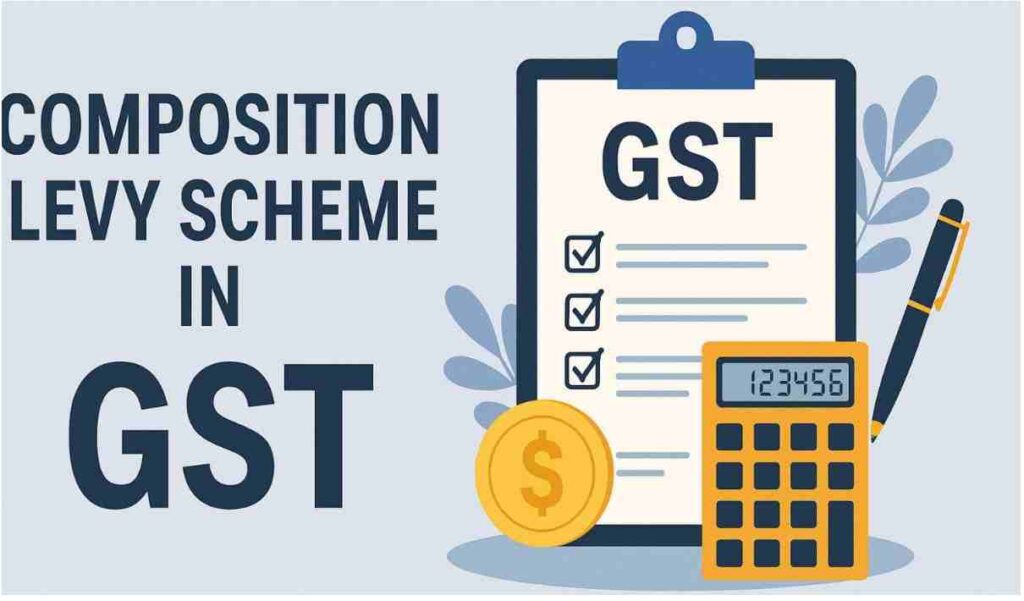
    The Composition Scheme: should your startup opt in?

    The Composition Scheme is a simplified tax option — flat rate on turnover, quarterly filing, lower compliance burden. But it comes with a major trade-off.

    Who can opt in?

    • Turnover up to ₹1.5 crore (goods) or ₹50 lakhs (services)
    • Flat tax rates: 1% traders, 2% manufacturers, 5% restaurants, 6% service providers
    • File CMP-08 quarterly and GSTR-4 annually

    The big trade-off

    Composition dealers cannot issue tax invoices or collect GST from customers. Your B2B clients can’t claim ITC on what they pay you — making you less attractive as a vendor. You also can’t make interstate supplies. For a SaaS startup in Mumbai selling to enterprise clients in Delhi, Composition Scheme is a non-starter.

    Post-registration compliance: what comes next

    GST return filing schedule

    • GSTR-1 (outward supplies): Monthly by 11th, or quarterly under QRMP scheme (turnover ≤ ₹5 crore)
    • GSTR-3B (summary return + tax payment): Monthly or quarterly
    • GSTR-9 (annual return): Due December 31st of following financial year

    Input Tax Credit (ITC) — the real financial benefit

    ITC lets you offset the GST paid on purchases against GST collected from clients. A quick example: ₹18,000 GST paid on purchases + ₹30,000 collected from clients = only ₹12,000 remitted to the government. You can only claim ITC if your supplier has filed their own GSTR-1 correctly.

    E-invoicing requirements

    Mandatory if your turnover exceeds ₹5 crore. Every B2B invoice must go through the Invoice Registration Portal (IRP) and carry an IRN and QR code. Invoices without a valid IRN can’t be used for ITC claims.

    Common mistakes that get startups into trouble

    • Registering too late: Must register within 30 days of crossing the threshold. Penalty: ₹10,000 minimum or 100% of tax due.
    • Wrong business address: Virtual office without proper NOC documentation triggers rejection or cancellation.
    • Wrong HSN/SAC codes: Picking the wrong code means charging the wrong GST rate — creating a liability later.
    • Ignoring nil returns: Even zero-sales months require a nil GSTR-3B. Missing it attracts ₹20/day late fee.
    • Not updating after changes: New director, new office, new branch — update on GST portal within 15 days via Form GST REG-14.

    Frequently asked questions

    Q: My startup’s turnover is below ₹20 lakhs. Do I still need GST registration?

    A: Not necessarily — but it depends on how you operate. If you only sell within your state to end consumers, you can legally operate without it. However, if you sell to B2B clients who need ITC, supply interstate, or sell through any e-commerce platform, registration is compulsory regardless of turnover.

    Q: How long does GST registration take in India?

    A: If your application is complete, the GST officer approves it within 7 working days. End-to-end with professional help typically takes 7–10 business days. Incomplete applications can push this to 3–4 weeks.

    Q: Can I get GST registration if my startup operates from a co-working space?

    A: Yes. You’ll need an NOC from the operator, plus their electricity bill or rent agreement as address proof. Make sure the name and address on the NOC exactly match what you submit — any mismatch is a common rejection trigger.

    Q: What happens if I don’t file GST returns after registration?

    A: Late fees apply immediately — ₹50/day for returns with tax liability, ₹20/day for nil returns. Consistent non-filing can lead to GSTIN suspension, meaning you can no longer legally collect GST or issue tax invoices.

    Q: Is GST registration the same as DPIIT Startup India recognition?

    A: No — they are separate. GST registration gives you a GSTIN for tax compliance. DPIIT recognition provides access to tax exemptions under Section 80IAC, self-certification under labour laws, and easier public procurement access. Many founders benefit from having both.

    Q: Can I cancel my GST registration if my startup shuts down?

    A: Yes, via Form GST REG-16 on the portal. The officer processes cancellation within 30 days. All pending returns must be filed and outstanding dues cleared before cancellation is approved.