Your trademark application status just flipped to “Objected” on the IP India portal. Your stomach drops. You’ve spent months building this brand — now what?
Here’s the thing: a trademark objection is not a rejection. It’s the examiner asking you to make your case. And if you respond well within the deadline, your mark moves forward.
📌 TL;DR: A trademark objection reply in India must be filed within 30 days of receiving the Examination Report on the IP India portal. Objections arise under Section 9 (absolute grounds like lack of distinctiveness) or Section 11 (relative grounds like similarity to existing marks) of the Trade Marks Act, 1999. A well-drafted reply with evidence, affidavits, and legal arguments can get your application accepted — and Lawizer’s trademark experts can handle the entire reply process for you online.
What You’ll Learn
- Why trademark objections are raised and what the two main grounds mean
- The exact 4-step process to file your objection reply online
- What documents you need to attach with your reply
- What happens after you file — hearings, journal publication, and beyond
- How to avoid common mistakes that lead to trademark abandonment
What Is a Trademark Objection — and Why Shouldn’t You Panic?
A trademark objection is a formal concern raised by the Trademark Examiner following the review of your application. It is not a dismissal — it’s a request to make your application clearer or change it. Think of it as the examiner putting up a hand and saying: “Convince me.”
The trademark examination report is a critical document issued after a thorough review of your application. It highlights any objections found. You’ll find this report on the IP India portal under your application number. Once you see the “Objected” status, your clock starts ticking.
What most founders miss: trademark objections are very common and most applications face them. However, trademark objections are not always fair. The registry sometimes raises them in a mechanical manner. That means a solid, well-argued reply often overturns the objection entirely. Don’t abandon your application without fighting for it.
The Two Grounds Under Which Objections Are Raised
Understanding why the examiner raised the objection determines your entire strategy. There are exactly two categories under the Trade Marks Act, 1999:
Section 9 — Absolute Grounds for Refusal
These objections come up when the trademark, in itself, doesn’t fulfil the basic requirements. Lack of distinctiveness means the mark is so common it doesn’t differentiate your goods or services from others. Descriptive or generic terms — words that just point out the quality, kind, or purpose of the product — are also flagged.
A quick example: if you try to register “Fresh Juice” for a juice brand, expect a Section 9 objection. The phrase describes the product, not a unique brand identity.
Section 11 — Relative Grounds for Refusal
These objections arise when the new trademark is found to be in conflict with an existing registered one. Similarity to existing marks — where the proposed name, logo, or style is found to be very close to a trademark already registered — is the primary trigger. Likelihood of confusion is also grounds: the products would be seen as related, and customers may be misled.
Let’s break this down with an example: applying for “Microma” when “Micromax” is already registered in a related category would almost certainly attract a Section 11 objection.
Step-by-Step: How to File Your Trademark Objection Reply Online
You have to file your response against the objection within one month from the date of the examination report. It is a written submission where you convince the examiner that your mark is distinct. Here’s the exact process:
Step 1 — Read the Examination Report Carefully
Download the full report from the IP India portal. Identify precisely which section — 9 or 11 — has been invoked, and what specific grounds are cited. The report will refer to specific sections of the Trademarks Act. Understanding the exact reason for the objection determines your entire reply strategy.
Step 2 — Draft a Persuasive Reply
The reply must contain reasons, facts, supporting rules of law, judgments supporting the case, and evidence along with other supporting documents that validate the response. An affidavit stating the usage of the trademark in the applicant’s website and social media network, advertisements, and availability of trademarked products on e-commerce sites should also be included.
Step 3 — File Online via the IP India Portal
Log in to the IP India Filing Portal. Select the option to upload a reply to the examination report. Attach your response as a PDF with supporting documents. No physical copies need to be submitted — it’s entirely online.
Step 4 — Wait for the Registry’s Response
In case the response is accepted, objections can be waived on the basis of the applicant’s response and the registry will allow the trademark application to be advertised before registration in the Trademark Journal. The registry may also require additional clarifications, in which case a trademark show cause hearing will be scheduled and the applicant will be notified with a notice.

Documents You Must Attach With Your Reply
Don’t file a bare-bones reply. Supporting documents are what convince examiners. Here’s what you’ll typically need:
- Affidavit of use — on Rs. 100 stamp paper, stating how long and how widely you’ve used the mark
- Invoices and purchase orders bearing the trademark, showing commercial use
- Website and social media screenshots showing the mark in active use
- Advertising materials — print, digital, or outdoor — featuring the trademark
- Sales data or turnover figures to establish market reputation (especially useful for Section 9 replies)
- Relevant case laws — precedents from Indian courts where similar marks were allowed
If you’re fighting a Section 11 objection, you’ll also want to build an argument around how your mark is visually, phonetically, and conceptually distinct from the cited mark. This is where legal expertise genuinely pays off. Lawizer’s trademark registration and reply services cover exactly this — online, without a CA visit.
What Happens After You File: Hearings and Beyond
Filing your reply doesn’t always close the matter. Here’s what can follow:
If the reply is accepted: After the hearing, if the outcome is positive, the mark will be accepted and ordered to be published in the Trademark Journal. From there, there’s a four-month opposition window for third parties to challenge — but you’re essentially on the final stretch.
If a hearing is called: There are some instances when the Examiner requests a hearing. You must go to the hearing well-prepared with your evidence, clarifications, and arguments. This is your opportunity to present your case in person before the Trademark Registrar. You can also send an authorised representative or a legal expert on your behalf.
If the reply is rejected: In case there is a negative outcome at the hearing, a Refusal Order will be passed by the registry along with a statement of reasons for such refusal. You can then approach the Intellectual Property Appellate Board (IPAB) for a further appeal.
What most founders miss: even a refusal at the hearing stage isn’t final. Appeals are possible, and many marks do get registered after the appellate process.
Common Mistakes That Kill Trademark Applications
Avoid these — they’re entirely preventable:
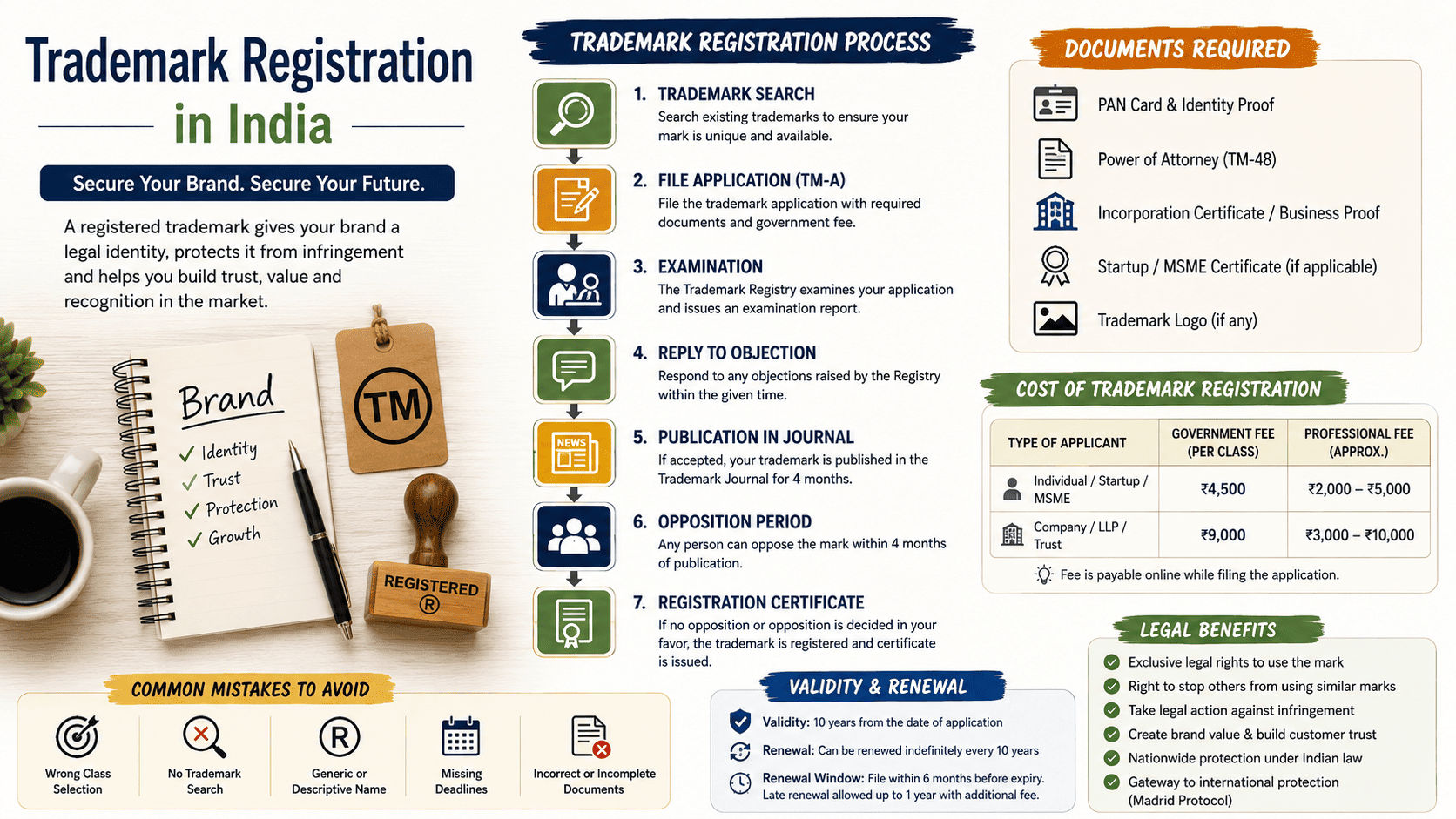
- Missing the 30-day deadline. If you don’t file a reply, your trademark application will be treated as abandoned by the Registry. There’s no grace period built in automatically.
- Filing a vague reply. A one-paragraph reply with no evidence and no case law is worse than no reply at all — it signals to the examiner that your case is weak.
- Not checking the portal regularly. Always keep a track on the trademark examination report. The trademark inspector may call you in person to clear any doubts.
- Confusing objection with opposition. An objection is raised by the authorities internally, not by a third party. When a third party challenges a trademark after publication, that process is referred to as trademark opposition. These are two entirely different proceedings with different timelines and processes.
- Filing without doing a prior art search. A trademark public search should always be done before the application is filed — it would greatly reduce the chances of objections occurring.
If you’re an MSME founder who’s already registered under Udyam, you have additional protections worth leveraging. Make sure your MSME registration is in order — it adds credibility to your trademark reply in terms of establishing business identity.
Frequently Asked Questions
Q: What does “Objected” status mean on the IP India trademark portal?
A: When your trademark application shows “Objected” on the IP India portal, it means the Trade Marks Examiner has reviewed your application and raised one or more formal concerns in an Examination Report. This is not a rejection — it’s an invitation to respond and defend your mark. You must download the Examination Report from the portal and file a reply within 30 days.
Q: How long do I have to reply to a trademark objection in India?
A: A reply to the trademark objection is required to be filed within 30 days of the date of the objection in the trademark examination report. Missing this window risks your application being treated as abandoned. If the status still shows “awaiting reply” after 30 days, you may still be able to file — but don’t rely on this.
Q: Can I file a trademark objection reply myself, without a lawyer?
A: Yes, you can file the TM objection reply on your own, but hiring a trademark attorney will always help as these people have the experience of drafting replies to the point. For straightforward Section 9 objections where your mark has clear distinctiveness, a self-filed reply with strong evidence can work. For Section 11 objections involving similarity to cited marks, expert legal help is strongly recommended.
Q: What happens if my trademark objection reply is rejected?
A: If the Examiner is not satisfied with your written reply, a Show Cause Hearing will be scheduled. You (or your representative) can appear before the Trademark Registrar and present your arguments in person. If the hearing outcome is also negative, a Refusal Order is issued — but you retain the right to appeal before the Intellectual Property Appellate Board (IPAB).
Q: What is the difference between a trademark objection and a trademark opposition in India?
A: A trademark objection is raised by the Trade Marks Examiner during the examination stage — it’s an internal proceeding between you and the registry. Trademark opposition, on the other hand, is raised by any person who has an issue with the trademark filed after it has been advertised in the Trademarks Journal for a period of four months. Opposition involves a third party; objection does not.
Q: How long does it take for a trademark objection to be resolved after I file my reply?
A: It generally takes 3–6 months for a reply to a trademark objection to be processed. If a hearing is scheduled, the timeline extends further depending on the registry’s backlog. The entire trademark registration process in India — from application to registration — can take 18–24 months in total, with objection resolution being one step along the way.
Ready to fight your trademark objection — and win? Lawizer’s trademark experts handle the entire reply process for you — drafting the legal response, preparing affidavits, filing on the IP India portal — fully online, starting at just ₹1,499. No lawyer visit needed.
File Your Trademark Objection Reply with Lawizer →
Approximate word count: ~1,550 words
Internal links used:
https://lawizer.com/startup-businesslegal/protectbusiness/TrademarkRegistrationPage— anchor: “trademark registration and reply services” — Section: Documents You Must Attachhttps://lawizer.com/startup-businesslegal/growbusiness/MSMEUdhyamRegistrationPage— anchor: “MSME registration” — Section: Common Mistakes
External links used:
https://ipindiaonline.gov.in— IP India Portal (official government trademark portal)- Quora community data — for founder pain points on deadline and reply format
Schema: Add Article schema (auto via RankMath/Yoast) + FAQPage schema using all 6 Q&A blocks above. Images needed: 2 — recommended search: “trademark registration India startup” on Unsplash. Size: 1024×669px. Place after Section 2 and Section 4.