Tag: MCA21

  • How to Register a Private Limited Company in India (2026): Step-by-Step Guide.

    How to Register a Private Limited Company in India (2026): Step-by-Step Guide.

    Over 1.12 lakh companies were incorporated in India in just the first eight months of FY 2024–25 β€” and private limited companies made up over 95% of that number. If you’re building something serious in India, there’s one structure most founders, investors, and banks trust above all others: the Private Limited Company.

    Getting it wrong costs months. Getting it right takes about 7 working days β€” if you know exactly what to do.

    πŸ“Œ TL;DR: Private Limited Company registration in India is a fully online process under the Companies Act, 2013, handled via the MCA21 portal using the SPICe+ form. You need a minimum of 2 directors and 2 shareholders, a DSC, DIN, name reservation, MoA and AoA filing, and can expect your Certificate of Incorporation in 5–7 working days. Lawizer’s experts handle the entire process end-to-end, starting at just β‚Ή1,499.

    What You’ll Learn

    • Who qualifies to register a Private Limited Company in India in 2026
    • Every step of the SPICe+ registration process β€” from DSC to Certificate of Incorporation
    • What documents you actually need (and common mistakes that delay approval)
    • Costs, timelines, and what happens after registration
    • How to stay compliant once your company is live

    What Is a Private Limited Company β€” and Why Do Founders Choose It?

    A Private Limited Company (Pvt. Ltd.) is a business entity incorporated under the Companies Act, 2013 and regulated by the Ministry of Corporate Affairs (MCA).

    The defining feature: your personal assets are legally separate from your company’s liabilities. If the business runs into debt, your personal savings, home, or car are not at risk.

    Here’s the thing β€” this structure is not just about protection. It’s about credibility. Banks, venture capitalists, and institutional clients in Bengaluru, Mumbai, and Delhi instinctively trust a Pvt. Ltd. entity over a sole proprietorship or partnership. It signals permanence, governance, and scalability.

    Key features at a glance:

    • Minimum 2 directors (at least one must be a resident Indian) and minimum 2 shareholders
    • Maximum 200 shareholders β€” shares cannot be listed on a public stock exchange
    • Separate legal identity β€” the company can own property, enter contracts, and sue or be sued in its own name
    • Perpetual succession β€” the company continues to exist even if directors or shareholders change
    • No minimum paid-up capital required since the Companies (Amendment) Act, 2015

    What most founders miss: a Pvt. Ltd. structure is almost mandatory if you’re planning to apply for DPIIT Startup India recognition, raise angel or VC funding, or issue ESOPs to your team.


    Eligibility and Pre-Registration Requirements

    Before you touch the MCA21 portal, there are a few boxes to check. Getting these right upfront prevents 80% of rejection delays.

    Director and Shareholder Requirements

    • Minimum 2 directors; maximum 15 directors
    • At least one director must be a resident Indian (stayed in India for at least 182 days in the previous calendar year)
    • Directors and shareholders can be the same individuals
    • Foreign nationals can be directors β€” they need a valid passport and address proof
    • A director must not be an undischarged insolvent or convicted of any offence involving moral turpitude
    Startup India Certificate 2026: Download & Verify Online

    Registered Office

    Your company needs a registered office address in India within 30 days of incorporation. This can be a home address, a co-working space, or a rented commercial property. You’ll need an NOC (No Objection Certificate) from the property owner plus a utility bill not older than 2 months.


    Step-by-Step: How to Register a Private Limited Company in India

    The entire process runs through the MCA21 portal β€” India’s Ministry of Corporate Affairs digital gateway. Let’s break this down step by step.

    Step 1: Obtain a Digital Signature Certificate (DSC)

    A DSC (Digital Signature Certificate) is your legal electronic signature. It’s mandatory for all proposed directors and shareholders (subscribers) who will sign the incorporation forms. You can apply through government-approved agencies like eMudhra or Sify. Expect a turnaround of 1–2 working days. Carry your PAN, Aadhaar, and a passport-size photo.

    Step 2: Reserve Your Company Name via SPICe+ Part A

    SPICe+ (Simplified Proforma for Incorporating Company Electronically Plus β€” MCA’s single-window incorporation form) has two parts. Part A handles name reservation. You can propose up to 2 names in order of preference. The name must end with “Private Limited” and must not be identical or confusingly similar to an existing company or trademark. MCA typically approves or rejects within 1–3 working days.

    A quick example: “Zelta Tech Solutions Private Limited” would pass if no similar name exists on the MCA database. “Reliance Innovations Private Limited” would almost certainly be rejected.

    Step 3: Apply for Director Identification Number (DIN)

    A DIN (Director Identification Number) is a unique 8-digit number issued by the MCA to every person who wants to become a director of a company. The good news: you don’t file a separate DIN application anymore. DIN allotment for up to 3 directors is integrated directly into SPICe+ Part B β€” it’s done in the same form as incorporation.

    Step 4: Draft MoA and AoA

    Two critical constitutional documents go into every incorporation filing:

    • MoA (Memorandum of Association β€” INC-33): Defines your company’s objectives and the scope of business activities it can undertake
    • AoA (Articles of Association β€” INC-34): Lays down the internal rules and regulations governing the company’s management

    These are drafted as e-MoA and e-AoA on the MCA portal and must be signed digitally by all subscribers. Getting the objects clause in your MoA right is critical β€” a narrowly drafted MoA can restrict future business activities. This is where professional help pays for itself.

    Step 5: File SPICe+ Part B and AGILE-PRO

    SPICe+ Part B is where everything comes together. This single integrated form covers: company incorporation, DIN allotment, PAN application, TAN application, EPFO registration, ESIC registration, and professional tax registration (in applicable states). Alongside Part B, you’ll file AGILE-PRO (INC-35) for GST registration and a bank account opening request.

    Supporting documents to attach: e-MoA, e-AoA, Form INC-9 (declaration by directors and subscribers), Form DIR-2 (consent to act as director), identity and address proofs for all directors and subscribers, and registered office proof.

    Step 6: Receive Your Certificate of Incorporation (CoI)

    Once the Registrar of Companies (ROC) processes and approves your application, you receive a digitally signed Certificate of Incorporation (CoI). This document contains your CIN (Corporate Identity Number β€” a 21-character alphanumeric identifier assigned to every registered company), PAN, and TAN. Typical timeline: 5–7 working days from a clean submission.

    How to Register a Private Limited Company in India: Complete MCA Portal Guide [2026]

    Documents Required for Private Limited Company Registration

    The short answer: documents fall into three categories β€” for directors, for shareholders, and for the registered office. All documents must be self-attested; foreign nationals must get their documents notarised and apostilled.

    For Directors and Shareholders (Subscribers)

    • PAN card (mandatory for Indian nationals)
    • Aadhaar card / Passport / Voter ID (identity proof)
    • Bank statement / Utility bill / Rent agreement not older than 2 months (address proof)
    • Recent passport-size photograph
    • Email address and mobile number (for DSC and DIN)

    For Registered Office

    • Utility bill (electricity / telephone) not older than 2 months
    • NOC (No Objection Certificate) from property owner if rented
    • Rent agreement or ownership proof

    Cost of Registering a Private Limited Company in India (2026)

    Here’s the thing that surprises most first-time founders: government fees for companies with an authorised capital up to β‚Ή15 lakh are zero, following MCA’s initiative to reduce the cost of starting a business. What you actually pay includes the professional fee for filing, DSC cost, and stamp duty β€” which varies by state.

    • DSC (per person): β‚Ή1,000–₹2,000
    • Government stamp duty: Varies by state β€” approximately β‚Ή500 in Delhi, higher in Maharashtra
    • Professional / service fees: β‚Ή1,500–₹8,000 depending on provider
    • Total out-of-pocket (typical): β‚Ή3,000–₹12,000 all-inclusive

    With Lawizer’s company incorporation service (https://lawizer.com/startup-businesslegal), you get end-to-end expert handling β€” name approval, DSC, DIN, SPICe+ filing, MoA and AoA drafting, PAN, TAN, and your Certificate of Incorporation β€” fully online, no CA visit required.


    Post-Registration Compliance: What Happens After You Get Your CoI

    Incorporation is day one, not the finish line. A Private Limited Company carries mandatory annual compliances under the Companies Act, 2013. Missing these attracts penalties β€” and the MCA has been tightening enforcement through its Companies (Filing of Documents and Forms in XBRL) Amendment Rules, 2025.

    • Open a current bank account in the company’s name within 30 days
    • File INC-20A (Declaration of Commencement of Business) within 180 days of incorporation if you have share capital
    • GST registration once your turnover crosses β‚Ή20 lakh (β‚Ή10 lakh for special category states)
    • Annual Return (Form MGT-7): filed within 60 days of AGM
    • Financial Statements (Form AOC-4): filed within 30 days of AGM
    • DIR-3 KYC: every director must complete KYC annually
    • Income Tax Return: mandatory regardless of profit or loss

    If you’re also registering your brand, getting your trademark registered through Lawizer (https://lawizer.com/startup-businesslegal/protectbusiness/TrademarkRegistrationPage) alongside incorporation is a smart move β€” it protects your company name and logo from day one.

    Understanding Private Limited Companies in India's Startup Ecosystem | Brand Stories (HT Tech)

    Frequently Asked Questions

    Q: How long does it take to register a Private Limited Company in India?

    A: With all documents in order, Private Limited Company registration in India typically takes 5–7 working days from the date of SPICe+ form submission to receipt of the Certificate of Incorporation from the Registrar of Companies. Delays usually occur due to name rejection, document errors, or ROC workload. Using a professional service like Lawizer significantly reduces the chances of resubmission.

    Q: What is the minimum capital required to start a Private Limited Company in India?

    A: There is no minimum paid-up capital requirement for a Private Limited Company in India since the Companies (Amendment) Act, 2015. You can incorporate with as little as β‚Ή1 in authorised capital, though most founders choose β‚Ή1 lakh as a practical starting point. Government fees for companies with authorised capital up to β‚Ή15 lakh are zero.

    Q: Can I register a Private Limited Company with only one person?

    A: No β€” a Private Limited Company requires a minimum of 2 directors and 2 shareholders. If you want a single-person structure with limited liability, the correct option is an OPC (One Person Company), also registered under the Companies Act, 2013. However, OPCs cannot issue ESOPs or raise external equity funding, which makes them unsuitable for startups seeking investor capital.

    Q: Can a foreign national be a director or shareholder in an Indian Private Limited Company?

    A: Yes. Foreign nationals can be directors and shareholders in a Private Limited Company in India, subject to FDI (Foreign Direct Investment) regulations under FEMA (Foreign Exchange Management Act). At least one director must be a resident Indian β€” meaning they must have stayed in India for at least 182 days in the preceding calendar year. Foreign directors need a notarised and apostilled passport copy and address proof.

    Q: What is the difference between MoA and AoA?

    A: The MoA (Memorandum of Association) defines the company’s objectives β€” what business activities it is permitted to carry out. The AoA (Articles of Association) lays down the internal governance rules β€” how meetings are held, how shares are transferred, and how directors are appointed or removed. Both are constitutional documents filed at incorporation and can only be changed through special resolutions approved by shareholders.

    Q: Do I need a CA or lawyer to register a Private Limited Company in India?

    A: You are not legally required to hire a CA or lawyer β€” the MCA portal is accessible directly. However, errors in SPICe+ filing, MoA drafting, or document preparation are the primary cause of rejections and resubmissions, adding days or weeks to the process. Most founders use a professional incorporation service to get it done right the first time. Lawizer offers end-to-end Private Limited Company registration fully online, starting at β‚Ή1,499.

    Q: Is GST registration mandatory at the time of company incorporation?

    A: GST registration is not mandatory at incorporation unless your business is in a sector where GST applies from the first transaction (such as e-commerce operators) or your projected turnover exceeds β‚Ή20 lakh in a year (β‚Ή10 lakh for special category states). However, the SPICe+ AGILE-PRO form allows you to apply for GST simultaneously with incorporation β€” a practical move for most businesses.


    Ready to incorporate your Private Limited Company?

    Lawizer’s experts handle everything β€” name reservation, SPICe+ filing, MoA and AoA drafting, PAN, TAN, and your Certificate of Incorporation β€” fully online, starting at just β‚Ή1,499. No CA visit needed.

    Start Your Company Registration Today β†’ https://lawizer.com/startup-businesslegal


  • Can AI Replace a CA or CS for Indian Startups? The Honest Answer :

    Can AI Replace a CA or CS for Indian Startups? The Honest Answer :

    Over 95,000 companies were incorporated in India in FY 2024–25 alone. And almost every founder, at some point, has asked the same question: “Do I really need a CA and CS, or can an AI tool just handle this?” It’s a fair question β€” especially when you’re bootstrapped and watching every rupee.

    The honest answer? AI can do more than you think. But it also cannot do several things that could land you in serious legal trouble if skipped. Let’s break this down properly.

    πŸ“Œ TL;DR: AI tools can meaningfully automate routine legal drafting, compliance reminders, contract review, and GST reconciliation for Indian startups β€” but they cannot replace a CA for statutory audits or a CS for ROC filings, both of which are legally mandated under the Companies Act 2013. The smartest move for Indian founders is using AI-powered platforms like Lawizer alongside qualified professionals, not instead of them.

    What You’ll Learn:

    • Exactly which compliance tasks AI tools can genuinely handle for Indian startups
    • Where Indian law requires a licensed CA or CS β€” and the penalties for skipping them
    • The five things AI still consistently gets wrong in an Indian regulatory context
    • How to build a hybrid CA + AI workflow that cuts costs without cutting corners

    Top Indian Startup Founders: Real Success Stories to Inspire You

    What AI Tools Can Actually Do for Indian Startup Compliance

    Here’s the thing β€” AI-powered legaltech has come a long way. The India AI LegalTech market is valued at approximately USD 1.8 billion in 2025, and the tools available to founders today are genuinely impressive.

    AI platforms can draft NDAs, founder agreements, employment contracts, and IP assignment clauses in minutes. They can scan contracts for clause deviations, flag unusual terms, and send deadline alerts for upcoming GST return dates, board meeting requirements, and DIN KYC deadlines.

    For a seed-stage startup in Bengaluru or Kolkata that can’t yet afford a full-time legal team, this is genuinely useful. Some Indian legaltech platforms report that AI tools reduce research time for routine compliance questions by as much as 70%. Contract automation, GST reconciliation, and GSTR-3B draft generation are all areas where AI delivers real, measurable value.

    What most founders miss, though, is the distinction between assisted compliance and statutory compliance. The former is where AI thrives. The latter is where Indian law draws a hard line β€” and where no AI tool, however sophisticated, can legally stand in for a human professional.


    Where Indian Law Mandates a CA β€” No Exceptions

    Let’s be direct about this. Section 139 of the Companies Act 2013 mandates that every registered company in India appoint a statutory auditor β€” who must be a practising CA or CA firm. This isn’t optional, and it doesn’t matter whether you’re a bootstrapped SaaS startup with zero revenue or a Series A company. Your audited financial statements, filed via Form AOC-4 with the MCA21 portal, must be signed off by a licensed Chartered Accountant.

    The stakes for missing this are real. Late ROC filings attract a penalty of β‚Ή100 per day per form with no upper cap for AOC-4 and MGT-7. A company that files nine months late could face penalties of β‚Ή54,000 or more β€” per form.

    If directors fail to file annual returns for three consecutive years, they face disqualification under Section 164 of the Companies Act 2013, which bars them from any directorship anywhere for five years. That’s a founder nightmare scenario.

    Beyond audits, a CA is also required for GST audit (if applicable thresholds are met), income tax filings, transfer pricing reports, and any statutory certification that banks or investors require during due diligence. No AI platform generates a digitally signed CA certificate that the MCA or Income Tax Department will accept. Period.


    Why Legal Compliance is Important for Industries | ISO vs EHS Compliance India - Sheel Technologies

    Where Indian Law Mandates a CS β€” And What Founders Often Get Wrong

    A Company Secretary β€” a professional certified by the Institute of Company Secretaries of India (ICSI) β€” is legally required for companies with a paid-up capital of β‚Ή5 crore or more under the Companies Act 2013. But even for startups below that threshold, the secretarial workload is significant. Filing Form MGT-7, the annual return containing director and shareholding details due within 60 days of the AGM, maintaining statutory registers, recording board meeting minutes, and filing event-based forms like DIR-12 for director changes or PAS-3 for share allotments β€” all of these carry strict deadlines with β‚Ή100/day penalties for late submission.

    Here’s what most founders get wrong: they assume this is just paperwork and try to handle it themselves or with a generic AI tool. The problem is that an error in a PAS-3 filing (share allotment) or a missed ADT-1 (auditor appointment) can make the underlying corporate action legally questionable β€” not just expensive. Investor diligence teams look at MCA21 filing histories carefully. A messy secretarial record has killed fundraising rounds at the term sheet stage.

    A quick example: if your startup issues ESOPs, the allotment must be reported to the ROC within 30 days. Miss that window and the shares are technically unregistered. No AI tool currently generates, validates, and submits e-forms on MCA V3 with the required Digital Signature Certificates on behalf of your directors. That chain of human accountability is still legally essential.


    The Five Things AI Still Gets Wrong in India’s Regulatory Context

    AI legaltech tools are genuinely good. But they carry specific failure modes that Indian founders need to understand before putting too much trust in them.

    First, hallucinating Indian law. General AI models frequently confuse Indian legal provisions with UK or US equivalents. A chatbot may cite a provision that doesn’t exist in the Companies Act 2013 or quote an outdated CGPDTM (Controller General of Patents, Designs and Trade Marks) circular. Indian-trained models have significantly lower hallucination rates, but the risk doesn’t disappear.

    Second, missing state-level variations. GST composition scheme limits, stamp duty rates, and shop-and-establishment registration rules vary by state. An AI tool trained primarily on central law may give you advice that’s wrong for Maharashtra but right for Karnataka.

    Third, no DSC or digital signing authority. MCA V3 filings, GST registrations, and patent applications require a valid Digital Signature Certificate. AI cannot hold or use a DSC. A human professional must always be in the loop for any submission to a government portal.

    Fourth, the professional liability gap. If your CA gives wrong advice and you suffer a penalty, you have legal recourse against them. If an AI tool gives you wrong advice, the liability is yours. This matters enormously when investors or banks rely on compliance certificates.

    Fifth, interpretation of fact-specific tax positions. Whether a particular SaaS subscription attracts 18% GST or qualifies for a lower rate, or whether your co-founder’s salary qualifies as a deductible business expense β€” these involve judgment calls that require someone who knows your specific business model, not pattern-matching against generic data.


    The Smart Hybrid Model: AI + CA/CS Working Together

    The founders who are managing compliance costs most effectively aren’t choosing between AI and professionals β€” they’re using both deliberately. The model looks like this: AI handles the operational layer (drafting routine contracts, sending compliance deadline alerts, generating GSTR-3B drafts, flagging unusual clauses in vendor agreements), while your CA and CS handle the statutory layer (signing off on audits, filing ROC forms with valid DSCs, advising on non-routine tax positions, and maintaining the statutory registers that investors and banks will eventually scrutinise).

    Platforms like Lawizer’s startup legal services are built around exactly this hybrid model. Instead of paying a retainer to a CA firm for work that can be standardised and automated, you use a platform that combines AI-powered document generation with qualified professionals who handle the pieces that require statutory sign-off. This keeps your compliance costs predictable and your legal house in order β€” without over-spending in the early stages when every rupee counts.

    What most founders miss: the hybrid model also makes your CA or CS more effective. When AI tools handle routine drafting and deadline tracking, your professional can spend their time on higher-value advisory work β€” structuring your ESOP pool, advising on a GST audit response, or preparing your company for Series A due diligence. That’s where a good CA or CS truly earns their fees.


    What This Means for Your Startup Right Now

    If you’re pre-incorporation, AI-assisted platforms can get you through the SPICe+ (Simplified Proforma for Incorporating Company Electronically Plus β€” MCA’s online incorporation form) process, help you draft a founders’ agreement, and set up your initial MSME Udyam registration. You don’t need to sit across a desk from a CA to get started. But the moment your company is incorporated, the statutory clock starts ticking β€” and some of those obligations begin on day one.

    If you’re already incorporated, run a quick health check on three things: Is your statutory auditor formally appointed and ADT-1 filed? Is your INC-20A (commencement of business declaration) filed within 180 days of incorporation? Are your DIR-3 KYC filings for all directors current? These are the three most commonly missed post-incorporation requirements that AI tools alone cannot resolve. You can protect your business proactively through Lawizer’s complete startup compliance services β€” managed entirely online with qualified CA and CS professionals.

    And if your brand is still unprotected, don’t overlook trademark registration. AI can help you search for conflicts, but the filing strategy and responding to CGPDTM objections requires professional judgment. Lawizer’s trademark registration service handles this end to end β€” so your brand is protected before someone else files first.


    Frequently Asked Questions

    Q: Can I use ChatGPT or an AI tool to file my GST returns in India?

    A: AI tools can help you draft and review GSTR-3B and GSTR-1 data before filing, but they cannot file on your behalf on the GSTN (Goods and Services Tax Network) portal. GST filings require valid login credentials and OTP authentication by an authorised signatory. Most founders use AI tools for pre-filing reconciliation and a CA or GST practitioner for the actual submission and any advisory on input tax credit claims.

    Q: Is a statutory audit mandatory for my startup even if we have zero revenue?

    A: Yes, completely. Under Section 139 of the Companies Act 2013, every company registered in India must appoint a statutory auditor regardless of turnover, profit, or activity level. Even a dormant startup with zero revenue must get its financial statements audited by a practising CA and file Form AOC-4 with the MCA21 portal annually. There are no exemptions for early-stage startups on this requirement.

    Q: What happens if I skip ROC filing and rely only on an AI compliance tool?

    A: AI compliance tools can remind you of deadlines and help you prepare documents, but they cannot submit filings to the Registrar of Companies on your behalf. If ROC filings like MGT-7 or AOC-4 are missed, your company faces penalties of β‚Ή100 per day per form with no upper cap. If annual returns go unfiled for three consecutive years, directors face disqualification under Section 164 of the Companies Act 2013, barring them from any directorship for five years.

    Q: Which AI tools are actually useful for Indian startup compliance right now?

    A: Several Indian legaltech platforms are worth exploring. SpotDraft is well-regarded for contract lifecycle management. NYAI is a compliance-native platform trained on Indian legal documents including MCA, tribunal, and High Court data. Simpliance handles labour law compliance tracking. For incorporation, GST, trademark, and ongoing ROC compliance, Lawizer provides an AI-assisted platform backed by qualified CA and CS professionals β€” so you get the speed of automation with the statutory sign-off Indian law requires.

    Q: Can AI help with trademark registration for my Indian startup?

    A: AI tools can run trademark availability searches and flag conflicting marks, which saves real time. However, filing with the CGPDTM and β€” critically β€” responding to any examination report or opposition requires professional judgment about trademark class selection, distinctiveness arguments, and evidentiary strategy. Platforms like Lawizer combine AI-powered search with professional representation so you’re not navigating the CGPDTM process alone.

    Q: How much can a startup realistically save by using AI tools alongside a CA instead of a full retainer?

    A: Early-stage startups that previously budgeted β‚Ή1–2 lakh annually for basic compliance retainers are finding that AI-assisted platforms can deliver comparable coverage at a fraction of the cost, while still involving a licensed professional for the statutory filings that Indian law mandates. The savings compound as you scale, because AI handles the growing volume of routine tasks while your CA’s time stays focused on the judgment-intensive work that genuinely requires it.


    Ready to get your startup legally sorted β€” without overpaying? Lawizer’s experts handle everything β€” ROC filings, statutory audits, GST registration, trademark protection β€” fully online, starting at just β‚Ή999. No CA office visits needed.

    Start your compliance review today β†’ https://lawizer.com/startup-businesslegal


  • India’s Legaltech Boom: What $793M in Funding Means for You

    India’s Legaltech Boom: What $793M in Funding Means for You

    India’s legaltech sector has attracted $793 million in cumulative funding. In 2025, the industry recorded a 781% year-on-year increase, marking the largest single-year funding surge in its history. That’s not a rounding error. That’s investors betting big money that Indian founders are done doing legal paperwork the old way.

    If you’re a founder who still emails PDFs back and forth with a CA for GST filing or MSME registration, things are about to change. This legaltech boom is redefining what “normal” looks like for business compliance.

    πŸ“Œ TL;DR: India’s legaltech industry has raised $793 million across roughly 960 companies, with 2025 funding up 781% year-on-year β€” the sector’s biggest jump on record. For founders, this means faster, cheaper, more reliable online options for company incorporation, GST, trademark, and MSME compliance instead of slow offline processes. Platforms like Lawizer are part of this shift, handling incorporation and compliance fully online so founders can skip the CA-office runaround.

    What You’ll Learn

    • Why $793 million is flowing into Indian legaltech right now
    • What’s actually driving the 781% funding surge in 2025
    • How this changes company incorporation, GST, and compliance for founders
    • What to watch for before picking a legaltech platform

    The Numbers Behind India’s Legaltech Boom

    Here’s the thing. Legaltech used to be the sleepy corner of Indian startup investing β€” the sector fintech and edtech investors barely glanced at. That’s flipped.According to data from Tracxn’s startup database, India is home to around 960 legaltech companies. Among them, 86 have secured funding, and one has achieved unicorn status.

    The real story is the pace. Legaltech funding in India has grown from about $107 million to a cumulative $793 million. In 2025, the sector recorded a 781% year-on-year increase, marking its highest annual investment to date.

    A quick example: SpotDraft, a contract automation platform, alone raised over $113 million across multiple rounds, including backing from Qualcomm Ventures. That’s the scale of confidence investors now have in Indian legal technology.

    Why Now?

    • India’s regulatory load keeps growing β€” DPDPA, GST updates, Companies Act 2013 amendments, and sector-specific rules all add compliance work
    • AI-powered document review and drafting cut turnaround time dramatically, making automation commercially viable
    • Millions of MSMEs and startups need affordable, scalable legal access that traditional law firms and CAs can’t deliver at volume

    What This Means for Company Incorporation

    Let’s break this down. Company incorporation in India runs through SPICe+ (Simplified Proforma for Incorporating Company Electronically Plus β€” MCA’s online incorporation form), filed on theΒ MCA21 portal.

    On paper, it’s already digital. In practice, most founders still end up stuck answering DIN queries, chasing digital signature certificates, or waiting on a CA who’s juggling twenty other clients.

    What most founders miss: the legaltech money isn’t just building flashy AI tools for law firms. A meaningful chunk is going into founder-facing platforms that handle the entire incorporation-to-compliance journey β€” private limited company registration, LLP setup, GST registration, and ongoing filings β€” without the founder ever stepping into a CA’s office. That’s the direct benefit of this funding wave reaching your desk.

    If you’re incorporating a company or setting up your compliance stack from scratch,Β Lawizer’s business registration servicesΒ are built exactly for this shift β€” online-first, no repeated office visits, transparent pricing

    GST, Trademark, and MSME: The Everyday Wins

    The short answer: automation is finally reaching the parts of compliance founders actually dread β€” recurring GST filings, trademark status tracking, and MSME/Udyam renewals. These aren’t glamorous problems, but they’re the ones that eat a founder’s Tuesday afternoon every single month.

    GST compliance, tracked through GSTN’s own systems, has traditionally meant founders relying on their CA to remember filing deadlines. As more legaltech investment flows into compliance automation, platforms now send proactive reminders. They also auto-populate returns and flag mismatches before they turn into legal notices.

    A trademark filed through the Controller General of Patents, Designs and Trademarks (CGPDTM) can now be tracked in real time. Founders no longer need to call their lawyer every few weeks to ask, “Any update?”

    Same logic applies to brand protection and MSME benefits. If you have not registered your trademark yet, do it early to protect your brand name. Early registration also reduces the risk of a competitor claiming it first. Lawizer’s trademark registration service handles the entire CGPDTM filing process from start to finish.

    And if you qualify for MSME status,Β Udyam registration through LawizerΒ unlocks collateral-free loans, delayed payment protection, and tender benefits that most founders don’t even know exist.

    What to Watch Before You Pick a Legaltech Platform

    A funding boom brings good tools β€” and also a lot of noise. Not every platform that raised money is built for a first-time founder in Bengaluru registering a two-person startup, versus an enterprise legal team in Mumbai managing thousand-contract portfolios. Here’s what actually matters when you’re evaluating options:

    • Does it handle India-specific requirements β€” MCA21 filings, state-wise GST rules, Aadhaar-based e-sign β€” or is it a generic tool adapted for India?
    • Is pricing transparent upfront, or do “starting from” prices balloon once you add government fees and follow-up filings?
    • Can you actually talk to a real compliance expert when something goes wrong, or is it a chatbot loop?

    What most founders miss: the platform’s funding size says nothing about whether it fits your stage. A well-capitalized enterprise CLM (Contract Lifecycle Management) tool is overkill if all you need is to file your first ITR (Income Tax Return). For income tax filing done right the first time,Β Lawizer’s ITR filing serviceΒ keeps it simple and founder-focused.

    Where This Is Headed

    A quick example of the trajectory: the Indian legaltech market is projected to cross $1.28 billion in 2026, growing at roughly 15.2% CAGR β€” a pace faster than the global average. That growth is driven by a simple fact β€” India’s regulatory load isn’t shrinking.

    Between DPDPA, evolving GST rules, and Companies Act compliance, founders will need more automated help, not less.

    Here’s the thing: this isn’t really about the funding number. It’s about what it buys founders β€” faster incorporation, fewer missed deadlines, and compliance that doesn’t require a law degree to understand. That’s the actual dividend of $793 million landing in this sector.

    Frequently Asked Questions

    Q: How much funding has India’s legaltech sector raised so far?

    A: India’s legaltech sector has raised a cumulative $793 million in venture capital and private equity across roughly 960 companies. 2025 alone saw a 781% year-on-year rise in funding compared to the previous year, marking the highest annual investment the sector has recorded so far.

    Q: Does the legaltech boom actually help small founders, or just big law firms?

    A: Both, but founder-facing platforms are a major part of the investment. A large share of legaltech funding is going into tools for company incorporation, GST filing, trademark tracking, and MSME registration β€” the everyday compliance work small founders deal with, not just enterprise contract management.

    Q: Is online company incorporation in India actually reliable now?

    A: Yes. Company incorporation runs through MCA’s SPICe+ form on the MCA21 portal, and legaltech platforms have built layers on top of it to handle document prep, DIN and DSC processing, and follow-up queries without the founder needing to visit an office. This is one of the most mature use cases in the current funding wave.

    Q: What should I check before choosing a legaltech platform for my startup?

    A: Check whether the platform handles India-specific requirements like state-wise GST rules and Aadhaar e-sign, confirm pricing is transparent with no hidden government-fee markups, and make sure you can reach a real compliance expert if an issue comes up. A platform’s total funding doesn’t tell you whether it’s built for your specific stage or need.

    Q: Why is India’s legaltech funding growing faster than other sectors right now?

    A: Growth is driven by increasing regulatory complexity β€” DPDPA, GST updates, and Companies Act compliance all create continuous demand β€” combined with AI tools that make automated drafting and review commercially viable at scale. India’s legaltech market is projected to grow faster than the global average through 2030.

    Ready to skip the compliance runaround?
    Lawizer’s experts handle everything β€” company incorporation, GST registration, trademark filing β€” fully online, starting at just β‚Ή1,999. No CA visit needed.

    Start your registration with Lawizer β†’

  • Director Identification Number (DIN): What It Is and How to Get One Fast?

    Director Identification Number (DIN): What It Is and How to Get One Fast?

    Over 1.5 million active companies are registered on India’s MCA21 portal β€” and every single director behind each one holds a Director Identification Number. Without it, you legally cannot sign a board resolution, file an MCA form, or be appointed to any company’s board. Not even for a day.

    Miss this step and your entire incorporation grinds to a halt.


    πŸ“Œ TL;DR: A Director Identification Number (DIN) is a mandatory, lifelong 8-digit ID issued by the Ministry of Corporate Affairs (MCA) to every company director in India. If you’re incorporating a new company, you get it automatically through SPICe+ (Simplified Proforma for Incorporating Company Electronically Plus). If you’re joining an existing company’s board, you apply separately via Form DIR-3 on MCA21. Annual DIR-3 KYC filing keeps it active. Lawizer handles the entire process β€” from DSC to DIN β€” fully online.


    What You’ll Learn

    • What a DIN is and why every Indian company director must have one
    • The two routes to getting a DIN β€” SPICe+ vs Form DIR-3 β€” and which applies to you
    • Exactly which documents you need and common mistakes that cause rejection
    • How to keep your DIN active with annual DIR-3 KYC and what happens if you miss it
    • Answers to the most common founder questions about DIN in plain language

    What Is a Director Identification Number (DIN)?

    A DIN is a unique 8-digit identification number that the Central Government of India assigns to anyone who is β€” or intends to become β€” a director of an Indian company. It’s governed by Section 153 of the Companies Act, 2013 and administered by the Ministry of Corporate Affairs (MCA) through the MCA21 portal.

    Think of it as a permanent corporate PAN card for directors. Once allotted, your DIN stays with you for life. It tracks your involvement across every company where you serve or have served as a director, and links to all your MCA filings.

    Here’s the thing: DIN isn’t just a formality. The MCA uses it to maintain a nationwide database of directors β€” cross-referencing filings, flagging potential duplicates, and identifying directors of shell or non-compliant companies. In 2017, the MCA mass-disqualified tens of thousands of directors of defaulting companies in a single enforcement sweep, deactivating their DINs overnight.

    The DIN also carries a limit: under Section 165 of the Companies Act, 2013, one person cannot simultaneously hold directorships in more than 20 companies (with a sub-limit of no more than 10 public companies). All of this is tracked through the DIN-linked database on MCA21.


    Who Needs a DIN β€” and When?

    If you’re planning to be a director of any company registered in India β€” private limited, public limited, One Person Company (OPC), or Section 8 β€” you need a DIN before your appointment is formalised. This applies equally to Indian nationals, NRIs, and foreign nationals.

    Let’s break this down by situation:

    Situation 1 β€” You’re incorporating a new company: DINs for up to 3 proposed directors are allotted automatically as part of the SPICe+ incorporation process. You don’t file separately. The DIN is generated once your incorporation application is approved.

    Situation 2 β€” You’re joining an existing company’s board: You must apply for a DIN in advance using e-Form DIR-3 on the MCA21 portal. The company must pass a board resolution intending to appoint you before you can file DIR-3.

    Situation 3 β€” You already have a DIN but your details have changed: File e-Form DIR-6 (no government fee) to update your information, such as address, email, or mobile number. Changes must be attested by a practicing CA, CS, or Cost Accountant.

    One important rule: you can hold only one DIN. If a duplicate is accidentally issued, you’re legally required to surrender the extra one via e-Form DIR-5.


    Documents Required for DIN Application

    Getting your documents right the first time saves you the most time. Mismatched names, blurry scans, and expired proofs are the top reasons DIR-3 applications get sent back for resubmission.

    For Indian nationals, you’ll need:

    • PAN card (mandatory β€” it’s your primary identity proof)
    • One additional identity proof: Aadhaar card, passport, voter ID, or driving licence
    • Address proof not older than 2 months: Aadhaar, bank statement, utility bill, or driving licence
    • A recent passport-size photograph (JPEG format)
    • Digital Signature Certificate (DSC) β€” Class 2 or Class 3, linked to your PAN
    • Declaration by the applicant (included in DIR-3 form)
    • Professional certification: the form must be verified digitally by a practising CA, CS, or Cost and Works Accountant (CWA)

    For foreign nationals and NRIs (resident outside India for more than 182 days): All documents must be notarised and apostilled by the Indian Embassy in the country of residence. Nationals of countries sharing a land border with India (as per MCA’s 2022 amendment) must also attach a security clearance from the Ministry of Home Affairs.

    A quick example: A co-founder in Bengaluru applying for DIR-3 submitted her Aadhaar as both identity and address proof but used a PDF downloaded from DigiLocker without self-attestation. Her form was sent back for resubmission. The fix: self-attested, clearly scanned individual documents β€” not a combined PDF.


    and Digital Signature Certificate (DSC ...

    Step-by-Step: How to Apply for DIN via Form DIR-3

    This route applies when you’re joining an existing company’s board. Here’s exactly what to do on the MCA21 portal (mca.gov.in):

    Step 1 β€” Register on MCA21: Create a Business User account at mca.gov.in if you don’t already have one.

    Step 2 β€” Download and fill Form DIR-3: Access it under MCA Services β†’ Director Services. Fill in your full name (exactly as on PAN), father’s name, date of birth, nationality, occupation type, address, mobile number, and email ID. Every starred field is mandatory.

    Step 3 β€” Attach documents: Upload self-attested copies of your identity proof, address proof, and photograph. Make sure the PAN name matches across all documents β€” even a middle name discrepancy causes rejection.

    Step 4 β€” Get professional certification: Have a practising CA, CS, or CWA digitally sign and certify the form. Without this, the form won’t process.

    Step 5 β€” Apply DSC and pay the fee: Sign the form electronically using your own DSC. Pay the prescribed government fee online.

    Step 6 β€” Submit and receive SRN: On submission, you’ll receive a Service Request Number (SRN). Track your application status at any time on the MCA portal.

    Step 7 β€” Receive DIN allotment letter: Once MCA approves your application, you’ll receive your DIN via email. Inform all companies where you act as director within 15 days, and ensure each company notifies its Registrar of Companies (ROC) within a further 15 days.

    What most founders miss: if MCA identifies your application as a potential duplicate, it goes to the DIN cell for manual back-office review, which can add time. Accurate documents from the start prevent this.

    If you’d rather skip the portal entirely, Lawizer’s team handles startup legal and company incorporation services end-to-end β€” DSC procurement, DIR-3 filing, and DIN tracking included.


    Keeping Your DIN Active: Annual DIR-3 KYC

    Getting your DIN is step one. Keeping it active is equally important β€” and many founders discover this only when their DIN gets deactivated mid-compliance cycle.

    Every DIN holder must file e-Form DIR-3 KYC annually by 30 September of each financial year. This KYC confirms your PAN, Aadhaar, address, email, and mobile on record with MCA. Filing before the deadline costs β‚Ή0 in government fees.

    Miss the 30 September deadline and the consequences kick in immediately:

    • MCA’s automated system deactivates your DIN on 1 October
    • Status changes to: “Deactivated due to non-filing of DIR-3 KYC”
    • You cannot sign any MCA form until the DIN is reactivated
    • Your company cannot file its annual returns or any compliance form requiring your digital signature
    • Reactivation requires filing the full DIR-3 KYC eForm with a β‚Ή5,000 penalty fee

    If you’ve missed multiple years, each year needs a separate filing and separate β‚Ή5,000 payment. Missing FY 2023–24 and FY 2024–25 means paying β‚Ή10,000 to get back on track.

    The short answer on timing: file in April, May, or June when the MCA portal is running smoothly. Every year in September, server loads spike as millions of directors file simultaneously, causing OTP delays and payment gateway failures. There’s no advantage to waiting.

    Note: As of December 2025, the MCA announced a shift from annual KYC filing to a three-year cycle, effective from FY 2025–26 onwards, while still requiring immediate updates for any changes in key personal details. Verify the latest directive on mca.gov.in before filing.


    Common Mistakes That Delay Your DIN

    Most DIN rejections and resubmission requests are entirely avoidable. Here are the ones that come up again and again:

    Name mismatch across documents: Your name in DIR-3 must match your PAN exactly β€” including initials and spelling. A difference of even one character between your PAN and Aadhaar triggers rejection.

    Expired or outdated address proof: Address proof documents must not be older than 2 months from the date of filing. Utility bills, bank statements, and Aadhaar updates must be current.

    Missing DSC: You cannot submit DIR-3 without your own valid Digital Signature Certificate. This is separate from the CA or CS who also signs the form.

    Filing combined documents: Uploading a multi-page combined PDF instead of individual self-attested scans for each document type is a common cause of resubmission.

    Checking DIN status only after rejection: Always verify your DIN status at mca.gov.in under Director Services β†’ Check DIN Status before initiating any MCA compliance filing. A deactivated DIN will cause the form to fail at portal level.


    Frequently Asked Questions

    Q: Is DIN mandatory for all company directors in India?

    A: Yes, without exception. Section 153 of the Companies Act, 2013 makes it mandatory for every individual to obtain a Director Identification Number before they can be appointed as a director in any Indian company β€” private limited, public limited, OPC, or LLP. Acting as a director without a valid DIN can attract penalties and imprisonment of up to 6 months.

    Q: What is the difference between getting a DIN through SPICe+ vs Form DIR-3?

    A: SPICe+ is used when you’re incorporating a new company β€” DINs for up to 3 proposed directors are generated as part of the incorporation filing itself, with no separate application needed. Form DIR-3 is used when you want to join an existing company’s board and don’t yet have a DIN. The right route depends entirely on your situation.

    Q: How long does it take to get a DIN after submitting Form DIR-3?

    A: In most cases where all documents are in order, MCA allots a provisional DIN almost immediately after submission. Final approval and the allotment letter typically follow within a few working days. Applications flagged as potential duplicates go to manual review, which can take up to 1 month. Accuracy at submission is the single biggest factor controlling your timeline.

    Q: What happens if my DIN gets deactivated?

    A: A deactivated DIN means you cannot sign any MCA form, be appointed as a director in any company, or help your company file its annual returns. To reactivate, file e-Form DIR-3 KYC on the MCA21 portal and pay the β‚Ή5,000 late fee. Once MCA processes the form (Straight Through Processing), your DIN status reverts to “Approved.”

    Q: Can I hold more than one DIN?

    A: No. Each individual is permitted only one DIN for life. If you accidentally end up with a duplicate, you’re legally required to surrender it using Form DIR-5 on MCA21. Retaining a duplicate DIN is a violation under the Companies Act, 2013.

    Q: Does DIN expire or need renewal?

    A: Your DIN itself has lifetime validity and does not expire. What requires annual action is the DIR-3 KYC filing, which keeps your DIN in active status with MCA. Failing to file by 30 September each year results in automatic deactivation.


    Ready to Incorporate and Get Your DIN Sorted?

    Lawizer’s experts handle everything β€” company incorporation via SPICe+, DSC procurement, DIR-3 filings, and annual DIR-3 KYC compliance β€” fully online, starting at just β‚Ή1,499. No CA visit needed.

    Start your incorporation today β†’

    Already incorporated and need trademark protection alongside your directorship setup? Register your trademark with Lawizer in 3 simple steps.

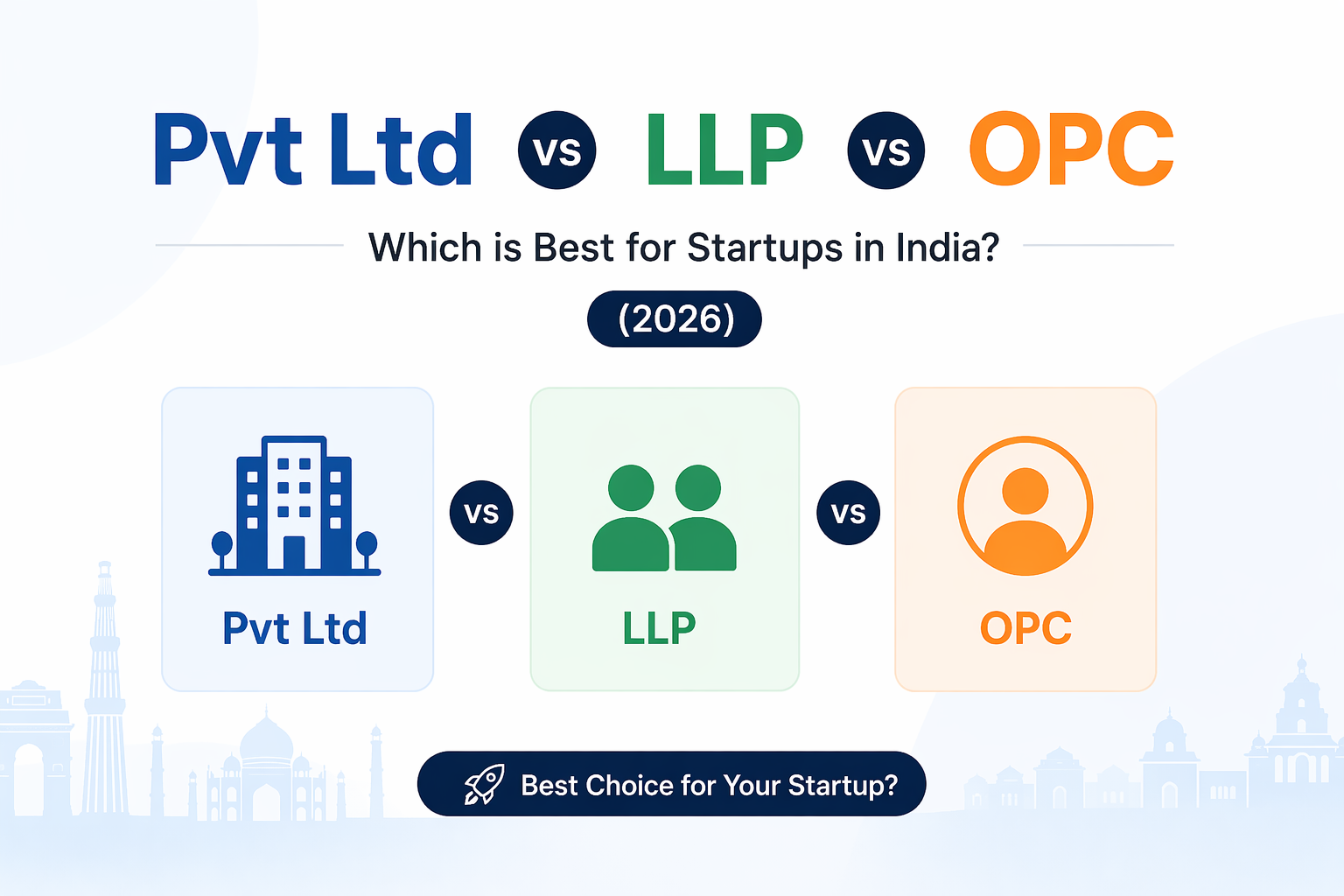
  • OPC vs LLP vs Private Limited: Which Structure is Right for Your Startup?

    OPC vs LLP vs Private Limited: Which Structure is Right for Your Startup?

    Entrepreneurs registered over 1.12 lakh new companies in India in just the first eight months of FY 2024–25β€”and many of those founders agonized over the same question you’re wrestling with right now: OPC, LLP, or Private Limited?

    Choosing the wrong business structure can increase your tax burden, discourage potential investors before your first pitch, and create unnecessary compliance challenges while your business is still in its early stages.

    The good news? You can easily avoid these problems once you understand how each structure affects your finances, liability, and growth potential.

    πŸ“Œ TL;DRChoosing between OPC vs LLP vs Private Limited Company in India comes down to three things β€” how many founders you have, whether you plan to raise external funding, and how much compliance you can handle.

    Solo founders with no immediate investor plans: go OPC. Service businesses with two or more partners: go LLP. Growth-focused startups targeting VC or angel investment: go Private Limited. Lawizer can help you register the right structure fully online, without a CA visit.

    What You’ll Learn

    • What OPC, LLP, and Private Limited actually mean β€” in plain language
    • How each structure compares on compliance, tax, funding, and costs
    • Exactly which structure fits your startup situation in 2025
    • Common mistakes founders make when choosing a business structure

    What Each Structure Actually Means

    Let’s break this down. The Ministry of Corporate Affairs (MCA) registers all three structuresβ€”OPC, LLP, and Private Limitedβ€”and each one gives you something a sole proprietorship doesn’t: limited liability. That means if your business hits a financial wall, your personal savings, house, and car stay protected. But that’s roughly where the similarities end.

    One Person Company (OPC)

    An OPC was introduced under the Companies Act 2013 specifically for solo entrepreneurs. You are the sole shareholder and director β€” both roles in one person. It gives you corporate credibility without needing a co-founder.

    One catch: you must nominate a second person who takes over if something happens to you, and there are turnover-based conversion thresholds to be aware of.

    Limited Liability Partnership (LLP)

    An LLP is governed by the Limited Liability Partnership Act 2008. Think of it as a partnership firm that’s been upgraded β€” partners get limited liability protection, but you keep the operational flexibility of a traditional partnership.

    It needs a minimum of 2 designated partners, at least one of whom must be an Indian resident. LLPs don’t issue equity shares, which is both their biggest strength (less complexity) and their biggest weakness (can’t raise VC money directly).

    Private Limited Company (Pvt Ltd)

    A Private Limited Company under the Companies Act 2013 requires at least 2 directors and 2 shareholders. It’s the structure that investors β€” angel networks, VCs, and most banks β€” are most comfortable with.

    Private limited companies make up 96% of all companies registered in India, and that number reflects a clear market preference. You can issue equity shares, bring on investors via convertible notes or SAFEs, and eventually IPO if you scale that far.

    Compliance and Annual Filing: The Real Ongoing Cost

    Here’s the thing β€” the registration fee is a one-time hit. What founders routinely underestimate is the annual compliance cost. This is where LLP, OPC, and Private Limited diverge most sharply.

    An LLP has the lightest compliance load. You file Form 11 (Annual Return) and Form 8 (Statement of Accounts) with the Registrar of Companies (ROC) each year.

    Statutory audit is only mandatory if your turnover crosses β‚Ή40 lakh or contribution exceeds β‚Ή25 lakh β€” which makes LLP incredibly cost-effective for early-stage service businesses.

    An OPC sits somewhere in the middle. Like a Private Limited company, it must hold board meetings and file annual returns with MCA21 (the government’s online company filing portal). However, the compliance is slightly simpler since there’s only one shareholder. Audits are mandatory regardless of turnover size.

    A Private Limited Company has the heaviest compliance requirements. You need to hold Annual General Meetings (AGMs), file financial statements (Form AOC-4) and annual returns (Form MGT-7) with ROC every year, maintain statutory registers, and get a statutory audit done regardless of revenue.

    What most founders miss: this burden is manageable if you’re growing, because the infrastructure you’re building also signals credibility to banks and investors.

    • LLP: Lowest compliance. Audit only if turnover exceeds β‚Ή40 lakh. Best for bootstrapped service businesses.
    • OPC: Medium compliance. Mandatory audit, but simpler than Pvt Ltd due to single-member structure.
    • Private Limited: Highest compliance. Mandatory AGMs, ROC filings, and annual statutory audit β€” but also comes with investor-ready credibility.

    Funding and Investment: Who Can Actually Raise Money?

    If raising money from angel investors, venture capitalists, or institutional funds is part of your long-term vision, the choice becomes simple: go with a Private Limited Company.

    Investors typically provide funding in exchange for equity (shares), and a Private Limited Company allows businesses to issue shares while offering the legal framework, governance standards, and exit opportunities that investors generally expect.

    An LLP, on the other hand, cannot issue equity shares. Although partners can contribute capital to an LLP, the structure does not support traditional startup fundraising effectively. As a result, most funded Indian startups choose to incorporate as Private Limited Companies.

    OPCs face another challenge. Since an OPC can have only one shareholder, bringing in investors requires converting it into a Private Limited Company first. If fundraising is likely within the next 12–18 months, starting as a Private Limited can save valuable time and effort later.

    Think of it this way: A Bengaluru-based D2C founder preparing to pitch at an angel investor demo day in six months would be far better off incorporating as a Private Limited Company from day one rather than dealing with conversion formalities during a crucial fundraising phase.

    Taxation: Which Structure Saves You More?

    Both LLPs and Private Limited Companies pay taxes as separate legal entities, but they face different tax rates.

    A Private Limited Company pays a flat corporate tax rate of 22% under the new regime (Section 115BAA of the Income Tax Act). Newly incorporated manufacturing companies may qualify for a lower 15% tax rate. In contrast, an LLP pays a flat 30% tax on its total income. A surcharge also applies when its profit exceeds β‚Ή1 crore.

    Many founders overlook this advantage. Private Limited Companies have better access to startup tax exemptions. These include the 3-year tax holiday available under Section 80-IAC for startups recognised by the DPIIT..

    LLPs can also obtain DPIIT recognition, but many startup schemes and incentives focus primarily on companies registered under the Companies Act, 2013 rather than the LLP Act. As a result, Private Limited Companies often find it easier to access certain startup benefits and funding opportunities.

    An OPC follows the same tax structure as a Private Limited Company and pays a 22% corporate tax rate under the applicable tax regime. LLPs look attractive for simplicity but can end up paying more tax at higher profit levels.

    If your projected annual profit is above β‚Ή15–20 lakh, this difference is worth calculating carefully with a CA.

    Which Structure Fits Your Situation β€” A Decision Framework

    Solo founder, no co-founder, not planning to fundraise immediately

    Go OPC. You get limited liability, a corporate identity (useful for opening a business bank account, signing contracts, and building client credibility), and lower complexity than a Pvt Ltd. You can always incorporate and convert to Private Limited later when you’re ready to scale.

    Two or more founders, service business, want to keep things lean

    Go LLP. This is the sweet spot for CA firms, consulting practices, IT service providers, and design studios. Low compliance, flexible profit-sharing, and no pressure to maintain complex corporate governance. Many thriving businesses in Delhi, Pune, and Kolkata run successfully as LLPs for years without needing to convert.

    Building a product startup, plan to raise funding, or want ESOP flexibility

    Go Private Limited. Full stop. Private limited companies can issue ESOPs (Employee Stock Ownership Plans) to attract talent, take angel or VC money, and eventually list on Indian stock exchanges. If your startup is in fintech, SaaS, edtech, or D2C β€” this is your structure.

    Already running a proprietorship, want to formalise on a budget

    An LLP or OPC is often the right first step. Both are cheaper to register and maintain than a Private Limited Company. Once your revenue stabilises, conversion is available β€” and it’s a solved process, not a reinvention.

    Quick Comparison: OPC vs LLP vs Private Limited

    Factor OPC LLP Private Limited
    Founders needed 1 2+ 2+
    Can raise VC/Angel funding? No (needs conversion) No Yes
    Tax rate 22% (corporate) 30% flat 22% (corporate)
    Compliance burden Medium Low High
    Mandatory audit Always Only if turnover > β‚Ή40L Always

    Frequently Asked Questions

    Q: Can I convert my OPC to a Private Limited Company later?

    A: Yes, you can convert an OPC to a Private Limited Company through MCA21 procedures under the Companies Act 2013. The process involves adding at least one more shareholder and director, filing the relevant forms with the Registrar of Companies, and amending your Memorandum of Association (MOA). It typically takes 4–8 weeks and involves legal costs. If you expect to fundraise within a year, it’s usually more efficient to start as a Private Limited directly.

    Q: Which structure is cheapest to register and maintain in India?

    A: LLP is generally the most cost-effective structure to register and maintain over the long term, particularly for businesses with turnover below β‚Ή40 lakh (which are exempt from mandatory statutory audit). OPC registration is similarly affordable upfront, but ongoing compliance costs are higher because audits are mandatory regardless of revenue. Private Limited Companies have the highest annual compliance cost due to mandatory audits, AGMs, and multiple ROC filings.

    Q: Can an LLP get MSME registration in India?

    A: Yes, an LLP is eligible to register as an MSME (Micro, Small and Medium Enterprise) on the Udyam Registration portal, as long as it meets the investment and turnover thresholds defined by the MSMED Act. MSME status gives you access to priority sector lending, government scheme benefits, and collateral-free loans. The registration applies equally to LLPs, OPCs, and Private Limited Companies.

    Q: Do I need a physical office address to register a company in India?

    A: Yes, all three structures require a registered office address in India at the time of incorporation. This can be your home address, a co-working space, or a rented office. Many founders in cities like Bengaluru, Mumbai, and Hyderabad use their residential address initially and update it later as the business grows.

    Q: Is Private Limited always better than LLP for a startup in India?

    A: Not always β€” it depends entirely on your business goals. If you’re building a funded, equity-driven, high-growth startup, then yes, Private Limited is the clear choice. But for a consulting firm, boutique agency, or professional practice where founders want to split profits flexibly and keep compliance simple, an LLP can be a smarter long-term choice. The “best” structure is the one that matches your actual business model and growth plan.

    Q: What is SPICe+ and how does it work for company registration?

    A: SPICe+ (Simplified Proforma for Incorporating Company Electronically Plus) is MCA’s integrated online form for registering a company in India. It combines multiple applications into one β€” Director Identification Number (DIN), company name reservation, PAN, TAN, GSTIN application, and EPFO/ESIC registration. It covers OPC and Private Limited Company registration. LLPs are incorporated through a separate FiLLiP form on the same MCA portal.