Legal List for New Founders: What You Need to Know
Starting a business in India involves more than choosing a name, building a product and finding customers. A new founder also needs to understand registration, taxation, contracts, intellectual property and ongoing compliance. This legal list for new founders brings the main requirements together in one practical guide.
The right legal setup depends on your business model. A freelancer, a small shop, an LLP and a venture-backed technology company will not have exactly the same obligations. Therefore, founders should avoid treating every startup checklist as a universal legal rule.
For company incorporation, founders can also review Lawizer’s startup and business legal services, which cover business structures, Startup India registration, GST, intellectual property and compliance.
What Is the Legal List for New Founders in India?
A startup legal checklist is a practical list of registrations, documents, contracts and recurring obligations that may apply to a new business. It is not one government form or a single statutory checklist.
For most founders, the process can be divided into five stages:
- Choose the appropriate business structure.
- Complete the required registration and tax formalities.
- Obtain licences and approvals relevant to the industry.
- Protect the brand, intellectual property and business relationships.
- Maintain tax, corporate and regulatory compliance after launch.
Keeping these stages separate makes the process easier. For example, incorporating a private limited company does not automatically mean that GST registration, every industry licence or every employee-related registration becomes mandatory.
Choose the Right Business Structure
The first major decision is the legal form of the business. Common options include a sole proprietorship, partnership firm, LLP, OPC and private limited company.
A Private Limited Company is often considered by founders who expect outside investment, equity-based ownership or significant scaling. It is a separate legal entity and provides limited liability, subject to applicable law.
A Limited Liability Partnership can be suitable where founders want limited liability with a partnership-style structure.
For an eligible solo founder, an One Person Company can provide a corporate structure with a single member.
The best structure depends on funding plans, ownership, liability, tax considerations, compliance requirements and the founders’ long-term plans.
Complete the Basic Registrations
For a company incorporated through the Ministry of Corporate Affairs, the incorporation process uses the MCA’s SPICe+ system. SPICe+ Part A deals with name reservation, while Part B contains the remaining incorporation information and linked services.
Depending on the structure, founders may receive or need documents such as the certificate of incorporation, PAN, TAN, DIN, DSC and constitutional documents.
Founders should keep digital copies of these records in a secure business folder. They are frequently needed for banking, taxation, contracts, funding and later compliance.
For a deeper explanation of director identification, see Lawizer’s guide to DIN and the director registration process.
What Are the Legal Procedures to Start a Startup in India?
The legal procedure depends on the entity and industry, but a typical founder journey follows a logical sequence.
Step 1: Decide Who Owns and Controls the Business
Before filing anything, decide who the founders are, how ownership will be divided and who will be responsible for key functions.
Where there are multiple founders, do not rely only on verbal promises. A written agreement can clarify ownership, responsibilities, intellectual property, decision-making and what happens if someone leaves.
Lawizer also provides a detailed guide to founders’ agreements for Indian startups.
Step 2: Select the Business Structure
Compare the available structures before incorporation. A high-growth startup seeking equity investment may have different requirements from a small professional business with two partners.
Do not choose a structure only because it is cheaper to register. Consider the compliance burden and whether changing the structure later could create additional legal, tax or administrative work.
Step 3: Register the Business
For companies, incorporation is handled through the MCA framework. The exact documents and declarations depend on the proposed entity, directors, subscribers and registered office.
For a private company, the incorporation documents generally include the company’s constitutional documents and identity/address documentation for the relevant individuals.
For an LLP, the LLP agreement is an important document because it records the internal relationship between the partners.
Step 4: Check GST and Other Tax Requirements
GST registration is not automatically required merely because a business has been incorporated. GST applicability depends on factors such as the nature of supplies, turnover, location and specified categories under GST law.
The GST portal provides the applicable registration process and allows a taxpayer to identify the date on which registration liability arises. Founders should check the current rules rather than relying on an old turnover figure.
If GST registration applies to your business, Lawizer’s GST registration service can be considered as part of the startup setup process.
Step 5: Check Industry-Specific Licences
Some businesses need additional approvals because of what they sell, where they operate or how they operate.
Depending on the business, founders may need to examine requirements relating to:
- Food and beverage operations.
- Import and export activities.
- Manufacturing and environmental permissions.
- Employment and labour requirements.
- State or local business registrations.
- Sector-specific financial, healthcare, education or other licences.
Therefore, a startup legal checklist should always include an industry-specific compliance review.
Step 6: Protect Intellectual Property
Your business name, logo, software, designs, content and inventions can become valuable assets. Founders should identify which forms of intellectual property matter before investing heavily in a brand.
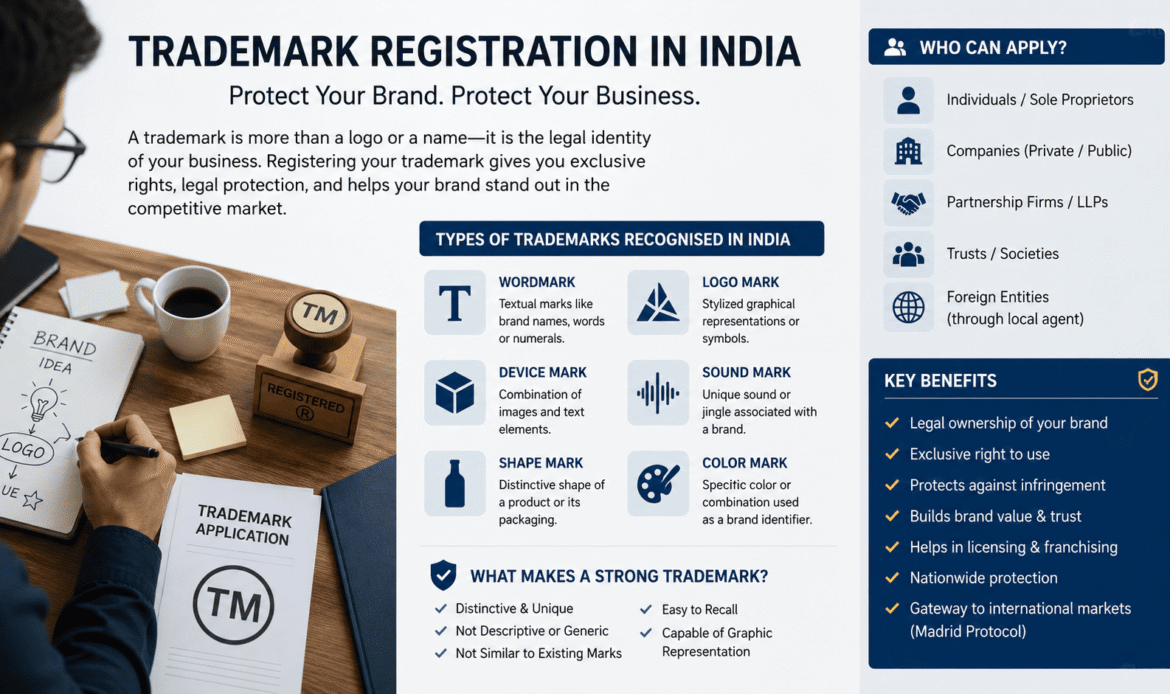
A registered trademark can provide stronger and clearer protection for a distinctive brand. The official IP India guidance explains that trademarks can cover word marks, logos, shapes, colour combinations and sound marks, subject to the legal requirements.
Lawizer offers trademark registration services for founders who want assistance with the filing process.
Step 7: Put Contracts in Place
Once the business starts dealing with employees, freelancers, customers, vendors or investors, written contracts become increasingly important.
A contract should clearly establish what each party must do, how payment works, who owns intellectual property, how confidential information is handled and what happens when the relationship ends.
What Legal Documents Should a Startup Have?
There is no single set of documents that every startup must have. However, a well-organised founder should maintain several categories of records.
Corporate and Registration Documents
- Certificate of Incorporation or applicable registration certificate.
- MOA and AOA, where applicable.
- LLP agreement or partnership deed, where applicable.
- PAN and TAN records.
- DIN and DSC records for relevant directors.
- Registered office documentation.
- GST registration certificate, where applicable.
Founder and Ownership Documents
For a startup with more than one founder, ownership arrangements should be documented clearly.
- Founders’ agreement.
- Shareholders’ agreement, where appropriate.
- Share subscription or transfer documents.
- Founder vesting arrangements, where applicable.
- Intellectual-property assignment documents.
These documents can prevent misunderstandings about equity, responsibilities and decision-making later.
Commercial Contracts
Commercial documents should match the way the business actually operates. Depending on the startup, this can include:
- Customer or service agreements.
- Vendor and supplier agreements.
- Consultancy agreements.
- Employment agreements.
- Non-disclosure agreements.
- Licensing agreements.
- Joint venture agreements.
- Letters of intent and term sheets.
Lawizer’s business documentation services cover several types of founder and commercial agreements.
Online Business Documents
If your startup operates a website, mobile application or online marketplace, consider the legal documents appropriate to the service and data you collect.
These may include terms of use, privacy documentation, refund or cancellation policies and other consumer-facing notices. The exact requirements depend on the business model and applicable laws.
What Is a Startup Legal Checklist?
A useful startup legal checklist should not stop when the certificate of incorporation arrives. Instead, divide it into three phases.
Before Launch
- Choose the business structure.
- Decide founder ownership and responsibilities.
- Check the proposed brand name.
- Register the business where required.
- Arrange PAN, TAN and banking requirements.
- Review GST applicability.
- Identify industry-specific licences.
- Protect important intellectual property.
Before Hiring or Signing Customers
- Use appropriate employment or consultancy agreements.
- Document founder arrangements.
- Use NDAs where confidentiality requires them.
- Set out customer and vendor obligations in writing.
- Clarify ownership of work created for the business.
After Launch
- Maintain accounting records.
- File applicable GST and tax returns.
- Complete required ROC filings.
- Track director and other statutory compliance.
- Renew licences and registrations where applicable.
- Keep contracts and corporate records updated.
For companies that have already been incorporated, Lawizer’s annual compliance service provides a useful starting point for understanding recurring ROC, tax and other compliance requirements.
What Is the ₹20 Lakh Grant for Startups?
The phrase “₹20 lakh startup grant” usually refers to a specific government funding opportunity rather than a universal grant available to every new business.
One important example is the Startup India Seed Fund Scheme (SISFS). The official Startup India scheme information states that eligible startups can receive up to ₹20 lakh as a grant for activities such as proof-of-concept validation, prototype development or product trials. The scheme also provides a separate investment route for market entry, commercialisation or scaling, subject to its conditions.
Eligibility matters. The scheme is aimed at eligible early-stage startups and is not simply a payment that every newly incorporated company can claim.
The official Startup India scheme material should always be checked before applying because scheme windows, eligibility conditions and application arrangements can change.
How Can Founders Get Money From the Government for a Startup?
Government support can come in different forms. A founder should first identify the type of assistance that fits the business.
- Startup grants for eligible innovation or development activities.
- Seed funding through government-backed programmes.
- State startup incentives.
- Incubator-linked funding.
- Credit-linked or subsidy-based programmes.
- Government procurement opportunities.
DPIIT recognition can also provide access to certain Startup India benefits. Current Startup India guidance says eligible recognised startups can access benefits including easier compliance, intellectual-property support and certain tax-related opportunities, subject to separate eligibility requirements.
Founders should also remember that DPIIT recognition is not the same thing as receiving funding. Recognition may make a startup eligible for particular programmes, but funding normally involves a separate scheme and assessment.
Lawizer provides Startup India registration assistance for founders seeking DPIIT recognition.
What Is the 80/20 Rule for Startups?
The 80/20 rule, also called the Pareto principle, is a business management idea rather than an Indian startup law.
It suggests that a relatively small number of inputs can sometimes produce a disproportionately large share of results. For example, a founder may discover that a small group of customers generates most of the company’s revenue.
The principle can help founders prioritise:
- The most profitable customers.
- The highest-performing marketing channels.
- The products generating most revenue.
- The operational problems causing most delays.
- The compliance tasks carrying the greatest risk.
However, 80/20 should be treated as a decision-making framework, not a guaranteed mathematical rule for every startup.
Why Do 90% of Startups Fail in India?
“90% of startups fail” is one of the most repeated claims in startup discussions. However, it should not be treated as a precise universal failure rate for Indian startups.
Startup failure rates vary depending on the definition of failure, the period measured, the industry and the dataset used.
Still, several recurring business problems can increase the risk of failure:
- Poor product-market fit.
- Insufficient or unpredictable cash flow.
- Weak unit economics.
- Scaling before demand is proven.
- High customer acquisition costs.
- Founder or team disputes.
- Regulatory and compliance failures.
- Inability to raise additional capital.
Legal compliance cannot guarantee that a startup will succeed. It can, however, prevent avoidable problems and make the business easier to operate, fund and sell.
For example, investors may investigate incorporation records, ownership, intellectual property, contracts and statutory filings during due diligence. Lawizer discusses these risks in its guide on startup compliance gaps that can affect funding rounds.
Which Startups Are in Loss?
There is no permanent list of “startups in loss.” A startup may report an accounting loss while still growing rapidly and investing heavily in technology, employees, marketing or market expansion.
For private companies, detailed financial information may also not be as easily available to the public as it is for listed companies.
Founders should therefore distinguish between:
- Accounting loss: expenses exceed recognised revenue for the relevant period.
- Cash burn: the business is consuming cash faster than it generates it.
- Negative cash flow: cash outflows exceed cash inflows during a period.
- Growth investment: spending is deliberately high because the company is trying to expand.
A better way to evaluate a startup is to look at revenue growth, gross margin, burn rate, runway, customer acquisition cost, retention and contribution margins alongside profitability.
Can You Provide a List of Registered Startup Companies in India?
The phrase “registered startup” can mean different things.
A business may be registered as a company or LLP with the MCA but may not have DPIIT startup recognition. Conversely, a DPIIT-recognised startup must satisfy the applicable Startup India eligibility requirements.
Current Startup India guidance states that eligible entities can include private limited companies, registered partnership firms, LLPs and cooperative societies, subject to the applicable startup criteria. The current general recognition framework also uses a 10-year age limit and a ₹200 crore turnover ceiling, while separate DeepTech criteria provide different limits.
Therefore, there is no single sensible list containing every “registered startup company” in India. Founders should first define whether they mean MCA-registered entities, DPIIT-recognised startups or startups registered under a particular state programme.
Startup Legal Compliance After Registration
Registration is the beginning of compliance, not the end.
Tax and GST Compliance
Businesses must identify the income-tax, GST, TDS and other tax obligations that apply to their activities and structure.
GST-registered businesses may have recurring return and record-keeping obligations. The exact return pattern depends on the taxpayer’s circumstances and applicable scheme.
For direct tax matters, founders should use the official Income Tax e-Filing portal for current filing and tax information.
ROC and Corporate Compliance
Companies and LLPs have continuing filing and record-keeping responsibilities. The exact forms and deadlines depend on the entity and circumstances.
For example, certain companies incorporated with share capital may have post-incorporation requirements such as the declaration of commencement of business. Lawizer explains the relevant INC-20A compliance requirement in detail.
MSME and Udyam Registration
Udyam registration is separate from company incorporation and GST registration. Eligible businesses can consider it where the MSME framework applies.
The official Udyam system provides the registration mechanism and eligibility framework. Founders should use the government portal for the latest requirements.
Lawizer also provides MSME/Udyam registration assistance as part of its business services.
Employment Compliance
Once a startup hires employees, additional obligations may arise under applicable labour and employment laws. These can depend on the number of employees, location, wages, nature of work and other factors.
Do not assume that every employment registration applies from the first hire. Instead, assess the applicable thresholds and state-specific requirements.
Data and Online Business Compliance
Consumer-facing startups should also consider privacy, data handling, terms of use and consumer-facing policies.
These documents should reflect the actual way the business collects, uses, stores and shares information. A generic privacy policy copied from another website may not accurately describe your business.
What Are the 7 Types of Startup Documents?
There is no universal legal classification called the “seven types of startup documents.” However, founders can organise their records into seven practical categories:
- Registration documents: incorporation and registration certificates.
- Ownership documents: shareholder and founder records.
- Tax documents: PAN, TAN, GST and tax filings where applicable.
- Commercial contracts: customer, vendor and service agreements.
- Employment documents: employment and consultancy agreements.
- Intellectual-property documents: trademark, copyright, patent and IP assignment records.
- Compliance records: ROC filings, statutory registers and other regulatory records.
This classification is useful because it makes due diligence easier. When an investor, lender, customer or regulator asks for documents, the founder can locate them quickly.
What Is a List of Documents for a New Business?
A practical document repository should contain more than incorporation papers.
At a minimum, create separate folders for corporate records, tax, banking, contracts, employees, intellectual property and compliance.
Use consistent file names and maintain the latest signed version of each agreement. Also keep evidence of filings and acknowledgements rather than retaining only draft forms.
This becomes especially important when the business starts raising funds. Missing documents can slow legal due diligence and may create questions about ownership or compliance.
What Are 10 Different Types of Business Documents?
Ten common categories or examples include:
- Certificate of Incorporation or business registration certificate.
- MOA and AOA, where applicable.
- Founder or shareholders’ agreement.
- Customer or service agreement.
- Vendor or supplier agreement.
- Employment agreement.
- Non-disclosure agreement.
- Intellectual-property registration or assignment document.
- Tax registration and filing records.
- Statutory and regulatory compliance records.
The exact document set should be tailored to the business. A SaaS company, restaurant, manufacturer and consulting firm can have very different legal requirements.
Frequently Asked Questions About the Legal List for New Founders
What are the legal procedures to start a startup in India?
Choose the business structure, complete the applicable registration, obtain required tax registrations and licences, document founder and commercial relationships, protect intellectual property and establish an ongoing compliance process.
What documents should a startup have?
A startup should maintain registration records, ownership documents, tax records, contracts, employment documents, IP records and ongoing compliance documents relevant to its structure and activities.
What is the ₹20 lakh grant for startups?
The ₹20 lakh figure is associated with specific government funding programmes such as the Startup India Seed Fund Scheme. It is not a universal grant automatically available to every newly incorporated startup.
How do I get money from the government for a startup?
Check DPIIT recognition, central and state startup schemes, incubators and government-backed funding programmes. Each programme has its own eligibility criteria, funding structure and application process.
What is the 80/20 rule for startups?
It is the Pareto principle, a business prioritisation concept. It is not a statutory Indian startup rule.
What is the 50/100/500 rule for startups?
The phrase does not represent one universal Indian startup law. Different articles or programmes may use similar numbers for different metrics. Founders should identify the specific rule or scheme before relying on it.
Is it true that 90% of startups fail?
There is no single reliable universal 90% failure rate that applies to every Indian startup. Failure rates depend on the dataset, definition and period being measured.
Which startups are in loss?
Many startups can operate at a loss while investing in growth. For private companies, complete financial information may not always be publicly available, so a current universal list is not practical.
What is a startup checklist?
It is a practical list of incorporation, tax, licensing, contract, IP and ongoing compliance tasks that a founder can use to organise the business legally.
Can a new startup get government funding immediately?
Not automatically. Funding schemes generally have eligibility conditions, application processes and assessment criteria. Incorporation alone does not guarantee government funding.
Final Legal Checklist for New Founders
Building a business is exciting, but legal groundwork should not be treated as an afterthought. A strong foundation helps founders avoid preventable disputes and makes future fundraising, hiring and expansion easier.
Before launching, review your business structure, ownership, registration, GST and tax position, licences, contracts and intellectual property. After launch, maintain your filings and records continuously.
Because legal and tax requirements vary by entity, state, industry and business activity, this guide should be used as general information rather than a substitute for advice on your specific situation.
If you are unsure where to begin, Lawizer’s startup and business legal team can help you review company registration, GST, Startup India, trademark, MSME and compliance requirements in one place.
Ready to put your startup on a stronger legal footing? Start with the requirement that applies to your business today, then build your compliance system as the business grows.