
₹20,722.5 crore. That’s the combined FY25 loss reported by 45 loss-making Indian startups so far. When the runway gets short, payroll is often the first casualty. Missing even one salary cycle may seem like a temporary cash-flow issue to a founder. Legally, however, it isn’t.
The moment payday passes without payment, the issue goes beyond a simple delay. You begin accumulating legal liability under at least three separate laws.
What You’ll Learn
- Whether delaying salary is actually illegal in India, and by how many days
- The specific laws that apply — Payment of Wages Act, IPC/BNS, Companies Act, IBC
- What your employees can legally do if you miss payroll
- How unpaid salaries can escalate into an insolvency petition against your company
- Practical steps to protect the company (and yourself, personally) before it gets there
Is It Actually Illegal to Delay Employee Salaries?
Yes — and most founders underestimate by how much. Employers must pay wages before the 7th day of the following month in smaller establishments and before the 10th day in larger ones, as required by the Payment of Wages Act, 1936. There’s no grace period for “waiting on the next funding tranche.”
Here’s the thing: this Act currently covers employees earning up to ₹24,000 a month, which includes the vast majority of early-career hires at most startups — support staff, junior developers, sales executives, and operations teams.
Employees who earn above that threshold still receive legal protection and can pursue civil recovery through a summary suit or, in senior roles, file a straightforward money recovery claim.
What most founders miss: a company doesn’t need to formally “refuse” to pay to be in breach. Simply missing the statutory deadline — even by a few days, even with a WhatsApp message promising payment “next week” — is a compliance violation the moment it happens.
The Laws That Kick In When Payroll Is Missed
Salary non-payment in India isn’t governed by one law — it’s a stack of them, and each one gets more serious than the last.

1. Payment of Wages Act, 1936 — the civil layer
This is the first trigger point. Delayed wages entitle the employee to file a claim with the labour authority, and courts have the power to order payment of the dues plus compensation, on top of the original amount owed.
2. Criminal liability for intentional non-payment
For example, if a startup records salaries as “paid” in its books but never transfers the money to employees, it does more than delay payment—it misrepresents the facts. Authorities can prosecute this conduct as cheating or criminal breach of trust under criminal law, in addition to any labour-related claims.
3. Companies Act, 2013 — fraud provisions
If a company combines unpaid salaries with falsified financial records—for example, by recording payroll as disbursed in books submitted for audit or fundraising while employees remain unpaid—Section 447 of the Companies Act treats the conduct as corporate fraud. This offence carries far more severe consequences than a simple wage dispute.
4. The new Labour Codes
India’s four consolidated labour codes came into force on November 21, 2025, replacing 29 older laws.
Under the new framework, authorities continue to penalize payment delays, and employers can no longer use payroll structures that artificially reduce statutory contributions. Basic pay must now account for at least 50% of total compensation, directly increasing gratuity and provident fund (PF) liability calculations.
What Employees Can Legally Do If You Miss Payroll
The short answer: more than most founders assume, and faster than most founders expect. A typical sequence looks like this:
- Send a formal legal notice demanding payment within a fixed window, usually 7–15 days
- File a complaint with the jurisdictional Labour Commissioner, who can summon the employer for reconciliation
- Escalate to the Labour Court if the complaint isn’t resolved, with claims filed within one year of default
- Pursue a civil recovery suit for managerial or senior staff not covered under the Payment of Wages Act
- File as an operational creditor under the Insolvency and Bankruptcy Code if dues cross ₹1 lakh
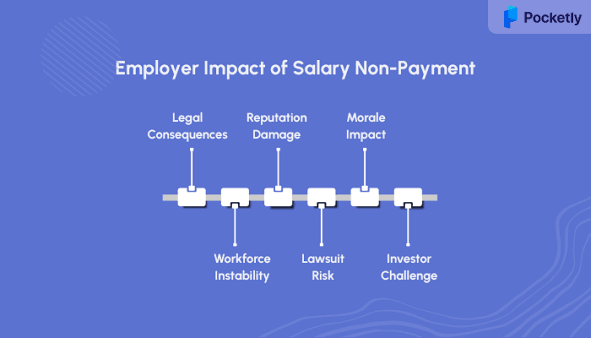
Let’s break this down further with the piece founders underestimate most: once a legal notice lands, the clock is already running publicly. A response — or lack of one — becomes evidence in any future proceeding.
This is exactly the kind of documentation gap that proper business compliance support is built to close before it becomes a liability.
How Missed Salaries Can Trigger Insolvency Proceedings
Here’s the escalation path founders genuinely don’t see coming. Under the Insolvency and Bankruptcy Code, an employee owed ₹1 lakh or more in unpaid wages qualifies as an “operational creditor” — the same legal category as an unpaid vendor.
The process starts with a demand notice. If the company doesn’t respond or settle within the specified period, employees can collectively petition the NCLT, which can trigger appointment of a resolution professional and formation of a creditors’ committee.
If the company fails to resolve the issue, creditors can push it into liquidation—a legal outcome that began with a missed payday.
A quick example shows why documentation matters: courts have repeatedly ruled that employers cannot arbitrarily withhold earned wages, and employees remain entitled to recover them even when the employment arrangement contains procedural irregularities.
Clean records protect both the company and the employee. Clean records protect the company as much as they protect the employee.
How Founders Can Protect Themselves Before It Escalates
The good news: almost every escalation on this list is avoidable with early, documented communication. What actually works:
- Communicate delays in writing before the due date, not after — silence is what triggers legal notices
- Never show salary as “paid” internally or to auditors if it hasn’t actually been disbursed
- Prioritise partial payments over zero payments — courts and employees respond very differently to good-faith effort
- Put a written settlement plan in place with dates, even if amounts are staggered
- Keep statutory filings — PF, ESIC, TDS on salary — current even when gross pay is delayed, since these carry separate penalties
If your startup is also behind on tax filings or MSME-linked payment obligations during a cash crunch, those compliance gaps compound fast — each one is a separate legal exposure, not a single combined problem.
Frequently Asked Questions
A: Yes. Under the Payment of Wages Act, 1936, employers must pay wages within 7 days after the wage period ends for smaller establishments and within 10 days for larger ones.Any delay beyond this, even without malicious intent, is technically a violation founders should treat seriously.
A: Yes, in cases involving intentional deception — such as salary shown as disbursed in records but never actually transferred. Authorities can pursue this as cheating or criminal breach of trust, separately from the labour claim for the unpaid amount.
A: Yes. Under the IBC, an employee owed ₹1 lakh or more can file as an operational creditor. If the company doesn’t respond to a demand notice, employees can collectively petition the NCLT, which can ultimately lead to liquidation proceedings.
A: Communicate the delay in writing before the due date, offer a partial payment if possible, and put a dated settlement plan on record.
The law treats documented, proactive communication very differently from silence that forces employees to escalate the issue on their own.
A: Yes. India’s four consolidated labour codes took effect on November 21, 2025, and payment delays remain fully punishable under the new framework.
Additionally, employers must keep basic pay at or above 50% of total compensation, changing how they calculate PF and gratuity liabilities even before a payment delay occurs.
Lawizer’s experts handle payroll compliance reviews, statutory filings, and labour law documentation — fully online, starting at just ₹1,999. No CA visit needed.