Tag: SPICe+ form

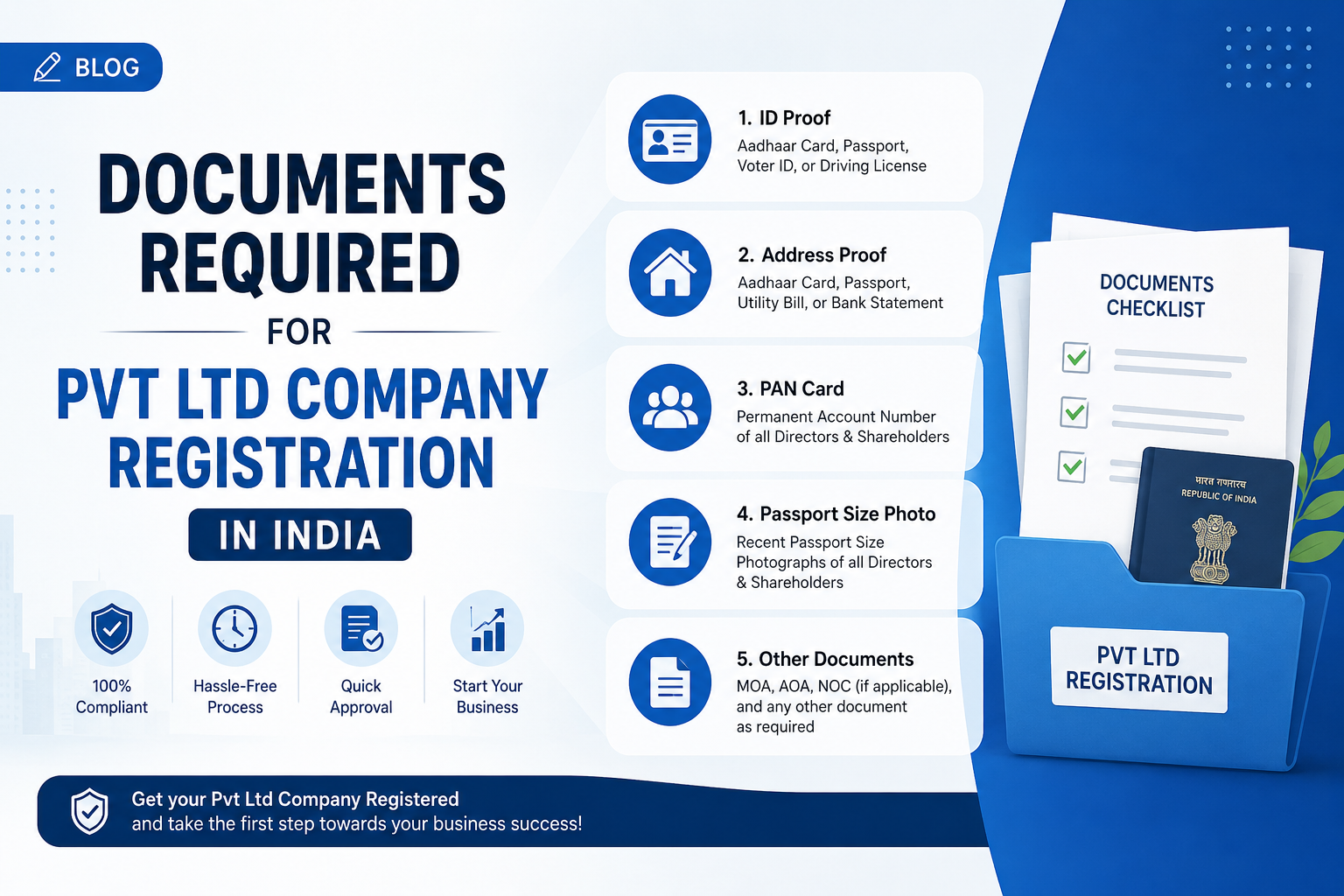
  • Documents Required for Company Registration in India: Complete Checklist

    Documents Required for Company Registration in India: Complete Checklist

    Documents Required for Company Registration in India: Complete Checklist

    India registered over 1,85,000 new companies in 2024 alone — an all-time high. Yet every single day, founders in Bengaluru, Kolkata, and Delhi get their MCA applications sent back for resubmission because of one mismatched name on a PAN card or an expired utility bill.

    Getting the documents required for company registration in India right is not optional — it’s the difference between launching in 10 days and waiting 6 weeks.

    Here’s exactly what you need — broken down by document type, business structure, and who it applies to.

    📌 TL;DR: The documents required for company registration in India include PAN card, Aadhaar card, address proof (utility bill not older than 2 months), Digital Signature Certificate (DSC), Director Identification Number (DIN), Memorandum of Association (MOA), Articles of Association (AOA), and registered office proof — all submitted through the SPICe+ form on MCA21. The exact list varies slightly by structure (Private Limited, LLP, OPC). Lawizer’s experts help you prepare and file the correct documents the first time, fully online.

    What You’ll Learn

    • The complete document checklist for Private Limited Company, LLP, and OPC registration in India
    • Which documents apply to directors, shareholders, and the registered office — and what formats MCA actually accepts
    • The most common document mistakes that cause MCA rejections, and how to avoid every one of them
    • Special requirements for NRIs and foreign nationals incorporating a company in India

    Startup India Registration Certificate online by Gov Portal

    Why Your Document Checklist Can Make or Break Registration

    The Ministry of Corporate Affairs (MCA) processes every incorporation application through its MCA21 portal using the SPICe+ (Simplified Proforma for Incorporating Company Electronically Plus — MCA’s integrated online incorporation form) system.

    Here’s the thing: MCA does not call you when something is wrong. It marks your application for “resubmission,” and the clock resets. In May 2025, new company registrations grew 29% year-on-year to 20,718 in a single month — meaning MCA reviewers are handling massive volumes. Clean, complete documents move faster through this queue.

    What most founders miss: every document must carry matching details across all identity proofs. If your PAN says “Rahul Kumar” and your Aadhaar says “R. Kumar,” that mismatch alone triggers a rejection. Plan your paperwork with this in mind before you upload anything.


    Documents Required for Directors and Shareholders

    A Private Limited Company requires a minimum of 2 directors and 2 shareholders under the Companies Act 2013 (India’s primary legislation governing company formation and management). Directors and shareholders can be the same individuals. Let’s break this down into what each person must submit.

    Identity Proof (Any One)

    • PAN Card — mandatory for all Indian nationals; the name must match exactly across all other documents
    • Passport — mandatory for foreign nationals and NRIs; must be valid and notarised if issued outside India

    Address Proof (Any One)

    • Aadhaar Card
    • Voter ID
    • Driving Licence
    • Passport (can double as address proof if it carries current address)

    Residential Proof (Any One — must not be older than 2 months)

    • Bank statement
    • Electricity bill
    • Mobile or telephone bill
    • Gas bill

    Every director also needs a Digital Signature Certificate (DSC) — an encrypted electronic key used to sign MCA forms online — and a Director Identification Number (DIN), a unique 8-digit government-issued ID for every company director in India.

    The DSC is obtained from MCA-approved certifying authorities. For those with an Aadhaar linked to a mobile number, DSC issuance is significantly faster through OTP-based verification.

    You’ll also need 2–3 recent passport-sized photographs per director and shareholder. Keep digital scans ready in JPEG format under 1MB — MCA portals have strict upload size limits.


    Registered Office Documents: What MCA Actually Wants

    Every company registered in India must have a registered office address within the country — and MCA accepts both residential and commercial properties. The documents you need depend on whether the property is rented or owned. This is one of the most common stumbling blocks for first-time founders, so get it right from the start.

    For a Rented Property

    • Rent agreement or lease deed (signed by both landlord and tenant)
    • No Objection Certificate (NOC) from the property owner — a written letter saying the owner permits the premises to be used as a registered office
    • Latest utility bill (electricity, water, or gas) in the owner’s name — not older than 2 months

    For an Owned Property

    • Ownership deed or sale deed
    • Latest utility bill in the owner’s name — not older than 2 months

    A quick example: if you’re using your parent’s home in Mumbai as your registered office, you’ll need an NOC signed by your parent (the owner), your rent agreement or a simple permission letter, and a recent utility bill from that address. Many founders in Bengaluru and Delhi use co-working spaces as their registered office — that’s valid too, but get the NOC and utility bill from the co-working company on their letterhead.


    Incorporation Documents: MOA, AOA, and SPICe+ Forms

    Beyond identity and address, you need a set of constitutional and statutory documents that formally define your company. These are drafted and filed as part of the SPICe+ process on MCA21.

    Memorandum of Association (MOA)

    The MOA is the charter document of your company. It defines what your company is — its name, registered state, the liability of members, authorised share capital, and most critically, its objects clause (what your business will actually do).

    Under the Companies Act 2013, your company can only legally carry out activities described in the MOA’s objects clause. If you plan to do e-commerce and also provide software services, both need to be captured. It is filed as INC-33 (eMoA) as part of the SPICe+ linked form set.

    Articles of Association (AOA)

    The AOA is your company’s internal rulebook. It governs how the company is managed — how directors are appointed, how shares are transferred, how meetings are conducted, and how decisions are made. It is filed as INC-34 (eAoA). Both MOA and AOA must be digitally signed by all subscribers (founding members).

    Other Statutory Forms Filed via SPICe+

    • INC-9 — Declaration by each proposed director and subscriber confirming they are not disqualified under the Companies Act 2013
    • DIR-2 — Consent to act as director
    • AGILE-PRO-S — Linked form for simultaneous GST registration, EPFO/ESIC registration, and bank account opening (filed together with SPICe+)

    Once all forms and documents are filed correctly, MCA issues a Certificate of Incorporation (COI) along with the company’s CIN (Corporate Identity Number — a 21-digit alphanumeric code that uniquely identifies your company), PAN, and TAN. The typical timeline, as per registrar data, is 7–15 working days for complete applications.


    Document Checklist by Business Structure

    The core documents remain consistent, but each business structure has a few specific requirements. Here’s a quick comparison before you decide which structure to register under.

    Private Limited Company (Pvt Ltd)

    • Minimum 2 directors’ KYC documents (PAN, address proof, residential proof, photographs)
    • DSC for each director
    • DIN (auto-generated through SPICe+ if not already held)
    • MOA (INC-33) + AOA (INC-34)
    • INC-9 declarations from all subscribers and directors
    • Registered office proof (rent agreement / NOC / utility bill)

    One Person Company (OPC)

    • Same as Pvt Ltd but only 1 director and 1 shareholder required
    • Nominee’s PAN and consent (filed via Form INC-3) — the nominee takes over if the sole member becomes incapacitated

    Limited Liability Partnership (LLP)

    • Minimum 2 Designated Partners’ documents (same KYC as above)
    • Filed through FiLLiP (Form for Incorporation of Limited Liability Partnership) on MCA21
    • LLP Agreement — must be executed and filed within 30 days of incorporation

    Documents for NRIs and Foreign Nationals

    Foreign nationals and NRIs can incorporate a Private Limited Company in India under the FDI (Foreign Direct Investment) policy through the automatic route in most sectors. The document requirements differ in one key area: notarisation and apostille.

    • Passport — valid, and notarised by a Notary Public in the country of residence; if from a Hague Convention country, it also needs an Apostille stamp
    • Address proof — overseas bank statement or utility bill, notarised and apostilled
    • Visa copy and date-of-entry stamp — if the foreign national is currently in India at the time of signing
    • DSC — obtainable in India from MCA-empanelled agencies even for foreign nationals

    The short answer: if even one director is a foreign national, plan for an extra 2–3 weeks for notarisation and apostille. Use that time to draft your MOA and AOA carefully.


    5 Document Mistakes That Cause MCA Rejections

    These are the actual reasons applications get sent back. Each one is avoidable if you know what to check.

    • Name mismatch — PAN says one thing, Aadhaar says another. MCA treats even minor abbreviation differences as discrepancies.
    • Expired utility bill — address proof for registered office and residential proof for directors must not be older than 2 months from the date of filing.
    • Missing NOC from property owner — especially common when founders use a home address; the landlord or parent’s NOC is non-negotiable.
    • Wrong objects clause in MOA — a fintech startup that lists only “software development” in its MOA cannot legally collect payments. The objects clause must match your actual business model.
    • DSC not linked to Aadhaar — if your DSC is not Aadhaar-linked and your OTP verification fails, the entire submission is held up.
    Importance of Certificate of Incorporation for New Businesses | Ebizfiling

    Frequently Asked Questions

    Q: What is the most important document for company registration in India?

    A: The PAN card is the most critical identity document for Indian nationals registering a company in India, as it links all tax filings to your company and directors. Without a valid PAN for each director and shareholder, the MCA will not process your SPICe+ application. For foreign nationals, a notarised and apostilled passport serves this function.

    Q: Can I use a residential address as a registered office for my company in India?

    A: Yes, MCA allows a residential address as the registered office of a company. You’ll need a No Objection Certificate (NOC) from the owner of the property, a rent agreement or permission letter, and a utility bill in the owner’s name not older than 2 months. Many early-stage founders in cities like Bengaluru and Mumbai use their home addresses before moving to commercial office space.

    Q: How long does company registration take in India if all documents are correct?

    A: When all documents are complete, correctly formatted, and names match across all proofs, most Private Limited Company registrations are approved by MCA within 7–15 working days. Incomplete applications or those flagged for resubmission can take significantly longer — sometimes 4–6 weeks. Submitting a clean, verified application the first time is the single biggest factor in a fast registration.

    Q: What documents does a foreign national need to register a company in India?

    A: A foreign national needs a valid passport (notarised and apostilled if from a Hague Convention country), overseas address proof (bank statement or utility bill — also notarised), and a Digital Signature Certificate. If the foreign national is in India at the time of signing, a visa copy and entry stamp are also required. At least one director of the company must be an Indian resident under the Companies Act 2013.

    Q: Is Aadhaar mandatory for company registration in India?

    A: Aadhaar is not strictly mandatory, but it significantly speeds up the process. An Aadhaar linked to a registered mobile number allows OTP-based DSC generation and simplifies KYC verification on the MCA21 portal. Without Aadhaar, directors must submit alternative address proofs (Voter ID, Driving Licence, Passport) and the DSC process may take longer through biometric verification.

    Q: What is the difference between MOA and AOA in company registration?

    A: The Memorandum of Association (MOA) is your company’s external-facing charter — it defines the company’s name, registered state, business objectives, and authorised share capital. The Articles of Association (AOA) is your internal rulebook — it governs how the company is run, how directors are appointed, and how decisions are made. Both are mandatory for Private Limited Company registration and must be filed as digitally signed documents on the MCA21 portal via the SPICe+ form.

    Q: Do I need a separate document for GST registration when incorporating a company?

    A: Not necessarily. The AGILE-PRO-S form, filed as part of the SPICe+ bundle, allows you to apply for GST registration simultaneously with company incorporation. This means the same set of KYC and address documents you submit for MCA can be used for GST registration as well, avoiding duplicate paperwork. However, if your business is not yet liable for GST at incorporation time, you can skip this and register for GST separately once your turnover crosses the applicable threshold.


    Ready to register your company without the document headache? Lawizer’s experts handle everything — document verification, DSC procurement, SPICe+ filing, and MCA follow-ups — fully online, starting at just ₹1,499. No CA visit needed.

    Start Your Company Registration with Lawizer → lawizer.com/startup-businesslegal

  • How to Register a Private Limited Company in India (2026): Step-by-Step Guide.

    How to Register a Private Limited Company in India (2026): Step-by-Step Guide.

    Over 1.12 lakh companies were incorporated in India in just the first eight months of FY 2024–25 — and private limited companies made up over 95% of that number. If you’re building something serious in India, there’s one structure most founders, investors, and banks trust above all others: the Private Limited Company.

    Getting it wrong costs months. Getting it right takes about 7 working days — if you know exactly what to do.

    📌 TL;DR: Private Limited Company registration in India is a fully online process under the Companies Act, 2013, handled via the MCA21 portal using the SPICe+ form. You need a minimum of 2 directors and 2 shareholders, a DSC, DIN, name reservation, MoA and AoA filing, and can expect your Certificate of Incorporation in 5–7 working days. Lawizer’s experts handle the entire process end-to-end, starting at just ₹1,499.

    What You’ll Learn

    • Who qualifies to register a Private Limited Company in India in 2026
    • Every step of the SPICe+ registration process — from DSC to Certificate of Incorporation
    • What documents you actually need (and common mistakes that delay approval)
    • Costs, timelines, and what happens after registration
    • How to stay compliant once your company is live

    What Is a Private Limited Company — and Why Do Founders Choose It?

    A Private Limited Company (Pvt. Ltd.) is a business entity incorporated under the Companies Act, 2013 and regulated by the Ministry of Corporate Affairs (MCA).

    The defining feature: your personal assets are legally separate from your company’s liabilities. If the business runs into debt, your personal savings, home, or car are not at risk.

    Here’s the thing — this structure is not just about protection. It’s about credibility. Banks, venture capitalists, and institutional clients in Bengaluru, Mumbai, and Delhi instinctively trust a Pvt. Ltd. entity over a sole proprietorship or partnership. It signals permanence, governance, and scalability.

    Key features at a glance:

    • Minimum 2 directors (at least one must be a resident Indian) and minimum 2 shareholders
    • Maximum 200 shareholders — shares cannot be listed on a public stock exchange
    • Separate legal identity — the company can own property, enter contracts, and sue or be sued in its own name
    • Perpetual succession — the company continues to exist even if directors or shareholders change
    • No minimum paid-up capital required since the Companies (Amendment) Act, 2015

    What most founders miss: a Pvt. Ltd. structure is almost mandatory if you’re planning to apply for DPIIT Startup India recognition, raise angel or VC funding, or issue ESOPs to your team.


    Eligibility and Pre-Registration Requirements

    Before you touch the MCA21 portal, there are a few boxes to check. Getting these right upfront prevents 80% of rejection delays.

    Director and Shareholder Requirements

    • Minimum 2 directors; maximum 15 directors
    • At least one director must be a resident Indian (stayed in India for at least 182 days in the previous calendar year)
    • Directors and shareholders can be the same individuals
    • Foreign nationals can be directors — they need a valid passport and address proof
    • A director must not be an undischarged insolvent or convicted of any offence involving moral turpitude
    Startup India Certificate 2026: Download & Verify Online

    Registered Office

    Your company needs a registered office address in India within 30 days of incorporation. This can be a home address, a co-working space, or a rented commercial property. You’ll need an NOC (No Objection Certificate) from the property owner plus a utility bill not older than 2 months.


    Step-by-Step: How to Register a Private Limited Company in India

    The entire process runs through the MCA21 portal — India’s Ministry of Corporate Affairs digital gateway. Let’s break this down step by step.

    Step 1: Obtain a Digital Signature Certificate (DSC)

    A DSC (Digital Signature Certificate) is your legal electronic signature. It’s mandatory for all proposed directors and shareholders (subscribers) who will sign the incorporation forms. You can apply through government-approved agencies like eMudhra or Sify. Expect a turnaround of 1–2 working days. Carry your PAN, Aadhaar, and a passport-size photo.

    Step 2: Reserve Your Company Name via SPICe+ Part A

    SPICe+ (Simplified Proforma for Incorporating Company Electronically Plus — MCA’s single-window incorporation form) has two parts. Part A handles name reservation. You can propose up to 2 names in order of preference. The name must end with “Private Limited” and must not be identical or confusingly similar to an existing company or trademark. MCA typically approves or rejects within 1–3 working days.

    A quick example: “Zelta Tech Solutions Private Limited” would pass if no similar name exists on the MCA database. “Reliance Innovations Private Limited” would almost certainly be rejected.

    Step 3: Apply for Director Identification Number (DIN)

    A DIN (Director Identification Number) is a unique 8-digit number issued by the MCA to every person who wants to become a director of a company. The good news: you don’t file a separate DIN application anymore. DIN allotment for up to 3 directors is integrated directly into SPICe+ Part B — it’s done in the same form as incorporation.

    Step 4: Draft MoA and AoA

    Two critical constitutional documents go into every incorporation filing:

    • MoA (Memorandum of Association — INC-33): Defines your company’s objectives and the scope of business activities it can undertake
    • AoA (Articles of Association — INC-34): Lays down the internal rules and regulations governing the company’s management

    These are drafted as e-MoA and e-AoA on the MCA portal and must be signed digitally by all subscribers. Getting the objects clause in your MoA right is critical — a narrowly drafted MoA can restrict future business activities. This is where professional help pays for itself.

    Step 5: File SPICe+ Part B and AGILE-PRO

    SPICe+ Part B is where everything comes together. This single integrated form covers: company incorporation, DIN allotment, PAN application, TAN application, EPFO registration, ESIC registration, and professional tax registration (in applicable states). Alongside Part B, you’ll file AGILE-PRO (INC-35) for GST registration and a bank account opening request.

    Supporting documents to attach: e-MoA, e-AoA, Form INC-9 (declaration by directors and subscribers), Form DIR-2 (consent to act as director), identity and address proofs for all directors and subscribers, and registered office proof.

    Step 6: Receive Your Certificate of Incorporation (CoI)

    Once the Registrar of Companies (ROC) processes and approves your application, you receive a digitally signed Certificate of Incorporation (CoI). This document contains your CIN (Corporate Identity Number — a 21-character alphanumeric identifier assigned to every registered company), PAN, and TAN. Typical timeline: 5–7 working days from a clean submission.

    How to Register a Private Limited Company in India: Complete MCA Portal Guide [2026]

    Documents Required for Private Limited Company Registration

    The short answer: documents fall into three categories — for directors, for shareholders, and for the registered office. All documents must be self-attested; foreign nationals must get their documents notarised and apostilled.

    For Directors and Shareholders (Subscribers)

    • PAN card (mandatory for Indian nationals)
    • Aadhaar card / Passport / Voter ID (identity proof)
    • Bank statement / Utility bill / Rent agreement not older than 2 months (address proof)
    • Recent passport-size photograph
    • Email address and mobile number (for DSC and DIN)

    For Registered Office

    • Utility bill (electricity / telephone) not older than 2 months
    • NOC (No Objection Certificate) from property owner if rented
    • Rent agreement or ownership proof

    Cost of Registering a Private Limited Company in India (2026)

    Here’s the thing that surprises most first-time founders: government fees for companies with an authorised capital up to ₹15 lakh are zero, following MCA’s initiative to reduce the cost of starting a business. What you actually pay includes the professional fee for filing, DSC cost, and stamp duty — which varies by state.

    • DSC (per person): ₹1,000–₹2,000
    • Government stamp duty: Varies by state — approximately ₹500 in Delhi, higher in Maharashtra
    • Professional / service fees: ₹1,500–₹8,000 depending on provider
    • Total out-of-pocket (typical): ₹3,000–₹12,000 all-inclusive

    With Lawizer’s company incorporation service (https://lawizer.com/startup-businesslegal), you get end-to-end expert handling — name approval, DSC, DIN, SPICe+ filing, MoA and AoA drafting, PAN, TAN, and your Certificate of Incorporation — fully online, no CA visit required.


    Post-Registration Compliance: What Happens After You Get Your CoI

    Incorporation is day one, not the finish line. A Private Limited Company carries mandatory annual compliances under the Companies Act, 2013. Missing these attracts penalties — and the MCA has been tightening enforcement through its Companies (Filing of Documents and Forms in XBRL) Amendment Rules, 2025.

    • Open a current bank account in the company’s name within 30 days
    • File INC-20A (Declaration of Commencement of Business) within 180 days of incorporation if you have share capital
    • GST registration once your turnover crosses ₹20 lakh (₹10 lakh for special category states)
    • Annual Return (Form MGT-7): filed within 60 days of AGM
    • Financial Statements (Form AOC-4): filed within 30 days of AGM
    • DIR-3 KYC: every director must complete KYC annually
    • Income Tax Return: mandatory regardless of profit or loss

    If you’re also registering your brand, getting your trademark registered through Lawizer (https://lawizer.com/startup-businesslegal/protectbusiness/TrademarkRegistrationPage) alongside incorporation is a smart move — it protects your company name and logo from day one.

    Understanding Private Limited Companies in India's Startup Ecosystem | Brand Stories (HT Tech)

    Frequently Asked Questions

    Q: How long does it take to register a Private Limited Company in India?

    A: With all documents in order, Private Limited Company registration in India typically takes 5–7 working days from the date of SPICe+ form submission to receipt of the Certificate of Incorporation from the Registrar of Companies. Delays usually occur due to name rejection, document errors, or ROC workload. Using a professional service like Lawizer significantly reduces the chances of resubmission.

    Q: What is the minimum capital required to start a Private Limited Company in India?

    A: There is no minimum paid-up capital requirement for a Private Limited Company in India since the Companies (Amendment) Act, 2015. You can incorporate with as little as ₹1 in authorised capital, though most founders choose ₹1 lakh as a practical starting point. Government fees for companies with authorised capital up to ₹15 lakh are zero.

    Q: Can I register a Private Limited Company with only one person?

    A: No — a Private Limited Company requires a minimum of 2 directors and 2 shareholders. If you want a single-person structure with limited liability, the correct option is an OPC (One Person Company), also registered under the Companies Act, 2013. However, OPCs cannot issue ESOPs or raise external equity funding, which makes them unsuitable for startups seeking investor capital.

    Q: Can a foreign national be a director or shareholder in an Indian Private Limited Company?

    A: Yes. Foreign nationals can be directors and shareholders in a Private Limited Company in India, subject to FDI (Foreign Direct Investment) regulations under FEMA (Foreign Exchange Management Act). At least one director must be a resident Indian — meaning they must have stayed in India for at least 182 days in the preceding calendar year. Foreign directors need a notarised and apostilled passport copy and address proof.

    Q: What is the difference between MoA and AoA?

    A: The MoA (Memorandum of Association) defines the company’s objectives — what business activities it is permitted to carry out. The AoA (Articles of Association) lays down the internal governance rules — how meetings are held, how shares are transferred, and how directors are appointed or removed. Both are constitutional documents filed at incorporation and can only be changed through special resolutions approved by shareholders.

    Q: Do I need a CA or lawyer to register a Private Limited Company in India?

    A: You are not legally required to hire a CA or lawyer — the MCA portal is accessible directly. However, errors in SPICe+ filing, MoA drafting, or document preparation are the primary cause of rejections and resubmissions, adding days or weeks to the process. Most founders use a professional incorporation service to get it done right the first time. Lawizer offers end-to-end Private Limited Company registration fully online, starting at ₹1,499.

    Q: Is GST registration mandatory at the time of company incorporation?

    A: GST registration is not mandatory at incorporation unless your business is in a sector where GST applies from the first transaction (such as e-commerce operators) or your projected turnover exceeds ₹20 lakh in a year (₹10 lakh for special category states). However, the SPICe+ AGILE-PRO form allows you to apply for GST simultaneously with incorporation — a practical move for most businesses.


    Ready to incorporate your Private Limited Company?

    Lawizer’s experts handle everything — name reservation, SPICe+ filing, MoA and AoA drafting, PAN, TAN, and your Certificate of Incorporation — fully online, starting at just ₹1,499. No CA visit needed.

    Start Your Company Registration Today → https://lawizer.com/startup-businesslegal


  • How to Register a Private Limited Company in India in 2025: Step-by-Step

    How to Register a Private Limited Company in India in 2025: Step-by-Step

    Over 1.38 lakh new companies were incorporated in India between April 2024 and March 2025 alone — and 96% of all active Indian companies are private limited companies.

    That’s not a coincidence. Private limited company registration gives founders limited liability, a separate legal identity, and instant credibility with investors, banks, and enterprise clients.

    But here’s the thing — most founders either overpay a CA, get stuck in document loops, or miss critical post-incorporation steps that cause compliance headaches later. This guide fixes all of that.

    📌 TL;DR: Private limited company registration in India is done entirely online through the MCA21 portal using the SPICe+ integrated form.

    You need at least 2 directors, 2 shareholders, a DSC, and a DIN — and the whole process takes 7–15 working days. Lawizer handles the end-to-end registration so you can focus on building your business, not filing forms.

    What You’ll Learn

    • The exact eligibility conditions and documents you need before you begin
    • Every step in the MCA SPICe+ registration process — in the correct sequence
    • Government fees, realistic timelines, and common mistakes that delay approval
    • What you must do immediately after getting your Certificate of Incorporation

    Why Register as a Private Limited Company? The Real Advantages

    Before getting into steps, it’s worth being clear about why Pvt Ltd is the default choice for serious founders.

    A private limited company is a separate legal entity under the Companies Act, 2013 — meaning the company can own assets, sign contracts, open bank accounts, and take on liabilities completely independently of its founders. Your personal savings aren’t on the line if the business goes under.

    What most founders miss: Pvt Ltd status is a hard prerequisite for most institutional investors. VC firms, angel networks, and accelerators like Y Combinator or 100X.VC will not write a cheque to an unincorporated entity or a proprietorship.

    And if you’re selling to enterprise clients in Bengaluru or Mumbai — or planning to raise foreign capital — a Pvt Ltd structure is essentially non-negotiable.

    There’s also the trust factor. Customers, vendors, and even potential hires perceive an incorporated company differently. A “Pvt Ltd” at the end of your business name signals permanence. And once incorporated, the company enjoys perpetual succession — it continues to exist even if directors change.

    Eligibility Checklist: What You Need Before You Apply

    Let’s break this down before touching the MCA portal. Getting these basics wrong wastes days. Here’s what’s mandatory under the Companies Act, 2013:

    • Minimum 2 directors — at least one must be an Indian resident (present in India for 182+ days in the previous calendar year)
    • Minimum 2 shareholders — directors and shareholders can be the same people
    • Maximum 200 shareholders — beyond this, you’d need a public limited structure
    • Registered office address in India — can be a rented space or a virtual office; a residential address works too
    • No minimum paid-up capital — the earlier ₹1 lakh requirement was removed by the Companies Amendment Act, 2015. You can start with ₹10,000 or less

    Documents you’ll need for each director and shareholder: PAN card, Aadhaar or passport, a recent bank statement or utility bill (address proof), and passport-size photographs. For the registered office: a utility bill of the premises plus a No Objection Certificate (NOC) from the owner if it’s rented.

    Step-by-Step: The Private Limited Company Registration Process in 2025

    In 2025, the entire process runs through the MCA21 portal — India’s unified corporate registry managed by the Ministry of Corporate Affairs. Gone are the days of courier-filing physical documents. Here’s the exact sequence:

    Step 1: Obtain a Digital Signature Certificate (DSC)

    A DSC — Digital Signature Certificate — is your e-signature for signing all MCA forms. Every proposed director and subscriber to the Memorandum of Association (MOA) must have one.

    You get it from government-approved agencies like eMudhra or Sify. Expect to submit ID proof, address proof, and a selfie or video for verification. This typically takes 1–2 days and costs ₹1,000–₹2,000 per DSC depending on validity (1 or 2 years).

    Step 2: Name Reservation via SPICe+ Part A

    SPICe+ (Simplified Proforma for Incorporating Company Electronically Plus) is MCA’s integrated web form — it handles incorporation, PAN, TAN, GST, EPFO, and ESIC registration all in one submission.

    Part A is just for name reservation. You can propose up to 2 names. The name must end with “Private Limited” and can’t conflict with existing trademarks or company names. Use the MCA Name Search tool to check availability before applying. Name approval typically takes 1–3 working days.

    A quick example: If you want “TechNova Solutions Private Limited,” search “TechNova” on the MCA portal first. If it’s taken or flagged as similar to a registered trademark, have a backup ready. Two rejections and you’ll need to refile, losing time and money.

    Step 3: File SPICe+ Part B — The Core Incorporation Form

    This is where the actual incorporation happens. Part B of SPICe+ asks for director details, registered office address, share capital structure, and other company particulars. It’s filed along with these key attachments:

    • MOA (Memorandum of Association) — defines the company’s objectives and scope of business; filed via eForm INC-33
    • AOA (Articles of Association) — the internal rulebook for governance; filed via eForm INC-34
    • AGILE-PRO-S — the linked form for simultaneous GST registration, EPFO (Employees’ Provident Fund Organisation), ESIC (Employees’ State Insurance Corporation), and a bank account opening request

    Director Identification Number (DIN) — a unique ID number issued by MCA to track an individual’s directorships — is auto-generated during the SPICe+ Part B filing process. You don’t need to apply separately.

    Step 4: Pay Government Fees and Stamp Duty

    Government fees depend on your authorised share capital. For a company with ₹1 lakh authorised capital, the total MCA fee is typically in the range of ₹3,000–₹7,000. Stamp duty varies by state

    — for example, it’s approximately ₹500 in Delhi but higher in Maharashtra. All payments are made online through the MCA portal. There are no offline payment options.

    Step 5: Certificate of Incorporation — You’re Live

    Once the Registrar of Companies (ROC) approves your application, you receive a digitally signed Certificate of Incorporation (COI) via email. The COI includes your CIN (Corporate Identity Number), and PAN and TAN are auto-issued in collaboration with the Income Tax Department.

    The short answer on timeline: 7–15 working days from the date of SPICe+ submission, assuming clean documentation and no name objections.

    Critical Post-Incorporation Steps (Most Founders Skip These)

    Getting the COI is not the finish line — it’s the starting gun. Here’s what must happen in the weeks after incorporation:

    • Open a current bank account in the company’s name within 30 days. Take your COI, MOA, AOA, PAN, and board resolution to any scheduled commercial bank.
    • File INC-20A (Commencement of Business Declaration) — this is mandatory within 180 days of incorporation. Directors must deposit the paid-up share capital into the company’s bank account before filing. Skipping this attracts a ₹50,000 penalty and can result in the company being struck off.
    • Issue share certificates to all subscribers within 60 days of incorporation.
    • Apply for GST registration if your turnover will exceed ₹40 lakh (₹20 lakh for service-only businesses or special category states). This can be done via the AGILE-PRO-S form at the time of incorporation itself, or later through the GSTN portal.
    • Protect your brand — company registration does NOT protect your brand name from being used by others. You’ll need a separate trademark registration for that.

    If your business qualifies as a Micro, Small, or Medium Enterprise under the MSMED Act, 2006, you should also consider an MSME Udyam registration — it unlocks priority sector lending, government scheme benefits, and faster payment protections from buyers.

    What Does It Cost? A Realistic Breakdown

    Here’s what the full cost looks like for a standard Pvt Ltd with ₹1 lakh authorised capital:

    • DSC (per director): ₹1,000–₹2,000
    • MCA government fees: ₹3,000–₹7,000 (varies by state and capital)
    • Stamp duty: ₹500–₹2,000 (varies by state)
    • Professional service fee: ₹5,000–₹15,000 if using a platform or CA

    Total: expect to spend ₹8,000–₹25,000 depending on the service provider and your state. Platforms like Lawizer keep the professional fee transparent and fixed — no surprise billings halfway through the process. You can see all business legal services at Lawizer’s startup legal hub.

    Common Mistakes That Delay Your Application

    Based on real founder experiences on forums and Q&A platforms, these are the errors that cause rejections and refilings:

    • Name conflicts: Proposing names too similar to existing brands or companies. Always search both the MCA database and the trademark registry before committing.
    • Address proof mismatch: The utility bill for the registered office is older than 2 months, or the address on the NOC doesn’t exactly match the address proof submitted.
    • DSC issues: Using an expired DSC or a DSC that isn’t mapped to your PAN correctly on the MCA portal.
    • MOA objects clause: Drafting overly broad or vague business objectives. The ROC can raise queries if the object clause isn’t specific enough to your business activity.
    • Forgetting INC-20A: Many founders think they’re done after the COI arrives. Skipping the Commencement of Business declaration is a serious non-compliance that attracts heavy penalties.

    Frequently Asked Questions

    Q: How long does it take to register a private limited company in India in 2025?

    A: The complete process — from DSC to Certificate of Incorporation — typically takes 7 to 15 working days in 2025. The name approval stage takes 1–3 days, DSC procurement takes 1–2 days, and the SPICe+ Part B processing takes 3–7 working days after submission.
    If documents are clean and the name is approved without objection, some incorporations are completed in as few as 7 working days. Errors in forms or name disputes can add a week or more.

    Q: What is the minimum capital required to register a private limited company in India?

    A: There is no minimum paid-up capital requirement. The Companies Amendment Act, 2015 removed the earlier mandatory ₹1 lakh minimum, so you can incorporate with as little as ₹10,000 or even less.
    That said, you should set an authorised capital that reflects your realistic fundraising needs — since increasing it later involves additional MCA fees and ROC filings.

    Q: Can a single person register a private limited company?

    A: No — a private limited company requires a minimum of 2 directors and 2 shareholders.
    If you’re a solo founder, you have two options: bring in a co-founder or family member as the second director/shareholder, or register as a One Person Company (OPC) instead. OPC is a separate legal structure under the Companies Act, 2013 designed for sole entrepreneurs and has its own eligibility conditions.

    Q: Is it mandatory to have a physical office to register a private limited company?

    A: You need a registered office address in India, but it doesn’t have to be a commercial space. A residential address works — many founders use their home address for early-stage companies. Virtual office addresses from co-working providers are also accepted, provided you can furnish a valid NOC from the building owner and a recent utility bill of the premises.

    Q: What is the SPICe+ form and do I need to fill it myself?

    A: SPICe+ (Simplified Proforma for Incorporating Company Electronically Plus) is MCA’s master incorporation form that handles company registration, PAN, TAN, GST, EPFO, and ESIC all in one linked application. It has two parts — Part A for name reservation and Part B for the full incorporation filing. While technically anyone can file it, the form is complex and errors cause rejections. Most founders use a legal platform or professional to prepare and file it correctly the first time.

    Q: Does registering a company name also protect it as a trademark?

    A: No — company registration and trademark registration are completely separate. Registering “XYZ Solutions Private Limited” with the MCA only prevents another company from using the exact same registered name. It does not stop someone from using “XYZ Solutions” as a brand name for products or services. To protect your brand, logo, or slogan against infringement, you need to file a separate trademark application with the CGPDTM (Controller General of Patents, Designs and Trade Marks).