
Tag: startup legal documents

  • Freelance Contracts in India: What Founders Must Include to Avoid Disputes

    Freelance Contracts in India: What Founders Must Include to Avoid Disputes

    One unpaid invoice. One “that wasn’t in scope” argument. One freelancer who walks off mid-project with your source files. A weak freelance contract in India turns into exactly that — and founders usually find out the hard way, after the money’s already gone.

    Here’s the good news: almost every one of these fights is preventable with five clauses, written correctly, before work starts.

    📌 TL;DR: A legally sound freelance contract in India must cover scope of work, payment terms with TDS/GST clarity, IP ownership, confidentiality, and dispute resolution. Under the Indian Contract Act, 1872, even an email exchange can form a binding contract — but without these five clauses spelled out in writing, founders are left arguing over interpretation instead of terms. Lawizer helps founders draft and review these agreements before they’re signed, not after a dispute starts.

    What You’ll Learn

    • Why a written contract matters even for a two-week project
    • How to write a scope clause that actually stops scope creep
    • The TDS and GST details most founders get wrong
    • How to lock down IP ownership and confidentiality
    • What a fair termination and dispute clause looks like

    Why a Handshake Deal Isn’t Enough

    Here’s the thing: a freelance contract in India doesn’t need a fancy format to be enforceable. Under the Indian Contract Act, 1872, any agreement with free consent, lawful consideration, and a lawful object is binding — even an exchange of emails can count as a concluded contract.

    That sounds reassuring, until you realise it also means a vague WhatsApp “sounds good, let’s start” can be legally binding too, with none of the protection a proper agreement gives you.

    What most founders miss: enforceable and easy-to-enforce are two different things. An email thread rarely has a payment schedule, an IP clause, or a jurisdiction for disputes.

    When the freelancer disappears mid-project or a client refuses to pay the final milestone, that’s exactly what you need in writing — not reconstructed from old chat messages.

    Freelancing in India isn’t a fringe arrangement anymore. Independent, project-based work has grown fast enough that most founders will hire a freelancer before they hire their first full-time employee — which makes a reusable, solid contract template one of the highest-leverage documents in a startup’s early life. Getting your business legal documentation right from the first hire avoids rework later.

    Scope of Work: Killing Scope Creep Before It Starts
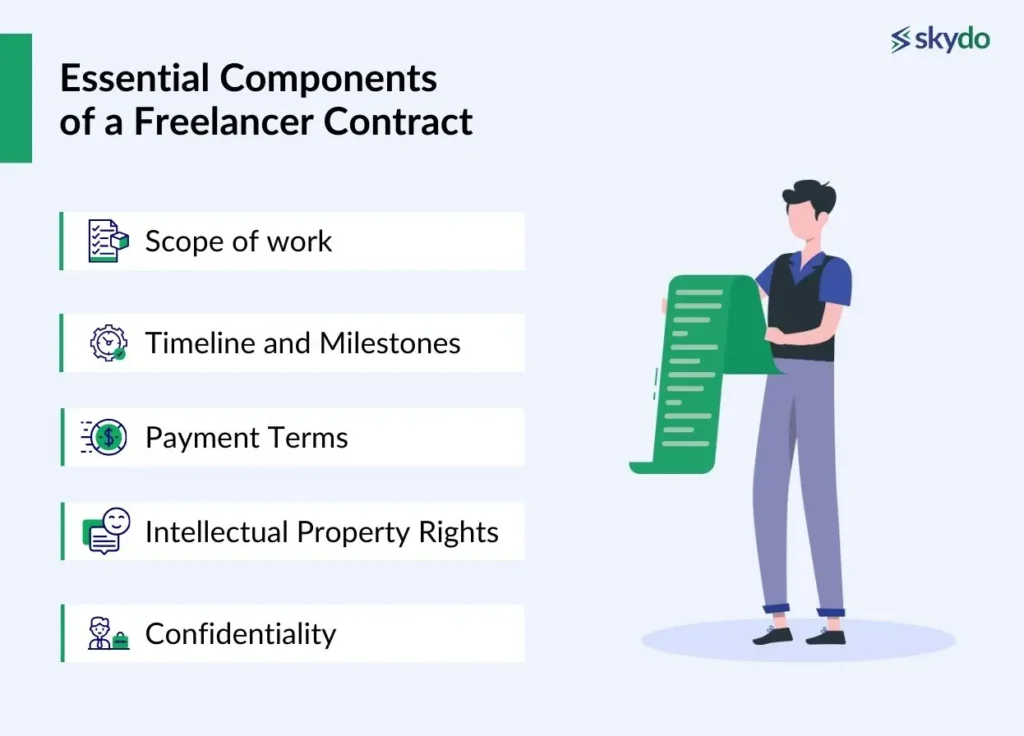
    The single most common freelance dispute isn’t about payment — it’s about what “the project” actually included. A scope clause should specify the deliverables, define the number of included revisions, and clearly list any exclusions. “Website redesign” is not a scope. “5 pages, 2 rounds of revisions, content upload not included” is.

    The short answer is simple: if it isn’t written down, the freelancer and the client will likely remember it differently.

    Add a change-order line — any request outside the listed scope needs written approval and a separate quote before work begins on it. This single sentence prevents most “can you also just add…” arguments from turning into unpaid extra work or a refused invoice.

    • List deliverables individually, not as a bundle
    • Name the exact number of revisions included
    • State explicitly what’s out of scope
    • Require written approval for any scope addition

    Payment Terms, TDS & GST: Where Money Fights Start

    Payment clauses fail founders in two ways: they’re either too vague to enforce, or they skip the tax details entirely. Let’s break this down. A proper payment clause needs the total fee, the schedule (say, 40% upfront and 60% on delivery), accepted payment methods, and a late-payment penalty — commonly 1.5–2% monthly interest on overdue invoices.

    Then there’s tax. If you’re paying a resident freelancer for professional services, you must typically deduct TDS (Tax Deducted at Source — the tax a business deducts before paying certain vendors) under Section 194J once payments exceed the threshold notified for the financial year. Check the current limit on the Income Tax Department portal before finalising the clause, as the government revises thresholds periodically.

    Separately, GST rules apply if the freelancer crosses the GST registration threshold. Your contract should state who is GST-registered. It should also explain how invoices will reflect GST. Confirm the current registration limits on the  GST portal.

    For example, if your contract doesn’t mention TDS, the freelancer may invoice you for the full amount and you may pay it in full. Months later, you could discover that the law required you to deduct tax before making the payment, creating a reconciliation headache for both sides.

    One line fixes this. Add the following clause: “Payments will be made after deducting applicable TDS under the Income Tax Act, 1961. The freelancer will provide a valid PAN for TDS purposes.”

    IP Ownership & Confidentiality: Who Owns the Work

    Most freelance disputes over intellectual property happen because founders assume ownership transfers automatically once they pay. It doesn’t. Your contract needs an explicit IP assignment clause stating that all rights in the work product transfer to the client upon full and final payment — not upon delivery, and not upon signing.

    Add a confidentiality clause covering any business data, product plans, or customer information the freelancer accesses during the project, and how long that obligation survives after the contract ends — typically one to three years.

    For technical freelancers, also include an IP indemnity clause. It ensures their work doesn’t infringe another person’s copyright or trademark, protecting you from legal liability if it does. If your work touches a registered mark or brand name, pairing this with a proper trademark registration closes the loop on ownership.

    Termination & Dispute Resolution: Your Exit Ramp

    What most founders miss until it’s too late: a contract with no exit clause traps both sides. Include a termination-for-convenience clause with a notice period (commonly 15–30 days), and specify what happens to work-in-progress and partial payments if either side ends the engagement early.

    For dispute resolution, name a mechanism upfront — negotiation first, then mediation or arbitration — and fix the jurisdiction (which city’s courts or arbitration seat applies). Skipping this doesn’t avoid disputes; it just means you’ll be arguing about where to argue, on top of the original disagreement.

    If your business is registered under a specific legal structure, make sure the entity name in the contract matches your incorporation documents exactly, since a mismatch can complicate enforcement later.

    Frequently Asked Questions

    Q: Is a freelance contract legally valid in India without a lawyer drafting it?

    A: Yes. Under the Indian Contract Act, 1872, an agreement is enforceable once it has free consent, lawful consideration, and a lawful object — a lawyer isn’t legally required to draft it. That said, for high-value or complex projects, a legal review helps catch gaps before they become disputes.

    Q: Can I sue a freelancer or client based only on WhatsApp or email messages?

    A: Possibly — Indian courts have held that a concluded contract can arise from correspondence alone, even without a signed document. However, email-only agreements usually lack payment terms, IP clauses, and a dispute mechanism, which makes proving your case slower and harder. A signed written agreement is the safer default.

    Q: Do I need to deduct TDS when paying an Indian freelancer?

    A: In most cases, yes — TDS applies to payments for professional services under Section 194J once you cross the threshold notified for the financial year. Confirm the current limit on the Income Tax Department portal before finalising your payment clause, since thresholds change periodically.

    Q: When does IP ownership transfer from the freelancer to my company?

    A: Only when your contract says so explicitly — ownership does not transfer automatically just because you paid. Most Indian freelance contracts state that all rights transfer to the client upon full and final payment, so this line needs to be written into the agreement, not assumed.

    Ready to get your freelance contracts dispute-proof?
    Lawizer’s experts handle contract drafting, GST registration, and MSME registration — fully online, starting at just ₹999. No CA visit needed.
    Get Your Freelance Contract Reviewed →

  • Why Every Indian Startup Needs a Strong Founder’s Agreement

    Why Every Indian Startup Needs a Strong Founder’s Agreement

    Introduction

    Starting a business is exciting and thrilling. It often begins with a powerful idea, a late-night conversation, or a shared dream between friends.

    In the early days, everything feels possible. Everyone is motivated. Everyone trusts each other.

    But while passion and trust are important, they are not enough to build a successful company. This is exactly where a founder’s agreement for startups becomes essential.

    Many Indian startups fail not because the idea was weak or the founders were not hardworking. They fail because the founders were not aligned.

    Misunderstandings, money disputes, unclear responsibilities, or ego clashes slowly damage the business. A strong founder’s agreement for startups can prevent these problems before they even begin.


    What Is a Founder’s Agreement for Startups?

    A founder’s agreement for startups is a legal document signed by co-founders at the early stage of the company. It clearly defines the relationship between the founders and sets expectations from day one.

    It usually answers key questions like:

    1. Who owns how much of the company?
    2. What are each founder’s roles and responsibilities?
    3. How will important decisions be made?
    4. What happens if a founder leaves?
    5. How will disputes be resolved?

    In simple words, it protects both the business and the people involved.

    In India, startups are commonly registered as a Private Limited Company or a Limited Liability Partnership. No matter the structure, having a founder’s agreement for startups is equally important.


    Why Is a Founder’s Agreement for Startups So Important in India?

    India’s startup ecosystem is growing rapidly. Cities like Bengaluru, Mumbai, and Hyderabad are becoming major startup hubs.

    With growth comes competition, investor pressure, and legal complexities. Here’s why every Indian startup needs a strong founder’s agreement for startups:

    1. It Prevents Future Conflicts

    In the beginning, no one thinks about worst-case scenarios. Everyone assumes things will work out smoothly.

    But what if:

    • One founder contributes more time than the others?
    • One founder wants to sell their shares?
    • One founder resigns after six months?

    Without a written founder’s agreement for startups, these situations can turn ugly. Disagreements become personal. The company suffers.

    A clear agreement sets expectations from day one. It reduces confusion and protects relationships.


    2. It Protects Equity and Ownership

    Equity is emotional. It represents ownership, control, and future wealth. Many founders split shares equally without discussing long-term contributions.

    But is equal always fair?

    One founder may bring the idea. Another may bring capital. Another may manage daily operations. A strong founder’s agreement for startups clearly defines:

    • The equity split
    • The vesting schedule (earning shares over time)
    • What happens to shares if someone exits

    Vesting is extremely important. It ensures that no founder walks away with a large percentage of ownership without contributing long-term value.


    3. Investors Expect It

    If you plan to raise funding, investors will almost always ask, “Do you have a founder’s agreement?” Investors look for stability.

    Many startups registered under Startup India later realise that investors carefully examine founder agreements before investing. A well-drafted founder’s agreement for startups builds trust, credibility, and confidence.


    4. It Clearly Defines Roles and Responsibilities

    Unclear roles are one of the biggest reasons startups fail.

    For example:

    • Who handles finance?
    • Who manages marketing?
    • Who makes the final business decisions?

    If two founders both believe they are the “CEO,” conflict is inevitable.

    A founder’s agreement for startups clearly defines:

    • Titles
    • Duties
    • Authority levels
    • Time commitment

    This clarity avoids overlapping responsibilities and unnecessary power struggles.


    5. It Covers Exit and Separation

    Not all partnerships last forever. Life changes. Priorities shift.

    A founder may want to:

    • Move abroad
    • Study further
    • Start another venture
    • Take a break

    A strong founder’s agreement for startups answers critical questions like:

    • Can a founder sell shares to outsiders?
    • Do other founders get the first right to buy those shares?
    • What happens in case of death or incapacity?

    Planning for exit does not mean you expect failure. It simply means you are being practical and prepared.


    6. It Protects Intellectual Property (IP)

    In startups, ideas are everything. Your app code, brand name, logo, designs, and product formula are all valuable intellectual property.

    Without a founder’s agreement for startups, confusion may arise about who owns what.

    A proper agreement clearly states that all intellectual property belongs to the company, not to individual founders.


    7. It Helps During Legal Disputes

    If disagreements escalate, the founder’s agreement becomes your strongest protection.

    It usually includes:

    • Dispute resolution methods
    • Arbitration clauses
    • Governing law (Indian law)

    This makes resolving conflicts faster, smoother, and less expensive.


    Why Many Indian Founders Ignore It

    Despite its importance, many founders delay drafting a founder’s agreement for startups because:

    • “We are friends.”
    • “We trust each other.”
    • “We will figure it out later.”
    • “Legal documents are expensive.”

    Money, pressure, investor expectations, and market competition can change dynamics. A written agreement does not show distrust. It shows professionalism and maturity.


    What Should a Strong Founder’s Agreement Include?

    For full protection, a founder’s agreement for startups should cover:

    1. Founder details
    2. Equity split
    3. Vesting schedule
    4. Roles and responsibilities
    5. Decision-making process
    6. Salary and compensation
    7. Confidentiality clauses
    8. Non-compete clauses
    9. Exit terms
    10. Dispute resolution mechanism

    It should always be drafted carefully, ideally with professional legal guidance.


    Conclusion

    Starting a business is like starting a journey. And no journey is smooth without a clear map.

    A founder’s agreement for startups is not just another legal formality. It is a protection shield. It protects friendships, ownership, attracts investors, and secures the future of the company.


    Frequently Asked Questions

    What is a Founder’s Agreement?

    A Founder’s Agreement is a legal document that defines the roles, responsibilities, and equity ownership of startup founders.

    Why is a Founder’s Agreement important?

    It prevents disputes among founders by clearly outlining responsibilities, ownership, and decision-making authority.

    When should startups create a Founder’s Agreement?

    Startups should ideally create a Founder’s Agreement at the time of company incorporation.

    What clauses are included in a Founder’s Agreement?

    Common clauses include equity distribution, vesting schedules, intellectual property ownership, founder roles, and exit terms.

    Does a Founder’s Agreement help in raising investment?

    Yes, investors prefer startups that have clear legal agreements between founders.

    What is founder equity vesting?

    Founder vesting means founders earn their equity gradually over time rather than receiving it immediately.

    Who owns intellectual property in a startup?

    A Founder’s Agreement ensures that intellectual property created by founders belongs to the company.

    Can a Founder’s Agreement resolve founder disputes?

    Yes, it provides dispute resolution mechanisms such as mediation or arbitration.