Trademark vs Copyright vs Patent: Key Differences
Trademark vs copyright vs patent is an important distinction for Indian founders and small-business owners who want to protect their brand, creative work, product design or invention. Although all three are forms of intellectual property protection, they protect different kinds of assets and give different legal rights.
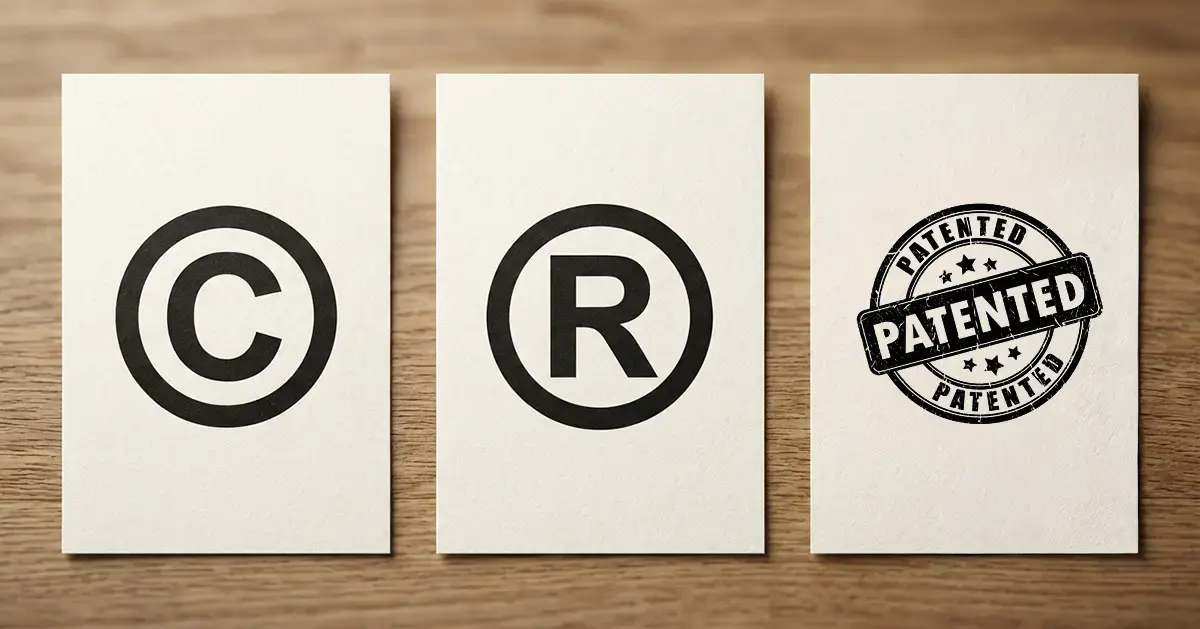
A trademark generally protects a distinctive sign used to identify and distinguish goods or services. Copyright protects original creative expression, such as writing, artwork, music, films and computer programs. A patent protects a qualifying invention that satisfies the legal requirements for patentability.
Understanding the difference before launching a product, building a brand or publicly disclosing an invention can help a business choose the right protection. In some cases, one business may need more than one form of intellectual property protection.
Trademark vs Copyright vs Patent: What Is the Difference?
The simplest way to understand the difference is to ask what exactly you are trying to protect.
- Trademark: Protects distinctive signs that identify and distinguish goods or services.
- Copyright: Protects original creative expression in qualifying works.
- Patent: Protects qualifying inventions that meet the requirements of patent law.
For example, if a startup creates a new brand name, the name may be considered for trademark protection. Its website articles, photographs, videos and original software may be protected by copyright if the statutory requirements are met. If the startup develops a genuinely new technical invention that satisfies patentability requirements, patent protection may also be relevant.
These rights are not interchangeable. The appropriate protection depends on the nature of the intellectual property, how it is used and the legal requirements applicable to it.
Trademark vs Copyright vs Patent in India
In India, trademarks are primarily governed by the Trade Marks Act, 1999. Copyright is governed by the Copyright Act, 1957, while patents are governed by the Patents Act, 1970.
The official IP India patent guidance explains the basic principles of patent protection. The official IP India trademark guidance provides information on trademarks and their renewal. For copyright matters, businesses can refer to the official Copyright Office website.
While these laws all fall within the broader field of intellectual property, their objectives are different. A trademark is closely connected with commercial source identification. Copyright is concerned with original expression. Patent law is concerned with qualifying inventions and the temporary exclusive rights granted to their owners.
What Does a Trademark Protect?
A trademark helps distinguish the goods or services of one business from those of another. Depending on the circumstances and applicable law, a trademark can include a word, name, logo, symbol, slogan, shape or other distinctive sign.
For a business, a trademark is closely connected to brand identity. Customers may recognise a company through its name, logo, tagline or other distinctive branding.
Examples of Assets That May Need Trademark Protection
- Business or brand names
- Logos and distinctive symbols
- Slogans and taglines
- Distinctive marks used in relation to goods or services
Trademark protection is connected to the goods or services for which the mark is registered. Choosing the appropriate class and describing the goods or services carefully are therefore important parts of a trademark application.
If you are preparing to launch a new brand, consider conducting a trademark search before investing heavily in packaging, advertising, websites and other brand assets.
Lawizer provides trademark registration services for businesses and founders looking to protect their brand identity.
What Does Copyright Protect?
Copyright protects original expression rather than an idea by itself. Under the Copyright Act, 1957, copyright can apply to original literary, dramatic, musical and artistic works, as well as cinematograph films and sound recordings.
The Copyright Office also recognises computer programs within the statutory category of literary works. This can be particularly relevant to technology businesses, software developers, agencies and digital businesses.
What Are Three Things That Can Be Copyrighted?
There are many categories of copyrightable works. Three straightforward examples are:
- Written content: Articles, books, reports and other original literary works.
- Visual works: Original artwork, photographs, drawings and other artistic works.
- Software: Computer programs and source code can qualify for copyright protection as literary works.
Other examples include music, films and sound recordings, subject to the requirements of the Copyright Act.
Copyright protection generally arises automatically when an original work is created. Registration is not a prerequisite for copyright to exist. However, registration can create an official record and may provide useful evidence in disputes concerning ownership.
You can learn more about copyright registration through Lawizer.
What Does a Patent Protect?
A patent protects a qualifying invention. Under Indian patent law, an invention generally needs to satisfy requirements such as novelty, inventive step and industrial applicability, while also falling within patentable subject matter under the Patents Act.
IP India describes a patent as an exclusive right granted for an invention. In India, the term of a patent is generally twenty years from the date of filing, subject to the provisions of the Patents Act and applicable renewal requirements.
Examples of Things That May Be Considered for Patent Protection
- A new technical product
- A qualifying new manufacturing process
- A technical improvement that satisfies patentability requirements
- A technological solution to a technical problem
Not every new idea qualifies for a patent. Patentability has to be assessed against the statutory requirements and exclusions under Indian patent law.
Founders should also be careful about publicly disclosing a potentially patentable invention before obtaining appropriate advice. The timing of disclosure can be important to patent strategy.
Trademark vs Copyright vs Patent: Comparison Table
| Feature | Trademark | Copyright | Patent |
|---|---|---|---|
| Main purpose | Protects brand identifiers | Protects original creative expression | Protects qualifying inventions |
| Typical examples | Brand name, logo, slogan | Writing, artwork, music, films, software | New product or technical process |
| Registration | Registration provides statutory trademark rights | Copyright exists automatically; registration is available | Patent rights arise through the statutory grant process |
| Indian law | Trade Marks Act, 1999 | Copyright Act, 1957 | Patents Act, 1970 |
| General duration | 10 years per registration period, renewable | Varies according to the type of work | Generally 20 years from filing |
| Best suited for | Brand identity | Creative content and expression | Qualifying technical inventions |
The exact scope and duration of protection can depend on the asset and applicable statutory provisions. The table is therefore a practical overview rather than a substitute for legal advice.
Is Coca-Cola a Trademark or Copyright?
A brand such as Coca-Cola illustrates why different intellectual property rights should not be confused.
The brand name and distinctive branding are primarily relevant to trademark protection. At the same time, particular creative materials associated with a brand, such as original advertising artwork, photographs or videos, may attract copyright protection if the statutory requirements are satisfied.
This means that one business can have several forms of intellectual property protection covering different assets. The trademark does not automatically protect every creative work produced by the business.
What Is the Most Famous Trademark?
There is no single legally defined “most famous trademark”. Many international and Indian businesses have highly recognisable marks.
For a founder, however, fame is not the main issue. A more important question is whether the proposed mark is distinctive, available for registration and appropriate for the goods or services you provide.
A strong trademark strategy begins before a brand becomes widely known. Searching for conflicting marks before filing can help identify potential problems at an early stage.
Is McDonald’s a Registered Trademark?
McDonald’s is a globally recognised brand and its name and other brand elements are associated with trademark protection in multiple jurisdictions.
However, trademark protection is jurisdiction-specific. A business should not assume that a mark is protected everywhere simply because it is famous internationally. Registration details, classes and rights can differ between countries.
For an Indian business, the relevant question is whether the proposed mark is protected or available under Indian trademark law and in the relevant classes.
Do I Need Copyright If I Have a Trademark?
Possibly. Trademark and copyright protect different things.
Suppose a startup creates a logo. The logo may have relevance under both trademark and copyright law, depending on the circumstances. Trademark protection can help protect the logo as a brand identifier, while copyright may protect qualifying original artistic expression in the logo.
Similarly, a business name may be relevant to trademark law, while the website articles, photographs, illustrations and software created by the business may raise separate copyright issues.
Therefore, having a trademark does not automatically protect all of the company’s creative content.
Can Someone Steal My Logo If It Is Not Trademarked?
Trademark registration is not the only legal issue that can arise when someone copies a logo. Depending on the facts, a logo may also involve copyright, passing off or other legal rights.
However, failing to register a valuable brand asset can make enforcement more complicated. Trademark registration can provide statutory rights and evidence of the registered proprietor’s rights.
Before launching an important brand, businesses should consider both trademark availability and ownership of the underlying creative work.
Which Is Cheaper: Trademark or Copyright?
There is no single answer because costs depend on the type of protection, applicant category, number of classes or works and other factors.
Copyright protection itself does not require registration to come into existence. A business may nevertheless choose to register important works for evidentiary and commercial reasons.
Trademark registration involves an application and prescribed government fees. Professional service fees may also apply if an applicant uses a lawyer, agent or legal service provider.
Instead of choosing purely on price, founders should first identify the asset they are trying to protect. The least expensive option is not necessarily the appropriate form of protection.
How Do You File for Copyright in India?
Copyright registration applications can be submitted through the prescribed process of the Copyright Office. The Copyright Office provides online filing facilities and requires applicants to provide relevant application details and supporting material.
For example, a computer program has specific requirements concerning the work submitted for registration. The Copyright Office provides guidance for registration of computer programs as literary works.
The process broadly involves:
- Identifying the work and the relevant category.
- Preparing the prescribed application.
- Providing the required details and supporting documents.
- Paying the applicable statutory fee.
- Responding to any objection or procedural issue, if applicable.
For current forms, procedures and fees, applicants should verify the latest information on the official Copyright Office website.
How Much Does It Cost to Get a Trademark?
Trademark registration costs are not identical for every applicant. Government fees depend on factors such as the applicant category and number of classes involved.
Professional service fees may also apply if an applicant engages an attorney, agent or legal service provider.
Because government fees and procedures can change, founders should verify the current fee schedule before filing. Lawizer’s trademark registration service can assist with the filing process and related documentation.
Can You Lose Copyright If You Do Not Protect It?
Copyright does not generally disappear simply because the owner has not registered the work. Under Indian law, copyright protection arises automatically when an original work satisfies the statutory requirements.
However, failing to document ownership can create practical difficulties when a dispute arises. Businesses should maintain records showing when works were created, who created them and how ownership was transferred or assigned.
For businesses working with employees, freelancers, designers or agencies, written agreements can also be important for establishing ownership and permitted use of intellectual property.
What Are Three Things Not Protected by Copyright?
Copyright protects expression, not every form of information or idea. Examples of material that generally falls outside copyright protection include:
- Ideas by themselves: A general idea or concept is not the same as protected expression.
- Methods or procedures: Copyright does not ordinarily give a monopoly over a method of operation.
- Short names and titles by themselves: A short name or phrase may not qualify for copyright protection merely because it is written down.
The Copyright Office explains that copyright does not protect ideas, procedures, methods of operation or mathematical concepts as such. Other forms of intellectual property protection may sometimes be relevant depending on the circumstances.
What Are Five Things That Can Be Copyrighted?
Five common examples of works that may qualify for copyright protection in India are:
- Original articles and written content
- Original photographs and artwork
- Music and musical works
- Films and videos
- Computer programs and software code
Copyright protection depends on the statutory requirements and the nature of the particular work. Simply putting information into a document does not automatically make every element of that document copyrightable.
Can You Protect the Same Business Asset With More Than One IP Right?
Yes. Intellectual property rights can overlap in some situations.
Consider a technology startup that develops a smart device. Its brand name may be protected through trademark law. Original website content, photographs and software code may be protected by copyright. A qualifying technical invention may be considered for patent protection. The visual appearance of a product may also raise industrial design considerations.
The key point is that intellectual property protection should be asset-specific. Instead of asking which single registration protects the entire business, founders should identify each important asset and consider the legal protection that may apply.
Which IP Protection Does Your Business Need?
- Brand name or logo – Trademark
- Article, artwork, video or software – Copyright
- New technical invention – Patent
- Multiple assets – More than one IP right may apply
This simple framework can help founders begin an intellectual property audit. The correct protection may depend on the asset, how it is used, whether it has already been disclosed and the commercial objectives of the business.
How Should a Startup Protect Its Intellectual Property?
IP protection should not begin only when a dispute arises. Founders can take practical steps from the early stages of the business.
1. Identify Your IP Assets
Make a list of your brand names, logos, content, software, designs, inventions, domain names and confidential information.
This helps you identify which assets may need registration and which require contractual or confidentiality protection.
2. Keep Ownership Clear
If founders, employees or freelancers create intellectual property, ownership should be documented appropriately.
Businesses should avoid assuming that paying a freelancer automatically resolves every ownership issue. Written agreements should clearly address ownership, licences, permitted use and delivery of source files where relevant.
3. Search Before You File
For trademarks and patents, searches can help identify existing rights and potential conflicts before substantial money is spent on a filing or product launch.
4. Avoid Unnecessary Public Disclosure
If an invention may be patentable, founders should obtain appropriate advice before publicly disclosing technical details. Patent strategy can be affected by what has already been made public.
5. Maintain Evidence
Keep dated drafts, source files, invoices, contracts, development records and other evidence showing how and when intellectual property was created and who owns it.
Trademark vs Copyright vs Patent: Which One Should You Choose?
There is no universal answer. The right choice depends on what your business has created.
If your primary asset is a brand identity, trademark protection is likely to be important. If your business creates original content, artwork, photographs, music, films or software, copyright may be relevant. If your business has developed a new technical invention, patent protection may need to be considered.
Many businesses need a combination rather than just one form of protection.
For example, a software startup may need trademark protection for its product name, copyright protection for its source code and website content, and potentially patent advice if it has developed a patentable technical invention.
Frequently Asked Questions
Is trademark the same as copyright?
No. A trademark protects a distinctive identifier used to distinguish goods or services, while copyright protects qualifying original creative expression.
Is a patent the same as a trademark?
No. A patent protects qualifying inventions. A trademark protects distinctive signs associated with goods or services.
Is copyright automatic in India?
Generally, yes. Copyright protection arises automatically when an original work satisfies the statutory requirements. Registration is available but is not a prerequisite for copyright to exist.
Do I need to register my trademark?
If you want the statutory benefits associated with registered trademark rights, registration is important. Unregistered marks may have other legal protection in appropriate circumstances, but the nature of those rights differs from registered trademark protection.
Can software be copyrighted in India?
Yes. Computer programs are included within the definition of literary work under the Copyright Act, 1957. The Copyright Office provides a registration route for computer programs.
Can an idea be copyrighted?
Copyright generally protects the expression of an idea, not the idea itself. Other forms of intellectual property protection may be relevant depending on the nature of the idea and the circumstances.
Can one product have trademark, copyright and patent protection?
Yes, potentially. Different aspects of the same product or business can qualify for different forms of intellectual property protection.
Which is better for a startup: trademark, copyright or patent?
It depends on the startup’s assets. A brand-focused business may prioritise trademark protection. A content or software business may need copyright protection. A technology business developing a qualifying invention may need patent advice as well.
Protect Your Business With the Right IP Strategy
Understanding trademark vs copyright vs patent is the first step. The next step is identifying which intellectual property assets matter most to your business and choosing protection accordingly.
Lawizer can assist founders and businesses with intellectual property-related services, including trademark registration and copyright registration.
You can also read Lawizer’s guide on trademark registration in India, including cost, process and timeline and its guide to filing a trademark objection reply in India.
If your business is unsure whether it needs trademark, copyright, patent or a combination of protections, getting advice at an early stage can help prevent avoidable disputes and protect valuable business assets.
Need help protecting your intellectual property? Consult Lawizer for practical legal support tailored to your business.