
Tag: taxation

  • Cryptocurrency and Tax in India: The Definitive 2026 Guide

    Cryptocurrency and Tax in India: The Definitive 2026 Guide

    Introduction

    The Indian crypto landscape has traveled a long road from the uncertainty of 2018 to the structured—yet stringent—regulatory framework of 2026.

    As Virtual Digital Assets (VDAs) become a mainstay in the portfolios of Indian retail investors and institutional players alike, staying compliant is no longer just about avoiding penalties; it is about protecting your digital wealth.

    With the Union Budget 2026 introducing refined definitions for Decentralized Finance (DeFi) and cross-border transactions, the tax authorities are watching more closely than ever.

    This guide breaks down everything you need to know about navigating crypto taxes in India this year.


    The Core Tax Architecture: The 30% Rule

    Since the introduction of Section 115BBH in the Income Tax Act, the fundamental rule for crypto taxation in India has remained consistent.

    The Flat Tax Rate

    Income from the transfer of any Virtual Digital Asset is taxed at a flat rate of 30%, regardless of your income tax slab.

    • No Deductions: Only the cost of acquisition is allowed. Expenses like electricity or platform fees cannot be claimed.
    • No Loss Set-off: Losses from one crypto asset cannot be adjusted against gains from another.

    The 1% TDS Mandate

    A 1% Tax Deducted at Source (TDS) under Section 194S is applicable on transactions exceeding ₹50,000 annually for specified persons.


    New for 2026: The Global Reporting Standard

    India has integrated with the Crypto-Asset Reporting Framework (CARF).

    The Income Tax Department now receives transaction data from international exchanges.

    This means offshore holdings are no longer invisible to regulators, and global compliance is now mandatory.


    Classifying Different Crypto Activities

    Taxation varies depending on how you engage with crypto assets:

    • Staking & Yield Farming: Taxed as “Income from Other Sources” at the time of receipt.
    • Airdrops & Gifts: Taxable if value exceeds ₹50,000.
    • Mining: Cost of acquisition is considered zero, making full sale value taxable.

    Why Compliance is Getting Complex: The PMLA Factor

    Crypto transactions now fall under the Prevention of Money Laundering Act (PMLA).

    Investors must maintain detailed records, including wallet addresses and transaction logs, for at least six years.


    How Lawizer Simplifies Crypto Compliance
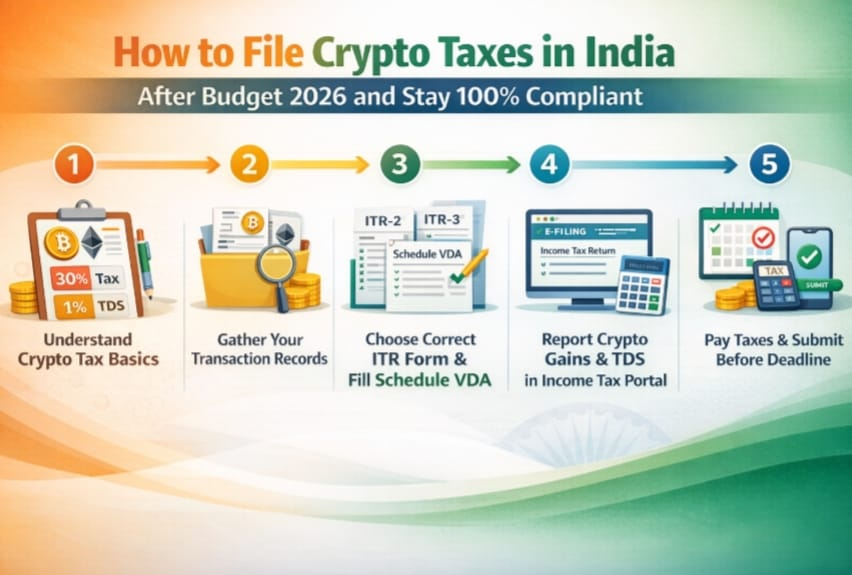
    Tracking crypto transactions across exchanges and DeFi platforms can be overwhelming.

    Lawizer provides a streamlined solution for managing crypto tax compliance and audit readiness.

    Why Choose Lawizer?

    1. Automated Audit Trails: Generates tax-ready reports based on latest compliance rules.
    2. PMLA Compliance Support: Ensures AML and KYC adherence.
    3. Legal Review: Helps ensure tokens and smart contracts align with regulatory guidelines.

    Filing Your Returns: ITR-2 and ITR-3

    When filing your Income Tax Returns (AY 2026–27), ensure accurate reporting:

    • Schedule VDA: Report acquisition and transfer details.
    • Schedule FA: Mandatory for foreign-held crypto assets.

    Failure to disclose foreign assets may attract penalties up to ₹10 lakh under applicable laws.


    The Road Ahead: Regulation vs Innovation

    India is moving toward a “Regulate to Protect” approach under global frameworks like the G20 coordination model.

    The Reserve Bank of India (RBI) is also advancing its Digital Rupee initiative, which will further define the future of digital assets.


    Conclusion: Don’t Trade in the Dark

    In 2026, transparency is essential for crypto investors. Compliance is no longer optional—it is critical for protecting your assets.

    Using platforms like Lawizer ensures that your crypto investments remain legally secure and audit-ready.


    Frequently Asked Questions

    Is the 30% tax on crypto profits still mandatory in 2026?

    A: Yes. Under Section 115BBH, crypto income is taxed at 30% plus surcharge and cess.

    Can I offset losses between different cryptocurrencies?

    A: No. Losses cannot be set off against gains from other VDAs.

    What is the purpose of 1% TDS?

    A: It helps the government track transactions and can be claimed as tax credit.

    Do I need to report crypto held on foreign exchanges?

    A: Yes. It must be disclosed in Schedule FA to avoid heavy penalties.

    How is staking income taxed?

    A: It is taxed at receipt as income and again at sale under capital gains rules.

    Are crypto-to-crypto swaps taxable?

    A: Yes. They are treated as transfers and taxed accordingly.

  • CORPORATE TAX FILING 101: A CHECKLIST FOR FILING ITR 6 FOR PRIVATE LIMITED COMPANIES

    CORPORATE TAX FILING 101: A CHECKLIST FOR FILING ITR 6 FOR PRIVATE LIMITED COMPANIES

    This blog will cover the basic requirements for filing ITR-6 , Importance of
    Corporate tax return India , ITR-6 Due date.

    ITR 6

    Introduction: Purpose Of Filing Under ITR-6:

    For filing under ITR-6 for the income tax return , it is especially done for
    companies which are incorporated under the Companies Act , 2013.

    This ensures not only reporting of income , deduction , taxes and transaction Filing an ITR-6 helps in maintaining the company whether is private or public, it keeps under a obligations effectively and systematically.

    Eligibility Criteria Of Filing ITR-6:

    The companies that are registered under the Companies Act 2013 should file
    ITR-6 . It includes Domestic Companies , Foreign Companies, Partnership Firms.

    Structure of the filing the ITR-6?

    • The Income Tax Department advices that are two parts and several
      schedules.
    • As a sequence wise they can file out a form by Part A , Schedules,
      Part B and Verification.

    How To File ITR-6 Form?

    This is generally done through compulsory electronically under digital signature to the income tax department.

    Filing Of ITR-6 Due Date:

    The due date for filing an income tax return is to be maintained by the is a assessee partner in a firm then the accounts is to be audited by 31st of October of the Assessment year.

    Benefits Of Filing In ITR-6?

    • It enhances and ensures transparency.
    • The collection of documents is required to be maintained for record
      purpose and tax audits statements.
    • It minimizes deduction and avoid penalties and interest charges.
    ITR 6

    Conclusion:

    The criteria and aspect of ITR-6 is detailed oriented and is only
    applicable to the companies.

    This helps companies in avoid penalties, interest and avoid tax compliance issue from tax authorities.

    Corporate Tax Doesn’t Have to Be Taxing. Private Limited Companies require precision—from balance sheets to audit reports.

    Don’t navigate the complex maze of corporate tax laws alone.

    Our team ensures your ITR-6 is filed with 100% accuracy and complete statutory compliance, letting you focus on growing your company.

    [Secure Your Corporate Tax Filing Services Now]

    Sources:

  • ITR-5 FILING GUIDE FOR PARTNERSHIP FIRMS AND LLPs: AVOID COMMON MISTAKES

    ITR-5 FILING GUIDE FOR PARTNERSHIP FIRMS AND LLPs: AVOID COMMON MISTAKES

    Introduction

    Many business entities such as partnership firms, Limited Liability Partnerships (LLPs), and associations are required to file their income tax returns every year. For these entities, the relevant tax return form is ITR-5.

    The procedure of filing ITR-5 is an important compliance requirement under the Income Tax Act. It helps businesses report their income, claim deductions, and ensure proper tax compliance with the Income Tax Department.

    Understanding the process of filing ITR-5, the due date, tax audit requirements, and applicable tax rates for partnership firms is essential for avoiding penalties and maintaining financial transparency.

    This guide explains the procedure of ITR-5 filing, LLP income tax returns, tax audit requirements, and the due date for filing ITR-5.


    What Is ITR-5?

    ITR-5 is the income tax return form used by certain business entities such as partnership firms, LLPs, and associations of persons.

    The form is designed to capture detailed financial information including business income, capital gains, deductions, and tax liabilities.

    ITR-5 is filed electronically through the Income Tax Department’s e-filing portal.


    Who Can File ITR-5?

    The following entities are eligible to file ITR-5:

    • Partnership Firms
    • Limited Liability Partnerships (LLPs)
    • Association of Persons (AOPs)
    • Body of Individuals (BOIs)
    • Co-operative Societies
    • Local Authorities

    However, individuals, Hindu Undivided Families (HUFs), and companies cannot use this form.


    Structure of the ITR-5 Form

    The ITR-5 form is comprehensive and contains several sections to report financial information accurately.

    The form is divided into two main parts:

    • Part A – General Information
    • Part B – Computation of Total Income and Tax Liability

    In addition, the form contains nearly 40 schedules used to report specific financial details such as capital gains, business income, deductions, and taxes paid.


    Procedure for Filing ITR-5

    The ITR-5 form must be filed electronically through the Income Tax Department’s e-filing portal.

    The return can be filed in the following ways:

    • Submitting the return electronically using a Digital Signature Certificate (DSC)
    • Uploading the return electronically and verifying it through e-verification methods

    After filing the return, the taxpayer must complete e-verification within 30 days of submission.


    Changes in ITR-5 Form (AY 2025-26)

    The Income Tax Department has introduced certain updates to the ITR-5 form for recent assessment years.

    • New reporting fields for high-value financial transactions exceeding ₹50 crore
    • Disclosure requirements for payments to Micro and Small Enterprises under Section 43B(h)
    • Additional reporting related to capital gains and specified securities

    These changes are intended to increase transparency and ensure proper reporting of financial transactions.


    Partnership Firm Tax Rate

    For the Assessment Year (AY) 2026-27, partnership firms including LLPs are taxed at a flat rate of 30% on their taxable income.

    In addition to this tax rate, surcharge and health & education cess may also apply depending on the income level.


    Tax Audit for Partnership Firms

    A tax audit is required to ensure that businesses maintain proper books of accounts and comply with the provisions of the Income Tax Act.

    Under Section 44AB, a tax audit becomes mandatory when the business turnover exceeds the prescribed limits.

    The audit helps verify:

    • Accuracy of financial statements
    • Proper maintenance of accounting records
    • Correct reporting of income and deductions
    • Compliance with tax regulations

    A tax audit also helps detect errors, irregularities, and potential financial discrepancies in the accounting records.


    Due Date for Filing ITR-5

    The due date for filing ITR-5 depends on whether the entity is subject to a tax audit.

    • 31 July – For entities not requiring a tax audit
    • 31 October – For entities requiring a tax audit

    Failing to file the return before the due date may lead to penalties and interest under the Income Tax Act.


    Conclusion

    Filing ITR-5 is a crucial compliance requirement for partnership firms, LLPs, and other eligible entities. It ensures that businesses properly report their income and comply with tax regulations.

    Timely filing of ITR-5, along with maintaining proper accounting records and completing tax audits when required, helps businesses avoid penalties and maintain financial transparency.

    Understanding the procedure of ITR-5 filing and staying updated with changes in tax laws allows firms to remain compliant and manage their finances effectively.


    Frequently Asked Questions

    Who cannot file ITR-5?

    Individuals, Hindu Undivided Families (HUFs), companies, and entities required to file ITR-7 cannot file ITR-5.

    Is tax audit applicable for ITR-5?

    Yes. A tax audit is required if the business turnover exceeds the limits specified under Section 44AB of the Income Tax Act.

    Is it mandatory for LLPs to file ITR-5?

    Yes. Limited Liability Partnerships (LLPs) are required to file their income tax return using the ITR-5 form.

    What is the time limit for e-verification of ITR-5?

    The return must be e-verified within 30 days of filing.


    Sources