This guide explains how logo trademark registration works in India, who can apply, the documents and government fees involved, how long the process can take, when you can use the TM or ® symbols, and the common mistakes businesses should avoid.
What Is Logo Trademark Registration?
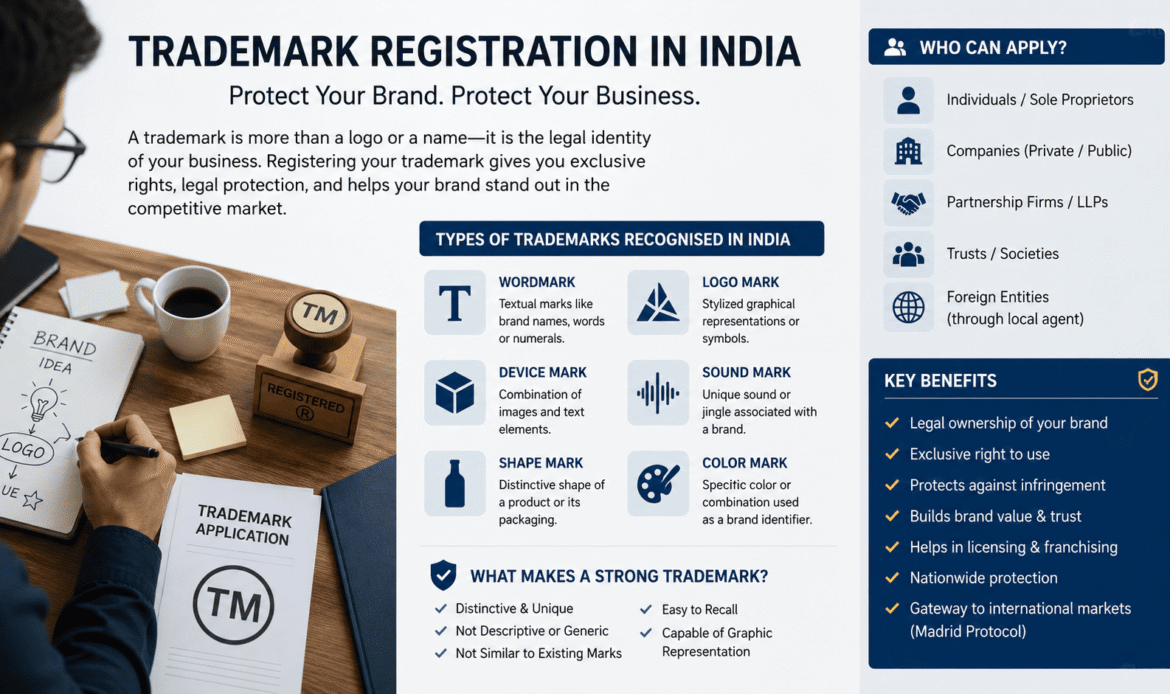
A logo can function as a trademark when it helps distinguish the goods or services of one business from those of another. In trademark terminology, a logo is commonly treated as a device or artistic mark.
Registration gives the proprietor statutory rights in the registered mark for the relevant goods or services, subject to the Trade Marks Act, 1999 and the limitations recorded on the Register.
It is important to understand that registration does not mean you own every similar design, word or image in every industry. Trademark protection is connected to the mark and the goods or services covered by the application.
For a broader explanation of trademark protection, read Lawizer’s guide to trademark registration in India.
Can a Logo Be Trademarked?
Yes. A distinctive logo can be registered as a trademark if it satisfies the legal requirements for registration.
The proposed logo should not create prohibited conflicts with earlier trademarks or fall within grounds for refusal under the law. Sections 9 and 11 of the Trade Marks Act are particularly relevant when assessing whether a proposed mark can be registered.
A proper trademark search should therefore be completed before filing. The search should consider more than an identical image. Similarity in appearance, sound, meaning and the commercial relationship between goods or services can also matter.
Logo Trademark vs Word Mark
A word mark generally protects the word or words themselves, while a logo or device mark protects the particular visual representation submitted for registration.
If a business has both a valuable brand name and a distinctive logo, it may need to consider protection for both. The appropriate filing strategy depends on what the business actually wants to protect and how the brand is being used.
Logo Trademark Registration in India: Step-by-Step Process
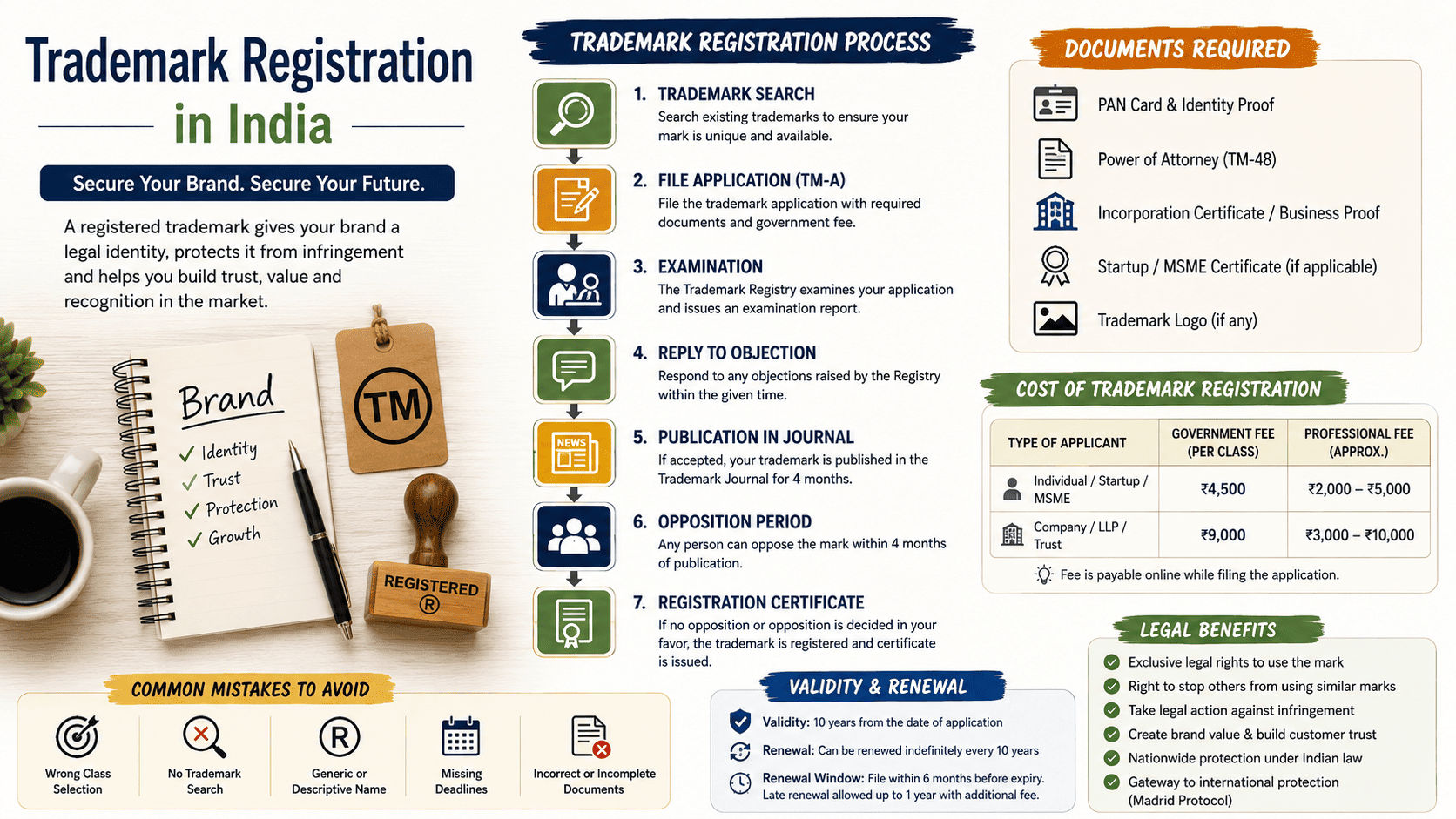
The Trade Marks Registry follows a structured process. The exact experience can vary depending on the mark, the class selected, examination objections and whether a third party opposes the application.
1. Finalise Your Logo
Before filing, decide which version of the logo you intend to use as your brand identifier.
Make sure the business has the necessary rights to use the artwork. If a freelancer, designer or agency created the logo, review the relevant agreement and ownership terms rather than assuming that payment automatically settles every intellectual-property issue.
If the logo is likely to change substantially soon, consider whether filing immediately for an old version is commercially sensible.
2. Conduct a Trademark Search
A trademark search is one of the most important steps before filing. Checking existing trademarks can help identify potential conflicts before you spend time and money on an application.
Do not search only for an exact copy of your logo. Look for potentially conflicting marks that are:
- Visually similar
- Phonetically similar where words are involved
- Conceptually similar
- Used for related goods or services
- Already registered or pending
For more background, see Lawizer’s guide on how to protect your brand name in India.
3. Select the Correct Trademark Class
Trademark applications are filed for specified goods or services. India follows the Nice Classification system, which contains 45 classes: Classes 1 to 34 generally cover goods and Classes 35 to 45 cover services.
The correct class depends on what your business actually sells or provides. A clothing business, restaurant, software company and consulting firm may require different classes.
Choosing a class merely because a competitor has used it can be a mistake. Your classification should reflect your own commercial activities.
4. Prepare the Application and Documents
The exact documents can vary according to the applicant and the claims made in the application. Typical information includes:
- Applicant’s name and address
- Applicant’s legal status
- A clear representation of the logo
- Goods or services covered by the application
- Relevant trademark class or classes
- Details regarding proposed use or prior use
- Supporting evidence where a prior-use claim is made
- Supporting documents for an applicable startup or small-enterprise fee category
- Authorisation documents where an agent or attorney files the application
Under the Trade Marks Rules, an application claiming prior use generally requires an affidavit and supporting documents concerning that use. Do not make a prior-use claim unless you can properly support it.
5. File Form TM-A
The standard application for registration of a trademark is made using Form TM-A. The application identifies the applicant, the mark and the goods or services for which registration is sought.
Applications can be filed electronically through the official IP India system. Once filed, the application receives an application number that can be used to monitor its progress.
For the latest official forms and fees, check the IP India trademark forms and official fees page.
6. Examination by the Trademark Registry
Filing an application does not mean the logo is automatically registered. The Registry examines the application and may raise objections.
Objections may relate to issues such as lack of distinctiveness, descriptiveness or similarity with an earlier trademark.
An examination objection is not the same as a final refusal. The applicant may need to file a response and, depending on the circumstances, attend a hearing.
If your application is objected to, Lawizer also provides guidance on responding to a trademark objection.
7. Publication and Opposition
If the application progresses through examination, it may be advertised in the Trade Marks Journal. This gives third parties an opportunity to oppose the application.
Under Rule 42 of the Trade Marks Rules, 2017, a notice of opposition is generally filed within four months from the date of publication or republication. An opposition is therefore different from an examination objection because it is initiated by a third party.
If an opposition is filed, the matter can involve a counterstatement, evidence and hearings. The timeline can consequently become considerably longer.
8. Registration and Certificate
If the application successfully completes the required stages and no successful opposition prevents registration, the Registrar can enter the mark on the Register and issue the registration certificate.
Once the logo is actually registered, the proprietor can use the ® symbol in connection with the registered mark, subject to the scope of the registration.
Can I Do Logo Trademark Registration Myself?
Yes. An eligible applicant can generally file a trademark application without hiring a lawyer or trademark agent.
Self-filing may be practical when the application is straightforward, the logo is clearly distinctive, the class is easy to identify and there are no complicated prior-use or ownership issues.
Professional assistance can become more useful when:
- A similar earlier trademark has been identified.
- The business operates across several classes.
- Prior use needs to be established.
- The application receives an examination objection.
- A third party files an opposition.
- Ownership or assignment issues are involved.
The important point is that using professional assistance does not guarantee registration. The strength and registrability of the mark remain central to the outcome.
How Much Does Logo Trademark Registration Cost in India?
The government filing fee depends on the applicant category, filing method, number of classes and number of marks.
For an online TM-A application, the current official government fee is:
- ₹4,500 per class per mark for an individual, startup or small enterprise.
- ₹9,000 per class per mark for other applicants.
The corresponding physical filing fees are ₹5,000 and ₹10,000 respectively. These are government fees and do not include professional or facilitation charges.
If you file in more than one class, the applicable fee is calculated for each class and mark. Always verify the current fee schedule before payment because official fees can change.
Eligible startups and small enterprises may also qualify for the applicable reduced government fee category, subject to the required documentation.
You can also compare the registration journey and costs in Lawizer’s trademark registration cost, process and timeline guide.
Is a GST Number Required for Trademark Registration?
A GST registration is not a general prerequisite for filing a trademark application. Trademark registration and GST registration are separate legal processes.
Whether your business needs GST registration depends on the GST law and facts such as turnover, nature of supplies and other applicable conditions.
If you are also setting up your tax compliance, you can explore Lawizer’s GST registration service.
How Long Does Logo Trademark Registration Take?
There is no single guaranteed number of days for completing a trademark registration in India.
A straightforward application may move through the Registry without major complications. An application facing objections, hearings or third-party opposition can take substantially longer.
The timeline can be affected by:
- Examination of the application
- Examination objections
- Responses and hearings
- Publication in the Trade Marks Journal
- Third-party opposition
- Registry processing and procedural requirements
Any estimated timeline should therefore be treated as indicative rather than guaranteed.
Can I Use TM on My Logo?
The ™ symbol is commonly used to indicate that a business is claiming a mark as its trademark. Registration is not required simply to use the TM symbol.
However, TM does not mean that the mark has been registered. A pending application and a registered trademark are different legal statuses.
Can I Put TM on My Logo Without Registering?
Generally, the TM symbol can be used to indicate a claimed trademark even when registration has not been completed.
The important distinction is between claiming a mark and falsely representing it as registered. Section 107 of the Trade Marks Act addresses false representations that an unregistered mark is registered.
Therefore, do not use the ® symbol merely because a trademark application has been filed.
Can I Use a Logo Without Registration?
Yes. A business can use a logo without first obtaining trademark registration.
However, using a logo and obtaining registered trademark protection are not the same thing. Registration provides statutory rights associated with the registered mark, while unregistered marks may require reliance on other legal remedies depending on the circumstances.
For a business that expects to invest significantly in advertising, packaging, websites, marketplaces or social media, early trademark planning can reduce the risk of discovering a serious brand conflict after substantial investment.
What Happens If My Logo Is Not Trademarked?
An unregistered logo is not automatically free for others to copy. Depending on the circumstances, other areas of law, including copyright or the common-law action of passing off, may become relevant.
However, registered trademark protection can provide a stronger statutory framework for enforcing rights in the registered mark.
There is also a commercial risk. If another business adopts a confusingly similar logo and obtains registration or develops earlier rights, your ability to continue using your branding may become more complicated.
This is why founders should consider trademark clearance before investing heavily in a new brand.
Who Is Eligible to Register a Logo Trademark?
You do not necessarily need a private limited company to register a trademark. An eligible person claiming to be the proprietor of a trademark can apply for registration.
Depending on the circumstances, applicants can include:
- Individuals and freelancers
- Sole proprietors
- Startups
- Small enterprises
- Partnership firms
- LLPs
- Private companies
- Public companies
- Other eligible entities
If you are still deciding on your business structure, Lawizer also provides Private Limited Company registration and LLP registration services.
What Are the Common Logo Trademark Registration Mistakes?
1. Filing Without a Trademark Search
A logo may look unique but still be confusingly similar to an earlier mark. A proper search can identify potential problems before filing.
2. Choosing the Wrong Class
Trademark protection is linked to the goods or services covered by the registration. Selecting the wrong class can leave an important part of your business inadequately protected.
3. Using a Logo That Is Too Similar to an Existing Mark
Changing a colour, font or small design element does not necessarily remove the risk of conflict. Similarity must be assessed on the facts of the particular case.
4. Claiming Prior Use Without Evidence
If you claim that the logo was used before the application date, the relevant rules require supporting material. An unsupported claim can create avoidable complications.
5. Ignoring an Examination Report
Filing the application is not the end of the process. Applicants should monitor the application and respond to Registry communications within the applicable deadlines.
6. Assuming Company Registration Protects the Logo
Company incorporation and trademark registration protect different things. Registering a company does not automatically register its logo as a trademark.
7. Using ® Before Registration
The ® symbol should not be used to represent an unregistered mark as registered. Use it only after the relevant trademark has actually been registered.
8. Forgetting About Ownership
If an outside designer created the logo, keep written documentation showing who owns the relevant rights and what rights have been transferred or licensed.
What Are the Advantages and Disadvantages of a Trademark?
Advantages of Registering a Logo
- Provides statutory trademark rights in the registered mark.
- Helps establish the registered proprietor’s rights.
- Can strengthen enforcement against infringement.
- Supports long-term brand building.
- Can become a valuable intellectual-property asset.
- Can support licensing, assignment and franchising arrangements.
Limitations and Disadvantages
- Government and professional costs may apply.
- The application can face examination objections.
- Third parties can oppose an advertised application.
- Protection is linked to the registered mark and covered goods or services.
- The registration must be renewed to remain active.
For a broader comparison of intellectual-property rights, read Lawizer’s trademark vs copyright vs patent guide.
What Happens If a Registered Trademark Is Not Used for 5 Years?
This question needs a careful answer. A registered trademark does not simply disappear automatically on the fifth anniversary of registration.
Section 47 of the Trade Marks Act provides grounds for removal of a registered trademark for non-use. One ground concerns a continuous period of five years from the date the trademark was actually entered in the Register, or longer, during which there has been no bona fide use in relation to the relevant goods or services, subject to the statutory conditions and exceptions.
In practical terms, businesses should use their registered mark genuinely in connection with the goods or services covered by the registration and maintain appropriate evidence of that use.
What Are the 7 Types of Logos?
The phrase “seven types of logos” generally refers to branding and design categories rather than seven separate legal categories under Indian trademark law.
Common design categories include:
- Wordmark: Uses the brand name as the main visual element.
- Lettermark: Uses initials or abbreviated letters.
- Monogram: Uses stylised letters or initials.
- Pictorial mark: Uses a recognisable graphic symbol.
- Abstract mark: Uses a non-literal graphic shape or design.
- Mascot: Uses an illustrated character as the brand identifier.
- Combination or emblem mark: Combines words and visual elements in a structured design.
From a trademark perspective, the important question is not which design category a logo belongs to, but whether the proposed mark satisfies the legal requirements for registration.
Logo Trademark Registration FAQs
Can I Register My Trademark by Myself?
Yes. An eligible applicant can generally file a trademark application without hiring a professional. However, professional assistance may be useful for complex searches, multiple classes, prior-use claims, objections or opposition proceedings.
What Are the Four Types of Trademarks?
Common legal categories discussed in trademark practice include word marks, device or logo marks, collective marks and certification marks. Other specialised categories also exist, so the correct classification depends on the particular mark and legal context.
Can a Logo Be Trademarked?
Yes. A distinctive logo can be registered as a trademark if it satisfies the requirements under the Trade Marks Act, 1999 and does not face grounds for refusal or an unresolved conflict with an earlier mark.
What Are Common Trademark Mistakes?
Common mistakes include skipping a trademark search, choosing the wrong class, making unsupported prior-use claims, ignoring examination reports, missing deadlines and using ® before registration.
What Are the Disadvantages of a Trademark?
Trademark registration involves government fees, requires appropriate classification and may involve objections or opposition. It also does not provide unlimited protection outside the registered mark and relevant goods or services.
What Happens If a Registered Trademark Is Not Used for 5 Years?
Five years of continuous non-use can become relevant to a removal application under Section 47, subject to the statutory requirements and exceptions. It is not an automatic cancellation simply because five years have passed.
How Much Does It Cost to Trademark a Logo in India?
The current online government fee is ₹4,500 per class per mark for an individual, startup or small enterprise and ₹9,000 per class per mark for other applicants. Professional fees, if any, are separate.
Can I File a Trademark Myself in India?
Yes. An eligible applicant can file a TM-A application themselves. The applicant is responsible for providing accurate information and complying with the applicable procedural requirements.
How Many Days Does Trademark Registration Take?
There is no guaranteed fixed number of days. Straightforward applications can progress faster than applications involving objections, hearings or opposition. The overall process should therefore be treated as variable rather than promised as a fixed duration.
Is a GST Number Required for Trademark Registration?
No. GST registration and trademark registration are separate legal processes. A GSTIN is not generally a prerequisite for filing a trademark application.
How Much Will It Cost for Trademark Registration?
The cost depends on the applicant category, filing method, number of classes and number of marks. Current online government fees are ₹4,500 per class per mark for eligible individuals, startups and small enterprises and ₹9,000 for other applicants.
Can I Use a Logo Without Registration?
Yes. Businesses can use logos without registration. However, registration provides statutory trademark rights that are different from the protection potentially available to an unregistered mark.
Can I Put TM on My Logo Without Registering?
Generally, yes. TM is commonly used to indicate a claimed trademark. It should not be confused with the ® symbol, which indicates registered trademark status.
What Happens If My Logo Is Not Trademarked?
You may still have legal rights depending on the circumstances, including possible copyright or passing-off remedies. However, you will not have the same statutory position as the registered proprietor of a trademark.
Who Is Eligible for a Trademark?
Individuals, sole proprietors, startups, small enterprises, partnerships, LLPs, companies and other eligible applicants can apply, depending on the circumstances.
Is It Illegal to Put TM on a Logo?
Using TM to indicate a claimed trademark is generally different from falsely representing a mark as registered. Section 107 specifically addresses false representations that an unregistered mark is registered. Businesses should therefore avoid using ® or otherwise suggesting registration before registration has actually been granted.
Is the TM Trademark Free?
The TM symbol itself is simply a symbol used to indicate a claimed trademark. Using the symbol does not mean that the trademark has been registered for free. Registration involves the applicable government filing fee and potentially professional charges.
Final Checklist Before Filing Your Logo
- Choose a distinctive logo.
- Confirm that the business has appropriate rights in the artwork.
- Search existing and pending trademarks.
- Identify every relevant goods or services class.
- Decide whether you need protection for the logo, word mark or both.
- Prepare accurate applicant information.
- Collect evidence if claiming prior use.
- Check whether you qualify for a reduced government fee category.
- File the appropriate TM-A application.
- Track the application after filing.
- Respond to Registry communications within the applicable deadlines.
- Use the appropriate TM or ® symbol according to the actual status of the mark.
Protect Your Brand With Lawizer
Your logo can become much more valuable as your business grows. Customers may associate it with your products, services, reputation and goodwill. Protecting that identity early can therefore be an important business decision.
Lawizer can assist founders and small businesses with trademark registration services and related intellectual-property requirements.
If you are building a startup, you can also explore Lawizer’s startup and business legal services, including MSME/Udyam registration, Startup India registration and GST registration.
For ongoing brand protection, you may also find Lawizer’s guides on trademark renewal, trademark objection replies and trademark, copyright and patent protection useful.
Need help protecting your logo or brand? Consult Lawizer for practical legal support with trademark filing and related business requirements.
Disclaimer: This article is for general informational and educational purposes only and does not constitute legal advice. Trademark registrability, fees, forms, deadlines and Registry procedures depend on the facts of each application and may change. Always verify the latest requirements with the official Trade Marks Registry or a qualified professional before filing.
Official resources: For current trademark legislation, forms, fees and filing procedures, refer to the Trade Marks Act, 1999, the Trade Marks Rules, 2017, and the official IP India trademark filing process.