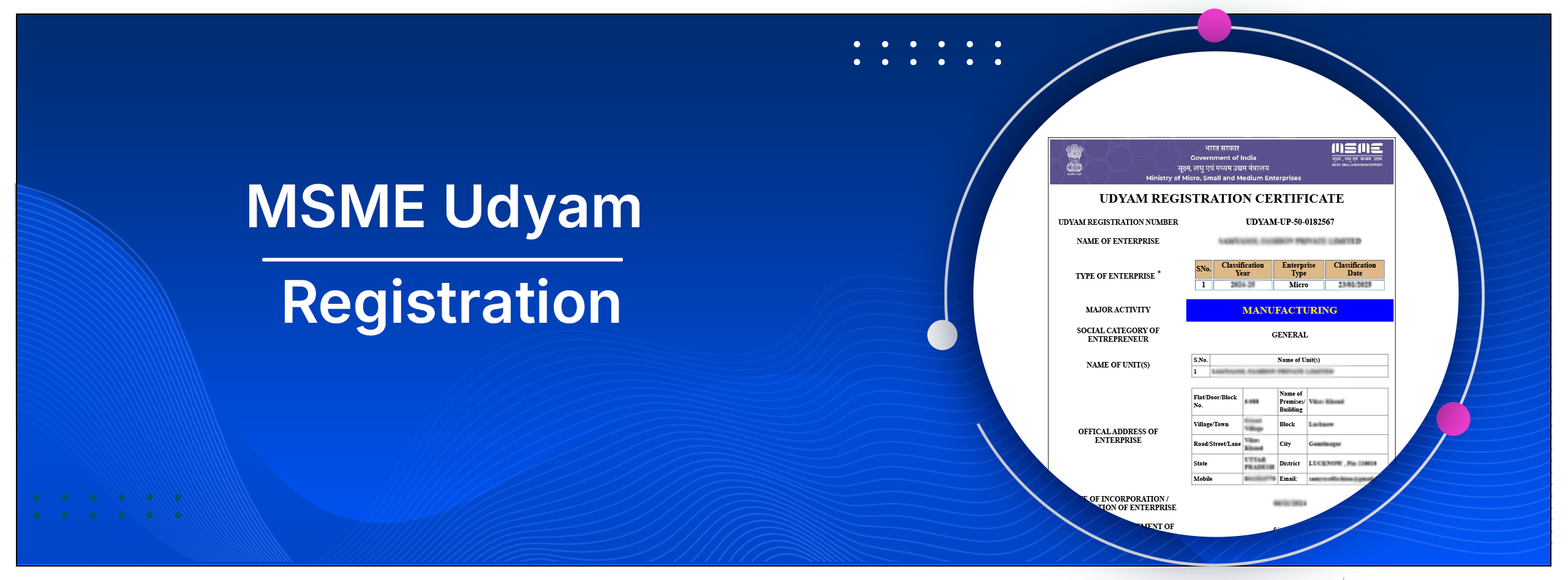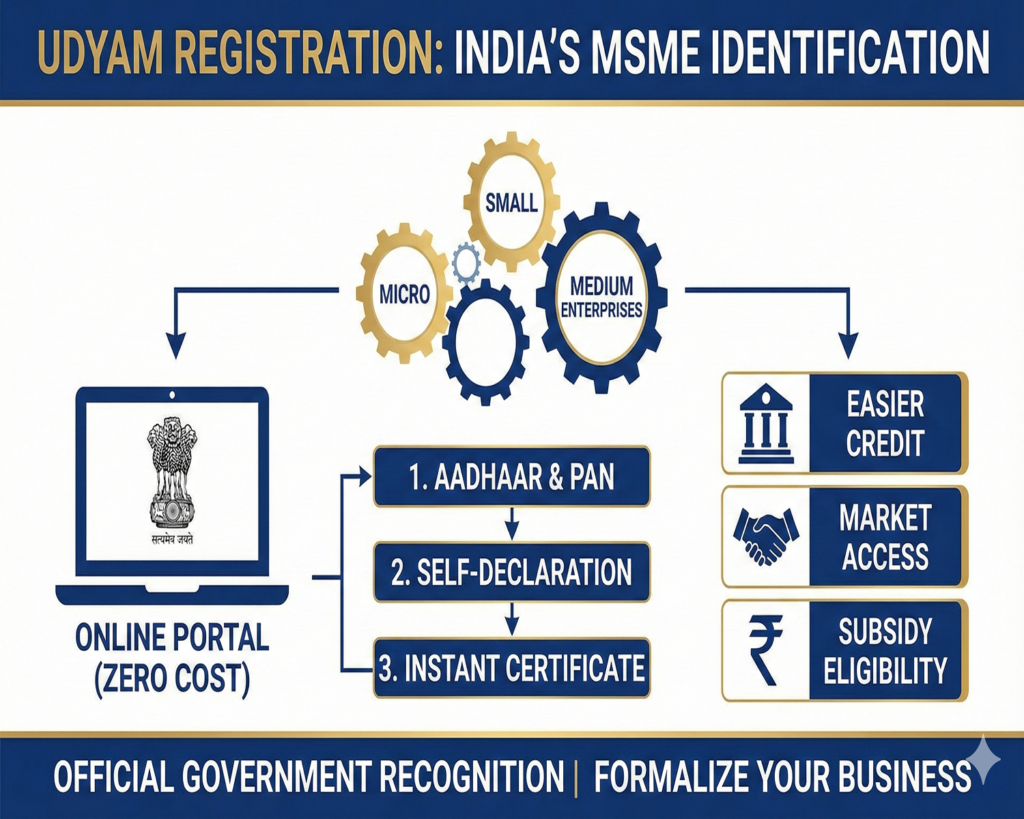
Tag: Udyam Registration

  • MSME Udyam Registration: Benefits, Eligibility & How to Register Free?

    MSME Udyam Registration: Benefits, Eligibility & How to Register Free?

    Over 7.30 crore enterprises have registered on the Udyam platform since July 2020 — and the ones that haven’t are leaving collateral-free loans, government tenders, and tax benefits on the table. MSME Udyam Registration is free, paperless, and takes under 30 minutes. Yet thousands of small business owners in Mumbai, Kolkata, Bengaluru, and beyond still skip it, either because they think they don’t qualify or assume the process is complicated.

    It isn’t. Here’s everything you need to know.

    📌 TL;DR: MSME Udyam Registration is the Government of India’s free, online process for recognising Micro, Small, and Medium Enterprises under the MSMED Act, 2006. As of April 2025, revised limits now qualify more businesses than ever — Micro up to ₹10 crore turnover, Small up to ₹100 crore, Medium up to ₹500 crore. Registered businesses get access to collateral-free loans, priority government tenders, trademark and patent subsidies, and protection against delayed buyer payments. You can complete the entire process at udyamregistration.gov.in at zero cost. Lawizer’s experts can guide you through the process if you need help.

    What You’ll Learn

    • Who qualifies for Udyam Registration under the revised 2025 limits
    • The full list of financial and legal benefits for registered MSMEs
    • A step-by-step walkthrough of the registration process on the official portal
    • What documents you need and common mistakes to avoid

    What Is MSME Udyam Registration and Why Does It Exist?

    Udyam Registration is the official government process — managed by the Ministry of Micro, Small and Medium Enterprises (MSME) — through which a business gets formally recognised as a Micro, Small, or Medium Enterprise under the MSMED Act, 2006 (the Micro, Small and Medium Enterprises Development Act).

    It replaced the older Udyog Aadhaar system in July 2020, and the upgrade was significant: the new system integrates your Aadhaar and PAN directly with government databases, meaning no document uploads, no physical visits, and no fees.

    Here’s the thing: MSME status isn’t just a label. It is a legal identity that unlocks a specific set of rights — from priority bank lending to protection against buyers delaying payments beyond 45 days. Without it, you’re running your business with one hand tied behind your back.

    Whether you’re a manufacturer in Pune, a service provider in Chennai, or a trader in Delhi, if your business falls within the defined limits, you qualify. And since July 2021, even retailers and wholesalers are eligible.


    Revised MSME Classification Limits: Are You Eligible?

    The Union Budget 2025 made the single biggest revision to MSME definitions since the system launched. Effective 1 April 2025, investment limits were increased by 2.5 times and turnover limits were doubled. This means lakhs of businesses that previously didn’t qualify now do — and existing registrations were upgraded automatically without any re-registration.

    Here’s how the three categories break down under the revised classification (both conditions — investment AND turnover — must be satisfied):

    Micro Enterprise: Investment up to ₹2.5 crore AND annual turnover up to ₹10 crore
    Small Enterprise: Investment up to ₹25 crore AND annual turnover up to ₹100 crore
    Medium Enterprise: Investment up to ₹125 crore AND annual turnover up to ₹500 crore

    What most founders miss: the classification uses composite criteria. If your turnover crosses the ceiling for your category — even if your investment hasn’t — you automatically move up. All units operating under a single PAN are aggregated when calculating these thresholds, so if you run multiple businesses, plan accordingly.

    A quick example: a Bengaluru-based SaaS firm with ₹8 crore invested in servers and ₹40 crore annual turnover qualifies as a Small Enterprise — eligible for the full suite of MSME benefits, including the enhanced credit guarantees introduced in Budget 2025-26.

    All business types are eligible: proprietorships, partnership firms, LLPs, private limited companies, public limited companies, HUFs, co-operative societies, trusts, and producer companies. Manufacturing, services, trading — all covered. The only entities that don’t qualify are those that exceed the Medium Enterprise ceilings (investment above ₹125 crore or turnover above ₹500 crore) and non-business entities like NGOs or government departments.
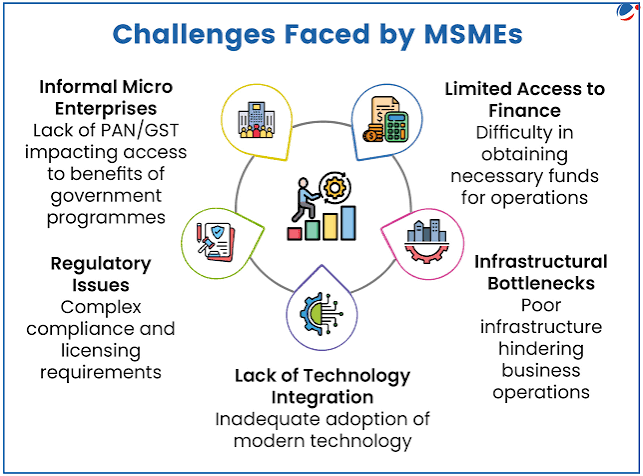
    New MSME classification criteria announced in Union Budget 2025-26 | Current Affairs | Vision IAS

    Key Benefits of MSME Udyam Registration in 2025–26:

    This is where registration pays for itself many times over. Let’s break this down by category.

    Financial and Credit Benefits

    The biggest draw for most businesses is access to institutional credit they’d otherwise struggle to get. Udyam-registered MSMEs are eligible for the Credit Guarantee Fund Trust for Micro and Small Enterprises (CGTMSE) — the government’s flagship scheme that allows banks to extend collateral-free loans up to ₹5 crore for micro and small enterprises, with the credit guarantee cover for micro enterprises doubled to ₹10 crore in Budget 2025.

    Loans under the MUDRA scheme (Micro Units Development and Refinance Agency) are also accessible, and banks are mandated to offer concessional interest rates to registered MSMEs. The new ME-Card — a customised credit card with a ₹5 lakh limit for Udyam-registered Micro Enterprises — was introduced in Budget 2025, with 10 lakh cards planned in the first year.

    Government Procurement Advantages

    Under the Public Procurement Policy, 25% of all Central Government procurement must come from MSMEs, with an additional 4% reserved for SC/ST-owned enterprises and 3% for women-owned enterprises. On GeM (Government e-Marketplace), Udyam-registered businesses get preferential access, exemption from Earnest Money Deposits (EMD), and are shortlisted for MSE-specific tenders with relaxed eligibility criteria.

    For any business wanting to supply to government departments, PSUs, railways, or defence establishments, Udyam registration is the baseline requirement.

    IP and Certification Subsidies

    This one surprises most founders. Registered MSMEs are eligible for up to 80% subsidy on patent filing fees and significant reimbursements on trademark registration and ISO certification costs. If you’re building a brand or a product and haven’t registered as an MSME, you’re paying full price for protections the government wants to help you afford. You can explore trademark registration for your startup through Lawizer’s MSME registration services.

    Protection Against Delayed Payments — Section 43B(h)

    The MSMED Act gives registered MSMEs a legal shield that unregistered businesses simply don’t have. Buyers are legally required to pay registered Micro and Small Enterprises within 45 days of delivery (or within the agreed credit period, whichever is shorter). If they don’t, the overdue amount attracts compound interest at three times the RBI’s bank rate.

    Under Section 43B(h) of the Income Tax Act (as amended), buyers cannot claim a tax deduction on payments to MSMEs made beyond 45 days — giving you real negotiating power. This protection is only available to registered businesses.

    Tax and Compliance Benefits

    Registered MSMEs get extended carry-forward of Minimum Alternate Tax (MAT) credit — up to 15 years instead of the standard 10. Several state governments offer additional incentives: electricity tariff subsidies, stamp duty exemptions on property transactions, and interest subvention schemes. These vary by state, so it’s worth checking with your state’s Directorate of Industries.
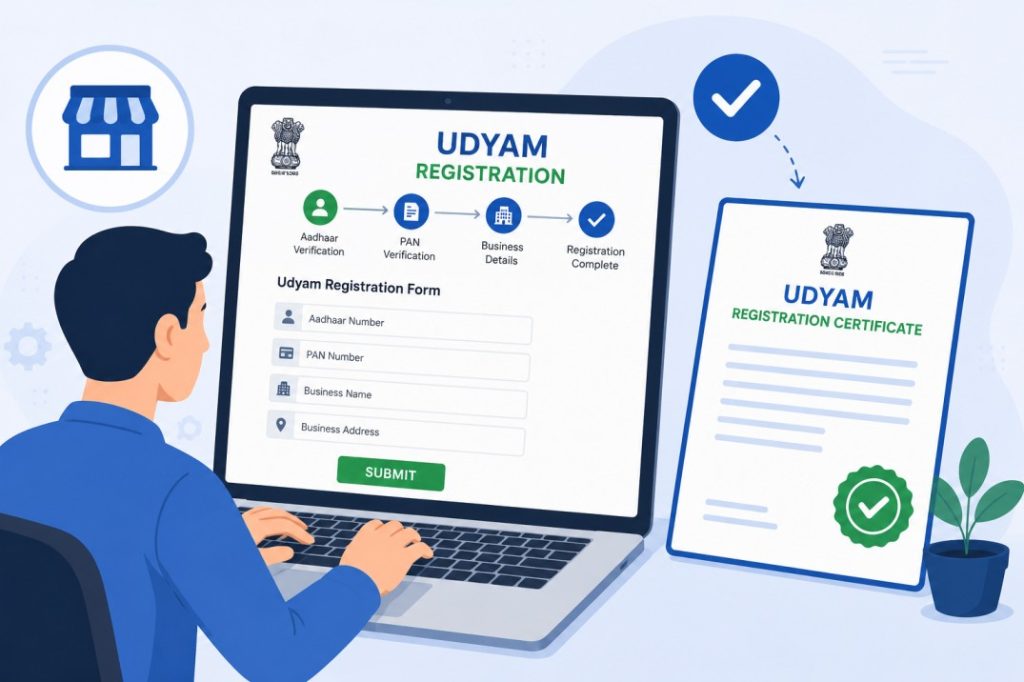
    Udyam Registration Kaise Kare? Full Step-by-Step Guide - FormSamajh

    How to Register for Udyam Online — Step by Step

    The registration process is entirely self-declaration based. You don’t upload any documents. The portal pulls your investment and turnover data directly from your Income Tax and GST filings. Here’s the complete process:

    Step 1 — Visit the Official Portal
    Go to udyamregistration.gov.in — the only government-authorised portal for Udyam Registration. Be careful: dozens of private websites charge fees for this process. The official portal is free.

    Step 2 — Choose the Right Application Type
    If you’re a new enterprise with no prior registration: select “For New Entrepreneurs who are not Registered yet as MSME or those with EM-II.”
    If you had a prior Udyog Aadhaar or EM-II registration: select the migration option to convert it.

    Step 3 — Enter Your Aadhaar Details
    The applicant’s Aadhaar number and name (as on the Aadhaar card) are required. For proprietorships, use the owner’s Aadhaar. For companies, partnerships, or LLPs, use the authorised signatory’s Aadhaar. OTP verification via registered mobile completes this step.

    Step 4 — Fill in PAN and Business Details
    Enter your PAN, business name, type of organisation, date of commencement, bank account details, and your main business activity (manufacturing or services). Select the appropriate NIC (National Industry Classification) 2008 code that matches your core business.

    Step 5 — Submit Investment and Turnover Details
    Enter investment in plant and machinery (or equipment) and annual turnover. The portal cross-verifies this against your ITR and GST filings automatically. No proof needs to be uploaded.

    Step 6 — Submit and Receive Your Udyam Registration Certificate
    After submission, you receive a unique 12-digit Udyam Registration Number (URN) and a digital e-certificate with a QR code. This certificate has lifetime validity — no renewal required. You can also store it in DigiLocker, and it’s legally recognised under the IT Act, 2000.

    What most founders miss: your Udyam classification is auto-recalculated every financial year based on the ITR and GST data you file. If your turnover grows and you cross a category ceiling, reclassification happens automatically. You don’t need to re-register, but you should check your Udyam portal status annually.


    Common Mistakes to Avoid

    • Let’s be direct about what goes wrong most often.
    • Registering on a private paid portal instead of udyamregistration.gov.in — the government portal is free, and there is no official fee whatsoever.
    • Entering NIC codes incorrectly — mismatched activity codes can cause verification issues when applying for tenders or schemes that require specific sector codes.
    • Mixing up Udyam with Udyog Aadhaar — if you have an old Udyog Aadhaar registration (valid till March 2021), it must be migrated to Udyam to continue accessing benefits. Unmigrated registrations are now considered inactive.
    • Not updating annually — failure to update your turnover and investment details on the Udyam portal can result in your status being marked inactive, cutting off access to schemes.
    • If you want a professional to handle the application and verify all details are accurate, Lawizer’s team can assist with your MSME Udyam Registration fully online — no CA visit required.

    Frequently Asked Questions

    Q: Is Udyam Registration really free, or are there hidden charges?

    A: Udyam Registration is completely free on the official government portal at udyamregistration.gov.in. There are no government fees, no charges for the certificate, and no renewal costs. The certificate has lifetime validity. If any website is asking you to pay for Udyam Registration, it is a private consultancy, not the government. You are not required to use any paid service for this process.

    Q: What documents do I need to register on the Udyam portal?

    A: You don’t upload any documents. The Udyam Registration process is entirely self-declaration based, and the portal cross-verifies your data directly against your Aadhaar, PAN, ITR, and GST records. You will need your Aadhaar number (with OTP access on the linked mobile), PAN card, business bank account details, and your approximate investment in plant and machinery or equipment. That’s it.

    Q: I already had Udyog Aadhaar. Do I need to re-register on Udyam?

    A: Yes, you need to migrate. Udyog Aadhaar registrations became invalid after March 31, 2021. To continue accessing MSME benefits — including loans, government tenders, and subsidies — you must migrate your registration to the Udyam portal. The migration option is available on udyamregistration.gov.in and the process is straightforward. Existing registrations that were migrated also automatically benefit from the revised 2025 limits without re-registration.

    Q: Can a private limited company or LLP register as an MSME?

    A: Yes. Any business entity — proprietorship, partnership firm, LLP, private limited company, public limited company, HUF, co-operative society, or trust — that falls within the investment and turnover limits can register under Udyam. For companies and LLPs, the authorised signatory’s Aadhaar is used for the application. All units of the same enterprise operating under a single PAN are treated as one entity when calculating the thresholds.

    Q: What is Section 43B(h) and how does it protect registered MSMEs?

    A: Section 43B(h) of the Income Tax Act (effective from April 1, 2024) disallows buyers from claiming a tax deduction on payments made to Micro and Small Enterprises beyond 45 days. This means that if your buyer delays payment, they lose their tax deduction — giving registered MSMEs significant legal and financial leverage over large buyers and corporates. This protection applies only to businesses registered under Udyam as Micro or Small Enterprises. Unregistered businesses have no such recourse.

    Q: What happens if my business grows and crosses the MSME limits?

    A: Your Udyam classification is automatically recalculated every financial year based on the ITR and GST returns you file. If your investment or turnover crosses the ceiling for your current category — say you cross ₹100 crore turnover as a Small Enterprise — you’re automatically reclassified as a Medium Enterprise. If you eventually cross the Medium ceiling (₹500 crore turnover or ₹125 crore investment), your MSME status lapses and you lose access to MSME-specific schemes going forward. You don’t need to manually update this; the portal handles it automatically.


    Ready to Get Your Udyam Certificate?

    Lawizer’s experts handle everything — MSME Udyam Registration, compliance filing, and GST registration — fully online, starting at just ₹499. No CA visit needed.


    Get Your MSME Registration Done Today →

  • India’s Creator Economy and the Law: What YouTubers and Influencers Must Register

    India’s Creator Economy and the Law: What YouTubers and Influencers Must Register

    India added roughly 4 million creators between 2020 and 2024. That marks a 322% increase. Many learned about their legal obligations the hard way. Some received GST notices. Others found TDS mismatches in Form 26AS. Many also saw brand deals stall because they had no invoice to raise.

    Creator economy law in India isn’t optional paperwork anymore. It’s the difference between a channel that scales and one that gets an income tax notice mid-growth.

    Here’s the thing: nobody hands new creators a checklist. Brands, MCNs, and even CAs assume you already know what to register. You don’t have to guess.

    📌 TL;DR: Under creator economy law in India, YouTubers and influencers must register for GST once turnover crosses ₹20 lakh (₹10 lakh in special category states), file ITR-3 or ITR-4 using profession code 16021, and follow ASCI disclosure rules on every paid post. Brands also deduct TDS under Sections 194R, 194J, or 194C depending on the deal structure. Lawizer handles GST, MSME (Udyam), and trademark registration for creators end-to-end, online.

    What You’ll Learn

    • When GST registration becomes mandatory for creators, and how the 18% rate applies
    • How TDS under Sections 194R, 194J, and 194C hits your brand deal payouts
    • Why trademarking your channel name protects your personal brand
    • When Udyam (MSME) registration and even a Private Limited company make sense

    GST Registration: The First Real Compliance Trigger

    The moment your annual turnover from brand deals, ad revenue, affiliate income, and even bartered products crosses ₹20 lakh (₹10 lakh in special category states like Assam or Himachal Pradesh), GST registration under the GSTN portal stops being optional. Content creation is classified as a supply of service under the CGST Act, and it attracts 18% GST — same rate as most professional services.

    Most founders overlook one important rule. GST turnover includes non-cash income. A ₹2 lakh gadget hamper counts at its market value. It counts even if no money changes hands. That value also contributes to your GST registration threshold.

    That value contributes to your GST registration threshold. After registering, you must issue GST-compliant tax invoices for every brand collaboration. Many brands now require these invoices before releasing payment.

    • Brand deals with foreign companies can qualify as “export of services” — zero-rated GST, if you file a Letter of Undertaking (LUT)
    • Once registered, you can claim Input Tax Credit (ITC) on equipment, software, and studio expenses.
    • Missing GST invoices on brand collaborations risks penalties during scrutiny

    Founders juggling multiple income streams — YouTube AdSense, Instagram deals, coaching — often set up their business registration at the same time as GST, since lenders and brands both ask for it.

    TDS: What Gets Deducted Before You See the Money

    The short answer: it depends on how the brand structures the deal. Section 194J applies 10% TDS on professional fees — the most common category for sponsored posts and endorsements. Section 194C applies a lower 1-2% TDS when you’re treated as a contractor executing a defined project.

    Section 194R is the one that catches creators off guard: if a brand gives you products, hotel stays, or gadgets worth more than ₹20,000 in a year, they must deduct 10% TDS on the fair market value — even though you never received cash.

    Profession Code 16021 in ITR Filing: How to Choose the Right ITR Form

    From FY 2024-25 (Assessment Year 2025-26) onward, the Income Tax Department introduced a dedicated profession code — 16021 — specifically for social media influencers and content creators. If you’re filing under this code with detailed books of accounts, ITR-3 is the correct form.

    If you’d rather declare a fixed percentage of income under presumptive taxation instead of maintaining detailed books, ITR-4 (Sugam) applies.

    What most founders miss here: mixing personal and business expenses is the fastest way to draw scrutiny. Only expenses directly tied to content creation — camera gear, editing software, internet bills, studio rent — qualify as deductions. A family vacation dressed up as a “travel content shoot” won’t survive an audit.

    • Foreign income (YouTube AdSense in USD, international brand deals) must be reported under Schedule FA
    • Late filing attracts a flat ₹5,000 penalty under Section 234F
    • Under-reported income can attract a 50-200% penalty under Section 270A

    Creators who also run e-commerce alongside content — merch, digital courses — often benefit from lining up their income tax return filing with proper business registration from the start, rather than retrofitting compliance after brands start asking for GSTINs and PANs.

    Trademark Your Channel Name Before Someone Else Does

    Here’s what catches creators off guard: your channel name, logo, or catchphrase isn’t automatically yours in law just because you built the audience.

    Anyone can file for trademark registration with the CGPDTM (Controller General of Patents, Designs and Trademarks) on an identical or similar name, and if they register first, you could be the one forced to rebrand — after years of building recognition.

    This matters more once merchandise, digital products, or a personal app enters the picture. A registered trademark also strengthens your position in brand negotiations and licensing deals, since it proves exclusive ownership over your name and likeness in commerce.

    Creators expanding into merch or courses typically pair trademark registration with their channel launch rather than waiting until a copycat account forces the issue.

    MSME (Udyam) Registration and When to Incorporate

    Once you’re running a studio, employing editors, or operating as a small media business rather than a solo creator, Udyam (MSME) registration opens up collateral-free loans, priority payment protections against brands, and government tender eligibility. It’s free, done entirely online through the Udyam portal, and takes minutes once your PAN and Aadhaar are ready.

    When creators should consider incorporating a company

    What most founders miss: at a certain income level, operating as an individual professional starts costing more in tax than incorporating a Private Limited company or LLP under the Companies Act, 2013. Incorporation also separates personal liability from business liability — useful once you’re signing large brand contracts, hiring a team, or bringing in investors for a media business.

    • Udyam registration: ideal for solo creators scaling into a small studio or team
    • Private Limited/LLP: better once annual income consistently crosses ₹50-75 lakh or you’re hiring full-time staff

    Founders scaling past solo-creator income levels often register through MSME Udyam registration before they need it, so brand contracts and bank credit lines aren’t held up later.

    ASCI Disclosure Rules: Compliance Requirements for Brands

    The Advertising Standards Council of India (ASCI) processed over 1,400 influencer violations through November 2025, with 94% involving disclosure failures — undisclosed paid posts hidden behind a dozen unrelated hashtags.

    ASCI’s April 2025 update tightened these rules across all categories. The Consumer Protection Act now enforces them with government penalties, not just industry warnings.

    Let’s break this down: if you receive cash, free products, travel, or even an affiliate commission for content, disclosure is mandatory — prominent, immediate, and impossible to miss, not buried in a caption.

    Finance and health creators face an even stricter Addendum 2: finfluencers must display SEBI registration or CA credentials, and health influencers must show their medical qualifications, or stick to personal experience with a clear disclaimer.

    Non-compliance carries serious risks. Brands may withhold payment or end contracts. They may also flag violations, making future partnerships harder to secure.

    Frequently Asked Questions

    Q: Do I need GST registration if I only make money from YouTube AdSense?

    A: Yes, once your total annual turnover — including AdSense, brand deals, and affiliate income combined — crosses ₹20 lakh (₹10 lakh in special category states). AdSense income counts toward this threshold the same as any other revenue stream.

    Q: What happens if a brand sends free products instead of paying cash?

    A: If the products are worth more than ₹20,000 in a financial year, the brand must deduct 10% TDS under Section 194R based on the fair market value. You’ll also need to declare this as taxable income, even though you didn’t receive cash.

    Q: Which ITR form should influencers file?

    A: Most creators file ITR-3 using profession code 16021, especially if they maintain detailed books of accounts. If you prefer the presumptive taxation scheme under Section 44AD instead of maintaining full books, ITR-4 (Sugam) applies.

    Q: Can someone else trademark my channel name if I haven’t registered it?

    A: Yes. Trademark rights in India generally go to whoever files first, not whoever built the audience first. Registering early with the CGPDTM protects your channel name, logo, and tagline from being claimed by someone else.

    Q: Do I need to disclose every sponsored post, even small gifting collaborations?

    A: Yes. Under ASCI guidelines, disclosure is required whenever you receive any benefit — cash, free products, travel, or affiliate commission — in exchange for content, regardless of follower count or the size of the deal.

    Ready to formalize your creator business?
    Lawizer’s experts handle everything — GST registration, MSME Udyam registration, and trademark filing for your channel — fully online, starting at just ₹999. No CA visit needed.

    Get Your Creator Compliance Sorted →

  • Udyam Registration: MSME Benefits, Eligibility & How to Apply Online

    Udyam Registration: MSME Benefits, Eligibility & How to Apply Online

    India has 7.86 crore registered MSMEs employing over 34 crore people — and yet thousands of eligible business owners still haven’t claimed their Udyam Registration. That one free certificate unlocks collateral-free loans up to ₹5 crore, government tender preferences, tax exemptions, and legal protection against delayed payments.

    If your business qualifies and you haven’t registered yet, you’re leaving real money — and real protection — on the table.

    📌 TL;DR: Udyam Registration is a free, fully online MSME certification issued by the Government of India that gives your business access to collateral-free loans, priority government tenders, tax benefits, and payment protection under the MSMED Act 2006. Any micro, small, or medium enterprise in manufacturing or services can apply in under 15 minutes at udyamregistration.gov.in — all you need is your Aadhaar and PAN. Lawizer can help you complete and verify the process without errors.

    What You’ll Learn

    • What Udyam Registration is and how it replaced Udyog Aadhaar
    • Exact MSME eligibility criteria and classification limits (updated April 2025)
    • Every major benefit your business gets after registration
    • Step-by-step process to apply online and get your certificate instantly
    • Common mistakes founders make and how to avoid them

    What Is Udyam Registration? (And Why Udyog Aadhaar No Longer Counts)

    Udyam Registration is the official government certification that recognises your business as an MSME — a Micro, Small, or Medium Enterprise — under the MSMED Act, 2006 (Micro, Small and Medium Enterprises Development Act).

    The Ministry of Micro, Small and Medium Enterprises launched the Udyam portal on July 1, 2020, replacing the older Udyog Aadhaar Memorandum (UAM) system entirely. If you registered under UAM before July 2020, that certificate is no longer valid for most benefits — you need to migrate to Udyam.

    Here’s the thing. Udyam isn’t just a piece of paper. It’s your business’s formal identity in India’s lending, procurement, and compliance ecosystem. Banks verify your Udyam Registration Number (URN) before approving priority-sector loans

    . Government departments check it before issuing tender preferences. And the MSME Samadhaan portal — the government’s delayed payment dispute system — requires a valid URN before you can file a complaint against a buyer who hasn’t paid. Without it, none of that is accessible.

    The registration is completely free, paperless, and self-declaration based. You don’t upload any physical documents. The system cross-verifies your details automatically using your PAN and GST data linked to Income Tax records.

    What most founders miss: the certificate has lifetime validity, so you register once and you’re covered as long as you update your details annually.

    MSME Eligibility: Who Can Apply for Udyam Registration?

    Any business in India — manufacturing or services — can apply for Udyam Registration if it falls within the classification limits set by the government. The criteria were updated effective April 1, 2025, expanding the thresholds to reflect how businesses actually scale today.

    Retail and wholesale traders were also made fully eligible from July 2021 onward, which was a major change that most small shop owners in cities like Kolkata, Mumbai, and Chennai are still unaware of.

    Updated MSME Classification Limits (w.e.f. April 1, 2025)

    Enterprise Type Investment in Plant & Machinery Annual Turnover
    Micro Up to ₹1 crore Up to ₹5 crore
    Small Up to ₹10 crore Up to ₹50 crore
    Medium Up to ₹50 crore Up to ₹250 crore

    A quick example: a Bengaluru-based SaaS service firm with ₹8 crore in equipment investment and ₹40 crore in annual turnover qualifies as a Small Enterprise. It can register on Udyam and access enhanced credit guarantees introduced under Budget 2025.

    Note that export turnover is excluded when calculating your threshold — only domestic turnover counts. And if your business grows and crosses limits, reclassification happens automatically — no penalty, as long as you’ve been reporting honestly.

    Any business structure is eligible — sole proprietorships, partnerships, LLPs, private limited companies, OPCs, and even Hindu Undivided Families (HUFs). The only businesses that can’t apply are those exceeding the medium enterprise limits, non-profits, government departments, and fully informal freelancers with no structured operations.

    If you want to structure your business correctly before applying, Lawizer’s startup and business legal services can help you pick the right entity type first.

    Key Benefits of Udyam Registration for Your Business

    Let’s break this down. Once you have your Udyam certificate, you’re not just “registered” — you get access to a stack of financial, legal, and market benefits that most unregistered businesses have zero access to.

    🏦

    1. Collateral-Free Loans Under CGTMSE

    The Credit Guarantee Fund Trust for Micro and Small Enterprises (CGTMSE) allows registered MSMEs to access collateral-free loans up to ₹5 crore, with guarantee coverage of up to 85% for eligible categories. Since inception, over ₹9.80 lakh crore in credit guarantees have been approved — and in FY 2024-25 alone, the government extended ₹3 lakh crore worth of guarantees. For a small founder who can’t mortgage property, this is transformative.

    📉

    2. Priority Sector Lending and Lower Interest Rates

    Banks are mandated by the Reserve Bank of India to lend to the MSME sector as part of Priority Sector Lending (PSL) requirements. This means registered MSMEs often get faster loan approvals, lower interest rates, and a 1% exemption on interest for bank overdraft (OD) facilities. Under the Pradhan Mantri Mudra Yojana (PMMY), over ₹33.65 lakh crore has been sanctioned across 52.37 crore Mudra loans since inception.

    ⚖️

    3. Protection Against Delayed Payments

    The MSMED Act gives you a legal right to receive payments within 45 days of delivering goods or services. If a buyer delays, they owe you compound interest at three times the bank rate. You can file a complaint on the MSME Samadhaan portal — routed to a Micro and Small Enterprises Facilitation Council (MSEFC) in your state. This protection is only available to Udyam-registered businesses.

    📋

    4. Government Tender Preferences

    No global tenders are invited for government procurement contracts valued up to ₹200 crore — reserving a huge pool of contracts exclusively for Indian MSMEs. Registered businesses also get a price preference of up to 15% in government procurement under the Public Procurement Policy. If your business sells products or services that government departments buy, this single benefit can transform your revenue pipeline.

    💸

    5. Tax Benefits and Subsidies

    Udyam-registered businesses are eligible for subsidies on patent registration, trademark fees, and industrial promotion. Several state governments also offer reduced electricity tariffs and stamp duty exemptions. If you’ve already registered your trademark, Lawizer’s trademark registration services can help you combine those savings with your MSME status for maximum benefit.

    How to Apply for Udyam Registration Online: Step-by-Step

    The good news: the entire process takes 10–15 minutes and is completely free on the official Udyam Registration Portal (udyamregistration.gov.in). Here’s exactly how it works.

    Documents You’ll Need (Keep These Ready)

    • Aadhaar number of the proprietor, managing partner, or authorised director (linked to a working mobile number for OTP)
    • PAN card of the business or individual
    • GSTIN (mandatory if your turnover exceeds the GST threshold)
    • Bank account details and NIC (National Industrial Classification) code for your business activity

    Step-by-Step Application Process

    1. 1
      Visit the Portal Go to udyamregistration.gov.in and click “For New Entrepreneurs who are not Registered yet as MSME”
    2. 2
      Aadhaar Validation Enter your Aadhaar number and name, then validate via OTP sent to your Aadhaar-linked mobile
    3. 3
      PAN Verification Enter your PAN — the system auto-verifies with the Income Tax database instantly
    4. 4
      Fill Enterprise Details Business name, activity type (manufacturing/service/trade), address, bank details, investment amount, turnover, employee count, and 2-digit NIC code
    5. 5
      Submit The portal cross-verifies your data with GST and ITR records automatically — no manual upload needed
    6. 6
      Download Certificate Your Udyam Registration Certificate with unique URN and QR code is issued instantly

    Common Mistakes to Avoid During Udyam Registration

    Most errors during Udyam registration come from small oversights — but they can delay benefits or cause classification mismatches. Here are the ones that come up most often.

    Using an unlinked Aadhaar: Your Aadhaar must be linked to your current mobile number. If it’s not, update your mobile at the nearest Aadhaar Seva Kendra before starting the application.
    Entering wrong investment figures: Investment refers to the value of plant, machinery, or equipment — not land or buildings. Many applicants accidentally include property values and get classified in a higher tier.
    Including export turnover: Export sales must be excluded from your annual turnover calculation. Including them inflates your figure and may push you into a higher MSME category unnecessarily.
    Registering through paid agents on unofficial portals: The government process is 100% free. Many third-party websites charge ₹500–₹2,000 for a form you can fill in 10 minutes on the official portal. Always use udyamregistration.gov.in.
    Not updating figures annually: If your investment or turnover has grown, failing to update means you’re in the wrong MSME category — which can affect your benefit eligibility.

    Frequently Asked Questions

    Q) Is Udyam Registration free or do I need to pay a government fee?

    Udyam Registration is completely free on the official government portal at udyamregistration.gov.in. There is no government fee at any stage of the application. If any website is charging you for registration, it is a private agent — not the official process. You only pay if you choose to hire a professional to assist with the filing.


    Q) Can a private limited company or LLP apply for Udyam Registration?

    Yes. Any business entity — sole proprietorship, partnership firm, LLP, private limited company, OPC, or HUF — can apply for Udyam Registration, provided it falls within the investment and turnover limits for micro, small, or medium enterprises. The Aadhaar used for verification should belong to the authorised signatory — the proprietor, a managing partner, or a director — depending on the business structure.

    Q) What is the difference between Udyam Registration and Udyog Aadhaar?

    Udyog Aadhaar (UAM) was the older MSME registration system discontinued on July 1, 2020. It has been fully replaced by Udyam Registration. Businesses that registered under UAM must migrate to the new Udyam portal to continue receiving MSME benefits. The Udyam system is more robust — it cross-verifies data with PAN, GST, and Income Tax records automatically, making classification more accurate and fraud-resistant.

    Q) Does Udyam Registration need to be renewed every year?

    No. Udyam Registration has lifetime validity — there is no annual renewal required. However, you are expected to update your investment and turnover figures on the Udyam portal at the end of each financial year to ensure your MSME classification remains accurate. Failing to update does not cancel your registration, but it may result in incorrect classification over time.


    Q) Can retail and wholesale traders apply for Udyam Registration?

    Yes. Since July 2, 2021, retail and wholesale traders have been eligible to register under Udyam, provided their investment and turnover fall within MSME classification limits. This change opened access to MSME benefits — including priority sector lending and payment protection — to a much larger group of businesses that was previously excluded from the scheme

    Q) How long does it take to get the Udyam Registration Certificate after applying?

    The certificate is issued instantly after successful submission of the application on the Udyam portal. Once your Aadhaar is verified via OTP and the system validates your PAN and GST data, your Udyam Registration Number (URN) and downloadable certificate are generated immediately. You can download and reprint the certificate at any time by logging in with your URN and Aadhaar OTP.

    Ready to get your Udyam Registration done right?

    Lawizer’s experts handle everything — MSME registration, business incorporation, and startup compliance — fully online, starting at just ₹499. No CA visit needed.
    Get Your Udyam Certificate Today →