Tag: privacy

  • Your Tenant Won’t Leave. Now What? | Lawizer Blog

    Your Tenant Won’t Leave. Now What? | Lawizer Blog

    Free legal consultation for new clients  ·  Book yours at lawizer.com →Lawizer

    Free Consultation

    Property Law · India

    Your Tenant Won’t Leave.
    Now What?

    A no-jargon guide for Indian landlords dealing with non-paying or non-vacating tenants — and how to resolve it legally, quickly, and without a single court visit.

    By Lawizer Legal Team|8 min read|PropertyTenant Disputes

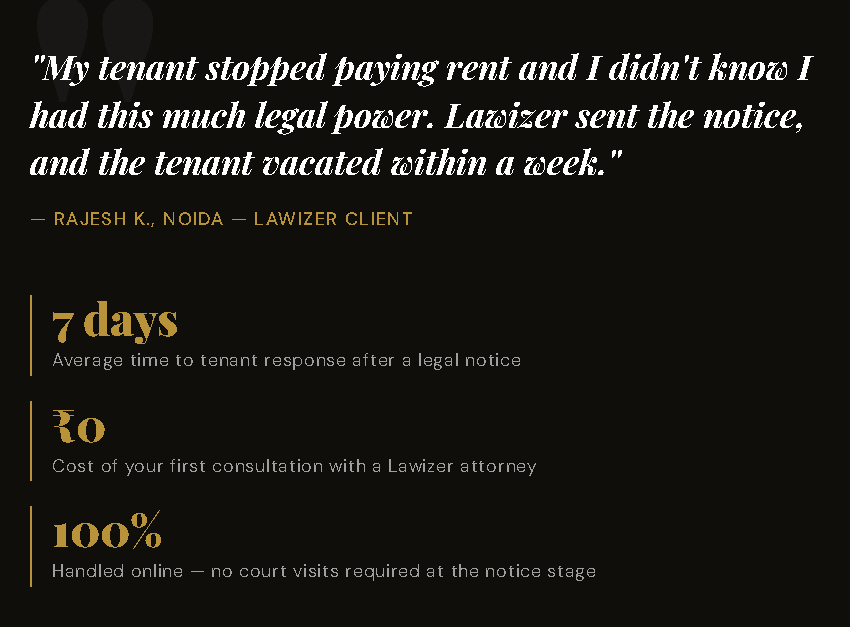
    “My tenant stopped paying rent and I didn’t know I had this much legal power. Lawizer sent the notice, and the tenant vacated within a week.”

    — Rajesh K., Noida — Lawizer Client

    7 days

    Average time to tenant response after a legal notice

    ₹0

    Cost of your first consultation with a Lawizer attorney

    100%

    Handled online — no court visits required at the notice stage

    The Situation No Landlord Expects:

    You trusted someone with your property. You signed a rent agreement. And now — they’ve stopped paying, stopped responding, or flatly refused to leave when the agreement expired. You’re owed money. Your property is stuck. And every time you think about going to court, you imagine years of hearings, lawyer fees, and exhausting paperwork.

    Here’s what most landlords in India don’t realize: you have far more power than you think, and most tenant disputes are resolved long before they reach a courtroom.

    This guide walks you through exactly what to do — step by step — from the moment you realize there’s a problem.

    “A well-drafted legal notice resolves more tenant disputes than all the court orders combined.”

    First, Know Where You Stand Legally:

    India doesn’t have a single national tenancy law. Depending on your state, your rights as a landlord are governed by one of these frameworks:

    Applicable Laws by State Type

    • States with Rent Control Acts (Delhi, Maharashtra, West Bengal, Tamil Nadu) — stronger tenant protections, specific eviction grounds required
    • States with new Model Tenancy Act alignment — more balanced landlord-tenant framework
    • Agreements registered under Transfer of Property Act, 1882 — contracts with teeth regardless of state-level rent control

    The most important document you have is your registered rent agreement. If it’s properly registered and clearly states the tenancy period, rent amount, and vacating clause — you’re in a strong position. If your agreement is unregistered or expired, don’t panic. You still have options, but timing matters.

    Your 5-Step Action Plan:

    01

    Document Everything Right Now

    Collect all rent receipts, bank transfer records, WhatsApp messages, and the signed agreement. Screenshot every message where you requested payment or vacation. This paper trail becomes your case.

    02

    Send a Formal Legal Notice

    This is the single most effective step. A legal notice sent by a lawyer via registered post carries serious weight. It signals you’re serious, creates a legal record, and gives the tenant a deadline to respond. Many disputes end here.

    03

    Negotiate a Settlement

    If the tenant responds, there’s often room to negotiate a departure timeline or partial payment. A structured exit — even if imperfect — is faster than litigation. Have a lawyer supervise any written agreement.

    04

    File an Eviction Case if Required

    Under the Transfer of Property Act Sec. 106 and your state’s Rent Control Act, you can file for eviction citing non-payment, misuse of property, or expiry of tenancy. Summary proceedings under CPC Order 37 allow faster recovery of dues.

    05

    Recover Unpaid Rent

    Rent recovery is a civil suit. Once you have a decree, the tenant’s movable assets or bank accounts can be attached. Combined with the eviction proceeding, most lawyers structure this as a single coordinated filing.

    Landlords underestimate the psychological and legal power of a formal notice. Here’s what it actually does:

    It creates a legal record. The moment your lawyer sends a registered notice, the clock starts. Any court proceeding later will note when you first formally demanded rent or vacation — this date matters for calculating dues and establishing bad faith on the tenant’s part.

    It triggers the response deadline. Under the Transfer of Property Act Sec. 106, tenants on a monthly lease must receive 15 days’ notice for termination. A formal notice starts this clock precisely.

    It moves the dispute out of the informal zone. Verbal requests, WhatsApp pleas, and in-person conversations carry no legal weight. A lawyer’s notice changes the entire dynamic — tenants who ignored you for months often respond within days.

    Lawizer Can Help

    Get a Legal Notice Drafted & Sent Today

    Our property lawyers review your agreement, draft a watertight notice, and send it via registered post — completely online. No office visit required. Consult a Property Lawyer Free →

    The 4 Mistakes Landlords Make (That Hurt Their Case)

    1. Cutting off electricity or water

    This feels satisfying. It is illegal. Courts treat it as coercion, and it can turn the landlord into the defendant. Do not do this under any circumstances.

    2. Accepting rent after the agreement expires

    If you accept even one month’s rent after the lease ends without a renewal, you may have legally created a periodic tenancy — and reset your eviction clock. Talk to a lawyer before accepting any post-agreement payments.

    3. Entering the property without notice

    Even as the owner, entering the tenant’s premises without advance notice (typically 24 hours) can constitute trespass. Document any entry attempts in writing.

    4. Waiting too long to act

    Every month of unpaid rent is a month of recoverable dues — but courts also look at whether you acted promptly. A six-month delay weakens your position. If the tenant hasn’t paid, issue a notice within 30 days of the first missed payment.

    Common Questions Landlords Ask Us:

    My rent agreement isn’t registered. Do I still have rights?

    Yes. An unregistered agreement is still evidence of the tenancy arrangement. However, it cannot be produced in court as primary evidence in the same way a registered document can. That said, bank records and messages corroborating rent payment can supplement the claim. Consult a lawyer to assess your specific situation.

    Can I ask the police to remove a tenant?

    In most cases, no. Tenancy disputes are civil matters. Police will not forcibly remove a tenant without a court order. However, if the tenant has physically threatened you or caused damage to property, an FIR and relevant IPC provisions may apply.

    How long does an eviction case actually take?

    It varies by state and court load. In Rent Control Tribunals (common in metro cities), cases can stretch from 6 months to several years. However, most disputes that begin with a proper legal notice are settled before a final order — which is exactly why that first step is so critical.

    What if the tenant just refuses to open the door?

    Once you have a court order for eviction, a court commissioner — accompanied by the local police — can enforce it. But you need the order first. The process is: notice → no compliance → court filing → order → enforcement.

    The landlord who documents everything and acts quickly wins. The one who waits six months hoping things resolve themselves — rarely does.

    The Bottom Line:

    A difficult tenant is stressful. But it’s a legal problem with a legal solution — and you don’t have to figure it out alone.

    Start with a free consultation. Have a lawyer look at your agreement and your situation. In most cases, a single strong legal notice is all it takes.

    Lawizer’s property lawyers have handled hundreds of landlord-tenant disputes across India — completely online, at transparent fees, with no surprise charges.

    If your tenant has stopped paying or won’t leave, the best time to act was last month. The second best time is today.

    In This Article

    1. 01 The situation no landlord expects
    2. 02 Know where you stand legally
    3. 03 Your 5-step action plan
    4. 04 The power of a legal notice
    5. 05 4 mistakes to avoid
    6. 06 Common questions answered
    7. 07 The bottom line

    Facing a tenant dispute right now?

    Talk to a Lawizer property lawyer free. We’ll tell you exactly where you stand in 30 minutes.Book Free Consultation

    Related Property Services

    More from the Lawizer Blog

    Startup Law Registering Your Company in India: The 7 Things No One Tells You Banking Cheque Bounce Under Section 138: Your Complete Legal Guide Tax ITR Filing Deadline 2025: Penalties, Extensions, and What to Do If You Missed It © 2026 Lawizer. All rights reserved.  ·  Privacy Policy  ·  Terms of Service  ·  +91 90628 15535

  • “SOLE VS SHARED CUSTODY: WHAT IS BEST FOR YOUR CHILD?”

    “SOLE VS SHARED CUSTODY: WHAT IS BEST FOR YOUR CHILD?”

    This Blog ensure about the Concept “Shared Parenting” which ensures the betterment of the child’s welfare of the Indian Courts. A Parent often does not know the difference between the Judicial Custody and Parental Custody.


    Types Of Custody In India

    • Physical Custody: This is the most common type of custody where the child lives with one parent and the other parent gets visitation rights. The custodial parent meets the child’s daily needs.
    • Joint Custody: The Joint Custody is not yet very common in India, but it is steadily gaining recognition. A Joint Custody explains how both parents share the custody of the child. This ensures the child’s upbringing and welfare while creating strong emotional bonds with both parents.
    • Legal Custody: This type of custody ensures the responsibility of the child’s long-term welfare. Even when a parent does not have physical custody, their role continues. They remain an important part of the child’s life including decisions about education, healthcare and other important matters.
    • Sole Custody: In situations where one parent is deemed unfit or in abusive circumstances, the court may grant sole custody to the other parent. The court carefully considers the child’s wellbeing before making such a decision.
    • Third Party Custody: This type of custody happens rarely where the court grants custody to a third person (non-biological guardian). The court may take this step only if the parents are unfit or incapable of taking care of the child.

    How To File An Application For Interim Custody Of A Child

    To file an application for child custody, a petition must be filed under Section 25 of the Guardians and Wards Act, 1890. This provision allows the court to grant custody of a minor child through a formal legal petition.

    Interim Custody refers to temporary custody of the child for a limited period of time. The application for interim custody of a minor child is generally filed under Section 12 read with Section 25 of the Guardians and Wards Act, 1890.

    Sole Custody and Shared Custody


    How Visitation Rights Can Preserve The Rights Of Parents

    Visitation rights are granted by the court based on mutual agreement between the parents. The aim is to ensure that the child continues to maintain a healthy relationship with both parents even after separation or divorce.

    Types Of Visitation

    Fixed Visitation: This includes predetermined days such as weekends or holidays when the parent can meet the child.

    Reasonable Visitation: This allows flexible time where parents decide mutually when the child can meet the non-custodial parent.

    Visitation rights support the emotional wellbeing of the child by helping them remain connected with both parents.


    Case Law: Yashita Sahu vs State of Rajasthan

    This case was decided by the Supreme Court of India and highlighted the importance of joint custody. The court emphasized that both parents should actively participate in the child’s upbringing and welfare.


    Conclusion

    Courts grant equal importance to the rights of both parents while prioritizing the welfare of the child. This approach ensures the child’s wellbeing both in the present and in the future.

    To resolve such sensitive disputes, courts also encourage counseling sessions and support mechanisms for both parents and children.

    Determining whether sole or shared custody is better depends entirely on the child’s welfare. Consulting child custody experts can help parents understand which arrangement best suits their family’s circumstances.

    Discuss Your Custody Case with the top lawyers of the country.


    Frequently Asked Questions

    How can you claim child custody under Hindu law?

    A: A custody claim can be filed under the Guardians and Wards Act along with provisions of the Hindu Minority and Guardianship Act.

    How much time does a child custody case take?

    A: A custody case may take around 2–3 years depending on the circumstances. However, parents can file an application for interim custody during the proceedings.

    Are visitation rights applicable to the father?

    A: Yes. Courts often grant visitation rights to fathers so that they can remain involved in the child’s life and contribute to the child’s welfare.

    Who gets custody of a minor child after divorce?

    A: Both parents have equal rights over the child. The court ultimately decides custody based on the best interests and welfare of the child.

  • HOW TO FILE A DOMESTIC VIOLENCE COMPLAINT : A
SURVIVOR’S LEGAL GUIDE:

    HOW TO FILE A DOMESTIC VIOLENCE COMPLAINT : A SURVIVOR’S LEGAL GUIDE:

    Introduction

    Domestic Violence is a form of violence that any person faces as a form abusive ness from their partner. It includes both Physical and mental abuse. This causes a trauma to the person and a serious threat to the society.

    In order to govern upon such matter it is very important to understand the rights , effectiveness , impact and legal framework in order to protect themselves from such situation.


    Legal Framework On Domestic Violence: What Are The Remedies Available For The Victims?

    Authoritative rights and protection is an eminent factor towards the people who are stuck in an abusive relationship, faces hurdles every day.

    There are many people who do not report for such offences due to social stigma which leads to rise of violence and gives power to such people who commits such act.

    Legal Reforms available to deal with such acts are:

    • One should file against such act under section 498A of the Indian Penal Code (IPC)
    • Should file a complaint under any specialized officer/NGOs.
    • Complaint or case can should be filed under The Domestic Violence Act for Women act 2005, which was governed and came into force in 2006.
    • Must seek assistance from the Police and file a report
    • Must seek assistance for counseling sessions
    • Must hire or seek approval an advocate and take proper assistance for it.

    How To File A Case Or Lawsuit Against Domestic Violence In India?

    Laws have becoming progressive and changing its pattern for new implementation and awareness.

    In such framework the victim should be completely make themselves ready to fight for their Justice.

    The court reforms are there to help for the victims to fight their dignity, considerations and legal aids.

    In order to fight such cases it is an utmost important aspect that the victim must hire a good lawyer to seek assistance and guidance.

    • First and fore most, The Government Of India has a Portal of National Commission for women available 24*7 for the women to register for sort of violence if they are being affected. Website link – https://www.digitalindia.gov.in and Helpline number – 14490.

    How Effective Is The Protection Of Women From Domestic Violation Act, 2005?

    • The Protection of Women from Domestic Violence Act, 2005 which came into force on 2005 aims to provide protection for women who get harassed by their partners, relatives etc. This act is made with a aim to help and provide protection to all the mothers, sisters and minor girl child and also covers issues of dowry or harassment cases.
    • Many NGOS, Portals, website are their available 24*7 for any assistance.
    • They can obtain for shelter, protection for themselves and their children.
    • Various legal aids are also available for help and monitoring such cases.
    • The affected party must lodge a complain to nearby Police Station, appoint a lawyer and make a lawsuit for the matter in the District Court.
    • A chief protection officer must also be appointed for looking into such matters cause this type of cases are sensitive and there are a lot of chance of cyber attacks or threats also takes place.
    • A women victim has the provision of getting an immediate civil remedies within 60 days.

    Recent Supreme Court Judgement

    Case Laws: We The Women Of India VS Union Of India

    On 20th May 2025, The SC made a detailed effective implementation towards THE PROTECTION OF WOMEN FROM DOMESTIC VIOLENCE ACT, 2005.

    They ensured about the importance of regular reporting, shelter homes, conduct awareness programs.

    This act is a civil law therefore monetary assistance, relief, custody is crucial.

    Last but not least they also mentioned about how the process are getting inconsistence and should be given utmost priority.


    Conclusion

    It is very important to take effective steps in order to attain protection, custody and interim relief in order to deal such matter.

    The law supports such safety and concern and well being towards the women.

    You do not have to suffer in silence. Lawizer provides a safe space and immediate legal avenues to file a complaint and seek protection orders. Your safety is our priority.


    Get Urgent Legal Protection, talk to our expert lawyers now.


    Frequently Asked Questions

    Are legal remedies available for this act?

    Absolutely available, a women can seek protection order or assistance from the portal given above.

    Can a wife complain against her husband?

    Yes, she can.

    Can a partner who is in a live-in relationship file for such offence?

    Yes, they can file a complain if any abusive or violence takes place.

    Who can guide to file the case?

    NGOs, Welfare Protection officer.

  • HINDU MARRIAGE ACT REGISTRATION: A STEP-BY-STEP GUIDE (2025)

    HINDU MARRIAGE ACT REGISTRATION: A STEP-BY-STEP GUIDE (2025)

    Introduction

    The Hindu Marriage Act, 1955 applies to the whole of India (originally excluding Jammu & Kashmir) and governs marriages among Hindus. The Act came into force on 18th May 1955.

    This Act applies to any person who is a Hindu by religion, including Buddhists, Jains, and Sikhs. It does not apply to Muslims, Christians, Parsis, or Jews unless specifically provided under law.


    Why Is Registration of Marriage Important?

    A Marriage Certificate is crucial to establish a lawful and legally recognized marriage. Marriage registration serves as official legal proof and protects the rights of both spouses.

    Registration acts as substantial evidence of marriage and safeguards individuals—especially women—from issues such as fraud, bigamy, and denial of marital rights.

    It also helps couples avoid legal complications related to property rights, visas, bank accounts, insurance, inheritance, and other official matters.


    Conditions for a Valid Hindu Marriage

    A marriage between two Hindus can be legally solemnized if the following conditions are fulfilled:

    • Neither party has a living spouse at the time of marriage.
    • Both parties give lawful and free consent.
    • The groom must be at least 21 years old and the bride must be at least 18 years old.
    • The parties must not fall within the degrees of prohibited relationship unless permitted by custom or usage.

    Legal Provisions for Registration (Section 8)

    • Registration of Hindu marriages is governed under Section 8 of the Hindu Marriage Act, 1955.
    • The State Government appoints a Marriage Registrar for this purpose.
    • Rules framed under this section must be laid before the State Legislature.
    • Failure to comply with prescribed rules may attract a nominal fine depending on state rules.
    • Although non-registration does not invalidate the marriage, registration provides strong legal evidence.

    Offline Procedure for Hindu Marriage Registration

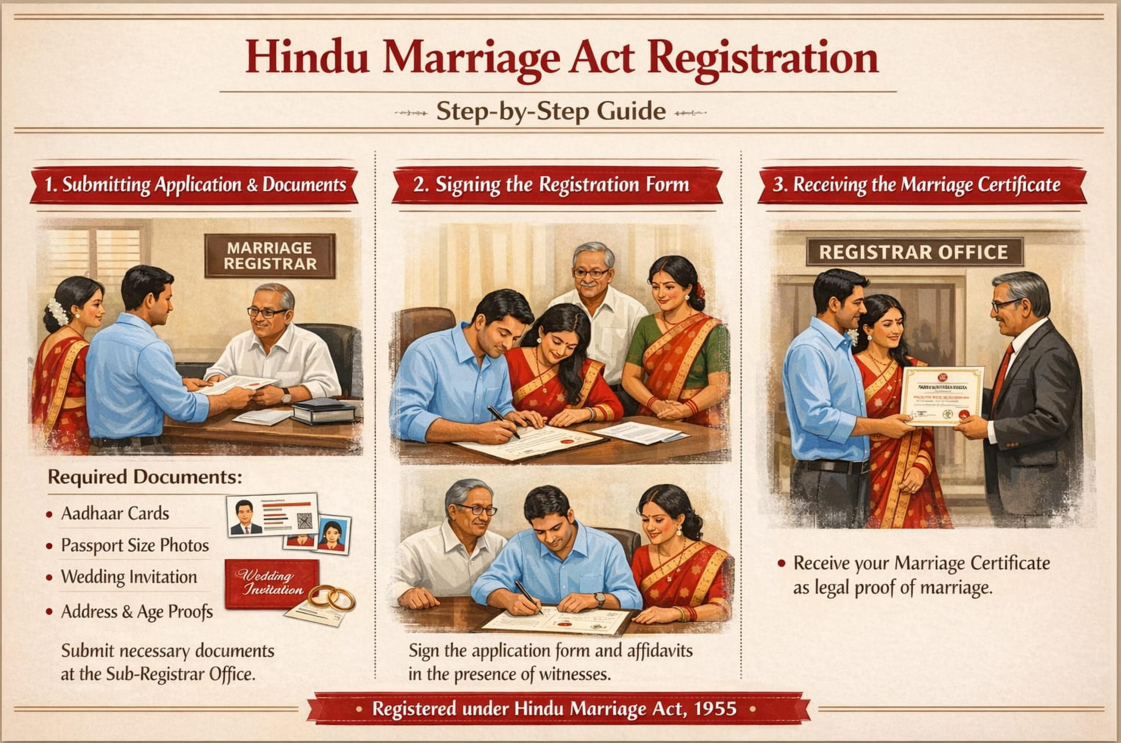
    1. Visit the office of the Marriage Registrar.
    2. Submit the prescribed application form, usually available through the Sub-Divisional Magistrate office.
    3. Provide the required documents along with identity and address proof.
    4. Witnesses (generally three, depending on applicable law) must be present.
    5. The marriage certificate is usually issued within 15–30 days depending on state procedures.

    Online Procedure for Hindu Marriage Registration

    Many states now provide online registration facilities through official government portals. The general process includes the following steps:

    1. Visit the official State e-District or Marriage Registration portal.
    2. Book an appointment with the Marriage Registrar.
    3. Fill out the online application form.
    4. Upload the required documents.
    5. Appear before the Sub-Divisional Magistrate for verification if required.
    6. Receive the digitally issued Marriage Certificate.

    Landmark Case Law: Smt. Seema v. Ashwani Kumar (AIR 2006 SC 1158)

    In this landmark judgment, the Hon’ble Supreme Court held that marriages in India should be compulsorily registered irrespective of religion. The ruling aimed to prevent child marriages, bigamy, and fraudulent practices while protecting the rights of women.


    Conclusion

    Although registration is not mandatory for the validity of a Hindu marriage, it is strongly recommended for legal security and documentation.

    The Hindu Marriage Act, 1955 plays an important role in authenticating marriages. Ceremonies such as Saptapadi (mentioned under Section 7) complete the solemnization of marriage, while registration provides official documentary proof.

    Marriage registration strengthens legal protection, promotes women’s welfare, and helps prevent fraudulent practices such as bigamy and child marriage.

    While traditional ceremonies remain culturally significant, obtaining a marriage certificate is essential for matters such as visas, loans, joint property ownership, insurance claims, and inheritance.

    Need assistance with marriage registration?
    Get Professional Registration Support


    Frequently Asked Questions

    Is it necessary to register a marriage under the Hindu Marriage Act?

    Answer: Registration is not mandatory for the validity of the marriage, but obtaining a marriage certificate is highly important as legal proof.

    What is the minimum age for marriage under the Hindu Marriage Act?

    Answer: The minimum age is 21 years for the groom and 18 years for the bride.

    Is a legal advisor required for Hindu Marriage registration?

    Answer: No, a legal advisor is not mandatory. However, professional guidance can help ensure a smoother and error-free registration process.

  • SPECIAL MARRIAGE ACT 1954: A STEP-BY-STEP REGISTRATION GUIDE FOR COUPLES

    SPECIAL MARRIAGE ACT 1954: A STEP-BY-STEP REGISTRATION GUIDE FOR COUPLES

    Introduction:

    In Indian Society, Marriage holds a sacred place and the Special Marriage Act promotes a framework how individual can marry through a civil procedure which is irrespective of religion, caste or creed.

    The Act permits individuals to marry outside their faith by laying down conditions relating to age, eligibility, soundness of mind and safeguarding towards the individual rights.

    Moreover, the Act creates certain complexities; it actively drives progressive social change by encouraging inter-caste and inter-faith marriages.

    Evolution and legislative Framework:

    The Legislature enacted this provision in newly independent India to establish an effective legislative framework.

    The Special Marriage act, 1954 was intended to regulate a special type of marriage by though a compulsory registration and certification which is an essential aspect in order to legalize the aspect of marriage.

    This act is applicable to all the Indian whether they live in India or outside.


    Basic Requirements For Registration:

    1) Both the parties must be Indian Citizen
    2) The parties must be in full consent of the marriage
    3) If any of the parties had an n earlier marriage then it has to been legally dissolved.
    4) The age limit of the male should be 21years and female should be at least eighteen years.

    5) The marriage is too solemnized in front of the marriage officer and three witnesses.
    6) Should have a copy for marriage notice book.

    Special Marriage Act
    Special Marriage Act

    Special Marriage Act Procedure:

    Why Does Registration Of Marriage Matter So Much Under The Special Marriage Act?

    This is an eminent step towards entering in to recognition of registration of the marriage which also symbolizes as secure and protection towards the couple.

    An application will be duly mandatory for both the parties in order to refrain from any objections of marriage.

    A marriage officer will be appointed and will give a notice period of 30 days as a mandatory enquiry.

    Now, within this period if any issue arises from any of the parties , then the marriage cannot be solemnized and therefore it might led to for an enquiry which will be conducted by the marriage officer.


    Legal Problems That Are Being Faced Under This Provision:

    1) This act compels both the parties to wait for the Mandatory one month notice period for any objection as per mentioned in section 5 of the act.

    The problem that arises is that the law provides an intimation of the parties which sometimes led to violation of privacy as the notice will be displayed publicly outside the Marriage Officers.

    Under such circumstances, this can lead to the individual’s life jeopardized and harm personal liberty.

    2) Another important issue that arises as per section 7 that any person may object before the expiration of thirty days’ notice period.

    This sometimes led to confusions, societal pressure which might cause insufficient and weak towards the existing protection. This creates a negative aspect to the socio culture belief leading to emotional coercion.

    3) Special Marriage acts aims to provide with a vision of secular marriage so that through this act so it does not create tension between the individual.

    However, a substantial segment of the population is unaware of the measures which lead to socio cultural oppression.

    4) Procedural regulation is often delayed which causes objections, regulations, lack of uniformity, harassment to both the intended parties.

    5) Last but not the least due to issuance of the notice of 30 days period publicly creates an objection towards infringement of Right to Privacy under article 21 of Constitution , were the disclosure of personal information such data of the individuals breaks the limits provided in section 5 and 7.


    Recent Legal Issues:


    FORGERY OF THE CERTIFICATE: Recently, in Allahabad High Court passed an
    order stating that a marriage which is being held under this act is only valid if there is no unlawful conversion of certificate.

    If one of the intended parties illegally found in conversion of certificate then the marriage will not be held valid.

    PIL FILLED AGAINST 30 DAYS NOTICE PERIOD: A Public Interest litigation
    was filled under Special Marriage Act, 1954 stating that the parties who intended to marry must obey the one month notice before solemnizing the marriage.

    This PIL was filled in Supreme Court, 2020. Later on the Petition was heard and dismissed as they found no such reason to be discussed upon.

    However, in April 2023 D Y CHANDRACHUD confronted and stated about the Provision to be “Patriarchal”.

    The major concern about this notice is that it raises a regime to privacy infringement and safety concern of the couple which are being exposed to public officially during the 30 days period.


    Conclusion:


    As we reach the end, we can conclude that The Special Marriage Act provides an exhaustive details relating the institution of marriage, promotes secular and empowers the people to believe in inter- caste and inter – faith marriages but also lacks in procedural segments that undermines privacy, safety and personal wellbeing to the individual parties.

    Planning an inter-faith or civil marriage? Don’t let bureaucratic hurdles delay your special day. We assist couples with document verification and the 30-day notice period to ensure a hassle-free registry marriage.

    Simplify Your Marriage Registration:

    Frequently Asked Questions:


    Q`1. Why does 30 days notice period is considered so essential and does it affect to an individual privacy?

    When the Special Marriage Act was enacted in 1954, the lawmakers intended to create a secular law for inter-faith or inter-caste couples. The 30-day notice (under Section 5 and 6) was designed as a public fraud-check mechanism.
    Public Scrutiny: The law requires the Marriage Officer to display a notice containing the couple’s names, addresses, photos, and occupation on a public board for 30 days.
    Inviting Objections: The purpose is to allow anyone to object if the marriage violates the law. The specific grounds for objection are:
    Bigamy: If one party is already married.
    Prohibited Relationship: If the parties are related by blood (incest).
    Age: If the groom is under 21 or the bride is under 18.
    Unsound Mind: If one party is mentally unfit to consent.

    Q2. How does this act provides protection and privacy to the couples?

    The Special Marriage Act (SMA) primarily protects couples by allowing them to marry without religious conversion, preserving their individual identities.
    It serves as a secular legal shield that overrides family objections and validates inter-faith unions.
    Regarding privacy, while the original law required a 30-day public notice, recent
    High Court rulings (like Safiya Sultana) have held that couples can opt out of this display to prevent harassment.
    Additionally, an SMA application acts as legal proof to secure immediate police protection and access to safe houses if the couple faces threats of violence.

    Q3. How procedural lapses causes unnecessary delays in this
    provision?

    Procedural lapses primarily stem from bureaucratic overreach. Marriage Officers sometimes demand documents not required by law (like parental no-objection certificates) or delay the process to investigate frivolous objections raised by the public under Section 8.
    Since the Act mandates an inquiry for every objection, a simple administrative lapse or a false claim can pause the marriage for an additional 30 days.
    Furthermore, minor clerical errors in the Notice of Intended Marriage often force couples to restart the entire notice period.