Introduction
The Hindu Marriage Act, 1955 applies to the whole of India (originally excluding Jammu & Kashmir) and governs marriages among Hindus. The Act came into force on 18th May 1955.
This Act applies to any person who is a Hindu by religion, including Buddhists, Jains, and Sikhs. It does not apply to Muslims, Christians, Parsis, or Jews unless specifically provided under law.
Why Is Registration of Marriage Important?
A Marriage Certificate is crucial to establish a lawful and legally recognized marriage. Marriage registration serves as official legal proof and protects the rights of both spouses.
Registration acts as substantial evidence of marriage and safeguards individuals—especially women—from issues such as fraud, bigamy, and denial of marital rights.
It also helps couples avoid legal complications related to property rights, visas, bank accounts, insurance, inheritance, and other official matters.
Conditions for a Valid Hindu Marriage
A marriage between two Hindus can be legally solemnized if the following conditions are fulfilled:
- Neither party has a living spouse at the time of marriage.
- Both parties give lawful and free consent.
- The groom must be at least 21 years old and the bride must be at least 18 years old.
- The parties must not fall within the degrees of prohibited relationship unless permitted by custom or usage.
Legal Provisions for Registration (Section 8)
- Registration of Hindu marriages is governed under Section 8 of the Hindu Marriage Act, 1955.
- The State Government appoints a Marriage Registrar for this purpose.
- Rules framed under this section must be laid before the State Legislature.
- Failure to comply with prescribed rules may attract a nominal fine depending on state rules.
- Although non-registration does not invalidate the marriage, registration provides strong legal evidence.
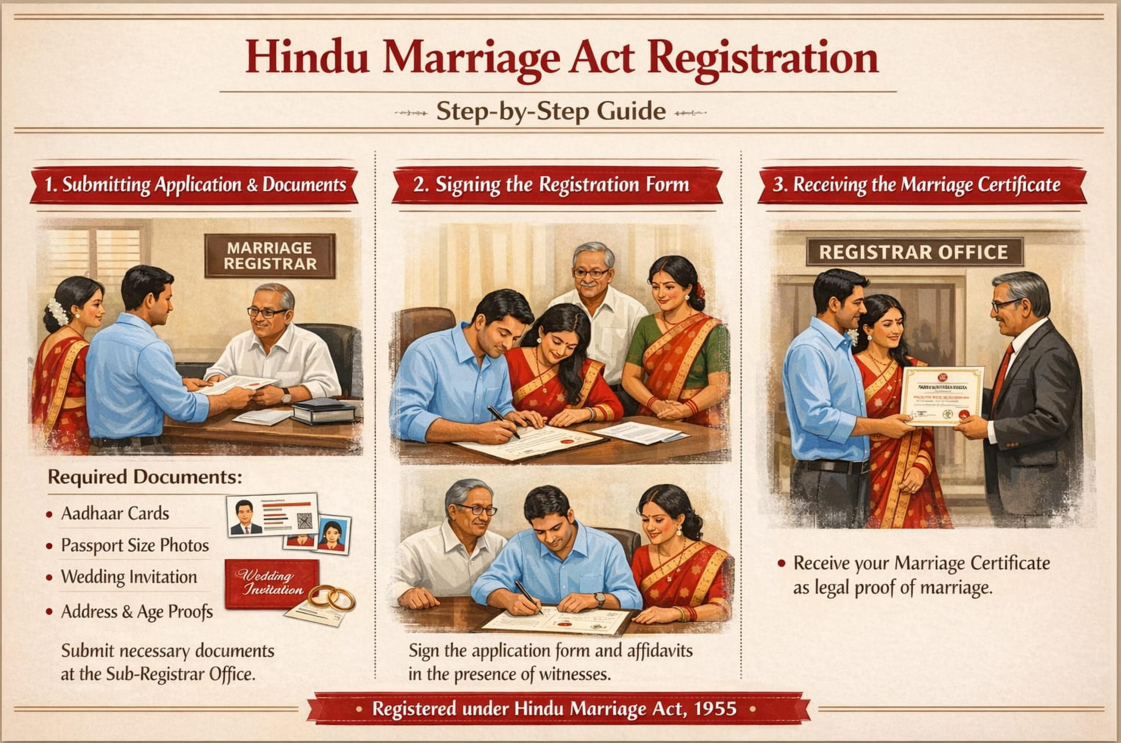
Offline Procedure for Hindu Marriage Registration
- Visit the office of the Marriage Registrar.
- Submit the prescribed application form, usually available through the Sub-Divisional Magistrate office.
- Provide the required documents along with identity and address proof.
- Witnesses (generally three, depending on applicable law) must be present.
- The marriage certificate is usually issued within 15–30 days depending on state procedures.
Online Procedure for Hindu Marriage Registration
Many states now provide online registration facilities through official government portals. The general process includes the following steps:
- Visit the official State e-District or Marriage Registration portal.
- Book an appointment with the Marriage Registrar.
- Fill out the online application form.
- Upload the required documents.
- Appear before the Sub-Divisional Magistrate for verification if required.
- Receive the digitally issued Marriage Certificate.
Landmark Case Law: Smt. Seema v. Ashwani Kumar (AIR 2006 SC 1158)
In this landmark judgment, the Hon’ble Supreme Court held that marriages in India should be compulsorily registered irrespective of religion. The ruling aimed to prevent child marriages, bigamy, and fraudulent practices while protecting the rights of women.
Conclusion
Although registration is not mandatory for the validity of a Hindu marriage, it is strongly recommended for legal security and documentation.
The Hindu Marriage Act, 1955 plays an important role in authenticating marriages. Ceremonies such as Saptapadi (mentioned under Section 7) complete the solemnization of marriage, while registration provides official documentary proof.
Marriage registration strengthens legal protection, promotes women’s welfare, and helps prevent fraudulent practices such as bigamy and child marriage.
While traditional ceremonies remain culturally significant, obtaining a marriage certificate is essential for matters such as visas, loans, joint property ownership, insurance claims, and inheritance.
Need assistance with marriage registration?
Get Professional Registration Support
Frequently Asked Questions
Is it necessary to register a marriage under the Hindu Marriage Act?
Answer: Registration is not mandatory for the validity of the marriage, but obtaining a marriage certificate is highly important as legal proof.
What is the minimum age for marriage under the Hindu Marriage Act?
Answer: The minimum age is 21 years for the groom and 18 years for the bride.
Is a legal advisor required for Hindu Marriage registration?
Answer: No, a legal advisor is not mandatory. However, professional guidance can help ensure a smoother and error-free registration process.
Leave a Reply