Tag: lawizer

  • Legal Consultation Online: How Lawizer Connects You to Experts 24/7

    Introduction

    Online legal consultation has witnessed tremendous growth, especially in India, where digital adoption continues to rise rapidly.

    The legal industry has undergone a major transformation in recent years. What was once considered traditional and conservative has now evolved into a more accessible, approachable, and affordable model.

    Today, individuals and businesses prefer quick, remote, and secure legal advice over traditional in-office visits. This shift has reshaped how legal services are delivered.


    What is Online Legal Consultation?

    Online legal consultation refers to seeking legal advice, document review, or case strategy guidance through digital platforms.

    This may include:

    • Video consultations
    • Phone consultations
    • Chat-based legal advice
    • Email-based legal opinions
    • Digital document review

    Instead of physically visiting a lawyer’s office, clients can now access professional legal support remotely through legal-tech platforms and law firm websites.


    Why Online Legal Consultation Has Escalated Over Time

    1. Increased Legal Awareness

    More individuals are aware of their legal rights and prefer taking preliminary advice before escalating disputes. This proactive approach has increased demand for quick consultations.


    2. Startup & MSME Growth

    The rise of startups and MSMEs has significantly increased the need for affordable legal advice related to:

    • Contracts
    • Compliance
    • Business incorporation
    • Regulatory filings

    Entrepreneurs now seek faster legal clarity without long appointment delays.


    3. Digital Trust & Security

    Secure payment gateways, encrypted communication systems, and verified lawyer networks have strengthened public trust in online legal services.


    4. Government Digital Integration

    Digital filings under the Ministry of Corporate Affairs and the expansion of e-court initiatives have supported the growth of online legal consultation.

    Legal processes are becoming increasingly technology-driven, making remote consultation more practical than ever.


    The Future of Online Legal Consultation

    Online legal services are expected to integrate advanced technologies such as:

    • AI-powered legal assistance
    • Automated document drafting
    • Predictive case analysis
    • Blockchain-based documentation security

    The legal profession is steadily transitioning into a tech-enabled service ecosystem.


    How Lawizer Connects You to Legal Experts 24/7

    Legal issues don’t arise only during office hours. Whether it’s a compliance concern, police-related matter, contract dispute, or women’s safety issue, timely legal advice is critical.

    Lawizer bridges this gap by offering 24/7 digital connectivity to verified legal experts.

    Here’s how the system works:


    1. Instant Digital Access

    Lawizer allows users to raise legal queries anytime—day or night.

    Users can:

    • Submit their issue online
    • Select consultation type
    • Request immediate assistance

    This removes geographical and time barriers completely.


    2. Verified Expert Network

    Lawizer connects clients with verified and experienced lawyers across practice areas such as:

    • Criminal law
    • Family law
    • Corporate compliance
    • Property disputes
    • Women-centric legal matters

    Every expert is vetted before onboarding to ensure professional reliability.


    3. Smart Case Matching System

    Once a user submits a query, the platform categorizes it based on legal domain and urgency.

    The case is routed to the most suitable expert, ensuring:

    • Faster response time
    • Domain-specific advice
    • Accurate legal direction

    This eliminates random allocation and improves consultation efficiency.


    4. Multiple Consultation Modes

    To maintain 24/7 availability, Lawizer offers flexible communication options:

    • Call consultations
    • Video meetings
    • Chat-based advisory
    • Document review support

    Users can choose the format that suits their urgency and comfort.


    5. Immediate Response for Urgent Matters

    For emergencies such as police involvement, threats, or sensitive disputes, Lawizer prioritizes rapid lawyer connection.

    This ensures users receive immediate legal clarity when time is critical.


    6. Transparent and Structured Process

    From booking to payment and follow-ups, the system is fully digital and streamlined.

    This reduces delays and ensures smooth communication between clients and legal experts.


    7. Continuous Support Model

    Unlike traditional systems restricted to office hours, Lawizer’s digital-first structure ensures legal assistance remains accessible round the clock.


    Conclusion

    Online legal consultation has evolved from a convenience-based alternative into a mainstream legal service model.

    Lawizer connects users to legal experts 24/7 through digital accessibility, verified professionals, smart case allocation, and flexible consultation modes.

    By eliminating time and location barriers, it ensures that professional legal support is always within reach—whenever it is needed most.


    Frequently Asked Questions

    What is online legal consultation?

    Answer: It is the process of seeking legal advice digitally through calls, video meetings, chat, or document review.

    Is online legal consultation reliable?

    Answer: Yes, when conducted through verified platforms like Lawizer with vetted legal professionals.

    How quickly can I connect with a lawyer on Lawizer?

    Answer: Users can raise queries instantly and get connected based on urgency and case type.

    Is online legal advice confidential?

    Answer: Yes, consultations are conducted through secure and encrypted communication systems.

    Can businesses use Lawizer for compliance support?

    Answer: Yes, startups and MSMEs can seek assistance for contracts, incorporation, and regulatory compliance.



  • The Essential Checklist for Business Incorporation in India (2026)

    Introduction

    In 2026, forming a company in India has become significantly easier due to digital platforms and integrated regulatory systems.

    However, business incorporation still requires proper planning, documentation, and strict compliance with legal formalities.

    This essential checklist will help you with the entire process to ensure your company is incorporated smoothly, legally, and successfully.


    Why Proper Incorporation Planning Matters

    Choosing the right structure and completing regulatory steps correctly helps:

    • Protect personal liability
    • Ensure tax compliance
    • Build investor confidence
    • Avoid future legal disputes
    • Establish long-term operational stability

    Let’s break down the step-by-step incorporation process.


    1. Decide Your Business Structure

    Before starting the incorporation process, choose the most suitable legal structure based on your goals:

    • Private Limited Company – Ideal for startups seeking funding
    • One Person Company (OPC) – Suitable for solo entrepreneurs
    • Limited Liability Partnership (LLP) – Limited liability with simpler compliance
    • Partnership Firm – Suitable for small professional ventures
    • Sole Proprietorship – Simple structure but no limited liability

    Your decision impacts taxation, funding opportunities, compliance burden, and liability protection.


    2. Obtain Digital Signature Certificate (DSC)

    A Digital Signature Certificate (DSC) is mandatory for filing electronic documents.

    • Directors and authorized signatories must obtain DSC from licensed certifying agencies.
    • It serves as your official digital identity for government filings.

    3. Apply for Director Identification Number (DIN)

    Every proposed director must obtain a Director Identification Number (DIN) from the Ministry of Corporate Affairs.

    • DIN is a unique 8-digit identification number.
    • It is mandatory before submitting incorporation documents.

    4. Name Reservation (RUN / SPICe+)

    Choosing a compliant and unique business name is a crucial step.

    Ensure that:

    • The name is not identical to an existing company or trademark.
    • It complies with MCA naming guidelines.
    • It reflects your business activity and brand identity.

    You can reserve the name through:

    • RUN (Reserve Unique Name)
    • SPICe+ incorporation form

    5. Draft Key Company Documents

    You must prepare foundational legal documents:

    Memorandum of Association (MOA)

    Defines the company’s objectives and permitted activities.

    Articles of Association (AOA)

    Specifies internal governance rules and shareholder rights.

    These documents form the legal backbone of your company.


    6. Prepare Registered Office Proof

    Every company must have a registered office in India.

    Required documents include:

    • Utility bill (issued within last 2 months)
    • Rent agreement (if applicable)
    • No Objection Certificate (NOC) from property owner

    This address becomes the official communication point for government correspondence.


    7. File Incorporation Forms (SPICe+)

    The primary step is filing the SPICe+ (Simplified Proforma for Incorporating Company Electronically) form via the MCA portal.

    SPICe+ covers:

    • Company registration
    • PAN and TAN allotment
    • GST registration (if applicable)
    • EPFO/ESIC registration (if applicable)
    • Bank account integration

    This integrated filing system reduces duplication and speeds up approvals.


    8. PAN, TAN & Bank Account Setup

    After approval:

    • PAN (Permanent Account Number) is auto-generated
    • TAN (Tax Deduction Account Number) is issued
    • Open a current business bank account
    • Deposit initial share capital

    These steps activate your company financially.


    9. GST Registration (If Applicable)

    GST registration is mandatory if:

    • Your turnover exceeds prescribed thresholds
    • You engage in inter-state trade
    • Your business falls under notified categories

    Early GST registration ensures smooth compliance and invoicing.


    10. Post-Incorporation Compliance

    After incorporation, companies must:

    • Appoint a statutory auditor (within 30 days)
    • Conduct first board meeting (within 30 days)
    • Issue share certificates
    • File commencement of business declaration (if required)
    • Maintain statutory registers

    Annual compliance includes financial statements, annual returns, and tax filings.


    Document Checklist for Business Incorporation

    ✔ Director’s identity proof (PAN, Aadhaar, Passport)
    ✔ Director’s address proof
    ✔ Passport-sized photographs
    ✔ Registered office proof
    ✔ MOA & AOA drafts
    ✔ Consent to act as director
    ✔ Digital Signature Certificate details


    Key 2026 Considerations

    Business incorporation in 2026 involves:

    • Increased digital verification
    • Stronger KYC norms
    • Integrated MCA-GST-tax systems
    • Higher penalties for non-compliance

    Staying updated with regulatory changes is essential.


    Conclusion

    Incorporating a business in India in 2026 is faster and more streamlined than ever before. However, precision in documentation and compliance remains critical.

    By following this essential checklist, you ensure your business is legally structured, financially prepared, and ready for sustainable growth.

    Whether you are launching a startup or expanding operations, proper incorporation sets the foundation for long-term success.


    Frequently Asked Questions (FAQs)

    How long does business incorporation take in India?

    Answer: Typically, it takes 7–15 working days, depending on documentation and approvals.

    Is DIN mandatory for all directors?

    Answer: Yes, every proposed director must obtain a valid DIN.

    Is GST registration compulsory for every company?

    Answer: No, it depends on turnover thresholds and business nature.

    Can I incorporate a company completely online?

    Answer: Yes, the entire incorporation process is digital through the MCA portal.

    What is the most preferred business structure in India?

    Answer: Private Limited Company is commonly preferred for startups and growth-focused businesses.


  • The Role of Lawizer in Scaling Your Fintech Startup Compliantly in India

    The Role of Lawizer in Scaling Your Fintech Startup Compliantly in India

    Introduction

    In the rapidly evolving digital economy of India, fintech startups are no longer just “apps”—they are sophisticated financial institutions operating under the watchful eye of multiple regulators.

    As of 2026, the mantra for success has shifted from “growth at any cost” to “growth through compliance”.

    For a founder, navigating the labyrinth of Indian financial laws while trying to scale is a Herculean task. This is where Lawizer transforms from a service provider into a strategic partner.

    Lawizer is a high-velocity legal-tech platform designed to provide the infrastructure that fintechs need to remain compliant without sacrificing speed.


    The Regulatory Framework of Indian Fintech

    To scale a fintech startup in India, you must understand the three key regulatory pillars: RBI, SEBI, and the DPDP Act.

    RBI’s Digital Lending Framework

    The Reserve Bank of India (RBI) has introduced strict norms under its Digital Lending Directions. Startups acting as Lending Service Providers (LSPs) must ensure:

    • Fund Flow Transparency: Direct transfer from bank/NBFC to borrower; no pool accounts allowed.
    • Key Fact Statement (KFS): Clear disclosure of APR, total loan cost, and recovery terms.
    • Grievance Redressal: Appointment of a nodal officer for complaints.

    Payment Aggregator (PA) Guidelines

    Fintechs handling merchant payments must comply with RBI’s Payment Aggregator framework:

    • Net Worth Requirement: Must reach ₹25 Crore within the prescribed time.
    • Escrow Mechanism: Merchant funds must be routed through regulated escrow accounts.

    Digital Personal Data Protection (DPDP) Act

    Data protection is now a core legal requirement under the DPDP Act:

    • Consent Architecture: Users must be able to give, manage, and withdraw consent.
    • Data Minimization: Only necessary data can be collected.
    • Penalties: Non-compliance can lead to heavy financial penalties.

    How Lawizer Supports Fintech Startup Formation

    Forming a fintech startup requires a legally robust structure that supports funding and compliance. Lawizer simplifies this process:

    Choosing the Right Legal Structure

    • Private Limited Company: Ideal for startups seeking funding and credibility.
    • One Person Company (OPC): Suitable for solo founders.
    • Limited Liability Partnership (LLP): Offers flexibility for partner-led businesses.

    Tax and Business Registrations

    Intellectual Property Protection

    • Trademark Registration: Protects brand identity.
    • Copyright Registration: Secures software and digital assets.

    Scaling and Compliance Support

    As fintech startups grow, compliance becomes an ongoing requirement. Lawizer ensures continuous support:

    • Annual Compliance: Filing and regulatory requirements for companies and LLPs.
    • Corporate Governance: Managing directors, addresses, and legal changes.
    • SOS Feature: Immediate assistance for legal notices and urgent issues.
    • Consultation Support: Access to verified professionals for legal advice.

    Conclusion

    Scaling a fintech startup in India requires navigating complex and evolving regulations.

    From RBI compliance to data protection under the DPDP Act, every aspect of the business must align with legal requirements.

    Lawizer simplifies this journey by automating compliance, managing documentation, and connecting founders with legal experts.

    In a highly regulated environment, having a reliable legal-tech partner ensures sustainable growth and minimizes risk.


    Frequently Asked Questions

    Is Lawizer a law firm?

    Answer: No, Lawizer is a legal-tech platform that connects users with verified professionals and automates legal processes.

    Where is Lawizer based?

    Answer: Lawizer is based in West Bengal, India.

    Is Lawizer legitimate?

    Answer: Yes, Lawizer is an initiative of Zeptus Pvt Ltd and operates as a registered digital service provider.

    Do I need an NBFC license to start a lending app?

    Answer: Yes, if you lend your own funds. Otherwise, you can operate as an LSP under RBI guidelines.

    What is a Regulatory Sandbox?

    Answer: It is a framework by RBI and SEBI that allows fintech startups to test innovative products in a controlled environment.

  • Step-by-Step Guide to GST Registration for Small Shop Owners

    Step-by-Step Guide to GST Registration for Small Shop Owners

    Introduction

    GST registration is a transformative step for any sole proprietorship in India. It is the bridge that transitions a small local business into a legally recognized, tax-compliant entity.

    While the government has digitized the process through integrated portals, the journey often remains challenging due to rigorous documentation and legal verification requirements.

    The Goods and Services Tax (GST) law can be overwhelming for individual shop owners.

    However, utilizing Lawizer, a leading legal-tech solution, enables a stress-free registration process through direct consultations with verified legal experts.


    Understanding GST for Small Store Owners

    GST is a comprehensive, destination-based indirect tax that replaced the fragmented old system of VAT, Service Tax, and Excise Duty. For a small business owner, the business and the individual are legally inseparable.

    Consequently, your Permanent Account Number (PAN) acts as the primary identifier for your 15-digit GST Identification Number (GSTIN).

    Breaking Down the GSTIN

    • First 2 digits: State Code.
    • Next 10 digits: Proprietor’s PAN.
    • Last 3 digits: Entity number, default character, and checksum digit.

    Why Should You Register Today?

    Registering under GST is not just a legal requirement. It opens up growth opportunities for your business and builds long-term credibility.

    1. Legal Compliance: Every business exceeding the threshold limit must register to avoid heavy legal penalties.
    2. Input Tax Credit (ITC): You can claim back the GST paid on business purchases such as furniture, laptops, or shop rent.
    3. Market Expansion: Many large corporations and B2B clients only collaborate with GST-compliant vendors.
    4. E-Commerce Access: A GSTIN is mandatory to sell products on platforms like Amazon, Flipkart, or Myntra.

    2026 Thresholds: When is GST Registration Compulsory?

    As of 2026, the following turnover limits apply to sole proprietorships in India:

    Category Mandatory Threshold
    Service Providers Annual turnover exceeding ₹20 Lakhs
    Goods Suppliers Annual turnover exceeding ₹40 Lakhs
    Special Category States ₹10 Lakhs for services / ₹20 Lakhs for goods

    Zero-Threshold Cases (Mandatory Regardless of Turnover):

    You must register if you:

    • Engage in interstate sales.
    • Sell through e-commerce platforms.
    • Operate as a Casual Taxable Person.

    The 6-Step GST Registration Process

    Step 1: Initiation via Part A

    Visit the official GST portal. Provide PAN, mobile number, and email. After OTP verification, a Temporary Reference Number (TRN) is generated.

    Step 2: Business Details

    Log in using TRN and complete Part B by entering trade name, selecting proprietorship, and stating the reason for registration.

    Step 3: Document Uploads

    • Identity Proof: Aadhaar Card and PAN Card
    • Photograph: Proprietor’s image
    • Address Proof: Rent agreement, NOC, or utility bills
    • Bank Proof: Cancelled cheque or passbook copy

    Step 4: Aadhaar Authentication

    An Aadhaar-based e-KYC verification is required. Successful verification may eliminate physical inspection.

    Step 5: Officer Verification

    An officer reviews your application. If needed, a clarification notice (REG-03) is issued, which must be answered within 7 working days.

    Step 6: GSTIN Generation

    Upon approval, your GSTIN and Registration Certificate (Form REG-06) are issued. Download and display it at your place of business.


    How Does Lawizer Make the Process Seamless?

    GST registration can be complex, and errors often lead to delays. Lawizer connects business owners with professionals like Chartered Accountants and Company Secretaries to simplify the process.

    Why Choose Lawizer?

    • Expert Oversight: Ensures documentation meets government standards.
    • Fast Response: Provides quick consultations.
    • Virtual Office Solutions: Helps with business address documentation.
    • Query Handling: Experts manage government notices and responses.
    • Affordable: Free consultation with transparent pricing.

    Get GST Registered Without Hassle. Choose Lawizer Today!


    Frequently Asked Questions

    What is Central GST (CGST)?

    A: CGST is the tax levied by the Central Government on intra-state transactions.

    What is State GST (SGST)?

    A: SGST is the tax levied by the State Government on intra-state transactions.

    What is Integrated GST (IGST)?

    A: IGST applies to inter-state transactions and is collected by the Central Government.

    Are there fees for registration?

    A: While the government portal is free, Lawizer charges a service fee for handling documentation and filing.

    How long does the process take?

    A: Typically, GSTIN is issued within 3 to 10 working days after successful Aadhaar authentication.

    Is Lawizer a registered company?

    A: Yes. Lawizer is an initiative of Zeptus Private Limited, a registered entity in India.

  • Why Your Brand Needs Trademark Registration in India Today?

    In the hyper-competitive Indian market, your brand name isn’t just a label—it is a vital business asset.

    Many founders make the mistake of thinking a Domain Name or a Company Registration (RoC) gives them ownership of their brand.

    However, in the eyes of Indian law, a domain name is merely an address, and a RoC provides a legal identity but zero Intellectual Property (IP) protection.

    Without a registered trademark, you are building your business on a weak foundation. Lawizer, a leading legal-tech platform, offers the most efficient way to secure your brand.


    1. The Shield and Sword of Your Business:

    A trademark acts as both a defensive shield and an offensive sword under the Trade Marks Act, 1999. Registration grants you the exclusive right to use your brand name, logo, and tagline nationwide.

    • The Shield: It prevents others from feeding on your hard-earned reputation.
    • The Sword: It gives you the legal power to sue copycats who try to confuse your customers with similar-sounding names.

    2. The Power of the ® Symbol:

    The transition from a “TM” to an ® is more than just a character change; it’s a global signal of authenticity and trust.

    • Exclusive Rights: Grants sole legal authority to use your brand identity.
    • Statutory Weight: Provides the necessary legal standing to win infringement cases quickly.
    • Marketplace Entry: Most major e-commerce platforms and government tenders require a registered trademark for onboarding.

    3. Business Expansion and Franchising:

    If you plan to scale, franchise, or license your brand, trademark registration is mandatory.

    Investors and partners are more likely to fund brands with secured legal protection. A registered trademark allows you to enter “e-commerce” and international markets without the fear of brand theft.

    Costs and Duration to Register:

    • Affordability: Government charges are concessional for startups, individuals, and small enterprises.
    • Validity: Protection lasts for 10 years and is renewable indefinitely.
    • Timeline: The process typically takes 12 to 18 months.

    Key Industries Powered by Trademark Registration

    Trademarking is a strategic asset across these high-growth sectors:

    IndustryWhy It Matters
    Consumer GoodsPrevents “look-alike” products in crowded markets.
    Food & BeverageProtects unique packaging and brand names.
    HealthcareEnsures trust and stops dangerous counterfeit products.
    Tech & SoftwareSecures identity in fast-moving, innovative sectors.
    Luxury & FashionPreserves exclusivity by stopping counterfeiters.

    Key Industries Powered by Trademark Registration

    Trademarking is a strategic asset across these high-growth sectors:

    IndustryWhy It Matters
    Consumer GoodsPrevents “look-alike” products in crowded markets.
    Food & BeverageProtects unique packaging and brand names.
    HealthcareEnsures trust and stops dangerous counterfeit products.
    Tech & SoftwareSecures identity in fast-moving, innovative sectors.
    Luxury & FashionPreserves exclusivity by stopping counterfeiters.

    Key Industries Powered by Trademark Registration

    Trademarking is a strategic asset across these high-growth sectors:

    IndustryWhy It Matters
    Consumer GoodsPrevents “look-alike” products in crowded markets.
    Food & BeverageProtects unique packaging and brand names.
    HealthcareEnsures trust and stops dangerous counterfeit products.
    Tech & SoftwareSecures identity in fast-moving, innovative sectors.
    Luxury & FashionPreserves exclusivity by stopping counterfeiters.

    Key Industries Powered by Trademark Registration

    Trademarking is a strategic asset across these high-growth sectors:

    IndustryWhy It Matters
    Consumer GoodsPrevents “look-alike” products in crowded markets.
    Food & BeverageProtects unique packaging and brand names.
    HealthcareEnsures trust and stops dangerous counterfeit products.
    Tech & SoftwareSecures identity in fast-moving, innovative sectors.
    Luxury & FashionPreserves exclusivity by stopping counterfeiters.

    How Lawizer Simplifies the Process:

    Lawizer, an initiative of Zeptus Pvt Ltd, makes the journey from “TM” to “®” easy and stress-free.

    Lawizer Prerequisites:

    To get started, you will need the following documents:

    For Individuals / Startups / MSMEs:
    • Applicant’s PAN Card & Aadhaar
    • Address Proof
    • MSME/Udyam Certificate (for a 50% government fee concession)
    For Companies / LLPs / Partnerships:
    • Incorporation Certificate / Partnership Deed
    • PAN Card of the Entity
    • TM-48 Form (Authorizes our legal experts)

    What You Receive Through the Lawizer Portal:

    1. Instant TM Number: Use the “TM” symbol immediately after filing.
    2. Objection Management: Our experts handle “Examination Reports” to keep your application moving.
    3. Emergency SOS Button: Connect with an advocate within 2-3 minutes for urgent help.
    4. Free Consultation: Expert guidance for all first-time users.

    Conclusion: Legitimizing Your Innovation:

    In the “move fast and break things” culture of startups, don’t let your brand equity be the thing you break. Trademark registration is a business asset that increases your valuation during funding rounds.

    Secure Your Brand Today:

    Stop wondering if your brand is safe. Get expert guidance and end-to-end support with Lawizer. We’ll get back to you within 24 hours.

    Frequently Asked Questions (FAQs):

    Q1. Can I register a domain name as a trademark?

    A: Yes. If customers identify your service through your URL (e.g., Lawizer.com), the domain itself can be your trademark.

    Q2. What is the benefit of MSME/Udyam Registration?

    A: It is a massive cost-saver. Filing fees are ₹9,000 for companies but only ₹4,500 for MSMEs/Startups. Lawizer helps you leverage these concessions.

    Q3. How do I handle an “Objection”?

    A: Objections are common. Lawizer provides end-to-end support for these hearings, drafting the necessary legal counter-statements for you.

    Q4. Is Lawizer a registered company?

    A: Yes. Lawizer is an initiative of Zeptus Private Limited, a registered entity in West Bengal, India.

    Q5. Is Lawizer a law firm?

    A: No, Lawizer is a digital legal platform that connects you with qualified and verified lawyers. It does not provide legal advice directly.

  • How to Use Lawizer’s SOS Button for Legal Emergencies in India

    How to Use Lawizer’s SOS Button for Legal Emergencies in India

    In India, finding legal help can be a challenge, especially during a crisis.

    Whether you are dealing with a wrongfully issued traffic challan, a cybercrime situation, or a threat to women’s safety, immediate access to professional counsel is vital.

    Lawizer is designed to provide that instant support.

    By bridging the gap between technology and the legal profession, it offers a real-time solution for those who need an emergency legal aid application or immediate advocate support when every second counts.

    What is Lawizer?

    Lawizer is a next-generation digital legal platform that makes legal support fast, simple, and affordable for individuals and startups.

    It is important to note that Lawizer is not a law firm and does not provide legal advice directly.

    Instead, it functions as a secure bridge connecting users with verified advocates before minor problems escalate into major legal battles.

    Key Features:

    • 24/7 Legal SOS Button: For urgent, real-time action.
    • Transparent Pricing: Zero hidden fees and a free first consultation.
    • Verified Experts: Choose advocates based on experience, language, and credentials.

    Steps to Use Lawizer’s SOS Emergency Button:

    The SOS feature acts as a “panic button,” connecting you with a legal expert within minutes. Follow these steps to get help:

    Step 1: Visit the Website:

    Use your mobile browser to search for Lawizer and open the official website.

    Step 2: Click the SOS Button:

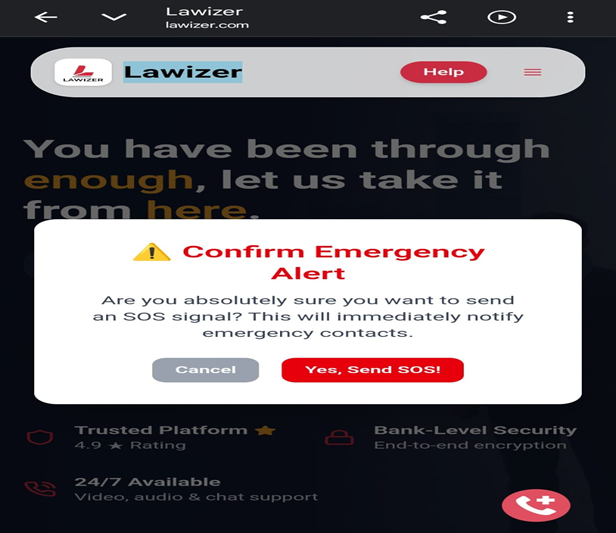
    On the homepage, locate and click the “Emergency SOS Button.”

    Step 3: Sign In or Register:

    You will be prompted to sign in. If you are a new user, enter your name, email, phone number, and a secure password.

    Step 4: Verify Your Email:

    Check your mailbox for a verification link to activate your account. This step is crucial for security.

    Step 5: Complete Your Profile:

    Log in and update your details, including your State and City. This helps the platform match you with a lawyer who understands your local jurisdiction.

    Step 6: Confirm the SOS Call:

    Click the Emergency SOS button once more to confirm. A phone number will appear on your dial pad. Call this number to be connected to an expert in 2–3 minutes.

    Tips for Efficient Communication During a Legal Crisis:

    When you are connected to a lawyer, providing structured information helps them protect you faster.

    1. Be Precise and Factual: Stick to the facts of the current situation.
    2. Share Evidence: Have your receipts, challans, or digital documents ready to share.
    3. Identify the Category: Specify if your issue is related to Criminal, Civil, Property, or Business law to bypass guesswork.
    4. Ask About Fees: While the first consultation is free, discuss future fee structures early to keep the process transparent.

    Conclusion:

    Lawizer’s 24/7 Legal SOS button empowers every Indian citizen to act with confidence during a crisis.

    By leveraging technology to provide real-time responses from verified experts, the platform ensures that help is always just a click away.

    Frequently Asked Questions (FAQs):

    Q1. Is Lawizer a legitimate company?

    A: Yes, Lawizer is an initiative of Zeptus Private Limited, registered in West Bengal, India.

    Q2. Is the first consultation really free?

    A: Yes. Lawizer offers the first consultation for free because they believe legal clarity should always come before cost.

    Q3. Can Lawizer help with cyber complaints or traffic police?

    A: Absolutely. The platform connects you with specialized lawyers for cybercrimes, traffic disputes, and general civil matters.

  • CORPORATE TAX FILING 101: A CHECKLIST FOR FILING ITR 6 FOR PRIVATE LIMITED COMPANIES

    CORPORATE TAX FILING 101: A CHECKLIST FOR FILING ITR 6 FOR PRIVATE LIMITED COMPANIES

    This blog will cover the basic requirements for filing ITR-6 , Importance of
    Corporate tax return India , ITR-6 Due date.

    ITR 6

    Introduction: Purpose Of Filing Under ITR-6:

    For filing under ITR-6 for the income tax return , it is especially done for
    companies which are incorporated under the Companies Act , 2013.

    This ensures not only reporting of income , deduction , taxes and transaction Filing an ITR-6 helps in maintaining the company whether is private or public, it keeps under a obligations effectively and systematically.

    Eligibility Criteria Of Filing ITR-6:

    The companies that are registered under the Companies Act 2013 should file
    ITR-6 . It includes Domestic Companies , Foreign Companies, Partnership Firms.

    Structure of the filing the ITR-6?

    • The Income Tax Department advices that are two parts and several
      schedules.
    • As a sequence wise they can file out a form by Part A , Schedules,
      Part B and Verification.

    How To File ITR-6 Form?

    This is generally done through compulsory electronically under digital signature to the income tax department.

    Filing Of ITR-6 Due Date:

    The due date for filing an income tax return is to be maintained by the is a assessee partner in a firm then the accounts is to be audited by 31st of October of the Assessment year.

    Benefits Of Filing In ITR-6?

    • It enhances and ensures transparency.
    • The collection of documents is required to be maintained for record
      purpose and tax audits statements.
    • It minimizes deduction and avoid penalties and interest charges.
    ITR 6

    Conclusion:

    The criteria and aspect of ITR-6 is detailed oriented and is only
    applicable to the companies.

    This helps companies in avoid penalties, interest and avoid tax compliance issue from tax authorities.

    Corporate Tax Doesn’t Have to Be Taxing. Private Limited Companies require precision—from balance sheets to audit reports.

    Don’t navigate the complex maze of corporate tax laws alone.

    Our team ensures your ITR-6 is filed with 100% accuracy and complete statutory compliance, letting you focus on growing your company.

    [Secure Your Corporate Tax Filing Services Now]

    Sources:

  • ITR-5 FILING GUIDE FOR PARTNERSHIP FIRMS AND LLPs: AVOID COMMON MISTAKES

    ITR-5 FILING GUIDE FOR PARTNERSHIP FIRMS AND LLPs: AVOID COMMON MISTAKES

    Introduction

    Many business entities such as partnership firms, Limited Liability Partnerships (LLPs), and associations are required to file their income tax returns every year. For these entities, the relevant tax return form is ITR-5.

    The procedure of filing ITR-5 is an important compliance requirement under the Income Tax Act. It helps businesses report their income, claim deductions, and ensure proper tax compliance with the Income Tax Department.

    Understanding the process of filing ITR-5, the due date, tax audit requirements, and applicable tax rates for partnership firms is essential for avoiding penalties and maintaining financial transparency.

    This guide explains the procedure of ITR-5 filing, LLP income tax returns, tax audit requirements, and the due date for filing ITR-5.


    What Is ITR-5?

    ITR-5 is the income tax return form used by certain business entities such as partnership firms, LLPs, and associations of persons.

    The form is designed to capture detailed financial information including business income, capital gains, deductions, and tax liabilities.

    ITR-5 is filed electronically through the Income Tax Department’s e-filing portal.


    Who Can File ITR-5?

    The following entities are eligible to file ITR-5:

    • Partnership Firms
    • Limited Liability Partnerships (LLPs)
    • Association of Persons (AOPs)
    • Body of Individuals (BOIs)
    • Co-operative Societies
    • Local Authorities

    However, individuals, Hindu Undivided Families (HUFs), and companies cannot use this form.


    Structure of the ITR-5 Form

    The ITR-5 form is comprehensive and contains several sections to report financial information accurately.

    The form is divided into two main parts:

    • Part A – General Information
    • Part B – Computation of Total Income and Tax Liability

    In addition, the form contains nearly 40 schedules used to report specific financial details such as capital gains, business income, deductions, and taxes paid.


    Procedure for Filing ITR-5

    The ITR-5 form must be filed electronically through the Income Tax Department’s e-filing portal.

    The return can be filed in the following ways:

    • Submitting the return electronically using a Digital Signature Certificate (DSC)
    • Uploading the return electronically and verifying it through e-verification methods

    After filing the return, the taxpayer must complete e-verification within 30 days of submission.


    Changes in ITR-5 Form (AY 2025-26)

    The Income Tax Department has introduced certain updates to the ITR-5 form for recent assessment years.

    • New reporting fields for high-value financial transactions exceeding ₹50 crore
    • Disclosure requirements for payments to Micro and Small Enterprises under Section 43B(h)
    • Additional reporting related to capital gains and specified securities

    These changes are intended to increase transparency and ensure proper reporting of financial transactions.


    Partnership Firm Tax Rate

    For the Assessment Year (AY) 2026-27, partnership firms including LLPs are taxed at a flat rate of 30% on their taxable income.

    In addition to this tax rate, surcharge and health & education cess may also apply depending on the income level.


    Tax Audit for Partnership Firms

    A tax audit is required to ensure that businesses maintain proper books of accounts and comply with the provisions of the Income Tax Act.

    Under Section 44AB, a tax audit becomes mandatory when the business turnover exceeds the prescribed limits.

    The audit helps verify:

    • Accuracy of financial statements
    • Proper maintenance of accounting records
    • Correct reporting of income and deductions
    • Compliance with tax regulations

    A tax audit also helps detect errors, irregularities, and potential financial discrepancies in the accounting records.


    Due Date for Filing ITR-5

    The due date for filing ITR-5 depends on whether the entity is subject to a tax audit.

    • 31 July – For entities not requiring a tax audit
    • 31 October – For entities requiring a tax audit

    Failing to file the return before the due date may lead to penalties and interest under the Income Tax Act.


    Conclusion

    Filing ITR-5 is a crucial compliance requirement for partnership firms, LLPs, and other eligible entities. It ensures that businesses properly report their income and comply with tax regulations.

    Timely filing of ITR-5, along with maintaining proper accounting records and completing tax audits when required, helps businesses avoid penalties and maintain financial transparency.

    Understanding the procedure of ITR-5 filing and staying updated with changes in tax laws allows firms to remain compliant and manage their finances effectively.


    Frequently Asked Questions

    Who cannot file ITR-5?

    Individuals, Hindu Undivided Families (HUFs), companies, and entities required to file ITR-7 cannot file ITR-5.

    Is tax audit applicable for ITR-5?

    Yes. A tax audit is required if the business turnover exceeds the limits specified under Section 44AB of the Income Tax Act.

    Is it mandatory for LLPs to file ITR-5?

    Yes. Limited Liability Partnerships (LLPs) are required to file their income tax return using the ITR-5 form.

    What is the time limit for e-verification of ITR-5?

    The return must be e-verified within 30 days of filing.


    Sources

  • HOW TO SAVE TAXES FOR THE SMALL BUSINESSES? (SECTION 44AD)

    HOW TO SAVE TAXES FOR THE SMALL BUSINESSES? (SECTION 44AD)

    This blog consists of Benefits of Section 44AD, Eligibility Criteria of ITR-4, Presumptive Taxation scheme and Tax saving for small business.


    ITR4


    Introduction: Purpose Of Section 44AD (Presumptive Taxtation)

    Section 44AD is designed to provide an easier way to solve compliance issue that sometimes arises in the business taxpayers by allowing income declaration to fixed percentages.

    This is applicable to any business except to any agency business or brokerage business.

    This section entails about maintaining detailed books of account that provides presumptive taxation scheme for small taxpayers.

    The Tax is payable in one installment by 15th march.


    Key Benefits

    • The tax issues gets simplified.
    • There is no such requirement for tax audit under section 44AB.

    Eligibility Criteria Of ITR-4

    A Resident individual, HUFs can file ITR-4 if the following conditions are fulfilled:

    • The income must not exceed Rs50 lakh during the financial year.
    • The income is applied on the basis of the presumptive basis under SECTION 44AD.
    • In case of long term capital gains the amount must not exceed beyond Rs 1.25 lakh.
    • Income from salary or pension or own house property is allowed about Rs 5000.

    Presumptive Taxation Scheme

    It is given as a relief to small taxpayers from the tedious job of maintenance of book of account.

    It is framed under the Presumptive Taxation Scheme under Section 44ADA and 44AE of the Income Tax Act, 1961.

    Eligibility Criteria For Presumptive Taxation In India

    • Legal
    • Medical
    • Engineering
    • Technical Consultancy
    • Architecture
    • Other Professions By CBDT

    Sec 44AD For Professional

    This is applicable to 8% of the turnover or gross receipt of the eligible business during the financial year which is amount to the total taxable income.

    In order to promote digital transaction and encourage small business to accept digital payments, income shall unorganized business to accept digital payments.

    Therefore the income will be compute to the 6% interest and 8% turnover.


    Tax Saving For Small Business

    Income Tax can be saving in small business if it is well planned practically.

    • By leveraging the business into deduction to reduce tax income.
    • By depreciating the cost of assets.
    • By strategically managing the travel expenses and other travel expenses.
    • By investing in medical insurance this reduces the tax deduction.
    • By advertisement like through Digital Marketing , it plays an effective role in tax – deductible.
    • By donating funds in charitable organization.

    Conclusion

    This concludes that ITR-4 promotes in ease for filing, time efficiency and simplified tax compliance for small business and hereby if an individual opts for the presumptive taxation scheme under Section 44AD this becomes easier and promotes less compliance issue.

    Simplify Your Taxes, Amplify Your Savings. Why drown in bookkeeping when you can use Presumptive Taxation?

    If you are a small business owner, Section 44AD is your golden ticket to easier compliance and lower tax burdens.

    We specialize in helping small businesses file ITR-4 (Sugam) correctly to ensure you never pay a penny more than needed.

    Start Your ITR-4 Filing & Save on Taxes Today


    Frequently Asked Questions

    What is the maximum income limit to file ITR-4?

    A: The maximum amount should not exceed to Rs50 lakh in the financial year.

    Is salary income allowed in ITR 4?

    A: Yes, they are allowed from salary/pension.

    Is agricultural income allowed in ITR-4?

    A: Yes, agriculture income is up to Rs 5000 can be allotted.

    Are professionals like doctors or lawyers file ITR-4?

    A: YES, only if they opt that under section 44ADA.

  • FREELANCER OR BUSINESS OWNER? COMPLETE GUIDE TO FILING ITR-3 AND CLAIMING EXPENSES

    FREELANCER OR BUSINESS OWNER? COMPLETE GUIDE TO FILING ITR-3 AND CLAIMING EXPENSES

    Introduction

    Many professionals, freelancers, and business owners in India are required to file their income tax returns every year. For individuals and Hindu Undivided Families (HUFs) who earn income from business or profession, the applicable tax return form is ITR-3.

    Understanding the procedure for filing ITR-3, the due date, audit limits, and allowable business expense deductions is important for maintaining tax compliance.

    This guide explains the process of filing ITR-3, audit requirements for businesses, due dates, and common business expense deductions for freelancers and professionals in India.


    What Is ITR-3?

    ITR-3 is the income tax return form used by individuals and Hindu Undivided Families (HUFs) who earn income from a business or profession and are required to maintain books of accounts.

    The form allows taxpayers to report income from multiple sources including:

    • Business or professional income
    • Salary or pension
    • Income from house property
    • Capital gains
    • Income from other sources

    ITR-3 is filed electronically through the Income Tax Department’s e-filing portal.


    Who Should File ITR-3?

    The following taxpayers are required to file ITR-3:

    • Individuals running a business
    • Freelancers and self-employed professionals
    • Hindu Undivided Families (HUFs) earning business income
    • Professionals such as consultants, doctors, lawyers, and architects

    However, individuals earning income only from salary, pension, or interest cannot use this form.


    Documents Required for Filing ITR-3

    To file the ITR-3 return accurately, taxpayers should keep the following documents ready:

    • Basic details such as PAN, Aadhaar, name, and address
    • Details of income from business or profession
    • Income details from salary, house property, or other sources
    • Bank account details for all accounts held during the financial year
    • Investment proofs for deductions under Section 80C, 80D, and other sections
    • Books of accounts and financial statements for the business

    Maintaining proper documentation helps ensure accurate reporting of income and deductions.


    Due Date for Filing ITR-3

    The due date for filing ITR-3 depends on whether the taxpayer is required to undergo a tax audit.

    • 31 July – For individuals or HUFs not requiring a tax audit
    • 31 October – For taxpayers whose accounts require a tax audit

    For example, for the Financial Year 2025-26 (Assessment Year 2026-27), the due date without audit is 31 July 2026.

    Filing the return after the due date may result in penalties and interest.


    Audit Limit for Business and Professionals

    A tax audit under Section 44AB of the Income Tax Act becomes mandatory when business or professional income exceeds certain limits.

    • Business: Audit required if turnover exceeds ₹1 crore (or higher limits depending on digital transactions).
    • Profession: Audit required if gross receipts exceed ₹50 lakh in a financial year.

    The purpose of a tax audit is to verify financial records, ensure correct reporting of income, and maintain compliance with tax laws.


    Understanding Business Expense Deductions

    Business expenses refer to costs incurred in the ordinary course of running a business or profession.

    These expenses are allowed as deductions while calculating taxable income.

    Keeping proper records of business expenses throughout the year helps reduce tax liability legally.

    Business expenses are generally categorized into two types:

    • Capital Expenditure – Expenses related to long-term assets such as machinery or equipment.
    • Operational Expenditure – Day-to-day expenses required for running the business.

    Common Deductible Business Expenses

    Some common expenses that freelancers and business owners can claim as deductions include:

    • Interest paid on business loans
    • Utility expenses such as electricity, internet, and phone bills
    • Advertising and marketing expenses
    • Office rent and maintenance costs
    • Employee salaries and wages
    • Professional service fees
    • Travel and transportation expenses for business purposes

    Proper documentation of these expenses helps reduce taxable income and ensures compliance during tax assessments.


    Conclusion

    Filing ITR-3 is essential for freelancers, professionals, and business owners who earn income from business activities.

    Understanding the filing procedure, audit limits, and available deductions helps taxpayers comply with the Income Tax Act and reduce their tax liability legally.

    Maintaining proper financial records and filing the return before the due date ensures smooth tax compliance and avoids penalties.


    Frequently Asked Questions

    Is ITR-3 applicable for freelancers?

    Yes. Freelancers and self-employed professionals who earn income from business or professional services must file their returns using the ITR-3 form.

    Is a tax audit compulsory for ITR-3?

    A tax audit is required only if business turnover or professional receipts exceed the limits specified under Section 44AB of the Income Tax Act.

    Who can file ITR-3?

    Individuals and Hindu Undivided Families (HUFs) who earn income from business or profession are required to file ITR-3.

    What is the deduction limit under Section 80C?

    Taxpayers can claim deductions up to ₹1.5 lakh per financial year under Section 80C for eligible investments such as PPF, ELSS, life insurance premiums, and others.


    Sources