Tag: lawizer

  • “SOLD STOCKS OR CRYPTO? WHY YOU MUST FILE ITR-2 INSTEAD OF ITR-1”

    “SOLD STOCKS OR CRYPTO? WHY YOU MUST FILE ITR-2 INSTEAD OF ITR-1”

    This blog will focus upon the Capital Gains Tax of India, Purpose of Crypto tax filing in India, ITR for mutual funds.


    ITR2


    Introduction: Purpose Of Investing In Stocks

    This is the most vital aspect for an individual in order to achieve in long term financial goals. Investing in stocks gives benefits to grow over time and gives presence of multiple buyers and sellers in the markets.

    The investor gets a lot of diverse aspect across all the sectors which help them in benefiting in higher liquidity, returns and plan them in reaching their investment goals.


    Why Capital Gains In India Are Important?

    Capital Gains

    • Long term capital gains are important in order to generate revenue for funds. Government gains assets sales through the share of the wealth created through investment.
    • Capital gains are necessary in order to get profit from increase in asset value to pay the fair share for wages and salary earners.
    • The long term capital gains ensures in encouragement in fairness towards the institution that provide productive gains from businesses, housing and infrastructure.
    • The long term capital gains helps in promoting productive reinvestment towards the growth sectors.

    Purpose of Crypto Tax Filing in India

    The crypto tax filing helps in regulating the legal framework and misuse of crypto transaction with the help of Virtual Digital Assets under the Income Tax Act.

    Filing crypto ensures that profits that are being generated from rapid digital assets markets contribute fairly to the national exchequer.

    It helps in checking TDS tracking; schedule VDA, proper flow of tax data sharing without in sort of laundering unaccounted.

    The government maintains a strict policy regarding the obligations to protect policy and helps in balancing innovation with oversight. This also empowers in preparing India for cross – border crypto regulations.


    Importance Of ITR For Mutual Funds

    1. Filing of Income Tax Return for Mutual is essential in order to support for effective financial planning for investors.
    2. Proper disclosure and transaction data helps in minimizing capital loss and thereby helps in reporting income accurately.
    3. Filing an ITR allows in supporting and gaining long term financial gains avoids any tax compliance issue.
    4. This helps in maintaining proper tracking investment performance and notices every income tax invoices without any penalties.

    Conclusion

    Crypto Tax filing is designed in such a way that it helps to minimize the compliance issue and prevent financial misuse and provides a robust legal framework in governing the standard regulations in order to gain profitability and generate revenue.

    Don’t Let Capital Gains Complicate Your Life. Calculating profit and loss on stocks or crypto can be a nightmare, and choosing the wrong form invites notice from the IT department.

    Skip the spreadsheets and confusion. Let our tax experts handle your Capital Gains calculations and file your ITR-2 accurately today.

    Click Here to File Your Capital Gains Tax Effortlessly


    Frequently Asked Questions

    Is it necessary to file an ITR if a person starts investing in mutual funds?

    A: Yes, when the capital gain which exceeds the total income exceeds the exemption limits, it is mandatory.

    Which form of ITR is basically useful for mutual fund income?

    A: ITR-2 is more preferable in order to have capital gains from mutual funds.

    State the list of documents that are required for filing the ITR for mutual funds?

    A:
    Pan card
    Aadhar card
    Bank details
    Capital Gain Statements

    Does the income tax record every financial statement and why so?

    A: Yes, the department records every detail in order to avoid mismatch errors that can arise from any income tax scrutiny.


    Sources

  • HOW TO FILE ITR-1 SAHAJ ONLINE (AY 2026 – 27) : A STEP -BY – STEP GUIDE FOR SALARIED EMPLOYEE

    HOW TO FILE ITR-1 SAHAJ ONLINE (AY 2026 – 27) : A STEP -BY – STEP GUIDE FOR SALARIED EMPLOYEE

    This blog will focus upon how to File ITR-1 online, What are the ITR-1 Sahaj step by step, Income Tax Return for the Salaried, ITR-1 eligibility, Old vs New Tax Regime of 2026.


    Introduction

    An ITR stands for Income Tax Return which is a form that a person or individual submits to the Income Tax Department of India to file the necessary financial documents needed for the income and tax payable during the respective year.

    The time required to file an ITR should be applicable between 1st April to 31st March of the next year.

    The source of income could be from profit of a business, dividends or capital gains. It carries out the forward loss and ask for the return from the income tax department.


    How To File ITR-1 Online?

    • STEP 1: The filing of ITR-1 form is done through the e-Filing Portal or by through the accessibility of html utility.
    • STEP 2: The registered user on the e-Filing Portal must login with the help of their valid user ID and password, their PAN card must be active.
    • STEP 3: The PAN and ADHAAR CARD must be linked.
    • STEP 4: Only the residential can file the ITR-1 whose income does not exceed Rs 50 lakh during the financial year.
    • STEP 5: Atleast one bank account must be pre-validated for receiving refunds.
    • STEP 6: The form includes 5 main pre-filled sections and the taxpayers must verify each steps before submissions. The steps includes personal informational, tax paid, total deductions, total tax liability.

    Eligibility Criteria Of ITR-1

    • Resident individual who have income from salary.
    • This includes one house property, interest or dividends, from agriculture income.
    • Income from other sources (excluding winnings, lottery and income from race horses from lottery taxable under sec 115BBDA).
    • Long term capital gains under section 112A up to Rs 1.25.

    Old vs New Tax Regimes 2026

    There have been numerous deductions and exemption been allotted in these regimes as given below:

    Old Tax Regimes

    1. It is been allotted to the House Rent allowances for the exemption available only on rent paid.
    2. Deduction on Rs 2 lakh on the loan interest on self – occupied property.
    3. Deduction on Rs 1.5 for investment under section 80C.
    4. Deductions for health insurance premium that are under section 80D.
    5. Deduction is allotted on education loans.

    New Tax Regimes

    1. The slab rates have been lowered.
    2. Rs 75000 have been the standard deduction amount for the salaried persons.
    3. It does not allow popular deduction under Section 80C.
    4. Tax free income up to Rs 12 lakh.

    Conclusion

    The main aspect of both the tax regime is totally dependent upon the individual person income structure. The income tax department had made both regime so that it can be helpful towards to the younger, professional and elderly people too.

    Filing your taxes as a salaried employee should be straightforward, but missing deductions can cost you money. Lawizer ensures your ITR-1 is filed accurately, claiming every benefit you are entitled to while keeping you fully compliant with the latest tax rules.


    File ITR-1 Now with Lawizer.


    Frequently Asked Questions

    How to choose which tax regimes for filing?

    For 2025-26 one can choose the old tax regime for filing an ITR whereas for new tax regime one has to file a form 10IEA within the due date for filing an ITR.

    Is the standard deduction allowed in the new tax regime?

    Yes, as per the new tax regime the standard deduction is Rs 75000.


    Sources

  • “SOLE VS SHARED CUSTODY: WHAT IS BEST FOR YOUR CHILD?”

    “SOLE VS SHARED CUSTODY: WHAT IS BEST FOR YOUR CHILD?”

    This Blog ensure about the Concept “Shared Parenting” which ensures the betterment of the child’s welfare of the Indian Courts. A Parent often does not know the difference between the Judicial Custody and Parental Custody.


    Types Of Custody In India

    • Physical Custody: This is the most common type of custody where the child lives with one parent and the other parent gets visitation rights. The custodial parent meets the child’s daily needs.
    • Joint Custody: The Joint Custody is not yet very common in India, but it is steadily gaining recognition. A Joint Custody explains how both parents share the custody of the child. This ensures the child’s upbringing and welfare while creating strong emotional bonds with both parents.
    • Legal Custody: This type of custody ensures the responsibility of the child’s long-term welfare. Even when a parent does not have physical custody, their role continues. They remain an important part of the child’s life including decisions about education, healthcare and other important matters.
    • Sole Custody: In situations where one parent is deemed unfit or in abusive circumstances, the court may grant sole custody to the other parent. The court carefully considers the child’s wellbeing before making such a decision.
    • Third Party Custody: This type of custody happens rarely where the court grants custody to a third person (non-biological guardian). The court may take this step only if the parents are unfit or incapable of taking care of the child.

    How To File An Application For Interim Custody Of A Child

    To file an application for child custody, a petition must be filed under Section 25 of the Guardians and Wards Act, 1890. This provision allows the court to grant custody of a minor child through a formal legal petition.

    Interim Custody refers to temporary custody of the child for a limited period of time. The application for interim custody of a minor child is generally filed under Section 12 read with Section 25 of the Guardians and Wards Act, 1890.

    Sole Custody and Shared Custody


    How Visitation Rights Can Preserve The Rights Of Parents

    Visitation rights are granted by the court based on mutual agreement between the parents. The aim is to ensure that the child continues to maintain a healthy relationship with both parents even after separation or divorce.

    Types Of Visitation

    Fixed Visitation: This includes predetermined days such as weekends or holidays when the parent can meet the child.

    Reasonable Visitation: This allows flexible time where parents decide mutually when the child can meet the non-custodial parent.

    Visitation rights support the emotional wellbeing of the child by helping them remain connected with both parents.


    Case Law: Yashita Sahu vs State of Rajasthan

    This case was decided by the Supreme Court of India and highlighted the importance of joint custody. The court emphasized that both parents should actively participate in the child’s upbringing and welfare.


    Conclusion

    Courts grant equal importance to the rights of both parents while prioritizing the welfare of the child. This approach ensures the child’s wellbeing both in the present and in the future.

    To resolve such sensitive disputes, courts also encourage counseling sessions and support mechanisms for both parents and children.

    Determining whether sole or shared custody is better depends entirely on the child’s welfare. Consulting child custody experts can help parents understand which arrangement best suits their family’s circumstances.

    Discuss Your Custody Case with the top lawyers of the country.


    Frequently Asked Questions

    How can you claim child custody under Hindu law?

    A: A custody claim can be filed under the Guardians and Wards Act along with provisions of the Hindu Minority and Guardianship Act.

    How much time does a child custody case take?

    A: A custody case may take around 2–3 years depending on the circumstances. However, parents can file an application for interim custody during the proceedings.

    Are visitation rights applicable to the father?

    A: Yes. Courts often grant visitation rights to fathers so that they can remain involved in the child’s life and contribute to the child’s welfare.

    Who gets custody of a minor child after divorce?

    A: Both parents have equal rights over the child. The court ultimately decides custody based on the best interests and welfare of the child.

  • HOW TO FILE A DOMESTIC VIOLENCE COMPLAINT : A
SURVIVOR’S LEGAL GUIDE:

    HOW TO FILE A DOMESTIC VIOLENCE COMPLAINT : A SURVIVOR’S LEGAL GUIDE:

    Introduction

    Domestic Violence is a form of violence that any person faces as a form abusive ness from their partner. It includes both Physical and mental abuse. This causes a trauma to the person and a serious threat to the society.

    In order to govern upon such matter it is very important to understand the rights , effectiveness , impact and legal framework in order to protect themselves from such situation.


    Legal Framework On Domestic Violence: What Are The Remedies Available For The Victims?

    Authoritative rights and protection is an eminent factor towards the people who are stuck in an abusive relationship, faces hurdles every day.

    There are many people who do not report for such offences due to social stigma which leads to rise of violence and gives power to such people who commits such act.

    Legal Reforms available to deal with such acts are:

    • One should file against such act under section 498A of the Indian Penal Code (IPC)
    • Should file a complaint under any specialized officer/NGOs.
    • Complaint or case can should be filed under The Domestic Violence Act for Women act 2005, which was governed and came into force in 2006.
    • Must seek assistance from the Police and file a report
    • Must seek assistance for counseling sessions
    • Must hire or seek approval an advocate and take proper assistance for it.

    How To File A Case Or Lawsuit Against Domestic Violence In India?

    Laws have becoming progressive and changing its pattern for new implementation and awareness.

    In such framework the victim should be completely make themselves ready to fight for their Justice.

    The court reforms are there to help for the victims to fight their dignity, considerations and legal aids.

    In order to fight such cases it is an utmost important aspect that the victim must hire a good lawyer to seek assistance and guidance.

    • First and fore most, The Government Of India has a Portal of National Commission for women available 24*7 for the women to register for sort of violence if they are being affected. Website link – https://www.digitalindia.gov.in and Helpline number – 14490.

    How Effective Is The Protection Of Women From Domestic Violation Act, 2005?

    • The Protection of Women from Domestic Violence Act, 2005 which came into force on 2005 aims to provide protection for women who get harassed by their partners, relatives etc. This act is made with a aim to help and provide protection to all the mothers, sisters and minor girl child and also covers issues of dowry or harassment cases.
    • Many NGOS, Portals, website are their available 24*7 for any assistance.
    • They can obtain for shelter, protection for themselves and their children.
    • Various legal aids are also available for help and monitoring such cases.
    • The affected party must lodge a complain to nearby Police Station, appoint a lawyer and make a lawsuit for the matter in the District Court.
    • A chief protection officer must also be appointed for looking into such matters cause this type of cases are sensitive and there are a lot of chance of cyber attacks or threats also takes place.
    • A women victim has the provision of getting an immediate civil remedies within 60 days.

    Recent Supreme Court Judgement

    Case Laws: We The Women Of India VS Union Of India

    On 20th May 2025, The SC made a detailed effective implementation towards THE PROTECTION OF WOMEN FROM DOMESTIC VIOLENCE ACT, 2005.

    They ensured about the importance of regular reporting, shelter homes, conduct awareness programs.

    This act is a civil law therefore monetary assistance, relief, custody is crucial.

    Last but not least they also mentioned about how the process are getting inconsistence and should be given utmost priority.


    Conclusion

    It is very important to take effective steps in order to attain protection, custody and interim relief in order to deal such matter.

    The law supports such safety and concern and well being towards the women.

    You do not have to suffer in silence. Lawizer provides a safe space and immediate legal avenues to file a complaint and seek protection orders. Your safety is our priority.


    Get Urgent Legal Protection, talk to our expert lawyers now.


    Frequently Asked Questions

    Are legal remedies available for this act?

    Absolutely available, a women can seek protection order or assistance from the portal given above.

    Can a wife complain against her husband?

    Yes, she can.

    Can a partner who is in a live-in relationship file for such offence?

    Yes, they can file a complain if any abusive or violence takes place.

    Who can guide to file the case?

    NGOs, Welfare Protection officer.

  • THE ADOPTION PROCESS: A STEP-BY-STEP LEGAL GUIDE FOR FAMILIES

    THE ADOPTION PROCESS: A STEP-BY-STEP LEGAL GUIDE FOR FAMILIES

    Introduction

    An adoption process is legal framework of adopting a child lawfully with all verification of the authorities through courts order.

    An adoption is seen as a change in both for the Child who has gone through a loss of being accepted, taken care of by their family or has never got a privilege to experience family bond.

    An adoption establishes a true sense of parenthood which they grant to the child and accept them with all heart. It creates a sense of belonging ness and creates a better life for the child.


    Legal Framework And Guidelines Governing Adoption

    In order to adopt a child legally and lawfully it is very necessary to have a comprehensive idea about the laws and procedure that will provide a basic idea about this.

    The eligibility criteria of adoption process in India are done with the help of Juvenile Justice (Care and Protection of Children) Act 2015, which involves registering with the CARA Portal (Central Adoption Resource Authority) with the help of an expert who can guide for Specialized Adoption Agency (SAA).

    This involves a step by step process in order to enter such framework.

    The process involves by filling a petition for a court order and matching the criteria that the parents needed in order to receive the child lawfully without any hindrance.


    Guidelines For CARA (Central Adoption Resource Authority)

    1. The Central Adoption Resource Authority functions under the Ministry of Women and Child Development and it involves all the effective adoption schemes that are needed for the betterment of the child.
    2. Every adoption process comes with effective criteria that will meet the standards of the child as well as the parents which includes healthcare, welfare, fostering of the child and overall upbringing.
    3. In order to have standardized and lawful procedure to adopt a child then they have to file a petition and registration process is necessary through CARA Portal under the authorization of the Juvenile Justice Act.
    4. A specialized counselor is mandatory to be appointed for both the Child and the Parent who have approach for the process. A counseling session is done and questioning to the non- biological parents is needed in order to have a basic consideration for the adoption of the child.
    5. The adoptive parents have to go through some regulatory assessment which will firmly believe that are ready to adopt the child.
    6. The role of Specialized Adoption Agencies (SAA) and Home study report is beneficiary in order to ensure the process is smooth and protected without any illegal practices.
    7. Court order is also necessary for the meeting all the above needs and gives the parental custody officially to the adoptive parents so that the child can lawfully attains all the rights.

    Conclusion

    The overall laws and guidelines are meant extending the best interest for the Child and foremost the emotional security that is been bonded to the adoptive parents.

    Upbringing a Child by emphasizing their care and moral support is all what a Child truly needs.

    There are many Children who are their struggling with identity crises, lost in their own thoughts at such a tender age, at that point all what matters is they need care and affection which a parent can give, who are willing to take up all the responsibility willfully.

    Hence this will benefit a large to the overall society.

    Adoption is a journey of love, but the CARA guidelines and court processes are strict legal steps. Our family lawyers guide prospective parents through the documentation to ensure your adoption is legally secure.


    Connect with Adoption Experts


    Frequently Asked Questions

    What are the Challenges those most adoptive centers?

    A lot of time it has happened that the child faces with their identity issue and lack of self believe if they can adjust in the new place.

    Can a person adopt a 6 Month old baby India?

    Yes absolutely, A person can adopt a Child from 6 months to 16 years of age.

    Is Registration Process mandatory for Adopting a Child?

    Yes, It is necessary for adopting a child. The procedure is done through CARA Portal governed by The Juvenile Justice Act, 2015.

    How much time does it take to go through this process?

    The time frame depends upon the regulatory framework, preferences that the child meets and needs and attaining every availability of the court without any due process.

    What are the rights that a child gets from the adoptive parents?

    After all the regulatory framework is done the Child gets the overall authority and lawful rights from their adoptive parents which is same as a biological parent gives to their child.

    Is the adoption process Reversible?

    No, once the process is done and gets a final order from court then it becomes irreversible.

  • “CHILD CUSTODY LAWS IN INDIA: HOW TO WIN CUSTODY AS A FATHER”

    “CHILD CUSTODY LAWS IN INDIA: HOW TO WIN CUSTODY AS A FATHER”

    Introduction

    Child custody is one of the most sensitive and important aspects of family law. It determines the future, wellbeing, and upbringing of a child when parents separate or divorce.

    During emotional custody disputes, the most crucial question the court considers is: what is in the best interest of the child?

    This guide explains the legal, emotional, and psychological aspects of child custody in India, along with the legal provisions that protect the rights of both parents and ensure the welfare of the child.


    What Is Child Custody and Why Is It Important?

    Child custody refers to the legal rights and responsibilities given to a parent or guardian to care for and make decisions about a child’s upbringing.

    Custody is not only a legal matter but also involves the emotional and psychological wellbeing of the child. Courts aim to ensure that the child receives proper care, stability, and support for their development.

    Parental separation can significantly affect a child’s emotional and mental health. Therefore, courts carefully evaluate all circumstances before making custody decisions.

    The Indian judicial system always follows one primary principle in such cases:

    The welfare of the child is the paramount consideration.


    Legal Provisions for Child Custody in India

    In India, child custody laws aim to ensure the child receives proper emotional, financial, and educational support.

    In cases involving older children (usually around 12 years or above), the court may consider the child’s opinion while deciding custody matters, as the child may have a basic understanding of their own welfare.

    The main laws governing child custody in India include:

    • The Guardians and Wards Act, 1890
    • The Special Marriage Act, 1954

    Under Section 7 of the Guardians and Wards Act, 1890, courts have the authority to appoint a guardian for a minor if it is necessary for the welfare of the child.

    This law applies to individuals of all religions.

    Additionally, Section 38 of the Special Marriage Act, 1954 empowers district courts to pass interim orders regarding the custody, maintenance, and education of minor children during matrimonial proceedings.

    The common objective of these provisions is to ensure the best possible upbringing and welfare of the child.


    Father’s Rights in Child Custody

    In custody disputes, the law recognizes that fathers also play an important role in the upbringing and development of a child.

    Some of the fundamental responsibilities and rights of a father include:

    1. Providing emotional and financial support to the child.
    2. Participating in important decisions regarding healthcare and education.
    3. Ensuring proper care, nurturing, and maintenance of the child.

    According to Section 17 of the Guardians and Wards Act, 1890, the court considers several factors while appointing a guardian, including the welfare and best interests of the child.

    Although younger children are often placed in the custody of the mother, modern courts increasingly recognize that fathers can also provide a stable and supportive environment for the child.


    Rights of a Custodial Father

    In certain situations, courts may grant custody of a child to the father. These circumstances may include:

    • If the mother is abusive or engages in violence against the child.
    • If the mother suffers from serious health issues that prevent proper care.
    • If the mother voluntarily transfers custody to the father.
    • If the father is capable of providing financial stability and proper upbringing when the mother is unable to do so.

    Courts evaluate each case carefully and make decisions based on what will provide the most stable and supportive environment for the child.


    Important Case Laws on Child Custody

    Vivek Singh vs. Romani Singh

    This case highlighted the significance of a father’s role in a child’s life and emphasized the importance of the child’s welfare.

    The court considered two major aspects:

    • The child expressed a desire to stay with the father.
    • The welfare and best interests of the child were the highest priority.


    Read more about this case

    Gaurav Nagpal vs. Sumedha Nagpal (2009)

    In this case, the court emphasized that the welfare of the child must always be the most important consideration in custody disputes.

    The decision recognized the importance of the father’s role while also ensuring visitation rights for the mother.

    The judgment demonstrated that courts are increasingly open to granting custody to fathers when they can provide a stable and supportive environment for the child.


    Read more about this case


    Conclusion

    Child custody disputes are highly sensitive matters that directly affect a child’s future. Courts must approach such cases with care, ensuring that the emotional wellbeing and development of the child remain the top priority.

    In many situations, counseling for both parents and the child can help reduce conflict and prevent parental alienation.

    Ultimately, providing a stable, supportive, and nurturing environment is essential for raising a healthy and confident individual.

    Fathers play a crucial role in a child’s life, and modern Indian courts increasingly recognize this. If you are facing a custody dispute, it is important to build a strong legal strategy that demonstrates your ability to provide a secure and supportive environment for your child.

    Secure Your Parental Rights by talking to the best custody lawyers in the country.


    Frequently Asked Questions

    Where should a child custody petition be filed?

    Child custody petitions are generally filed in the Family Court or the District Court that has jurisdiction over the matter.

    At what stage can child custody be requested?

    A parent can request custody of a child at any stage during divorce proceedings or marital disputes.

    Does the child’s opinion matter in custody cases?

    Yes. Courts may consider the child’s preference, particularly if the child is mature enough to understand the situation. The court evaluates the emotional bond between the child and each parent before making a decision.

    Are visitation rights granted to fathers?

    Yes. Even if custody is granted to the mother, fathers are often given visitation rights to maintain a healthy relationship with the child.


    Sources

  • HINDU MARRIAGE ACT REGISTRATION: A STEP-BY-STEP GUIDE (2025)

    HINDU MARRIAGE ACT REGISTRATION: A STEP-BY-STEP GUIDE (2025)

    Introduction

    The Hindu Marriage Act, 1955 applies to the whole of India (originally excluding Jammu & Kashmir) and governs marriages among Hindus. The Act came into force on 18th May 1955.

    This Act applies to any person who is a Hindu by religion, including Buddhists, Jains, and Sikhs. It does not apply to Muslims, Christians, Parsis, or Jews unless specifically provided under law.


    Why Is Registration of Marriage Important?

    A Marriage Certificate is crucial to establish a lawful and legally recognized marriage. Marriage registration serves as official legal proof and protects the rights of both spouses.

    Registration acts as substantial evidence of marriage and safeguards individuals—especially women—from issues such as fraud, bigamy, and denial of marital rights.

    It also helps couples avoid legal complications related to property rights, visas, bank accounts, insurance, inheritance, and other official matters.


    Conditions for a Valid Hindu Marriage

    A marriage between two Hindus can be legally solemnized if the following conditions are fulfilled:

    • Neither party has a living spouse at the time of marriage.
    • Both parties give lawful and free consent.
    • The groom must be at least 21 years old and the bride must be at least 18 years old.
    • The parties must not fall within the degrees of prohibited relationship unless permitted by custom or usage.

    Legal Provisions for Registration (Section 8)

    • Registration of Hindu marriages is governed under Section 8 of the Hindu Marriage Act, 1955.
    • The State Government appoints a Marriage Registrar for this purpose.
    • Rules framed under this section must be laid before the State Legislature.
    • Failure to comply with prescribed rules may attract a nominal fine depending on state rules.
    • Although non-registration does not invalidate the marriage, registration provides strong legal evidence.

    Offline Procedure for Hindu Marriage Registration

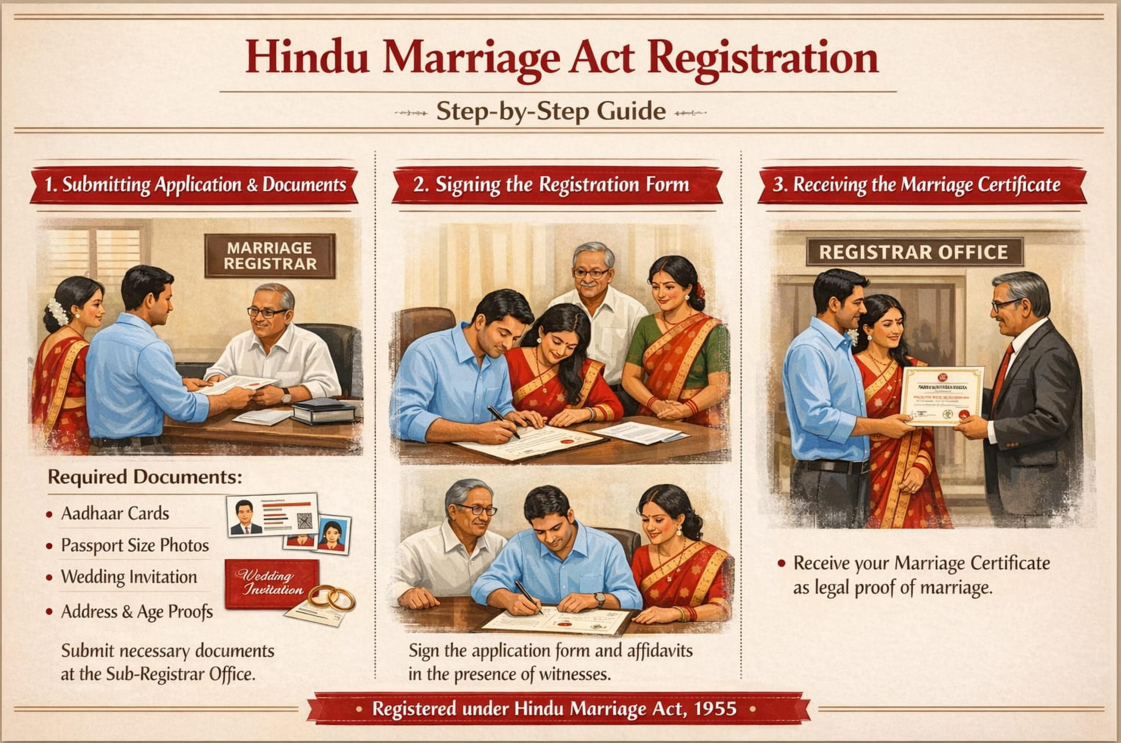
    1. Visit the office of the Marriage Registrar.
    2. Submit the prescribed application form, usually available through the Sub-Divisional Magistrate office.
    3. Provide the required documents along with identity and address proof.
    4. Witnesses (generally three, depending on applicable law) must be present.
    5. The marriage certificate is usually issued within 15–30 days depending on state procedures.

    Online Procedure for Hindu Marriage Registration

    Many states now provide online registration facilities through official government portals. The general process includes the following steps:

    1. Visit the official State e-District or Marriage Registration portal.
    2. Book an appointment with the Marriage Registrar.
    3. Fill out the online application form.
    4. Upload the required documents.
    5. Appear before the Sub-Divisional Magistrate for verification if required.
    6. Receive the digitally issued Marriage Certificate.

    Landmark Case Law: Smt. Seema v. Ashwani Kumar (AIR 2006 SC 1158)

    In this landmark judgment, the Hon’ble Supreme Court held that marriages in India should be compulsorily registered irrespective of religion. The ruling aimed to prevent child marriages, bigamy, and fraudulent practices while protecting the rights of women.


    Conclusion

    Although registration is not mandatory for the validity of a Hindu marriage, it is strongly recommended for legal security and documentation.

    The Hindu Marriage Act, 1955 plays an important role in authenticating marriages. Ceremonies such as Saptapadi (mentioned under Section 7) complete the solemnization of marriage, while registration provides official documentary proof.

    Marriage registration strengthens legal protection, promotes women’s welfare, and helps prevent fraudulent practices such as bigamy and child marriage.

    While traditional ceremonies remain culturally significant, obtaining a marriage certificate is essential for matters such as visas, loans, joint property ownership, insurance claims, and inheritance.

    Need assistance with marriage registration?
    Get Professional Registration Support


    Frequently Asked Questions

    Is it necessary to register a marriage under the Hindu Marriage Act?

    Answer: Registration is not mandatory for the validity of the marriage, but obtaining a marriage certificate is highly important as legal proof.

    What is the minimum age for marriage under the Hindu Marriage Act?

    Answer: The minimum age is 21 years for the groom and 18 years for the bride.

    Is a legal advisor required for Hindu Marriage registration?

    Answer: No, a legal advisor is not mandatory. However, professional guidance can help ensure a smoother and error-free registration process.

  • CHEQUE BOUNCE CASE (SECTION 138): LEGAL NOTICE, RULES & PUNISHMENT

    CHEQUE BOUNCE CASE (SECTION 138): LEGAL NOTICE, RULES & PUNISHMENT

    Introduction:

    Cheque Bounce (or dishonor of cheque) comes under section 138 of the Negotiable Instrument Act, 1881.

    This occurs when a cheque may bounce if it is being expired or there has been serious issue with the date. It usually happens when a bank refuses to pay a cheque usually due to insufficient funds.

    Section 138 Of Negotiable Instrument Act:

    It is essentially makes it an offense to issue a cheque that bounces, providing a legal recourse for the payee or holder in due course. There are three key aspects to it:

    • Dishonor Of Cheque This states when a cheque is drawn on an account which is maintained by the drawer for payment of a debt or liability is returned unpaid by the bank.
    • Cause Of Dishonor : The cheque can be returned unpaid due to insufficient funds in the account or because signature mismatch or it could be the amount exceeds the arrangement made with the bank.
    • Punishment: If the above following conditions are met, then the drawer of the cheques can be punished with the imprisonment which can extend upto 2 years or a fine which can lead to twice the amount of the cheque or both.
    Notice for cheque bounce
    Notice for cheque bounce

    What Is A Cheque?

    It is defined under Section 6 of the NI Act stating that a cheque as a Bill of exchange drawn on a specified banker and not expressed to be payable otherwise then on demand and it includes the electronic image and in an electronic form.

    A Cheque in the electronic form means a cheque drawn in the electronic form by using any computer resources and signed in a secure system with digital signature (with or without biometric signatures) and Asymmetric Crypto System or with electronic signatures.

    What Is The Due Date For Clearance?

    Key Essential Features Under Section 138 NI Act:

    NI Act penalizes the dishonor of a cheque, however dishonor of a cheque is by itself if the following ingredients have to be fulfilled.

    • Drawing of the cheque.
    • Presentation of the cheque of the Bank.
    • Return of the cheque unpaid by the drawee bank.
    • Issuance of the notice in the writing to the drawer of the cheque demanding payment of the cheque amount.
    • Failure of the drawer to make the payment within 15 days of receipt of the notice.

    Legal Process For The Dishonor Of Cheque Or Cheque Bounce:

    1) Drawing of the Cheque : The Cheque is created by the drawer.

    2) Presentation to the Bank: The Cheque is to submitted to the bank for
    payment.

    3) Issuance of Notice: The holder in due course must send a written legal
    demand notice to the drawer within 30days.

    4) Return unpaid: A notice period of 15 days is given to the drawer to make the payment , if not given then the action arises.

    5) Filling of complaint: If the drawer fails to pay within 15 days , then as it is a criminal act intent , so a criminal complaint will be lodged against the drawer within the 30 days before the Judicial Magistrate of First class.

    A Limitation For Filing A Complaint In Respect Of The
    Offence Under Section 138 NI Act:

    Section 142 NI Act prescribed an outer limit of one month for filing of a complaint from the data of the cause of action arises.

    Recent Guidelines By Supreme Court Of India On Cheque Bounce:

    • The Supreme Court of India has issued a fresh guidelines to ensure a speedy procedure regarding the cheque bounces cases which has created a lot of backlogs.
    • Dishonor of cheque under Section 138 of Negotiable Instruments Act which accounts for upto 50% of pending cases
    • As per the new directions that has been issued by the Supreme Court the cheque bounces cases are now to be served only in person by through digital medium that is via Email and Whatsapp.
    • Complainants are there to provide there necessary details for quick response.
    • These creates and facilitates to provide early dispute towards such issues.

    Conclusion:

    Thus we conclude, the statutory framework relating to cheque dishonor ensures financial discipline towards by providing an effective legal remedy against the defaulters which creates a strong financial instruments by strong legal framework.

    In essence with that it creates striking balance in reinforcement and safeguards regarding the dishonor of payment.

    If a cheque issued to you has dishonoured, time is of the essence. You must send a statutory legal notice within the stipulated timeline to recover your dues or initiate criminal proceedings against the defaulter.

    Send a Legal Notice Today:

    Frequently Asked Questions:

    Q1. What are the documents needed for cheque bounce case?

    Ans: To file a case under Section 138, you must submit the original dishonored cheque and the bank’s return memo stating the reason for rejection. You also need a copy of the legal notice sent to the defaulter within 30 days, the postal proof of service or delivery report, and the formal complaint petition supported by a sworn affidavit. Invoices or agreements proving the debt are also recommended.

    Q2. Can a company be held liable for cheque bounce?

    Ans: Yes, under Section 141 of the NI Act, a company is a legal entity and can be prosecuted. Along with the company, every person (like a Director or Manager) who was “in charge of and responsible for” the business at the time of the offense is vicariously liable.
    However, you must arraign the company itself as an accused; suing only the directors is not legally maintainable.

    Q3. Can multiple cheque bounce may lead to multiple case?

    Ans: Yes, but the law allows grouping them. Under Section 219 of the CrPC, up to three offenses of the same kind committed by the same person within 12 months can be tried together in a single trial.
    A single legal notice can also cover multiple dishonored cheques if they relate to the same transaction. Courts are now encouraged to hold joint trials to expedite these cases.

    Q4. What is the due date for clearance?

    Ans: Legally, a cheque is valid for presentation and clearance for 3 months from the date issued.
    Regarding bank processing speed, current RBI guidelines under the Cheque Truncation System (CTS) ensure that cheques deposited by 4:00 PM are cleared and settled by the same day or the next working day.
    New “Continuous Clearing” measures are further reducing this time to just a few hours.

  • SECOND MARRIAGE REGISTRATION IN INDIA: PROCEUDURE & DOCUMENTS (2025)

    SECOND MARRIAGE REGISTRATION IN INDIA: PROCEUDURE & DOCUMENTS (2025)

    Introduction:

    A Second Marriage in India refers to the marriage which is being contracted by a person which has been lawfully dissolved or either the husband or wife has died.

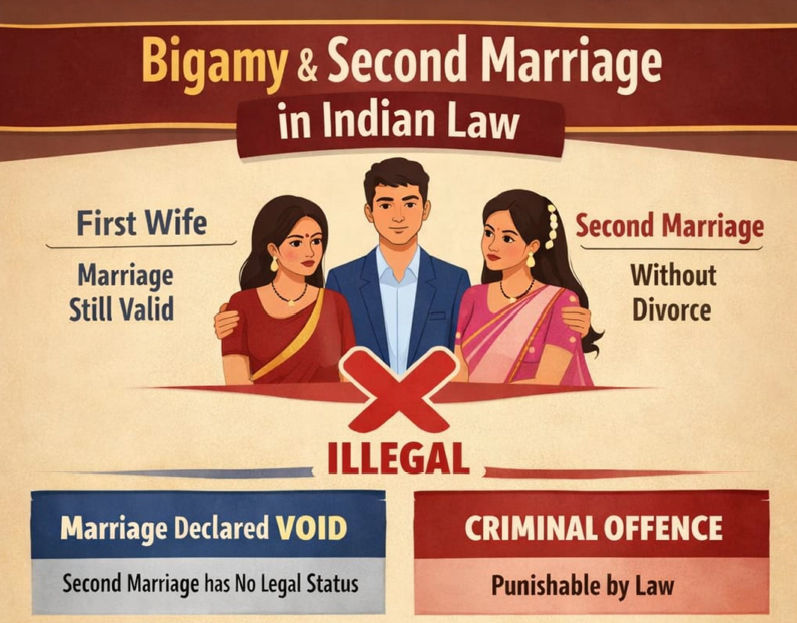
    Otherwise the second marriage would be held void or it may condemn a criminal liability. This provision comes under the Hindu Marriage Act, 1955.

    Registration Procedure For Second Marriage:

    • The First marriage has to be lawfully ended which is mandatory eligibility criteria for this procedure.
    • The intended party must submit an affidavit which clarifies that the previous marriage has been dissolved.
    • An application is mandatory to be filed with the Marriage Registrar or local Sub-Registrar Office
    • Verification is required by the registrar who will act as a conclusive proof towards the marriage.
    • For the verification purpose some necessary documents are required such as identity proof, proof of the previous marriage to be dissolved (certificate),passport size photo

    Applicability Of Second Marriage Under Special Marriage Act, 1954:

    Penalties of Remarriage & its legalities
    Penalties of Remarriage & its legalities
    • Both the parties have free will to marry under this act only if the previous marriage has been dissolved or lawfully ended.
    • A 30 Day notice period is required as per the act for registration purpose.

    Common Legal Issues:

    1) If the First marriage is in subsistence then the second marriage would be
    condemned to void under the Hindu Marriage Act, 1954.
    2) If the intended party fails to provide previous marriage valid divorce
    certificate or death certificate that it can lead to major issues towards legal
    disputes.
    3) The parties should have proper consent towards each other mutual decision otherwise it creates procedural irregularities.
    4) In aspect of the child inheritance there have been major issues from the
    second marriage.
    5) While registration procedure there have been many a times legal Compliance issue or delays in documentation process.

    Recent Judgement Passed On Kerala High Court:

    A Muslim man had fallen in love with other women while being in
    existence of his first marriage. He claimed for a plea stating that he married
    for the second time only with the consent of his first wife.

    The court said that the marriage registration officer can hear and will let the Muslim women give an opportunity of hearing when the husband re marry.

    Later on the plea was dismissed.
    This clarifies that the second marriage is not invalid only if the legal
    requirement of the first marriage is being dissolved.

    Documentation Required For Second Marriage Registration:

    • ID/Adhere proofs.
    • Previous Divorce Decree/Death Certificate.
    • Address proof.
    • An Affidavit which states about the previous marriage decree or dissolution of marriage.
    • Three Witnesses (If the marriage is being solemnized Under Special Marriage Act,1954)

    Conclusion:

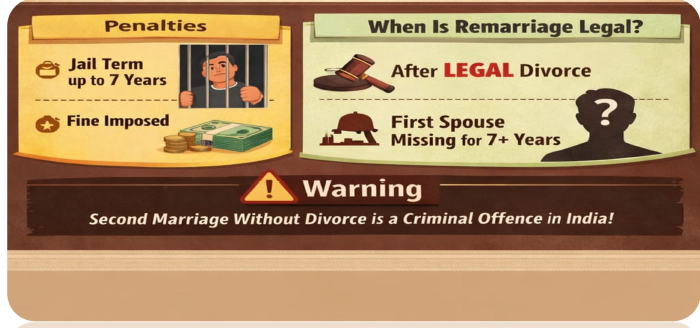
    Thus we conclude that the procedure for registration for Second Marriage Act which comes under the Hindu Marriage Act strictly restrict if first marriage is in existence, it will claim to be void and a criminal act.

    The law is abide by it rule and it does not overpower it though its strict legislative procedure it protects and creates liability towards the society so that there must be no issues of child inheritance or bigamy.

    This act is abiding by to protect its dignity to the overall aspect of marriage and makes a clear understanding that are sought for clarity.

    Remarriage comes with specific legal prerequisites regarding divorce decrees or death certificates of previous spouses. Ensure your new union is legally valid and fully compliant with Indian laws by consulting our specialists. Consult on Remarriage Laws with India’s top lawyers.

    Frequently Asked Questions:

    Q1. Does the registrar verify or check the documents?

    Yes, rigorous verification is mandatory. For a second marriage, the verification process is stricter than for a first marriage. The Marriage Officer (or Sub-Registrar) is legally obligated to verify the eligibility of both parties to ensure no fraud or bigamy is being committed. They specifically check:
    The Death Certificate of the previous spouse (if widowed).
    The Decree of Divorce (if divorced) to ensure the appeal period has passed.
    Age and identity proofs.

    Q2. To whom are the affidavits needed to be submitted?

    The affidavits must be submitted to the Marriage Registrar or the Sub-Divisional Magistrate (SDM) of the district where you are applying. Both parties must file separate affidavits stating:
    Current Marital Status (e.g., “Divorcee” or “Widower”).
    Date of the previous marriage’s dissolution (Death or Divorce).
    A declaration that they are not related to each other within the “prohibited degree of relationship.”

    Q3. Is it obligatory to end the first marriage in order to for
    first marriage?

    Absolutely Yes. Under Indian laws (Section 5(i) of the Hindu Marriage Act and Section 4(a) of the Special Marriage Act), a second marriage is legal only if the first marriage is dissolved.
    If you marry without a legal divorce or death certificate, the second marriage is Void (invalid) ab initio.
    You can also be prosecuted for Bigamy (Section 494 IPC), which carries a prison sentence of up to 7 years. Mere separation is not enough; a court decree is mandatory.

  • SPECIAL MARRIAGE ACT 1954: A STEP-BY-STEP REGISTRATION GUIDE FOR COUPLES

    SPECIAL MARRIAGE ACT 1954: A STEP-BY-STEP REGISTRATION GUIDE FOR COUPLES

    Introduction:

    In Indian Society, Marriage holds a sacred place and the Special Marriage Act promotes a framework how individual can marry through a civil procedure which is irrespective of religion, caste or creed.

    The Act permits individuals to marry outside their faith by laying down conditions relating to age, eligibility, soundness of mind and safeguarding towards the individual rights.

    Moreover, the Act creates certain complexities; it actively drives progressive social change by encouraging inter-caste and inter-faith marriages.

    Evolution and legislative Framework:

    The Legislature enacted this provision in newly independent India to establish an effective legislative framework.

    The Special Marriage act, 1954 was intended to regulate a special type of marriage by though a compulsory registration and certification which is an essential aspect in order to legalize the aspect of marriage.

    This act is applicable to all the Indian whether they live in India or outside.


    Basic Requirements For Registration:

    1) Both the parties must be Indian Citizen
    2) The parties must be in full consent of the marriage
    3) If any of the parties had an n earlier marriage then it has to been legally dissolved.
    4) The age limit of the male should be 21years and female should be at least eighteen years.

    5) The marriage is too solemnized in front of the marriage officer and three witnesses.
    6) Should have a copy for marriage notice book.

    Special Marriage Act
    Special Marriage Act

    Special Marriage Act Procedure:

    Why Does Registration Of Marriage Matter So Much Under The Special Marriage Act?

    This is an eminent step towards entering in to recognition of registration of the marriage which also symbolizes as secure and protection towards the couple.

    An application will be duly mandatory for both the parties in order to refrain from any objections of marriage.

    A marriage officer will be appointed and will give a notice period of 30 days as a mandatory enquiry.

    Now, within this period if any issue arises from any of the parties , then the marriage cannot be solemnized and therefore it might led to for an enquiry which will be conducted by the marriage officer.


    Legal Problems That Are Being Faced Under This Provision:

    1) This act compels both the parties to wait for the Mandatory one month notice period for any objection as per mentioned in section 5 of the act.

    The problem that arises is that the law provides an intimation of the parties which sometimes led to violation of privacy as the notice will be displayed publicly outside the Marriage Officers.

    Under such circumstances, this can lead to the individual’s life jeopardized and harm personal liberty.

    2) Another important issue that arises as per section 7 that any person may object before the expiration of thirty days’ notice period.

    This sometimes led to confusions, societal pressure which might cause insufficient and weak towards the existing protection. This creates a negative aspect to the socio culture belief leading to emotional coercion.

    3) Special Marriage acts aims to provide with a vision of secular marriage so that through this act so it does not create tension between the individual.

    However, a substantial segment of the population is unaware of the measures which lead to socio cultural oppression.

    4) Procedural regulation is often delayed which causes objections, regulations, lack of uniformity, harassment to both the intended parties.

    5) Last but not the least due to issuance of the notice of 30 days period publicly creates an objection towards infringement of Right to Privacy under article 21 of Constitution , were the disclosure of personal information such data of the individuals breaks the limits provided in section 5 and 7.


    Recent Legal Issues:


    FORGERY OF THE CERTIFICATE: Recently, in Allahabad High Court passed an
    order stating that a marriage which is being held under this act is only valid if there is no unlawful conversion of certificate.

    If one of the intended parties illegally found in conversion of certificate then the marriage will not be held valid.

    PIL FILLED AGAINST 30 DAYS NOTICE PERIOD: A Public Interest litigation
    was filled under Special Marriage Act, 1954 stating that the parties who intended to marry must obey the one month notice before solemnizing the marriage.

    This PIL was filled in Supreme Court, 2020. Later on the Petition was heard and dismissed as they found no such reason to be discussed upon.

    However, in April 2023 D Y CHANDRACHUD confronted and stated about the Provision to be “Patriarchal”.

    The major concern about this notice is that it raises a regime to privacy infringement and safety concern of the couple which are being exposed to public officially during the 30 days period.


    Conclusion:


    As we reach the end, we can conclude that The Special Marriage Act provides an exhaustive details relating the institution of marriage, promotes secular and empowers the people to believe in inter- caste and inter – faith marriages but also lacks in procedural segments that undermines privacy, safety and personal wellbeing to the individual parties.

    Planning an inter-faith or civil marriage? Don’t let bureaucratic hurdles delay your special day. We assist couples with document verification and the 30-day notice period to ensure a hassle-free registry marriage.

    Simplify Your Marriage Registration:

    Frequently Asked Questions:


    Q`1. Why does 30 days notice period is considered so essential and does it affect to an individual privacy?

    When the Special Marriage Act was enacted in 1954, the lawmakers intended to create a secular law for inter-faith or inter-caste couples. The 30-day notice (under Section 5 and 6) was designed as a public fraud-check mechanism.
    Public Scrutiny: The law requires the Marriage Officer to display a notice containing the couple’s names, addresses, photos, and occupation on a public board for 30 days.
    Inviting Objections: The purpose is to allow anyone to object if the marriage violates the law. The specific grounds for objection are:
    Bigamy: If one party is already married.
    Prohibited Relationship: If the parties are related by blood (incest).
    Age: If the groom is under 21 or the bride is under 18.
    Unsound Mind: If one party is mentally unfit to consent.

    Q2. How does this act provides protection and privacy to the couples?

    The Special Marriage Act (SMA) primarily protects couples by allowing them to marry without religious conversion, preserving their individual identities.
    It serves as a secular legal shield that overrides family objections and validates inter-faith unions.
    Regarding privacy, while the original law required a 30-day public notice, recent
    High Court rulings (like Safiya Sultana) have held that couples can opt out of this display to prevent harassment.
    Additionally, an SMA application acts as legal proof to secure immediate police protection and access to safe houses if the couple faces threats of violence.

    Q3. How procedural lapses causes unnecessary delays in this
    provision?

    Procedural lapses primarily stem from bureaucratic overreach. Marriage Officers sometimes demand documents not required by law (like parental no-objection certificates) or delay the process to investigate frivolous objections raised by the public under Section 8.
    Since the Act mandates an inquiry for every objection, a simple administrative lapse or a false claim can pause the marriage for an additional 30 days.
    Furthermore, minor clerical errors in the Notice of Intended Marriage often force couples to restart the entire notice period.